
Which is better motorcycle or car: pros and cons. Several myths about motorcycles
Motorcycle pros
All too often we hear about the dangers of riding a motorcycle, but rarely are the physical and, more importantly, spiritual benefits mentioned. Some of the benefits are obvious, others are not so strong. This is why you feel so good after the long journey home.
Positive attitude
It is a feeling of pure joy after a long ride that every motorcyclist feels. The reason we feel so happy is pretty simple: every turn of the wrist releases adrenaline, which in turn releases endorphins. These hormones make us “feel good,” improve our mood, increase pleasure, and reduce pain.
Endorphins give us this joyful feeling, but after the trip there is a feeling of relief, as if the body is flying. We can advise a car dealership that guarantees you a good mood even for cars.
It's like mindfulness meditation: body position, speed, position on the road – on a motorcycle you constantly analyze and correct depending on the situation. It connects us to reality, and means that there is no room in our brains to worry about money, work, or any other day-to-day problems.
You are fully occupied while driving. This is why your mind is like a blank slate when you swing your leg after a long trip.
Cognitive function
If someone told me that I could boost my cognitive function by grinning ear to ear with joy, I would probably tell them to tell this crazy somewhere else.
But scientific research by Ryuto Kawashima, who has collaborated with Yamaha Japan and Tohoku University, has proven just that. Riding a motorcycle improves your cognitive function by as much as 50%.
This is because riding a motorcycle requires a high level of alertness and quick problem solving. According to Kawashima, “the driver's brain is activated when riding motorcycles.”
The strength of the heart and neck
The day after their first long ride, many motorcyclists report the same pain – the muscles in our necks are always at the top of the list. Wearing a helmet for several hours a day will strengthen your neck and you will get a real workout. This is especially true for those who drive without a windshield.
You still need to make sure that your bike fits you perfectly, as the constant cranking or straining of your neck will have negative consequences in the long run. This means that the handlebar, seating position and legs are suitable for your body.
Riding a motorcycle requires a lot of muscles to work together, but your structure ties everything together.
Every maneuver you make on a motorcycle involves using your body, especially low speed maneuvers. The movements are insignificant and relatively small, so you may not notice it, but if you have been rolling for a while, your body will be stronger.
No more squats
Riding a motorcycle requires you to constantly move around on the bike using your hips and knees. These movements strengthen your hips and, in turn, strengthen your knees.
The thigh muscles are used to hold the patella and other bones in the knee.
Because movement is minor, people with knee or hip pain describe motorcycle riding as a form of physical therapy.
For those fortunate enough not to have such problems, riding can help you avoid injury.
Burning calories
Yes, you can burn a significant amount of calories while riding a motorcycle.
Food lovers can burn up to 600 calories per hour of intense motocross riding. Stick to urban driving and you can burn 200 to 300 calories an hour, especially if you are driving with some energy.
Costs
While this can be expensive, moto is generally more fuel efficient than cars for several reasons. You definitely save on fuel. It's not just about gasoline, however, as maintaining a motorcycle is also cheaper than servicing a car. Overall, there are even more ways to save money when it comes to fixing or maintaining your bike, such as reading reviews and DIY repairs.
Easier to park
You may love your car, but it can be difficult to park with it, especially if you are driving a large car. Not to mention, there are usually other people to consider. You must be careful not to scratch other cars or block other drivers who are parked. With a motorcycle, parking is unlikely to ever be an issue as they are small enough to fit in most areas.
You can even get off and maneuver into the perfect parking spot if you really want to.
Weather
When it comes to bad weather, motorcycles are almost always in the garage. Cars can be used in any weather, while moto is good for driving only on a sunny or even dry day. If it starts raining, the fun is pretty much over.
Arguments in favor of a motorcycle:
- Saving parking space, since 3 or 4 motorcycles can be placed instead of one car;
- You will not stand on a motorcycle in a traffic jam, you can always ride it;
- A motorcycle consumes less fuel, and a journey of about 100 km means consumption of about 9 liters of gasoline;
Easier to pick up a motorcycle; - We find that bikes look better :), they can have more futuristic shapes and are easier to convert.
- The cost of buying a motorcycle is significantly lower than even a used car. Even exclusive bikes are cheaper!
- The cost of insurance is lower and the parking space is cheaper.
- You can repair a motor without even being a mechanic.
- It is safer to ride motorcycles. Have you ever seen a riding motorcyclist write SMS or talk on a mobile phone? We are not!
- A motorcycle brings people closer together – they usually sit in the same seat.
- Also, how many motorcycle events are there in the entire calendar year?
- Riding a motorcycle is good for your health – after all, you are outdoors all the time.
- We recommend riding a motorcycle as it improves balance and coordination.
- When riding a motorcycle, you will be able to accelerate faster than driving a car.
Arguments in favor of the machine:
- The motorcycle is good for driving only if the weather is good and there are no accidents;
- The car will suit more people – friends who do not have motorcycles would also like to go on a trip with you;
- The car will suit not only more people, but also the luggage compartment!
- Have you ever seen the president on a motorcycle? No, most often he is driven in a luxurious car … Well, unless our president suddenly drives a Harley on vacation?
- Long distance travel is more comfortable by car, also due to changing weather conditions.
- The versatility of the car is also indisputable.
- When you travel by car, you do not need to worry about clothes, except for shoes, because it is uncomfortable and dangerous to ride in high-heeled shoes, there is a risk of blocking the pedal or mat
Counter flow
Maybe the driver of the oncoming car is typing a WhatsApp message on his mobile phone. Maybe he's eating a local fast food burger. Maybe the driver was just daydreaming. It doesn't matter what causes the distraction, but all that is needed to cause a serious accident is to drive into the “oncoming lane”, being distracted by something on purpose, simply not noticing the oncoming motorcyclist or not evaluating his speed.
The most dangerous thing here is that the driver does not even need to hit the motorcyclist directly, because even if he maneuvers sharply to avoid a head-on collision with an oncoming vehicle, the motorcycle driver can easily lose control of his horse. The traditional way of avoiding road accidents by motorists – to go to the sidelines – will also work badly here, since a motorcycle (if not a mountain bike) is unlikely to stay there at a high speed.
Unfortunately, constant attention to potential danger is the only way to minimize the risk of colliding with oncoming traffic, although this is difficult to predict.
Cars allowing oncoming traffic to turn left / make a U-turn
Inattentive drivers who simply do not notice motorcycles are another big danger for the latter. Probably, almost all bikers have their own stories about “blind” drivers, with whom they managed to avoid collisions, when they, without noticing them, jumped out in front of them, and, unfortunately, too many of them, in fact, have stories about accidents with such cars – sometimes quite deplorable.
In fact, experts argue that the driver, missing the oncoming traffic before turning / turning, is simply programmed for large obstacles – cars, but, since everything happens quickly enough (sometimes, indeed, at least a small “window” in the oncoming traffic is searched for skip), then their eyes simply do not notice either motorcycles or bicycles.
Riders should put their cell phones back in place and pay more attention to what is happening around them, but biker riders should also pay extra attention when driving through intersections. This extra vigilance can save lives.
Failure to keep the distance
At first, we wanted to write not a non-observance of the distance, but a sharp braking in front of a driving car, but, you must admit, the fault in a collision in this case still lies with the motorcyclist – at least that's what the traffic rules prescribe to us (paragraph 9.10).
There is always the potential to get hit from behind when someone is forced to emergency brakes, but this is always more dangerous when you are on a motorcycle. Since the front brake of a motorcycle provides up to 70% of the total stopping power, it does a lot of good to avoid an accident, but if you apply the brakes too hard, the front wheel will lock up and there is a risk of overturning.
Buying a bike with an anti-lock braking system will help alleviate this problem, but if you don't have ABS it is even more important to get a feel for how your bike handles hard braking ahead of time.
Gravel on the road
Motorcycles are very good at cornering in normal situations on normal roads, but when the road becomes less than ideal surface then things get more complicated. Branches, dirt, gravel, gravel, pebbles and even just a layer of dust can cause skidding.
The solution may be to reduce the speed in corners, as this greatly reduces the effort on the side skid.
Too much speed when cornering
One of the best things about motorcycles is that they are fast. For the cost of the new Hyundai Solaris, you can buy a bike that, in terms of acceleration and speed, due to its low weight, will be able to compete with supercars costing several million rubles. Unbridled speed is intoxicating, but it is also very dangerous.
In a straight line, most riders don't get too much trouble, but learning to “take a corner” is much more difficult. Newbie bikers are especially at risk of cornering too quickly, but even experienced riders sometimes make mistakes.
Opening car doors
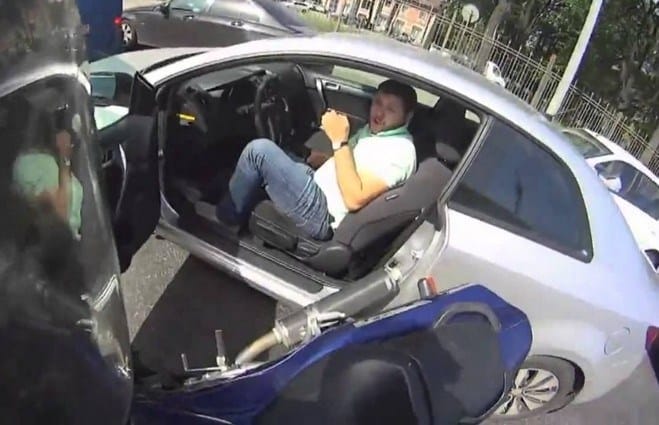
Usually this is not a problem when you are driving on an open road on the highway, as drivers rarely open their doors while driving, but in cities, drivers must be on the alert, not only opening their doors themselves, but also watching their passenger exiting or getting into the car on the left. Cyclists and motorcyclists have dealt with this problem for years, but it is even more dangerous for motorcyclists, who often ride at higher speeds than bicycles. At the same time, in the case of the front driver's door, the situation is most often much more deplorable than the rear one – it most often has an acute angle into which the motorcyclist flies.
Myth 1: Motorcyclists wear leather because it looks cool
Not really. Although leather has long been associated with motorcycle culture, they wear it because of its unique properties, not because of the visual aspects (although, of course, leather never went out of style). The leather is extremely abrasion resistant, protects against scratches and cuts, and also serves as an excellent insulator to keep the body warm.
The motorcycle leather jacket has become an indispensable piece of clothing for motorcyclists.
Clothing designer Irving Schott popularized such garments in the 1920s. Over time, jackets have been developed to provide additional protection for the shoulders, elbows and back. Leather gloves, vests and shoes are also common among motor sports enthusiasts. They are usually made from cowhide, which is considered better than the pig and buffalo alternatives.
MYTH 2. Closed helmets reduce visibility and “sense of freedom”
Of course not. There are security standards from the Ministry of Transport. They require all helmets to have a vision of at least 210 degrees, which means the helmet will not affect peripheral vision. But this is not the only reason to abandon open-faced helmets in favor of closed ones.
In addition to head protection, the helmet protects against wind, insects, rain and sand, allowing you to fully enjoy our favorite pastimes. I was also afraid that when my head closes in a helmet, the pleasure will not be the same. As it turned out, you do not lose anything from emotions and sensations, but you get comfort – especially on long trips.
Myth 3. Big bikes for everyone
A newly baked motorcyclist on a giant motorcycle? This is probably a bad idea.
It often happens that a beginner gets on a large motorcycle to make up for his lack of experience and impress his friends. But it can end badly: Big bikes can weigh over 300kg, making tight corners and parking difficult to handle.
Higher engine torque also requires skill that inexperienced riders do not have. Even small throttle travel can cause the wheel to spin unintentionally. The 250kg Yamaha Drag Star was my first bike and believe me – the first two seasons were more of a fear than a pleasure.
MYTH 4. Car drivers remember that “motorcycles are everywhere”
One of the safe driving rules is that car drivers will not see you. This explains why motorcyclists prefer to drive close to the median line or in the leftmost lane on motorways. Thanks to this technique, they avoid blind spots and always have the ability to turn in two directions, left or right, if something goes wrong.
Motorcyclists enter corners carefully to avoid getting too close to the lane during tight corners and excessive braking. Other safe driving practices include wearing reflective clothing at night, grooming your motorcycle regularly, and keeping an adequate distance from other vehicles on the road.
MYTH 5. Wheels lose traction on wet surfaces.
Studies by American scientists prove (and this is true) that wet asphalt retains 80% of grip on dry surfaces. This is the value that should give us comfort when driving and performing various maneuvers.
What should I avoid and what to look for? The rain will wash away various contaminants (oils, grease, sand, etc.), but you must be careful not to fall into the slippery puddle. In addition, it is dangerous mainly in cities – pedestrian paths and road markings are usually very slippery + of course all tram and railway crossings.
Everyone sees, hears, waits for me
Initially, I advise you to brush up on the article “Top 5 mistakes of a beginner motorcyclist”. There are also myths here, in which many firmly believe, but then crash on the asphalt of reality. For example, the myth that bikers are awaited and always remembered on the road. I will not repeat myself, experienced motorcyclists have long learned that we are not often noticed on the road, there are many reasons for this: from the size of the motorcycle to the nature of the ride.
during an accident you need to “put down the motorcycle”
Many people talk about this, but alas, not every motorcyclist listens or it happens by accident due to loss of control. However, not only motorcyclists believe in such a myth! People who are far from professional riding firmly believe in the rite of putting a bike on the altar of fortune. In my city there was a terrible accident, the motorcycle pilot, naturally, according to the classic curves of an accident, lost control, dropped the bike in front of an obstacle. Later, the guards discussed the accident, one of them recounted the accident:
– He put the bike down when he realized that there was a pedestrian, because … well, because they have it so, during an accident you need to put the bike down!
It was said with complete certainty. Seriously? No, really? How about fighting to the end? How about a motorcycle braking hundreds of times more efficiently in an upright position than tumbling on a freeway?
The problem is that people have had a substitution of concepts. The motorcyclist falls before the accident, not because someone started it, but because he lost control. There are a lot of similar stories: you would try to rectify the situation, but the balance failed and now you are no longer in the saddle.
Someone is ashamed to admit: I put the bike down because I could not hold it. Then an interesting turn begins, the fall before the accident develops into a supposedly controlled ejection and braking in the horizontal plane under the sparks of the slipper.
You see, it was not he who fell, it was the plan! Tough guys don't turn around and put the bike down to avoid an accident.
this will never happen to me!
From the category of “do not renounce”.
“This will never happen to me,” say those who watch / read / discuss other accidents or take a similar argument to explain their unwillingness to wear equipment.
Remember any of your epic fiasco, you probably also thought before that that with anyone, but not with me? The truth is, it's impossible to predict 100%. No matter how attentive and experienced you are, this is not a guarantee of the attentiveness and experience of other road users.
motorcyclists don't live long
Conversations about suicide bombers and “crunches” are here. You buy a bike and you immediately hear around that motorcyclists always crash. Every motorcyclist has fallen at least once – an indisputable fact. But not everyone is killed. Injuries, yes. Serious health problems after the accident are possible. But having a motorcycle does not become a ticket to the next world.
motorcyclists carefree reckless drivers
Nonsense. A good half of motorcyclists are serious working people who love life on two wheels and this does not prevent them from being office workers or directors, journalists, mechanics or teachers – any other person who can think deeply, take responsibility and plan life.
The myth about carelessness of motorcyclists was born out of the desire of many characters to live their lives “outside the system”, because of the behavior of individual drivers who violate traffic rules on a public road. In addition, regular or quiet motorcyclists are almost invisible on the road, but bright and dashing are remembered by everyone, albeit mostly from a negative point of view.
And then, as if there are no reckless drivers among motorists? It is commonplace – motorcyclists are more mobile, mobile and easy-going!
egoist motorcycle
The myth originates from the fact that on a motorcycle you cannot drive the whole family with a cat, a dog and a sack of potatoes. In general, where did you go without me? Most ordinary mortals perceive the life of a motorcyclist as a lone ranger or a lone wolf. You argue that there are motorcycle clubs. Motorcyclists ride in groups, in columns. But rarely does anyone drive the whole family, even in a group, so accusations about egoists are pouring in. However, joining motorcycle clubs is not considered a cure for accusations of selfishness. Can you guess why? There is an opposition of family versus “you and your motorcycle friends”.
Although if you talk, it turns out that none of the motorcyclists would mind if their family switched to bikes. Therefore, it is somehow strange to receive a reproach for selfishness if the claim comes from a person who does not strive for this world himself.
Road strategy
Road strategy is a body of knowledge and skills of a motorcyclist that allows him to:
- Correctly and effectively assess the surrounding traffic situation
- Select a suitable position in the stream, speed and direction of travel
Management skills
Handling skills, as applied to public roads, is the rider's ability to steer the motorcycle along a chosen path at the desired speed and acceleration. As a rule, the more effective the road strategy is, the less management skills it requires. And vice versa – a motorcyclist who has driven himself into a difficult situation due to a mistake in road strategy will be able to get out of the water only if he has sufficient driving skills.
Protective gear
Protective equipment is the last line of defense against serious injury. There is a widespread misconception about the low efficiency of motorcycle equipment. Usually this view is motivated by the high speed of collisions in road accidents. However, according to statistics, the average speed of a motorcycle at the time of an accident is about 35 km / h. At these speeds, the equipment is more than effective. Its absence, even at lower speeds, significantly increases the likelihood of permanent injury.
Helmets cause neck and spinal cord injuries
Here's how you, people who think this is true, can best explain why this is not so? Mm? You know what?! So run about 20-30 steps that way, and shand your head against the wall. THIS is the cause of neck and spinal cord injuries!
By the way, approximately the same effect awaits your crown when it, along with the body, flies off the motorcycle and rushes onto the asphalt road. Please, my dears, for a start – do not be offended by such directness and overcoats. For your own good, I apologize, and please wear a helmet.
Helmet impairs hearing and vision when driving
Well I do not know. If you wear a cardboard helmet from FixPrice, then maybe yes. And if you have a copy worth at least 3000 rubles, then no such problems will arise. Just wipe the visor from time to time (this is how a rising glass is called) and everything will be fine. Wear a helmet.
Motorcycle helmets law violates certain individual rights
Better watch the course from Vyacheslav Luzhnykh, as he did a master training on this matter. I don't even understand what it is. I will say, perhaps, two words: wear a helmet.
Let me remind you that in practice, motorcyclists most often die from head injuries. Take care of her!
And also, do not forget to read this text below, which we do not accidentally insert into each of our posts. I almost forgot (although, how can you forget this), subscribe to us on Telegram, because our channel always talks about important things. All the best, MotoKim was with you.
Want to reduce your chances of getting into an accident?
Want to reduce your chances of getting into an accident? Get an education. There are many special courses and motorcycle schools that will teach you all the features of riding a bike. There are courses for beginners who take the risk of riding a motorcycle for the first time, there are also specialized courses for extreme driving and for racing on the track. Don't be alarmed by the prices – you can always find a good school at a reasonable price
Don't forget about equipment. Not only can it save your life, it will also make it easier to ride a motorcycle, making it more comfortable, and will help you better control the motorcycle itself. Among other things, bright gear and reflective elements will help other drivers see you on the road, which will also help to avoid one of the types of accidents described below.
In order to protect yourself from possible accidents, first remember:
- Don't drive if you don't have a license!
- Getting on a bike while drunk is taboo!
- It's dangerous to ride without a helmet and minimal equipment!
- Any malfunction of the motorcycle can lead to tragic consequences!
The car turns left in front of you
The most common type of road accident. The driver either does not see you or misjudges your speed when turning in front of you at an intersection. Inattention, distraction, blind spots and banal psychology are to blame – the driver perceives only the absence of cars, and not the presence of a motorcycle.
How to avoid:everything is simple – you need to carefully monitor the road. Your job as a motorcyclist is to develop your sixth sense. Look for any signs that the driver is about to turn / U-turn – the vehicle is at an intersection waiting to turn, there is space in the traffic near the intersection, driveway, or parking lot. In any situation, slow down, rely on the brakes and get ready to dodge obstacles. Yes, yes, you just need to perceive the car as a serious and immediate threat to your life. You also need to consider objects outside of your field of vision. Free space in the flow of cars does not mean at all that you will take this place first, because you may simply not see anyone because of blind spots. And once again – in case of danger – always be ready to dodge the threat!
And once you have identified a threat, you can internally work through all the severity levels of that danger.
- Is the driver able to see you?
- Are the side mirrors of the car obstructing your view?
- Trees?
- Signs?
- Does the driver really see you?
- How are the rest of the cars positioned on the road?
- What is their speed?
- Where are their wheels pointing?
Look at the wheels, not the car – they will give you the first clue to this problem. Always be mindful of those who are behind or next to you. If you need to dodge, you always need to know exactly where! After the first analysis of the situation on the road, think about your options. What is the road surface? Will your bike be able to handle the full force of the brakes or are you going to lock them – you know how to use ABS (anti-lock braking system), don't you?
In no case should you “put your motorcycle down”. Your best chance to survive is to get rid of the speed possible before the collision, and you should do your best to keep the bike fully upright, use engine braking and rear brake. Even if you only have time to lose 20 or 30 km / h, it can give you a big advantage to go home with only bruises and, in principle, stay alive.
Skid on a primer
You are caught in a skid on an area of sand, gravel, leaves, horse manure, or whatever else comes your way. You turned the front wheel out and skidded.
How to avoid: Don't slow down right away! Try to drive at the same pace until your reaction and ability to act effectively match your ability to act effectively. On the road, the “slow entry, fast exit” principle is an extremely important rule. Enter the skid angle as wide as possible to increase your view of the obstacle and at a speed that is comfortable for you. You can speed up a little when exiting a skid as soon as you see the opportunity.
Rear wheel braking is a more advanced skill that you will need to learn and practice on the court before applying this skill in an urban setting.
Ideally, the plan to avoid a skid accident on uneven roads is as follows:
- LEVEL THE BIKE
- BRAKE ON A STRAIGHT TRAJECTORY CLAMP BOTH BRAKES SIMULTANEOUSLY
- ONLY THEN ON THE CLUTCH AND CHANGE THE SPEED TO NEUTRAL, FIRST OR SECOND.
Yes, in some situations it may be inconvenient, but, nevertheless, try to adhere to these rules, because life and health are above all!
There is another advanced skill that is a bit contrary to America's so rule-loving, but taught to advanced police riders overseas. It is to maximize vision by using the entire width of the road, regardless of lane. Vision = safety = speed. Again, learn this from a professional before trying it yourself.
You entered the turn too quickly
… and now this turn is unexpectedly delayed, or you just did not expect such a long turn.
How to avoid: don't be a fool! Drive as fast as you can, look for and use visual cues such as poles and signs to judge the direction of the road, even if that road disappears on a blind climb.
If you find yourself on a bend too quickly, the best solution is to trust the bike and try to get past that bend. The motorcycle is probably more capable of this than you are! Tilt the bike as far as possible, look where you want to go, keep calm and smooth handling. Do not lock the brakes, throw the gas, or do anything that could compromise the stability of the motorcycle and cause a loss of traction. Don't panic if your knee or any part of the bike hits the ground – just try to maintain that lean angle, look out of the corner and pull yourself out of there.
This is another situation in which rear wheel braking can be a real help, allowing you to safely decelerate while already in a corner. Please note that braking with the rear brake while cornering flattens the motorcycle and the trajectory of the corner is flattened. Do not brake with the rear brake, but slow down, otherwise you can leave the road.
The car is changing into your lane in front of you
You are calmly driving in your lane, and, suddenly, a car in another lane suddenly turns to the place you are occupying. Remember that our tiny motorcycles easily fit into the “blind spots” of cars, and the drivers of driving cars do not psychologically perceive motorcycles as an equivalent vehicle (here, snobs!).
How to avoid: remember where the blind spots are and spend as little time as possible in those areas. If you see the driver's eyes in their mirrors, then they also have the ability to see you (but remember that still doesn't always mean they can see you – Ed.).
Avoid situations where lane changes are more likely. Is the traffic on the roads slowing down with one lane moving faster than the others? Motorists usually want to be in this lane. Don't be where they want to be.
Look for signs of a car changing lane:
- turn signals
- inverted wheels
- a car shifted to the edge of its own lane while the driver checks their mirrors
- moving head drivers
Remember all this, be careful and everything will be fine!
The car hit you from behind
You stop at a stop sign (intersection, intersection, in order to let a family of ducks or a child pass), and the driver behind you does not see you or does not try to see you and drives straight into you at high speed. The most common car accident is a “fender bender” (Amer. It is usually a small incident, but not so difficult as not to be able to leave the accident site on your own – Ed.) Or in Russian – the cars “kissed”.
And it can kill a motorcyclist!
How To Avoid: Use Cars As Your Own “Mitigation Zone”
I will explain that this is usually that part of the car, especially the extreme front and rear, designed to bend slightly in a collision and absorb the main force of the impact.
Has one car stopped at a multi-lane traffic light and more cars are following? Lean forward a little and you will be safe from any subsequent blows. On a dividing line between a line of cars, this works just as well.
No free “softening zones”? Move to the side, leave the center of the lane, quickly turn on / off the brake light by pressing the brake lever, keep your right hand on the gas. Pay attention to what is happening behind you, and be ready to bounce if it turns out that someone is about to start driving into you.
Also, this advice works in situations where there is poor visibility around, drunk driving predominates (bars around you and their visitors who got out of there at 1 am), or when stops are unexpected, for example: at pedestrian intersections, on very busy streets, and such “surprises” as ducks crossing the road.
Sources used and useful links on the topic: https://skuterov.ru/motocikl/ili-mashina https://motonoob.ru/mototsikl-luchshe-chem-avtomobill/ https://howcarworks.ru/%D0%B2% D0% BE% D0% BF% D1% 80% D0% BE% D1% 81 /% D1% 87% D0% B5% D0% B3% D0% BE-% D0% BD% D1% 83% D0% B6% D0% BD% D0% BE-% D0% B8% D0% B7% D0% B1% D0% B5% D0% B3% D0% B0% D1% 82% D1% 8C-% D0% B1% D0% B0% D0% B9% D0% BA% D0% B5% D1% 80% D1% 83-8-% D1% 81% D0% B0% D0% BC% D1% 8B% D1% 85-% D0% B1% D0% BE% D0% BB% D1% 8C% D1% 88% D0% B8% D1% 85-% D0% BE% D0% BF% D0% B0% D1% 81% D0% BD% D0% BE% D1% 81 % D1% 82% D0% B5% D0% B9-% D0% B4% D0% BB% D1% 8F https://motonoob.ru/6-mifov-o-mototsiklah/ https: //www.partner-moto .ru / blog / top-10-neizbitikh-mifov-o-mototsiklakh-i-mototsiklistakh / https://moto-control.ru/opasen-li-motocikl/ https://zen.yandex.ru/media/id/5ae195519d5cb3396fb3848c/kak-i-pochemu-motocikly-opasny-5af735ca8c8be3edc9fe732e https://www.partner-moto.ru/blog/top-10-prichin-moto-avariy /
Post source: lastici.ru