
How to pump up the pectoral muscles at home with push-ups from the floor. How to do push-ups correctly
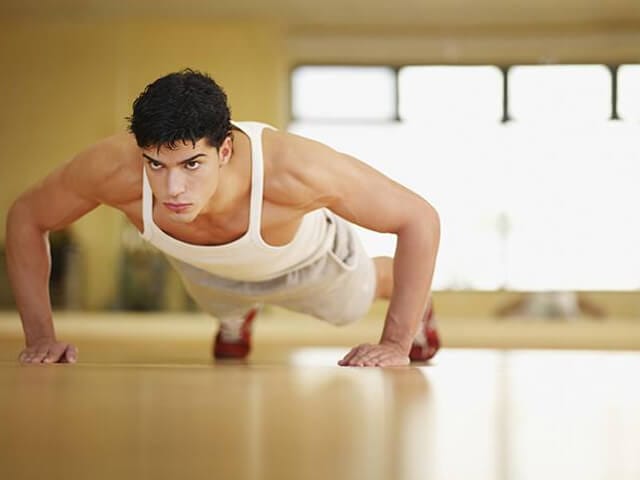
Technique for performing classic push-ups
The classic version of push-ups, performed with an emphasis on the hands and feet on the floor. This is how we did this exercise in physical education lessons. Therefore, there should be no technical problems with its implementation.
Initial position:
- Take a prone position. We put our hands wider than the shoulders. In this case, the body should be even. That is, if we mentally draw a line from head to heels, it will be perfectly straight. To achieve this, you need to tighten your abs, back muscles and buttocks.
- Place the palms in line with the shoulders. The elbows are directed straight back.
- The gaze during execution should always be directed downward. This will keep your neck in a perfectly comfortable position.
Performance:
- We take a breath and lower the body down, by bending the arms at the elbow joint.
- We work at the maximum full amplitude, but at the lowest point we do not need to touch the floor.
- Then we exhale and squeeze our body from the floor until it returns to its original position. Watch the position of the elbows. They should not be pressed against the body and are strongly parted to the sides. Don't look up. Also watch the position of the pelvis. Movements should be under your control. We slowly go down, and with force we squeeze the body up.
Severe arch in the lower back (sagging pelvis)
The main thing when doing push-ups is to keep your body level. But for some athletes, due to the fact that the muscles of the core are not sufficiently developed, the pelvis may sag. This implementation will shift most of the load on the lower back. And everything can end with a spinal injury. Therefore, it makes sense to work on the strength of these muscles. Exercises such as PLANKS and CROSSING ON THE PRESS can perfectly help with this.
Not working at full amplitude
This error begins to manifest itself after several repetitions. The athlete, in order to perform the required number of repetitions, begins to push-ups to half the amplitude. But this approach will not give you the desired result. Instead, focus on full lowering in order to properly stretch your chest muscles and use their full potential during the exercise. Remember, push-ups are about quality, not quantity.
Elbow location
This moment is very important. You can often find athletes who try to turn their elbows to the side as much as possible. Thinking that this way they use the pectoral muscles more. In principle, it is so. The pectorals will indeed receive more load than the triceps. But don't forget the shoulders. With this position of the elbows, they will be greatly overloaded. Consequently, this will lead to injury over time. Therefore, during push-ups, it is recommended to rotate the elbows 45 °. The picture below shows the correct option.
A little about the benefits of push-ups
Push-ups are the main exercise for pumping chest muscles, and working out the triceps, shoulder girdle, abs and back. Plus, they are good for your health. When you exercise, your muscular and cardiovascular systems are stimulated. The heart rate increases and the muscles fill with blood.
Push-ups also help burn fat, keep a person in shape remarkably. One of their advantages is that they can be performed both in the gym and at home. You can vary the load using all kinds of weights. Of course, the answer to the question of whether it is possible to pump up the pectoral muscles with push-ups will be positive, and by exercising regularly, you can see for yourself.
Push-ups for the pectoral muscles: rules for the effectiveness of classes
When composing a program on how to do push-ups to build pectoral muscles, initially consider the following important rules:
- Warm up before you start exercising. It is also recommended to use warming creams. This will help prevent injury to muscles, joints, and tendons. Warm up for at least 10-15 minutes.
- Pain is an alarming symptom. If you feel it, stop exercising and determine the cause of the discomfort.
- Keep in mind that to build muscle, you need to not only exercise, but also take care of your diet. Muscles need a building material, and proteins act as it, of which there should be a sufficient amount in the athlete's diet.
- On the question of how to pump up the pectoral muscles with push-ups, success largely depends on overcoming. When the body gets used to specific loads, and it becomes easy to perform them, it's time to increase the number of approaches, apply additional weights.
- When working on the muscles of the chest, do not forget to also work on the external and internal muscles of the core. Strong chest muscles combined with weak abs and back are one of the main causes of slouching. Also, this kind of muscle imbalance can be dangerous due to improper weight distribution.
- The force load on the muscles of the chest leads to the fact that they are gradually shortened. Because of this, it is possible to flatten the shoulders and visual imbalance in different areas of the back. That is why after the push-ups, cool down in the form of stretching exercises.
- There is no need to load the body abruptly. Start with the minimum number of reps and work your way up.
- The program should include rest days to help the chest muscles recover. These days can be devoted to working out the muscles of other areas.
Be sure to control your breathing while exercising. If you do not breathe properly, your body will not receive enough nutrients, which will affect the effectiveness of your workouts. Also, incorrect breathing technique can cause disturbances in the work of the heart and internal circulation.
Basic exercises for working out the pectoral muscles
The main exercises for pumping up the chest are push-ups for the pectoral muscles, push-ups on the uneven bars, and also the bench press. Let's consider them in more detail.
Pushups
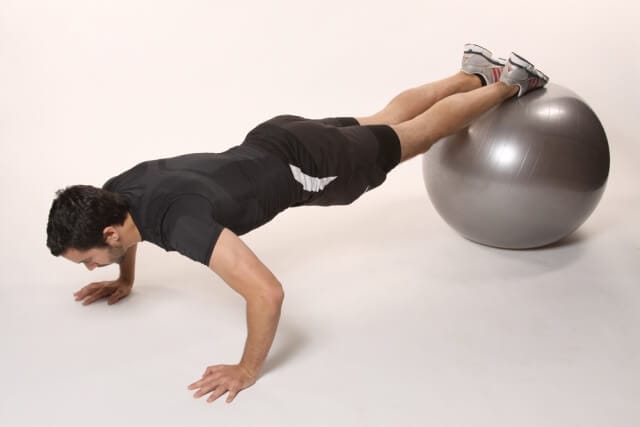
Let's figure out how to pump up the pectoral muscles with push-ups from the floor. Such push-ups involve raising and lowering the body only with your own hands. The body should be horizontal with the face down. The fulcrum is the feet and palms. There are various exercise techniques that can help you target different sections of your pectoral muscles:
- Classic push-ups with medium arms. When doing the exercise, your palms should be parallel to each other. Spread your arms shoulder-width apart. The feet should be close to each other. As you descend, your elbows should move along your torso. While rising, it is not necessary to unbend the arms at the elbow joint entirely. This exercise allows you to moderately engage the pectoral muscles.
- Wide-arm push-ups. You can pump your pectoral muscles with push-ups from the floor, spreading your arms almost twice as wide as shoulder width. In this case, the middle pectoral muscles are worked out qualitatively. Your elbows should be spread out to the sides when lowering.
- Push-ups with a narrow setting of arms. In this case, the pectoral muscles are worked out less than the triceps, but this exercise can also be included in the breast pumping program. Also, the shoulder muscles will be included in the work – as a result, the torso will look harmonious and proportional.
- Push-ups with hands behind the back (face up). In this exercise, the hands are placed on a small elevation behind the back. The legs can remain on the floor, or they can lean on the opposing bench. This variation of push-ups works well on the lower chest.
- Stand leg push-ups. These are push-ups for the upper pectoral muscles. Feet can be placed on a step, box, bench. Otherwise, the exercise is performed in the same way as the classic push-up.
- Push-ups on one hand. They are performed as follows: take a standard starting position, but place the entire weight on one hand, and raise the other. Leave your opposite leg to the side to keep your balance. When you get it easy, start doing push-ups. Such push-ups work out the entire chest area, but they are quite difficult, and it is better to perform them already when you have mastered the classic push-ups on two hands.
Bench press
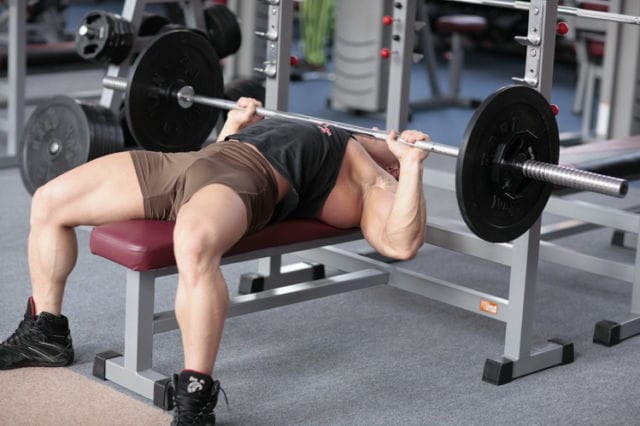
If we are pumping our chest with push-ups, then it is worth complementing the program with a bench press, which helps to achieve very good results. There are three main types of bench press. They allow you to develop, increase the volume and strength of the upper, middle and lower third of the chest.
- Bench press with a surface parallel to the floor, working out the middle group of the pectoral muscles.
- Bench press from a tilted down bench. With this exercise, both your torso and your head will be tilted in the floor. It helps to strengthen the lower part of the chest. To achieve maximum results, you can straighten your arms at the top point as much as possible. This exercise is quite difficult, so it's best to have someone back up.
- Bench press. This exercise is aimed at working out the upper part of the chest.
- Press with a reverse grip of the bar (to the face with palms). Exercise allows you to work harder on the muscles of the upper chest. But keep in mind that this exercise can lead to injury to the shoulder joints, so you need to perform it very carefully, already having a certain level of training.
Dips on the uneven bars
In the question of how to do push-ups to pump up the pectoral muscles for men, the uneven bars will also help you. Push-ups on them help to work out the upper chest. The bottom line is that you need to raise your own body with outstretched arms, while lifting your legs. The torso can be held upright or slightly tilted relative to the floor.
In order to increase the load, you can use weights suspended by straps around the neck. They can also be replaced by a special weight vest or a regular backpack of sufficient weight.
It is recommended to do push-ups for the upper chest muscles on the uneven bars where the distance between the handrails is greater than the width of your shoulders. With a narrow setting of the arms, the triceps will swing more, and not the chest.
How to stimulate the growth of the pectoral muscles
- Try TRX push-ups to increase muscle endurance.
Use TRX loops if you can. In terms of the level of load on the lower back, legs and buttocks, they surpass BOSU balance boards and platforms.
- Try plyometric push-ups for explosive strength.
There is a great reason to do push-ups with cotton: in laboratory conditions, it was found that with this option, the force on the surface is higher than with the other three types of explosive push-ups.
- Narrow grip push-ups are aimed at working out the triceps.
While most people associate wide-arm stance with enlarged chest muscles, electromyographic readings show that narrow-grip push-ups also work out triceps.
- Bent-over push-ups that benefit the shoulders.
Research shows that placing your feet on a bench or step increases the work of the stabilizing muscles and also increases the load on the shoulders throughout the exercise.
- One-arm push-ups to strengthen your core and brute strength.
The Journal Of Strength & Conditions says this exercise is great for strengthening your core muscles. Spread your legs wide to distribute the load efficiently.
Classic version
Classic push-ups are a great exercise for building muscle endurance in the pectorals, anterior delta, shoulder, and triceps muscles. A great way to work them to failure, which will further lead to the growth of muscle fibers. To do this, complete each set of bench press to failure. Once you have done 8-10 reps, lie on the floor and start pushing up until you can do a single repetition with the correct technique. The work will focus on those muscle fibers that are not involved in the bench press, so you will increase volume, strength and endurance.
Execution technique
- Take a lying position.
- Tighten your abs and lift your hips so that your body forms a straight line from head to heels.
- Distribute the load on the upper body, bend your elbows, lower your chest to the floor. Don't let your hips sag or lift during the approach. In the first case, the load on the lower back will increase, and in the second, the load on the chest will decrease.
- Pause at the bottom. The chest should be as close to the floor as possible, but not touching it.
- Push up from the floor, returning to the starting position.
According to Lerville, many people do not take into account the benefits of classic push-ups and prefer the bench press, lying dumbbell raises, crossover arms, and other resistance exercises. But push-ups have proven to be a great tool for building chest muscles, and the beauty of this exercise is that you can do it anytime you want.
[message type = “success”] Try the following technique: 4 seconds for lowering the body to the floor without a pause at the bottom point and one second for lifting up without a pause at the top point. This is necessary in order to control every movement.
Or try a different pace: 3 seconds for lowering the body to the floor with a pause of one second at the lowest point, one second for raising the body to the starting position without a pause at the top point. This “easy” and “boring” exercise is great for building muscle.
Close-grip push-ups
Do you want big arms and powerful breasts? This push-up option is for you because the focus is on the triceps and mid-pectorals. To get the most out of your exercise, make sure your elbows are fully extended with each rep, and how your triceps contract as you lower to the floor, use a steady pace. The more attention you focus on muscle work, the better results you will achieve.
Correct technique
- The starting position is the same as for classic push-ups, but the arms are placed together. Connect your thumbs and forefingers so that you get a diamond.
- Tighten your core muscles and lift your hips so that your body forms a straight line from head to heels.
- With your weight distributed over your upper body, bend your elbows and lower your chest to the floor. Make sure the elbows move along the body to avoid putting undue stress on the joint.
- Pause briefly at the bottom.
- Push up from the floor and return to the starting position.
Expert advice
“The exercise is much more difficult than it looks, which explains why people give up quickly because they can't do a lot of full-range reps. Says Lerville. – To get stronger and do a lot more reps, just slowly lower your chest to the floor so that the muscles work harder. Get on your knees, then take the starting position. Or lower your body to the floor with a narrow grip, and push up from the floor with your arms wide apart. “
Push-ups with wide arms
Raising the arms wider than the shoulders increases the load on the chest and reduces the work of the triceps and shoulders. Remember to be safe: Slowly lower your chest to the floor, keeping each muscle in control, this will reduce the risk of injury and increase the effectiveness of the exercise. As you lower your torso to the floor, you will feel a stretch in your chest.
How to do it right
- The starting position is the same as for the classic push-ups, but the arms are spaced about two shoulders width apart.
- Tighten your core muscles and lift your hips so that your body forms a straight line from head to heels.
- Distribute your weight on your upper body, bend your elbows, lowering your chest to the floor.
- Pause at the bottom, your chest should be as close to the floor as possible, but not touching it.
- Push up from the floor and return to the starting position.
Expert advice
According to Lerville, keep your head and back in line. Lowering your head can cause your shoulders and back to bulge and the exercise becomes ineffective. This happens most often on the last repetitions. Therefore, if you realize that the technique is starting to limp, stop, rest and take another approach. If you fail the second time, take a break and then take the last set.
Side to side push-ups
This option is great for putting more stress on your pecs, triceps, and shoulders, making them work harder as you move your torso from side to side. The core muscles, in turn, will be in constant tension, maintaining the desired core position throughout the entire set. The effectiveness of the exercise depends on the amplitude. If it is difficult for you, then reduce the number of repetitions, focusing on the execution technique.
Correct execution
- Take a prone position with your arms wider than your shoulders.
- Tighten your core muscles and lift your hips so that your body forms a straight line from head to heels.
- Distribute the load on your upper body, bend your elbows and lower your chest to the floor.
- Move the body to the left hand so that the head is in front.
- Keeping your body as close to the floor as possible, move your body to your right hand.
- After repeating, return to the starting position.
Expert advice
This is a difficult exercise, Lerville says, so it's okay to want to do each rep as quickly as possible in order to finish the set sooner. But you need to resist this temptation in order to effectively pump the target muscles. As with many exercises, it is best to focus on quality over quantity. Try to add one or two reps to each set. But the priority remains smooth execution to increase muscle work time and minimize the risk of injury.
Spiderman Pushups
This superhero variation isn't just aimed at chest, shoulders and triceps. The upper and lower body must be fully engaged while pulling one knee up to the elbow and returning it back. And you need to keep the press in tension throughout the approach. This is a hard exercise, but it contributes to better performance and development of the physique. Keeping the torso level with the floor without rotating while pulling the knee concentrates the maximum load on the abs.
Technics
- Take a lying position.
- Tighten your core muscles and pull your hips so that your body forms a straight line from head to heels.
- Transfer the load to your upper body, bend your elbows and lower your chest to the floor.
- Pull your knee up to your elbow.
- Pause briefly. The chest should be as close to the floor as possible.
- Return to the starting position and do the same with the other knee.
The first step, Lerville says, is to engage your core muscles to be more productive. Do this by pressing down on your navel. By focusing on keeping your torso stationary, you can fully lift your knee and achieve maximum performance.
Dive push ups
The very nature of this exercise suggests that each rep involves a variety of muscle groups that are tense all the time, contributing to muscle size, strength, and definition. Moving up and down, and back and up, forces your ribcage, shoulders, triceps, and core muscles to work differently and more laboriously than in classic push-ups.
Technics
- Take a lying position so that your body looks like the letter “L”.
- Tighten your core muscles, then lower your head and chest to your arms, arching your body in an arc.
- Continue moving your upper body until your eyes are looking forward and your chest is bulging forward.
- Raise your hips to return to the starting position.
- Despite the harsh-sounding name, the key to this exercise is smooth movement throughout.
Expert advice
Don't focus on the number of repetitions in each set. Instead, focus on working your muscles at each point to build a productive ligament that will allow you to train more efficiently. The nature of the exercise suggests that in some places it becomes more difficult to perform. And difficulties come when your shoulders or triceps are tired, but your chest is still in good shape. If this happens, do the exercise to failure and then move on to classic or wide-arm push-ups.
Push-ups on the fingers
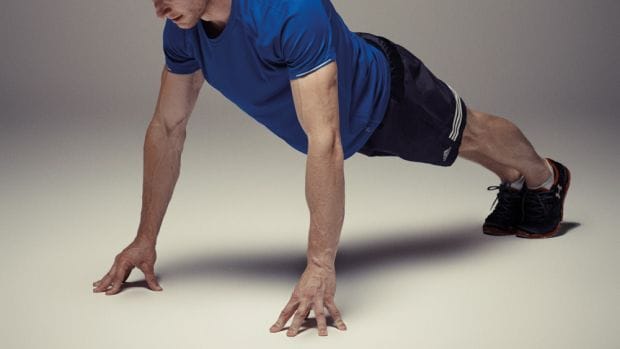
In this variation, the focus is more on the fingers and wrists than on the upper body. That is, it is more suitable for those people who need to strengthen their fingers and wrists, for example, MMA fighters, climbers and gymnasts. If you are not one of this number, but still yearn for challenges, then try this. But don't be discouraged when you fail. As with any exercise, it takes time and effort to get results. Add one to two reps per set per week or month to gradually build finger strength without risk of injury. If you can't do push-ups on your toes, just stand on them for as long as possible. This way, you will still strengthen your wrists and fingers.
Technics
- Take the position of an emphasis lying on your fingers.
- Tighten your core muscles and lift your hips so that your body forms a straight line from head to heels.
- With your weight distributed over your upper body, bend your elbows and lower your chest to the floor. Make sure the elbows move along the body to avoid putting undue stress on the joint.
- Pause briefly at the bottom.
- Push up from the floor and return to the starting position.
Advice
It is worth trying push-ups with different finger positions. We are all anatomically different, so some people find it easier to do the exercise with fingers apart, others more difficult. It all depends on the length of the fingers, the size and length of the hand, and many other factors. If you have mastered one method, try another. There are many ways to adapt and progress with this exercise, so feel free to experiment. Maybe someday you will be able to do push-ups with a dive on your toes.
Is it possible to pump up the chest with push-ups
Answering this question, we can definitely say: yes, push-ups can pump not only the chest, but also the triceps, back muscles, abs and shoulder girdle. And at the same time – significantly improve health, increase the body's endurance and tone the muscles.
Push-ups stimulate an increase in the activity of the cardiovascular system and the respiratory system. Raising the heart rate stimulates improved blood circulation, oxygenation of the muscles and an accelerated metabolism. Also push-ups help to activate the process of fat burning, which helps to keep yourself in shape.
How many times do you need to do push-ups
Newbies are most often interested in the question of how many repetitions to strive for. It is enough for women to bring the number of push-ups to 30-40, and for men – to 50-100 push-ups. These are decent results, but not marginal. People who want to have a pumped up powerful body or are involved in sports should set higher goals for themselves.
In a month and a half, if you practice regularly, women can reach 50, and men 100 repetitions. In this case, you need to train no more than 10-15 minutes. This is quite enough to increase the strength of the hands, as well as the appearance of visually noticeable changes. There is one important point to keep in mind here. There is an opinion that more than 15 repetitions per set will increase endurance, but only at the expense of an increase in volume and physical strength.
To increase power indicators and muscle gain, increased attention should be paid to the technique of execution, to complicate the movements and amplitude performed. You can do push-ups from stops or other difficult options.
Basic rules of classes for their effectiveness
Regular training and a well-designed program do not always guarantee the desired result. Therefore, it is important to consider the following rules:
- Any workout should start with a warm-up. Warming up muscles contributes to the saturation of tissues with blood and stretching of muscle fibers, which can significantly reduce the risk of injury. The warm-up should take about 10 minutes. The warm-up method is selected individually based on the abilities and training of the person.
- A set of workouts should contain stretching. This will reduce pain the next day. It is also very important to maintain your posture. Muscles contract after exercise, pulling the shoulders to the chest, which can cause stoop.
- It is impossible to build any muscles without adequate nutrition. A proper diet is very important for the growth of muscle mass, as it saturates the body with building materials. The diet should contain proteins and carbohydrates. Carbohydrates provide the body with the energy it needs for a full workout, and proteins are converted into muscle fibers.
- It is necessary to monitor the condition of the body. If you feel pain in your muscles or joints, you should stop exercising. If pain occurs periodically, you should consult a doctor to determine the cause of the pain.
- High-quality chest training is impossible without increasing the load. When muscles become accustomed to the same loads, the growth of muscle fibers stops. Therefore, you need to constantly complicate your workouts by performing various push-up techniques or using additional weight. Moreover, an increase in the number of approaches with a stable load will not bring the desired effect, muscle growth in this case is minimal, but endurance and tone are significantly increased.
- The growth of the chest muscles is impossible without the growth of the rest of the muscle groups. Therefore, it is very important to train the whole body. Exercising your core will help you maintain your posture, slim your waist, and define your shoulders and chest. Exercising the legs helps to activate the release of hormones that are necessary for the growth of muscle fibers.
- It is impossible to abruptly load an unprepared organism, as this can lead to overload and negative consequences, in this case we will not talk about any growth. You need to start classes gradually, with a small number of repetitions.
- You can't do it every day, you must definitely include rest days in the training program. This is necessary so that the muscle fibers have time to recover and overgrow with new tissue. On these days, you can train other muscle groups.
- It is very important to breathe correctly during exercise, since a lack of oxygen will not allow a sufficient metabolism to be activated. Holding your breath can lead to serious heart failure. It is recommended to inhale while bending the arms and exhale while extending.
Relaxation
Why, in 90% of cases, beginners in pursuit of a beautiful body quickly begin and soon end up doing their body work? – It's simple. Never before has anyone managed to get a beautiful pumped-up chest in 1-2 weeks, and beginners with “burning” eyes begin to train every day, exhausting their body and body. Beginners begin to work on their body according to the logic “The more I train, my muscles will be faster and more powerful there.”
This and all such statements are delusional. During the training process, the muscles receive many microtraumas, the recovery and growth of which requires good, and most importantly, high-quality rest. If you cannot provide your muscles with the necessary rest, then the last workout was spent in vain and you will not get any result from it.
Therefore, remember: to give your muscles the opportunity to grow, you need a good rest after each workout, for example, 1-2 days. Also, do not give the muscles too long rest, otherwise they will again begin to be in a state of stagnation, and the result that you have achieved before will come to naught.
How to build chest muscles with push-ups
For pumping the chest, basic push-up techniques are enough. Most of them are based on the principle of lowering and raising one's own body with the help of hands. In this case, the body must be kept strictly horizontal so that the palms and feet become the fulcrum.
Consider the main ways to perform push-ups for pumping different parts of the chest:
- Classic push-ups. Performed with an average placement of arms about shoulder-width apart, with palms parallel. The legs should be next to each other. After taking the support while lying down, you can begin to lower yourself, bending your arms at the elbows. The elbows should move along the body. After fully lowering, you need to raise the body up. This push-up method helps to evenly distribute the load on the pecs, shoulders, and triceps.
- Wide-arm push-ups. With this type, the inner part of the chest is pumped. To perform it, you need to spread your arms wide so that the elbows, when bent, form an angle of 90 degrees and are spread apart.
- Push-ups with narrow arms. This type of exercise is less effective for the chest, but works great for the triceps and shoulders. Its implementation allows you to harmoniously develop the torso.
- Push-ups with your back to the bench. This is a special type of push-up that differs significantly from the classic ones. It is performed face up with the rest of the hands on a hill, for which a chair or bench is great. This exercise perfectly loads the triceps and chest, the fibers of which are maximally stretched during execution. By lifting your feet to the opposite bench, you can complicate this element. This element is suitable for training the lower chest, which is minimally loaded with classic push-ups.
- Dips on the uneven bars. With an exercise machine such as the parallel bars, you can perform effective push-ups that work well on your chest, shoulders, and triceps.
- Push-ups with legs on a hill. This exercise is aimed at training the shoulders and upper chest. It is performed in the same way as classic push-ups, but with raised legs on some kind of hill. The level of load directly depends on the height of the stand.
- Push-ups against the wall. Such push-ups are performed with the legs resting on the wall, head down. This exercise requires considerable physical fitness and should be done after several months of normal push-ups. By adjusting the angle of inclination of the body to the wall, the load level can be controlled. You need to perform such push-ups carefully, after laying something soft on the floor. It is not recommended for high blood pressure, vascular disease and eye pressure problems.
- Push-ups on stands. Classic push-ups are limited to the floor level, which does not allow the chest to be fully worked out. Therefore, placing your palms on some kind of hill, be it books, bricks or chairs, you can do push-ups deeper, working your chest more intensively.
- Push-ups with weights. If regular push-ups are easy without causing difficulty, additional weights should be used. At home, you can use a regular backpack, placing dumbbells, books, sandbags or any other heavy objects in it.
- Push-ups with cotton. They are performed in the same way as the classic ones, but when lifting the torso, you should perform an explosive upward movement so that you have time to clap. It is not recommended to perform without proper preparation. For a start, you can give up cotton by simply doing upward throws of the body. It loads well the muscle fibers of the chest and develops explosive strength.
- Push-ups on one hand. The most difficult training option, which not every man can do. Their implementation allows you to significantly increase the load and effectiveness of training, as well as work out the entire chest area. To perform them, you need to take a lying position, spread your legs to maintain balance, and transfer your body weight to one arm. Then you can flex the arm parallel to the body.
Why do newbies most often ask this question?
Beginners, for a number of reasons, try to find an alternative to full-fledged real workouts. More specifically, then, most often, the following reasons can be distinguished:
- Misunderstanding of basic training principles. Many beginners do not even have a superficial understanding of the causes of muscle growth. Recovery, supercompensation, exercise progression – all of these concepts are often unfamiliar to them.
- Reluctance to go to the gym. Someone has no money for this. Someone has time. Someone does not have a hall within walking distance, but they do not want to go to the hall to the other end of the city. Therefore, people are trying to find a way to train at home, without special equipment. Push-ups from the floor are just such an exercise that is practically not done in gyms (where there is the necessary equipment), and is used, most often, in home workouts.
- Fear of going to the gym. This item can be distinguished separately, although it is similar to the previous item. The fact is that, although some people have the opportunity to visit the simulator, they are simply afraid to go there. They just don't have enough self-confidence. They are afraid to “embarrass themselves” in front of experienced visitors, and feel insecure among all these pumped-up thugs.
Is it possible to pump up the chest with push-ups at home?
It cannot be said unequivocally that push-ups are done only at home. But, nevertheless, in the overwhelming majority of cases, the question of whether it is possible to pump up the chest with push-ups should be understood as the question: “Is it possible to pump up the chest with push-ups at home?”
Therefore, let's look at what features home workouts have, and whether they can help us achieve our goal.
By and large, if you don't go into too much detail, then for muscle growth we need to provide two conditions: 1) create a sufficient training load, 2) ensure a constant progression of the load.
In fact, there are many subtleties. You need to provide yourself with adequate nutrition, recovery, choose the right training program, etc., but these two conditions to a greater extent create differences between home workouts and workouts in the gym.
Home workouts differ in that it is extremely difficult to ensure that these two conditions are met. That is, the required load is difficult to create, and it is difficult to constantly increase it. Let's take a closer look at why this is the case.
If you were engaged in the gym, then you could take a barbell, hang the required number of pancakes on it, and thereby create the necessary load on the pectoral muscles. Then, as your strength indicators grow (that is, your fitness level increases), you can add weight to the barbell, thereby creating a new level of load that will induce new muscle adaptation. This will lead to muscle growth.
Now let's pretend that you are just doing push-ups at home. If you are doing push-ups with your own weight, then the load will always be the same. At first it may be enough, but sooner or later, it will become too small for you. And if you have a high level of fitness, then it may seem small to you from the very beginning.
In general, a 6-12 rep range is best for muscle growth. At the same time, most people can easily do push-ups more times. Someone 20 times, some 30, and some all 50. Therefore, this type of load is not the best way for muscle growth. This is a good way to keep your muscles toned, but you probably won't be able to achieve serious growth that way.
Not only will the load be insufficient, but also you can create its progression only by increasing the number of approaches, and / or the number of push-ups in the approach, which is not the best option in this case.
Of course, someone might say that you can put on a backpack and put some weights in it. But why reinvent the wheel if the equipped room already has everything you need?
Therefore, if you want to really pump up your chest, you need to consider first of all not home workouts, but full-fledged workouts in the gym. With this option, you can pump not only the pectoral muscles, but also muscles throughout the body. Home workouts are not a complete alternative to gym workouts.
Workout program for pumping pectoral muscles with push-ups
Okay, let's now assume that you have read and understood everything that was written above, but, in spite of everything, you still want to do push-ups at home. Let's say you have some good reason for this. What do you do then? What is the right way to practice in this case?
We offer you the following training program. This is not to say that she is the best in the world, but she will be quite good, and she has the right training principles.
You need to train 2-3 times a week. More often not needed. Less often – also not necessary. Strict adherence to the schedule is also optional. You can rest a little more once, and a little less the next time, but make sure to keep within 2-3 workouts per week.
You can train at any time of the day, as it suits you best. If it's more convenient in the morning, train in the morning. It is more convenient in the evening – exercise in the evening. Do not exceed the recommended number of sets. Regular training is more important than a large volume of training itself.
You need to perform three options for push-ups, which will consistently load different sections of the pectoral muscles – top, middle and bottom.
The first exercise is on the top, since the top of the pectorals traditionally receives insufficient load, and often remains underdeveloped, compared to the middle and bottom. In order to load the upper part of the chest, you need to perform push-ups, placing your legs on an elevation (for example, on a sofa, chair, etc.) so that in the lower part of the amplitude the head and shoulder girdle is below the legs.
Keep your back and legs straight without bending. The arms should be wider than the shoulders. During push-ups, the elbows should be spread apart, and not pressed against the body. This will transfer the load from the triceps to the pectoral muscles.
You need to perform 4 sets of 12 repetitions. Rest between sets – 1 minute. The pace of execution is medium (not too fast). If you follow all these recommendations, then even without additional load, the exercise can be quite difficult for you.
If you feel that you cannot complete all 12 repetitions in each set, then do as much as you can. This will be a good sign, since we are trying to complicate the work, not make it easier, and your fatigue will tell us that we have succeeded in doing this.
Before moving on to the second exercise of the complex, you also need to rest for 1 minute.
The second exercise is classic push-ups. Feet on the floor. The rest of the recommendations are similar to the first exercise: arms are wider than shoulders, elbows to the sides, 4 sets of 12 reps, average pace, rest – 1 minute. Classic push-ups will allow you to put a load on the middle part of the pectoral muscles.
The rest time before the third exercise is the same – 1 minute.
The third exercise is reverse push-ups. Starting position – you are sitting on the floor, legs are straight, hands rest on a sofa or chair behind you. Rise by straightening your arms, and again “sit down.” It is desirable, due to the muscular feeling, to create an effort with the lower part of the pectoral muscles, and not with the triceps. It may not work (not right away), but it's worth a try.
Plan: 4 sets of 12 reps. The pace is average. Rest between sets – 1 minute. If the exercise seems too easy to you, try placing your feet not on the floor, but on an elevation so that you can lower yourself deeper.
You can learn about what should be the correct breathing when push-ups from the floor from this article – “Correct breathing when push-ups from the floor: simple advice!”.
This simple set of three exercises will allow you to maximize the potential of home workouts. But when you feel that the complex has become too easy for you, consider starting a gym.
For full gym activities, you will need to prepare a suitable meal and workout plan for yourself.
Pectoral anatomy
The chest muscles are made up of the pectoralis major and minor. A large muscle covers the entire chest and is divided into three parts: clavicular, sternocostal and abdominal. All parts are arranged in a fan-like manner and the name of each speaks about the place of fixation.
The small muscle has a triangular shape. It is under the big one, duplicates its functions and plays a smaller role. These muscles are responsible for a wide range of movements of the upper limbs and never work in isolation – only together.
Why pump your breasts?
Well-developed chest muscles are the adornment of any man. In addition to the aesthetic side of the issue, there is another: the strength of the blow and the ability to perform work, which is considered exclusively male, depend on their development. Also, trained chest muscles relieve excess tension from the back and neck, which eliminates frequent headaches and allows you to increase the range of motion in different exercises.
How to make the pectoral muscles grow?
To answer the question of whether it is possible to pump up the chest with push-ups alone, let's first analyze what makes the muscles grow. The main prerequisite for thickening muscle fibers is an increase in strength. To gain muscle mass, you need to do up to 12 repetitions in a resistance set or work to failure with maximum weight.
Of course, doing 12 push-ups will not give you the optimum load. In classic push-ups, a person lifts 70% of their body mass. If you put your feet on a hill, then this percentage will increase. However, sooner or later, the load will become habitual.
If you dream of wide and well-developed chest muscles, then you cannot do without hard training in the gym. To achieve the result, you will have to train for more than one month, but more than a year. Subsequently, you will need to constantly work out to maintain shape.
Do not dream of a muscular body like the Spartans, but just want to shape your breasts, make them a little more attractive and tightened? Normal push-ups, which can be performed at home without sports equipment, will also cope with this task. They will not give a noticeable increase in muscle mass, but they will improve the appearance and actually increase the tone. Do not forget to train your arms, back and core as well, because muscle imbalance is dangerous to health.
Advantages and disadvantages of push-ups
The benefits of push-ups:
- stimulate the cardiovascular system;
- increase strength and endurance;
- improve joint mobility;
- additionally load the muscles of the arms and back;
- give the upper body a beautiful relief;
- accelerate metabolism.
Cons of push-ups and harm:
- increase blood pressure in people prone to hypertension;
- worsen the condition if there are problems with the shoulder and elbow joints;
- not suitable for people who are overweight;
- without training the back muscles lead to stoop.
Push-ups on stools
The advantage of this type of push-ups is that the body is in an elevated position when resting on the stools and it is possible to drop below their level, thereby putting a load on the pectoral muscles. You can use stools, a stack of books, steps. The pectoral muscles are stretched to the maximum at the lowest point.
- We take stools and put them at the width of outstretched arms.
- We put our feet on a hill – a bench or also a stool.
- We accept the lying position, as with a regular push-up, leaning on the stools with our hands and feet.
- We do push-ups and go down as low as possible between the stools, keeping the body straight.
- We return to the starting position.
- We repeat several times.
“Technique for performing push-ups on stools” Exercise can be complicated by using weights on the back, in the form of a weight disk or water bottles in a backpack. Experienced athletes advise to linger at the bottom point and only then rise to increase the load on the muscles and get quick results.
Push-ups with an incline forward
With this type of push-up, you can reduce or increase the load on various muscle groups, depending on the position of the body. The main load here falls on the arms, so the upper part of the pectoral muscles is effectively worked out.
- We put our feet on a hill, for example, on a bench.
- We accept an emphasis lying, hands at a distance slightly more than shoulder-width apart.
- We hold the body straight and do push-ups, touching the floor with the chest.
- We return to the starting position.
- We repeat several times.
“Push-ups with an incline forward”
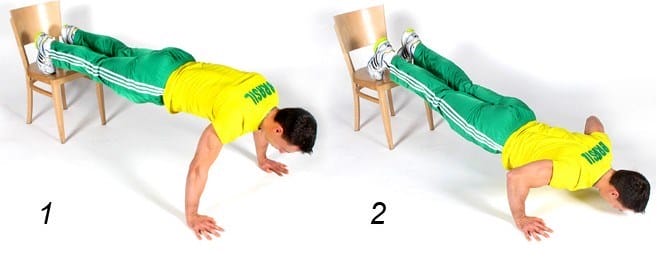
“Technique for performing push-ups with an inclination forward” It is important to know that the wider we put our hands during this push-up, the better the outer part of the chest is worked out. If you make a narrow grip, then the load falls on the triceps. The higher we put our legs, the more actively the deltoid muscles work.
Stop push-ups
Push-up pauses help to more effectively affect the muscles, giving them static and dynamic loads at the same time, thereby stimulating their rapid growth.
- We accept an emphasis lying, we place our feet close to each other.
- We bend our arms and lower ourselves halfway, making a groove for 2-3 seconds.
- We continue to go down to the very bottom, slightly touching the floor with the chest. We pause for another 2-3 seconds.
- We extend our arms in half and again linger in this position for several seconds.
- We return to the original state with straightened arms.
- After a 2-3 second pause, repeat the exercise again.
“Push-ups with a stop”
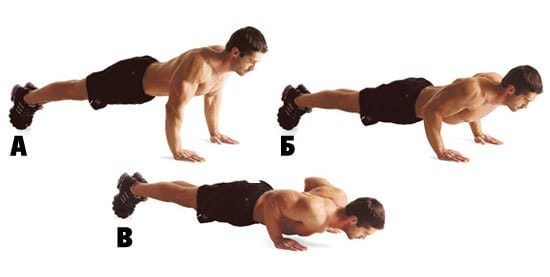
“Technique for performing push-ups with a stop”
Push-ups with bounce and cotton
Quite a difficult type of push-up, designed for those who have already completely mastered the technique of the classic push-up. Designed to develop explosive strength, which is used by professional athletes in preparation: in boxing, gymnastics, various types of martial arts. Explosive power requires more energy, is aimed at developing speed and strength.
- We accept an emphasis lying, we place our feet close to each other.
- We push up to parallel with the floor.
- With a sharp explosive movement we try to push our body up in order to have time to make a clap.
- We return to the starting position lying with outstretched arms.
- We repeat several times.
“Push-ups with bounce and clap”
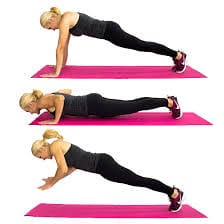
“Technique for performing push-ups with a jump and clap” The meaning of this exercise is to jump up as high as possible, while doing everything as quickly and clearly as possible.
What other push-ups can you use to pump your breasts?
At home, you can work out the breast with the help of:
-
Classic variation. Medium hand setting is used. The position of the hands can be changed, but this will not affect the pectoral muscles in any way. Hands are usually shoulder-width apart. The pectoral muscles will take a moderate part in the work.
-
Narrow arms. In this position, most of the load falls on the triceps. However, due to the fact that the load is shifted to the inside of the chest, the exercise should be included in the program. It is worth noting that there are few exercises on the inside of the chest, so push-ups with a narrow setting of the arms will allow you to work out this part better.
All of the above variations can be done at home. However, one of the problems of pumping at home is the lack of discipline in some, which can be a reason for laziness. As a result, there is no desired result. To get the effect of training, you need to do it correctly and regularly.
Chest dips
The parallel bars are a great tool for working out your triceps and pecs. They are found on almost any outdoor sports ground. And with a sufficient area, you can install them in the apartment.
The execution technique is not particularly difficult:
- Starting position: we take on the uneven bars the starting position on straight arms with a grip slightly wider than the shoulders. The legs should not touch the floor, for this they can be bent and crossed at the knees.
- We take a breath: we smoothly go down by spreading the elbows to the sides. In this case, the body is slightly tilted forward, and the upper back is bent. We go down until we feel a stretch in the pectoral muscles.
- We exhale: we go up, we strain the pectoral muscles as much as possible. At the top point, you can linger for a few seconds, tightening the pectoral muscles.
Should women do pectoral push-ups?
Many women are afraid to perform this exercise and work with the pectoral muscles. This position is justified by the misjudgment that as a result the breasts will be “like a man's.” But in fact this is not the case.
Push-ups, as well as the development of the pectoral muscles in general, will have a beneficial effect on the female breast, giving it shape and raising its tone. Therefore, girls should reconsider their position and try.
Sources used and useful links on the topic: https://willandwin.ru/otzhimaniya-na-grudnye-myshczy/ https://www.fitnessera.ru/programma-otzhimanij-dlya-grudnyx-myshc-dlya-muzhchin.html https: //zazozh.com/sport/trenirovki/kak-nakachat-grud-otzhimaniyami.html https://med-diagnostikum.ru/drugoe/otzhimaniya-dlya-grudnyh-myshc-muzhchine.html http://muscle24.ru /programmy-trenirovok/mozhno-li-nakachat-grudnye-myshtsy-otzhimaniyami.html https://trenirofka.ru/programmy-trenirovok/uprazhnenija-po-gruppam-myshc/kak-grud-nakhatami / -otzhml /rulebody.ru/trenirovki/grud/pravilno-otzhimatsya-metody-otzhimaniya-nakachat-grudnye-myshcy-92/ https://fitspine.ru/uprazhnenija/grud/kak-pravilno-nakachat-grudnye-mzh
Post source: lastici.ru