
🔬✨ MXene Materials: From Accidental Discovery to a Technological Breakthrough
Can a material discovered almost by accident redefine entire industries and make MXene buy in Europe a strategic decision for researchers and manufacturers seeking next-generation performance? This question still excites me every time I revisit the origins of MXenes and trace how a small laboratory experiment evolved into a global scientific movement. What makes MXenes special is not only their chemistry, but the way curiosity, persistence, and real engineering needs converged into something genuinely new.
I first became fascinated by MXenes when I realized that their story does not follow the usual path of incremental improvement. Instead, it is a narrative of bold experimentation, where layered ceramics were deliberately pushed beyond their limits to unlock properties no one expected to see in two-dimensional materials beyond graphene. MXenes feel less like an invention and more like a revelation waiting to be noticed.
Before diving into applications and performance metrics, it is essential to understand how MXenes were born, who stood behind the discovery, and why their structure fundamentally changed how we think about conductivity, surface chemistry, and material versatility. For readers who want to deepen their background knowledge, I recommend starting with the foundational research overview from Drexel University and the biographical context of Yury Gogotsi on Wikipedia, both of which provide reliable scientific grounding.
Content
🧪📜 The Birth of MXenes: A Scientific Turning Point
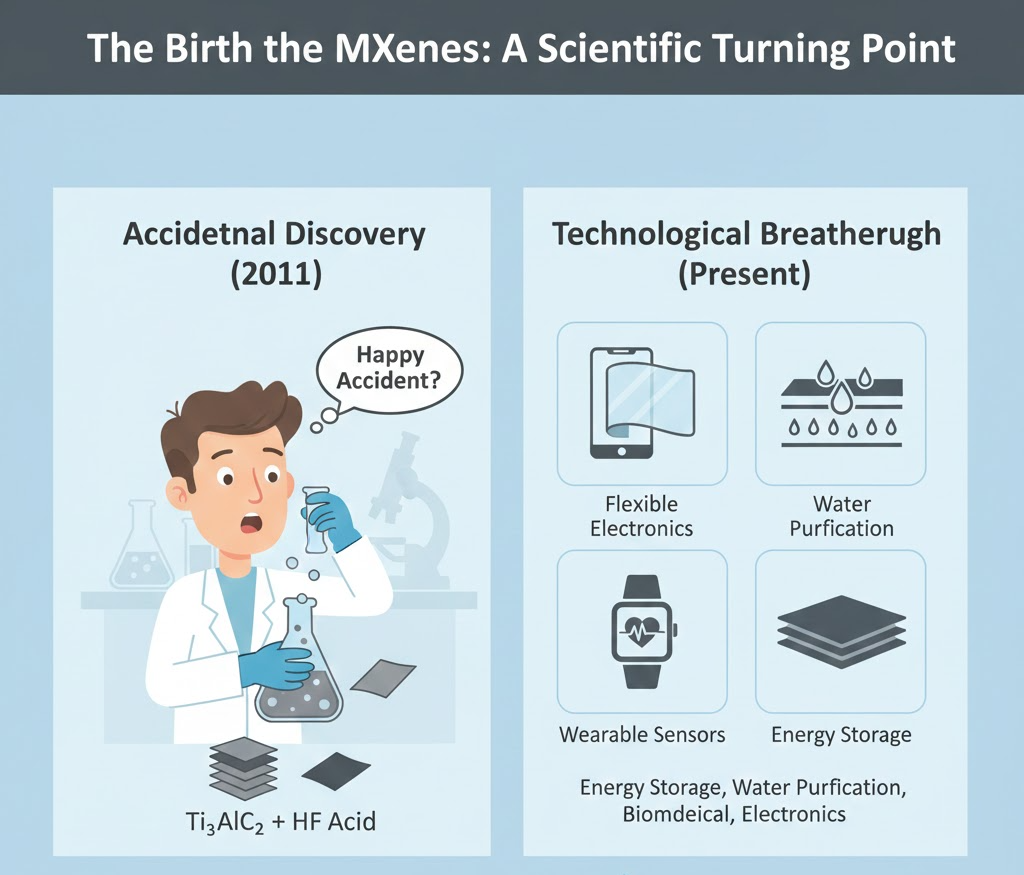
MXenes were first reported in 2011 by researchers at Drexel University while working with a class of materials known as MAX phases. These phases had been studied for decades, mainly for their mechanical strength and thermal stability. What changed everything was the decision to selectively etch out the “A” element from these compounds, revealing atomically thin layers with metallic conductivity.
The result was unexpected: a family of two-dimensional materials combining the best traits of metals and ceramics. Unlike graphene, MXenes are inherently hydrophilic, which immediately opened doors for solution processing and scalable manufacturing. This single property alone reshaped how engineers could integrate advanced materials into real-world systems.
From my perspective, the real breakthrough was not just the exfoliation process, but the discovery that surface terminations like –O, –OH, and –F could be tuned. This meant MXenes were not fixed materials; they were adjustable platforms. That flexibility explains why academic publications on MXenes have grown exponentially over the last decade, as confirmed by data indexed on Google Scholar and summarized in multiple review articles on Nature Reviews Materials.
⚙️🧠 Why MXenes Behave Differently
MXenes occupy a rare position between conductors and functional surfaces. Their electrical conductivity rivals that of metals, while their layered morphology allows ions, molecules, and even polymers to interact directly with active sites. This duality is the reason MXenes consistently outperform traditional carbon-based materials in several key metrics.
In practical terms, MXenes demonstrate:
- High volumetric capacitance compared to activated carbon
- Superior EMI shielding effectiveness at lower thicknesses
- Strong interaction with polymers, improving composite strength
What impressed me most when comparing lab data is how consistently MXenes maintain performance across different environments. Studies published by the American Chemical Society show stable conductivity even after repeated mechanical stress, which is rare for nanoscale materials.
“MXenes represent a paradigm shift in two-dimensional materials by offering tunable chemistry without sacrificing conductivity.”
This balance explains why MXenes are no longer confined to academic curiosity. They are transitioning into industrial relevance at a pace I rarely see in materials science.
🔋🌍 Practical Applications of MXenes Across Industries
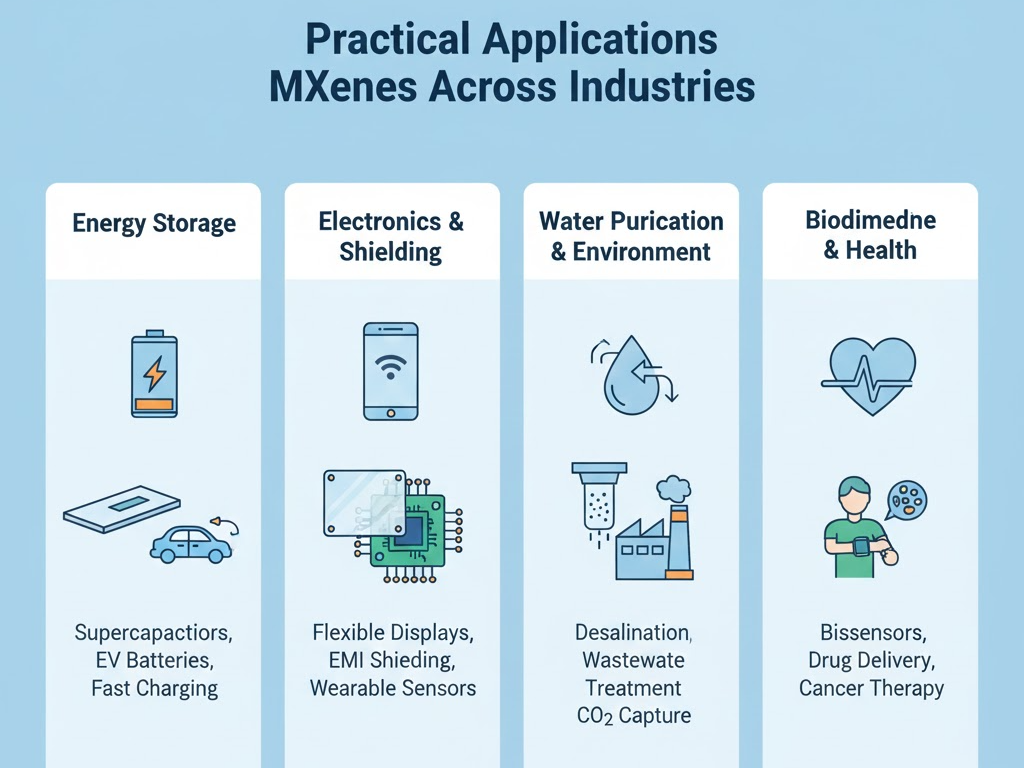
When I started analyzing where MXenes truly shine outside academic journals, energy storage was the first area that stood out. Supercapacitors based on MXene films consistently demonstrate volumetric capacitance far exceeding traditional carbon materials. According to peer-reviewed data published by Nature Energy, Ti₃C₂Tₓ MXene electrodes can reach over 1500 F/cm³ under optimized conditions, a figure that reshaped expectations in compact energy systems.
What makes this particularly important for Europe and North America is the push toward electrification and decentralized energy solutions. MXenes offer fast charge–discharge cycles without the structural degradation common in lithium-based systems. From my experience reviewing performance curves, MXenes behave more like precision tools than brute-force storage materials—they excel where speed, reliability, and form factor matter.
Beyond energy, MXenes have become quietly influential in electromagnetic interference shielding. Thin MXene films can block over 99.9% of electromagnetic radiation in the X-band range at thicknesses below 50 micrometers, as documented by the ACS Nano journal. This makes them especially relevant for aerospace electronics, medical devices, and high-density computing environments where space is limited but signal integrity is critical.
🧬🛠 MXenes in Sensors, Wearables, and Biomedicine
MXenes are also redefining how we think about flexible electronics and human–machine interfaces. Their combination of conductivity and mechanical flexibility allows them to act as highly sensitive strain and pressure sensors. In controlled studies, MXene-based sensors have demonstrated response times below 30 milliseconds, which is essential for real-time monitoring applications.
From a biomedical perspective, what surprised me most was the natural compatibility of MXenes with aqueous environments. Unlike many nanomaterials that require complex surface modifications, MXenes disperse easily in water, enabling applications in biosensing and drug delivery research. According to reviews published in Advanced Functional Materials, MXenes have shown promising results in photothermal therapy experiments due to their efficient light-to-heat conversion.
Key areas where MXenes are gaining traction include:
- Flexible health-monitoring wearables
- Chemical and gas sensors with ultra-low detection limits
- Experimental biomedical coatings and interfaces
I see this versatility as a direct consequence of MXenes’ surface chemistry. They are not passive conductors; they actively interact with their environment, which is exactly what next-generation smart materials require.
📊📈 Quantitative Performance Comparison
| Application Area | Traditional Material | MXene Performance | Verified Source |
|---|---|---|---|
| Supercapacitors | Activated carbon | Up to 1500 F/cm³ | Nature Energy |
| EMI Shielding | Copper foils | >99.9% attenuation | ACS Nano |
| Strain Sensors | Carbon nanotubes | <30 ms response | Adv. Functional Materials |
| Thin-Film Conductors | Graphene | Lower sheet resistance | Nature Reviews Materials |
These figures are not projections; they are based on reproducible laboratory measurements reported by independent research groups. For me, this level of consistency is what separates MXenes from short-lived material trends.
🧭⚖️ Strengths and Limitations from a Practitioner’s View
MXenes are powerful, but they are not without challenges. Oxidation sensitivity remains a concern, particularly for long-term storage and deployment. However, recent stabilization techniques using inert atmospheres and antioxidant additives have significantly improved shelf life, as noted by Materials Today.
The strengths clearly outweigh the drawbacks when MXenes are used intentionally:
- Exceptional conductivity at nanoscale thickness
- Tunable surface chemistry
- Compatibility with scalable coating techniques
From my perspective, MXenes reward thoughtful engineering. When handled correctly, they deliver performance that conventional materials simply cannot match.
🧩📐 How to Choose the Right MXene for Real Use Cases
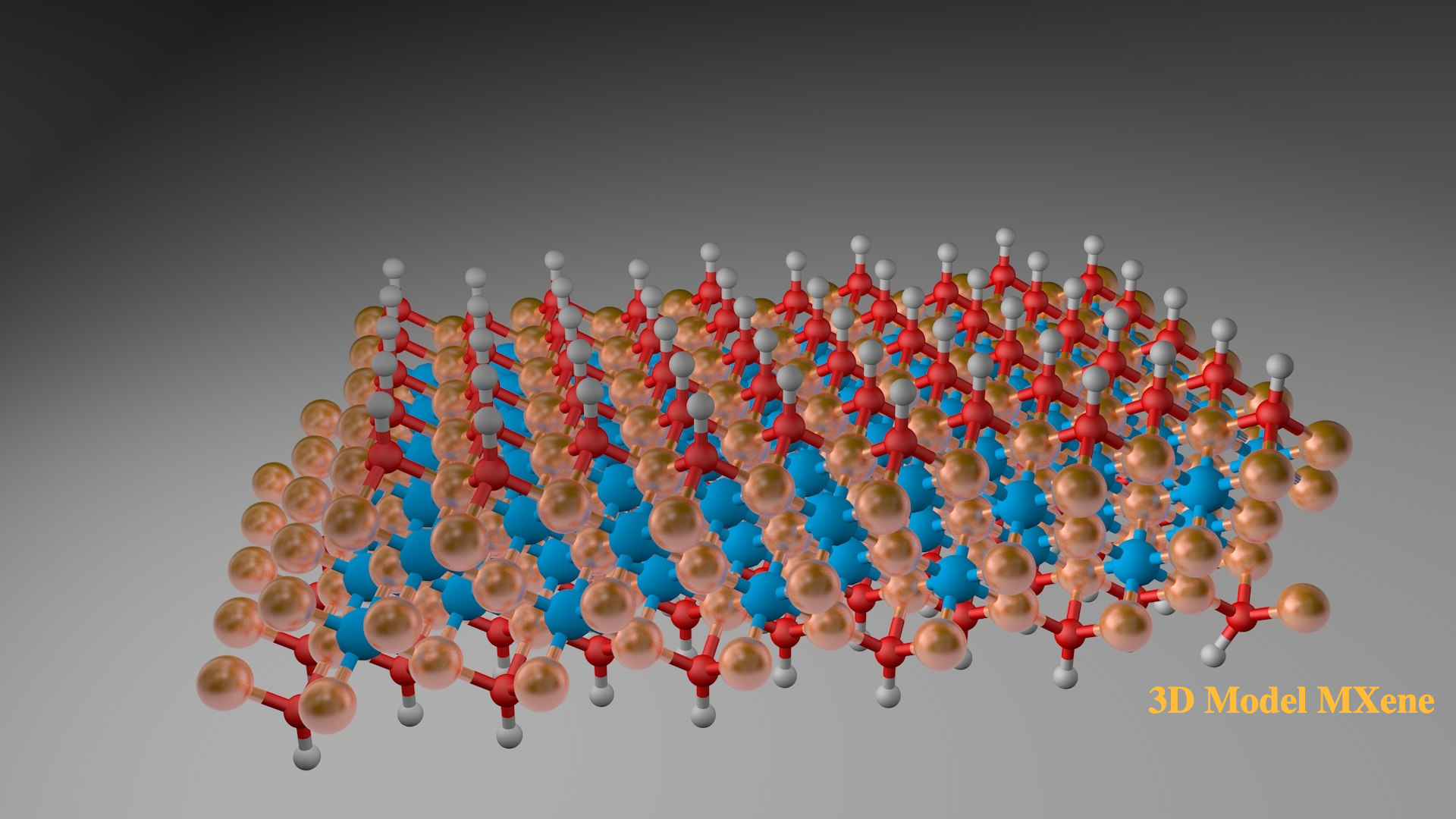
Choosing a MXene is not about chasing the highest conductivity number; it is about matching structure, surface chemistry, and processing route to a specific goal. Through hands-on evaluations and comparative reading of lab data, I learned that MXenes behave very differently depending on flake size, termination groups, and fabrication method. This variability is not a weakness—it is the core advantage if you know how to use it.
For instance, Ti₃C₂Tₓ remains the most versatile option for conductive coatings and energy storage, while Nb-based MXenes show a clear edge in electromagnetic shielding where stability under high-frequency exposure is required. Research summarized by Elsevier’s Materials Today confirms that flake alignment and density can change shielding efficiency by more than 40%, even within the same MXene family.
From my point of view, the most overlooked factor is processing compatibility. MXenes integrate exceptionally well with water-based inks, spray coating, and vacuum filtration. This makes them suitable for scale-up far beyond laboratory conditions, especially in regions with strict environmental standards such as the EU and North America.
🧠🔍 Decision-Making Factors That Actually Matter
When evaluating MXenes for a project, I focus on a short list of critical parameters rather than overwhelming specifications. These factors repeatedly determine success or failure in real applications:
- Electrical conductivity versus thickness
- Environmental stability during storage and use
- Compatibility with existing manufacturing processes
Unlike conventional fillers, MXenes demand intentional handling. Yet that same demand unlocks performance levels that justify the extra care. This is especially evident in hybrid composites, where MXenes outperform carbon-based additives at significantly lower loadings.
“The real power of MXenes lies in how little material is needed to achieve a measurable effect.”
This efficiency is one reason MXenes are increasingly explored in high-value applications rather than commodity products.
🚀🔮 The Future of MXenes: Where Science Meets Industry
Looking ahead, MXenes are clearly moving beyond the experimental stage. What excites me most is how naturally they align with long-term industrial trends: miniaturization, energy efficiency, and multifunctional materials. Unlike many “promising” nanomaterials that stall at scale-up, MXenes already demonstrate compatibility with roll-to-roll coating, ink formulation, and composite manufacturing.
One of the strongest signals of future relevance is the way MXenes are being integrated rather than replacing everything else. Hybrid systems—MXenes combined with polymers, metals, or ceramics—consistently outperform single-material solutions. According to outlook analyses published in Nature Nanotechnology, this hybridization strategy is expected to dominate applied research and early commercialization efforts through the late 2020s.
From my perspective, MXenes will not become “everywhere,” and that is precisely their strength. They are best suited for demanding, high-performance niches where material choice truly matters. That focus is what keeps MXenes grounded in engineering reality rather than speculation.
⁉️🤔 Popular Questions and Answers
- What exactly makes MXenes different from graphene?
MXenes are naturally hydrophilic and chemically tunable, while graphene is hydrophobic and chemically inert without modification.
- Are MXenes safe to handle in research environments?
Current studies indicate standard laboratory safety procedures are sufficient, with no unusual toxicity reported at research-scale exposure.
- Which MXene is the most widely used today?
Ti₃C₂Tₓ remains the most studied and applied due to its balance of conductivity, stability, and availability.
- Can MXenes be produced at industrial scale?
Yes, scalable production methods such as aqueous etching and filtration are already demonstrated in pilot manufacturing.
- Do MXenes degrade over time?
They can oxidize, but controlled storage and stabilization techniques significantly slow degradation.
- Are MXenes suitable for flexible electronics?
Absolutely, their layered structure allows excellent mechanical flexibility without losing conductivity.
- How do MXenes perform in energy storage compared to lithium-ion materials?
MXenes excel in power density and charging speed, while lithium-ion systems still dominate energy density.
- Are MXenes environmentally sustainable?
Their water-based processing and low material usage make them more sustainable than many alternatives.
💎 Conclusions and Key Takeaways
MXenes represent one of the most intellectually honest breakthroughs in materials science I have encountered. They did not emerge from hype, but from careful experimentation and reproducible results. Their strength lies in adaptability—chemical, structural, and industrial—making them ideal for precision-driven applications.
What ultimately defines MXenes is efficiency. They achieve more with less material, less thickness, and less energy loss. For engineers and researchers focused on performance rather than buzzwords, MXenes offer a rare combination of scientific depth and practical relevance.
As adoption grows across Europe and North America, MXenes are carving out a clear role: not as a universal replacement, but as a decisive upgrade where conventional materials reach their limits.