
How to develop muscle strength – best exercises and guiding principles. How to train properly to increase strength?

Features of strength training
Training for the development of strength indicators involves working with large weights. High repetitions, blocks and isolation exercises are foreign to athletes whose training is aimed at developing strength. Naturally, exercises such as the pull of the upper block in the simulator or the leg press in the simulator may well be present in the training process, but as an additional load and not even in every workout.
Key features of strength training:
- Strength training mainly consists of basic exercises.
- The main feature of such workouts is to reduce repetitions. Usually, the exercise is performed up to five repetitions.
- The number of approaches, in comparison with the usual training to increase muscle mass, is greater. There may be 6-8 of them.
- The rest time between sets also increases and ranges from three to five minutes. The rest time can be longer.
- Also, to achieve the effect, exercises are used to develop explosive strength. It is a push and a jerk.
- The amount of strength training will depend on your working weight. For example, if your weight is 100 percent of your one-repetition maximum (1RM), then a workout that includes this exercise should be done once a week. If the weight is lower, for example, 80 percent of the one-rep maximum, then the workout can be done twice a week.
- Such training should not be carried out more than once every four days.
- Also, the speed of the exercise should be observed. It usually decreases from medium to low. This is necessary so that the body does not get used to the load.
But aerobic exercise is completely irrelevant in the training regime for increasing strength.
Particular attention should be paid to the exercise technique. Firstly, due to the correct execution, the risk of injury is reduced, and secondly, the correct technique increases the innervation of the muscles (creates more nerve endings), respectively, we get a powerful and in all the aspects we need, the best response of the muscles.
To develop strength, the ladder technique is used, in which weight increases with each subsequent approach, and the last approaches are performed with maximum weight (either 80% of the maximum, or 100%).
To “break through” a stop in the development of strength, which all athletes face, presses with a pause in the direction of movement may be relevant. For example, while performing a bench press lying down: press and lower the bar are performed with fixation in the center of the amplitude.
Additional exercises, which were already discussed at the beginning, can also be added, these are exercises in simulators, and work with dumbbells, and other types of exercises.
Basic principles of strength growth
But first, it is very important to swing the theory in order to understand what is going on with us, and why we do not need to act in a certain way in order to gain strength. Therefore, I do not advise you to neglect this. Let's not beat around the bush and immediately discuss the main unshakable principles of increasing strength.
If we try to briefly describe this process, then we can say that all our muscles and strength increase due to a constant increase in load, namely due to the fact that muscle fibers are damaged during hard training. Then, during rest and recovery, the brain activates its powerful functions of “healing” muscle wounds and after this treatment, the muscle gains its mass and grows. But after recovery, the muscle does not return to its original state, but becomes stronger. The body, as it were, compensates for the losses, and provides energy with a reserve to adapt to such training. This phenomenon in bodybuilding is called “supercompensation”.
And it is already becoming clear to us like a white day that for the development of muscle strength, training must be more powerlifting in nature than bodybuilding. And there is a more detailed explanation for this. It's all about muscle responses to training of various kinds. Let's pay attention to 2 main types of muscle growth:
- Sarcoplasmic hypertrophy is an increase in muscle volume due to the growth of sarcoplasm. Sarcoplasm (or cellular fluid) is that part of our muscles that does not contract and its growth is stimulated by an increase in mitochondrial proteins and metabolic reserves of our muscles (for example, glycogen and creatine phosphate). Growth can also be affected by a denser network of blood capillaries. This type of growth is sought by bodybuilders, as they use a multi- repetition style of training (8-20 reps per set), which increases the sarcoplasm the most. Such hypertrophy is short-lived and therefore needs constant “pumping” both in terms of training and in terms of special nutrition, where creatine must be present.
- Myofibrillar hypertrophy is an increase in the volume of protein cells (myofibrils), which are responsible for the process of contraction of our muscles. Along with the growth of the volume, the density of this matter also increases. This hypertrophy significantly increases strength performance. It takes longer and more difficult, but the result is much more durable. The emphasis on this type of hypertrophy is made by powerlifters, since they lift very large weights a small number of times (5-10 repetitions per set).
The picture will help you see everything written above clearly, please note:
Myofibril (translated from Latin for “fiber”) is the thin filaments of our striated muscles, or cells. In length, they can reach up to 20 cm. These threads have a cylindrical shape and for the most part consist of 2 types of fabrics.
- Actin myofilaments (composed of actin) are thinner threads and respond well to aerobic exercise (running, aerobics, cardio, in short, where endurance is needed and you need to sweat).
- Myosin myofilaments (composed of myosin) are thicker protein structures. They are the ones that interest us when it comes to developing strength and muscle mass. This type of muscle strand responds well to strength training where heavy weights need to be lifted.
Our muscles and muscle cells are 2/3 composed of myofibrils, the main task of which is to tighten the muscle fiber under the influence of a nerve impulse.
It is problematic to develop strength at home, so we immediately go to the gym.
Bars
Bodyweight exercises are also performed on uneven bars. These are classic push-ups for the muscles of the chest and triceps and lifts for the press.
To make a press on the uneven bars, you need to climb on them, place the pelvis on one pipe, lean back a little and place your legs under the second pipe. Now you can lean back even further, while your legs will support your body so that it does not tip over. From this position, with your arms crossed behind your head or on your chest, you can swing the press.
You can do push-ups in different ways. Again, a lot is decided by the position of the hands, and also the angle of inclination of the body forward. If you lean forward, the load will go to the chest, if you keep the body upright – to the triceps.
You can swing the press on the uneven bars in one more way:
- Hang on the uneven bars, lean forward, press your chin to your chest.
- Raise your legs, bent at the knees up to the chin. You can raise straight legs – but then you will swing. Or you can imitate walking by alternately moving your legs.
Hyperextension
How to build back muscles without exercise machines? There is only one answer – hyperextension. This exercise is often used in spine health complexes.
You can do hyperextension at home or exercise outdoors.
In the first case, you need to lie on your stomach on the mat, stretching your arms and legs. Next, lift your arms and legs up. Hold for a second and lower. This is one repeat. You can fix your legs and raise only the upper body. Choose the most convenient option for yourself.
In the second case, you need to find two adjacent horizontal pipes of different levels. This design is often found on sports fields. Fix your legs under one tube, lean on the other with the front of your thighs. From this position, perform back flexion and extension.
Pull-ups
A versatile upper body exercise. And, perhaps, the most popular male exercise in the world.
Many grips can be used to develop maximum strength, but two should be fully mastered: the reverse grip, which requires more biceps strength, and the direct grip, in which the upper, external latissimus muscles are more loaded. Repetitions should be performed with an active, pronounced upward movement and a slow, controlled downward movement.
Pull-ups can be added to almost anywhere in your workout, but it's best to include them at the start of your workout as they require a lot of strength to do them. To target multiple muscle fibers, you should try to vary the rep ranges either within a single workout or within a weekly training cycle. For maximum results, do 3-4 sets of 8-15 reps on one day of the week and 4-5 heavy sets of 3 reps on another day of the week.
Army press
Our commitment to the bench press will never be broken! But the main bench press, which is often overlooked when working on the muscles of the upper body, is the overhead press.
The overhead press is best done on a separate day of your shoulder workout when you're fresh. Shifting this exercise to the chest day or combining it with other muscle groups when not done first will completely deprive your body of the ability to form the correct movement technique. Concentrate on pressing the weight in a strictly vertical direction, in line with the body and ears, until the arms are fully extended over the head.
When performing the exercise while standing, more involvement of the muscles of the torso is required, as well as correct breathing: a deep breath when lowering the weight and exhale evenly when passing the midpoint of the movement. Dumbbells are ideal for athletes with overhead press problems to brush up on correct exercise technique as they move the weight along a natural path for your body. When doing a barbell exercise, your chin and nose get in the way, and if your torso is not strong enough, your shoulders and lower back are likely to become in the wrong position.
Try to do 3-5 sets of 6-8 reps: this is how you get the most out of it; do not work with heavy weights in which you cannot control the ideal technique for performing each repetition.
Squats
Bodyweight squats not only help build muscle, but are also good cardio workouts. Try to sit down 50 times and count your heart rate – it goes off scale, right?
Squats can be significantly heavier by squatting on one leg. The exercise is called a pistol. Not everyone can do it. And not so much because of the lack of strength, but because of the wrong technique. Therefore, before proceeding with the implementation, clarify all the nuances for yourself. This exercise is not advisable if you have sore knees.
Walking Barbell Lunges

Lunging walking is an excellent exercise with many benefits for a wide range of athletes.
With each rep, the stride should be wide enough to make the front knee and back knee 90 degrees, with the back knee touching the ground. Taking too short a step can stretch the ligaments of the front knee. Taking too long a stride can stretch the hip flexor of the hind leg and the gluteus muscle of the front leg. Concentrate on explosive forward and upward movement with your front leg to properly engage your glutes.
After mastering the basic technique, you can begin to walk with a lunge with a heavier weight and in greater volume. Walking like this isn't just for developing quads. Research has shown that lunges are actually more effective at developing hamstring strength, provided you achieve the correct range of motion with stretching of the gluteus and hamstrings with each rep.
Once you have mastered the correct stride length and depth, do three sets of 8-10 reps per leg at the end of your leg workout.
Raises on socks
Raising on socks to train the calf muscles without weight makes sense to do on one leg and provided that the heel hangs in the air. This is necessary so that you can pull the toe towards you, lowering the heel as far down as possible. Thus, you will be able to work out the caviar at all possible amplitude.
Pushups
You can do push-ups from the floor in a horizontal position and at different angles. The most challenging options affecting the shoulders, chest, and triceps are upside-down push-ups.
The effectiveness of push-ups for individual muscles can be changed by varying the position of the elbows and palms.
Basically, the triceps, deltoids and pectoral muscle work.
Long jump
Long jumps not only activate your fast-twitch muscle fibers and prepare your central nervous system for explosive movements, but they also train your muscles and central nervous system to “shoot” better when you are using a barbell in a squat frame.
For correct exercise, take a track and field stance behind the mark on the ground, with your legs narrower than your shoulders. Push with both legs, swing with both arms and bend your knees to jump forward. Be sure to throw your pelvis forward to activate the posterior muscle chain (hamstrings and glutes) as well as the quads.
To perform the exercise most effectively, you need an explosive movement in the ankles, knees and hip joint, with an active forward swing of the arms. At the end of the jump, quickly bend your hip, knees and ankles, trying to land as softly as possible in a stable gymnastic stance.
Safe load
It is believed that weights that do not exceed our body weight are safe for our muscles. And if work, for example, with a barbell is not shown to everyone, then the load created by your own body is quite comfortable for everyone.
The ability to adapt in response to exercise is an excellent quality of our musculature. But nature initially provided for the ability to control only the weight of its own body. Indeed, in ancient times, our ancestors ran away from predators, hunted, climbed trees and rocks.
Big bulky muscles, or the ability to lift very heavy objects (bodybuilding and powerlifting) was not a necessity in terms of survival. Accordingly, our muscular system is not designed for this by default.
Advanced athletes with weights significantly exceeding their own weight achieve these results through long and hard training. And beginners who are trying to jump off the bat are injured and tend to lose interest in the sport.
Therefore, it is exercises with their own weight that are the most natural and safe type of physical activity. They are designed to help everyone, regardless of their level of training, to get in good physical shape and fit.
The next level of progress is adding weights.
No matter how good calisthenics is, there will be a moment when certain muscle groups, especially such as chest, legs, hips, require a lot of weight. Also, calisthenics requires the use of multiple muscle groups to perform the exercise, which is not bad for functional and natural development, but it makes it difficult to isolate individual muscles. This does not mean that calisthenics has no place in the training program, you just need to understand its application.
Benefits of Bodyweight Training for Seniors
Scientific experiments have shown that some bodyweight exercises benefit not only young people, but older people as well. Seniors using a bodyweight training program increase muscle mass, increase joint mobility, increase bone density, reduce depression, and promote healthy sleep.
It is also believed that training based on body weight can help reduce or reduce cognitive (mental) decline as people age. In addition, the increased risk of falls seen in older adults can be reduced by exercising with your body.
Who Needs Muscle Strength Training and When
In addition to weightlifting athletes, powerlifters and athletes of various bench press competitions, strength training is relevant for bodybuilders who, with their help, overcome the “plateau” in achievements, when the usual training and nutrition are no longer able to increase the volume and mass of muscles.
Also, these exercises are performed by some athletes and other sports, for example, as always, a brilliant example is American football players. Of course, although the training of football players consists of exercises aimed at increasing strength indicators, nevertheless, the training is aimed at the overall development of indicators.
Consider light running.
It can be very costly for the heart muscle and promote its growth, but it will not lead to the growth of muscle tissue in the legs. The fact is that the load is not so strong as to affect all muscle fibers of the legs.

The number of approaches and reps
The most optimal number of repetitions will be around 6. (An exception for pumping up the legs as well as the abdominal press there may be a little more approaches).
If you do a lot of repetitions, for example in the region of 10, then this lesson will already be aimed at increasing muscle mass, which is also called “pumping”. If the number of repetitions is in the region of 20-30, then here the focus is more on increasing endurance and fat burning. The cardiovascular system will already be trained.
That is why the scales of your shells need to be calculated so that the 4th, 5th or 6th time is really the last, tense, and so that you simply have no strength left. That is, press until complete failure.

That is why such training must be approached with great care, since they are very traumatic. If you really want to give 100%, then you better find yourself a partner who will insure you, or do not forget to use safety devices on the simulators (if any).
- Be sure to warm up all the muscles very thoroughly for 10 minutes before training. This is always important, but critical for strength training.
- Workouts should be done about 3 times a week. If you train according to a particularly difficult program, then even 2 training sessions per week may be sufficient. Otherwise, the muscles will not have time to recover and you will enter a “plateau” state.
- If in training for mass gain you need the correct focus, only on one muscle, for example, when pumping pectorals, try to work only with them. Then, in strength training, you can use more muscles, that is, both the shoulders and triceps and pectorals. Here, your main task is to lift the weight as much as you can, and here you can include all muscle groups that will help.
Exercises to increase muscle strength are done with a large number of approaches, there should be 7-10 of them. It is recommended to perform according to the following algorithm:
- The first 2-3 times should be warm-up, the weight for them should be set so that you can squeeze it more than 10 times. This is done in order to further warm up your muscles and thoroughly prepare for the next approaches.
- Then do about 3-4 approaches with maximum weights. Which you can squeeze 1 to 6 times.
- In the last 2 sets, you need to make such a weight so that you can again lift the bar about 10 times. This is necessary in order to better pump blood through your muscles in the last approach. This will give you faster results.
In strength training, it is very important to give your body a good rest between heavy sets. Therefore, the breaks here should be longer, about 4-8 minutes. For example, in a workout for gaining muscle mass, the break is 2-3 minutes, and for endurance about a minute.
Here it is better to listen to your body yourself. In the interval of 4-8 minutes, choose the time suitable for yourself, when you already celebrate that you have recovered and are ready. This feeling comes with experience.
Best Strength Exercises
It is not enough to work with large weights to increase strength. The muscular framework must develop comprehensively, since a weak “link” in the muscle structure, for example, the muscles of the lower back, when taking a lot of weight on squats, completely deprives you of the opportunity to develop in strength indicators, and also threatens with serious injury, so each strength exercise is This is the exercise in which the maximum number of muscles works. But that's not all. For the development of strength indicators, it is imperative to pay attention to explosive strength, therefore, jerk techniques cannot be ruled out.
Here is a list of great strength-building exercises:
- Deadlift.
- Squats.
- Bench press.
- Barbell lunges or dumbbell lunges moving through the hall.
- Pull-ups with a narrow reverse grip with weight.
- Bent-over barbell row.
- Dips with weights.
- Schwangi.
- Press the bar from behind the head.
- Turkish climbs.
These are the main strength training exercises for all muscle groups, which strengthen the athlete's ligamentous apparatus and prepare for various tests.
Best Hand Strength Exercises
Of these, the best exercises for developing arm strength are: bench press, pull-ups, push-ups on the uneven bars, shvungs, and standing barbell press. These are basic exercises that, in addition to the deltoids and shoulder muscles, help to strengthen other, larger muscles, such as the back and chest. The fact is that to develop strength, you should not perform isolation exercises, like curling the arms with a barbell or the French press. These are narrowly focused exercises that hone the shape and relief of a particular muscle, but they directly affect the development of strength to a lesser extent.
The best exercises for leg strength
These exercises are deadlifts, squats, lunges, jumping. These exercises more than others contribute to an increase in strength, including explosive, all muscles in general and give an anabolic boost by increasing testosterone production. Without these exercises, you should not hope for the development of the muscles of the arms or other groups.
Remember, strength development is a complex method that requires the involvement of more muscles and ligaments in the exercise, the development of not only external muscles, but also deep ones. And this will be facilitated not only by the dynamic load, but also by the static one – holding the position for a certain period of time. As you can see further, the training process is also aimed at developing explosive strength, without which sometimes it is impossible to get out of the stagnation of strength indicators. Read about static exercises here →
The development of strength enslaves the muscles and contributes to their shortening due to their constant contraction and overstrain. Therefore, it is important to return the fibers to their normal anatomical condition and help improve their flexibility and elasticity. To do this, do not neglect stretching your muscles at the end of your workout.
Important notes
- A horizontal bar will be a good end to a working day for strength training. If you don't have enough strength to do push-ups, you can just hang on it. This is necessary for good stretching of the spine after heavy loads on the back and shoulder girdle.
- Strength training is very stressful and stressful for the body, so it is very important to give it sufficient rest time. And for more progress, the best approach is to alternate between strength, endurance, and weight gain workouts and combine them. Most professional athletes follow this method. This is called building training cycles.
- When training strength at a time, it is better to work out no more than 2 muscle groups, and work them out efficiently and to the stop. If you take more for work, then the quality of the load on them will decrease, since you will get tired and will not be able to perform them correctly.
Weight gain and weight training
Bodyweight exercises are not effective for gaining mass. Of course, given good genetics and a short bone lever, you can gain a little even by exercising without weights. But this is rare.
When exercising with your own weight, the muscles tone up, good endurance appears, the relief is drawn and strength grows to some limits. But, in order to cause precisely hypertrophy of the muscle fiber, large weights are needed.
That is, strength exercises without weights can hardly be called strength exercises.
Strength gain rules
Load dosing is an important skill that is essential on the way to high strength performance.
The specificity of strength training consists in lifting large weights, but you cannot constantly work to the limit of possibilities. If you thoughtlessly pull a barbell with a bunch of pancakes, then you will have to forget about strength.
Firstly, because strength is not built by such methods, and secondly, because people who constantly work with large weights are often injured. The recovery process will take a long time, and the dream of becoming strong will remain a dream.
Training weights should range from 50% to 95%.
For example, today is Monday, on this day you need to do a light press and a heavy squat. This means that the press will be performed with a weight of 50% -70% of the maximum, and the squat will be between 70 and 95%. You can learn more about this from the training program described below.
Reps are much easier than barbell weights. An athlete who exercises with the goal of increasing strength should perform from 1 to 6 repetitions in one approach. This rule is true for heavy basic exercises. The so-called “utility” (bodybuilding exercises) is performed in the range of 8 to 12 repetitions.
The number of approaches is determined purely individually and depends on the degree of fitness of the athlete, the type of training, the exercise performed and other points.
The number of basic, heavy approaches is usually about five, no one counts warm-ups.
A training macro cycle does not have to be tied to a calendar week. The program described below will not be tied to seven days. To develop strength, you need not only to train correctly, but also to recover. Therefore, training will be relatively rare. However, this fact does not prevent you from becoming a truly strong athlete.
Separately, it must be said about the technique, which is very specific when performing exercises in a power manner. Before starting hard training, it is necessary to set the correct technique in all exercises. Deadlifts and squats are primarily concerned with this rule. Neglecting correct exercise technique can lead to serious injury.
Strength Program: Advanced
This weight and strength training program is suitable for people with good physical fitness. Classes are calculated taking into account a three-time weekly visit to the gym.
The first day aims to work out the legs and chest muscles. The following exercises are performed
- 90% squatting with a bar in the amount of 7 approaches according to the scheme 5x5x5x4x3x2x1;
- 70% bench press performed according to the 5 × 5 scheme;
- pattern 3 pullover
The second workout aims to work out the shoulder muscles, back muscles and triceps. The following complex is performed:
- press with a narrow grip – 5 × 8;
- army bench press – 4 × 8;
- barbell thrust in the slope – 4 × 8;
- shrags – 3 × 20;
The goal of the third day of training is to work out the muscles of the back and chest. The following complex is performed:
- 55% Barbell Squats – 5 × 5
- 90% Bench Press – 5 sets strength training program using the 5x5x4x3x2 pattern;
- 90% deadlift 5
The training program aimed at developing strength and endurance is designed for 30 sessions over 12 weeks. There is a 1 day rest between each gym visit, but the break can be 2 days if necessary.
To achieve the desired result, it is enough to adhere to the program of performing a set of basic exercises aimed at developing strength skills. The main thing for achieving this goal can be considered self-confidence, the correctness of the main exercises and the frequency of training.
Training program examples
Immediately I want to draw your attention to the fact that you should not look for any miracle program that will give you the results you need. Don't bother with it. Below will be given an approximate plan and type of the training program itself. But you can change it however you like. The main thing is to give the muscles enough time to recover – at least 48 hours.
One of my favorite muscle strength workouts looks like this:
| Understand. | Tuesday | Wednesday | Thursday | Friday | Saturday | Resurrected. |
| Chest-back | Relaxation | Leg press | Relaxation | Arms and shoulders | Relaxation | Relaxation |
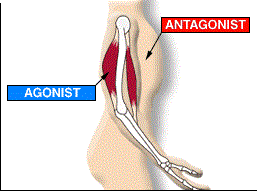 Based on this plan, you can create your own training program. But personally, I recommend that you combine the training of antagonist muscles, that is, muscles that are opposite in their functions. These muscles include the chest-back (the chest muscles push the bar forward, and the back muscles, on the contrary, pull towards themselves), biceps-triceps (flexion, extension of the arm), biceps of the hip-quadriceps (flexion and extension of the leg).
Often you will notice that after a chest workout, back exercises are easier. This is because during the pressing movements for the pectoral muscles, the back muscles resist this, since they are antagonists. But when we already move on to training the back, then the chest will no longer be able to resist so much, since it will be previously tired. This is a great opportunity to throw on a couple of extra pounds. That is why Arnold Schwarzenegger and other great bodybuilders loved to train chest and back. I think the point is clear to you.
I sometimes did the bench press and immediately did pull-ups on the horizontal bar. This adds variety to your workout and creates a moderate intensity. You should definitely try it.
Approximate workout plan:
CHEST-BACK-PRESS (MONDAY / TUESDAY)
| The exercise | Approaches | Repetitions |
|---|---|---|
| Bench press | five | five |
| Incline Barbell Press | 3 | 8-12 |
| Dumbbell bench press | 6 | eight |
| Deadlift | five | five |
| Row of the bar to the belt in the slope | 6 | eight |
| Shrugs with a barbell (swing the trapezoid) | five | eight |
FEET PRESS (WEDNESDAY / THURSDAY)
| The exercise | Approaches | Repetitions |
|---|---|---|
| Squats | five | five |
| Leg press in the simulator | 6 | eight |
| Extension of the legs in the simulator | 3 | 8-12 |
| Romanian deadlift with dumbbells | five | five |
| Leg curl in the simulator | 6 | eight |
| Standing, Seated Calf Raises | eight | 10 |
HANDS-SHOULDERS (FRIDAY / SATURDAY)
| The exercise | Approaches | Repetitions |
|---|---|---|
| Seated Barbell Press | five | five |
| Seated Dumbbell Press | 6 | eight |
| Swing dumbbells to the sides in an incline | 3 | 8-12 |
| Bench press with a narrow grip | five | eight |
| French press | five | 8-10 |
| Standing barbell curls | five | five |
| Sitting dumbbell curls on an incline bench | 3 | 8-12 |
ATTENTION: You can train abs at the end of each workout, that is, 3 times a week. You can choose any exercises that you want.
Risks when working with large weights
Training with large weights, even with the correct technique, carries certain destruction to the body. This is especially true for the joints and ligaments. Consider the risks and preventions separately for the major joints:
- The shoulder joint is the most flexible and fragile. To keep your shoulder joint alive, do the right bench press and squat. In the first exercise, you need to bring the shoulder blades as much as possible and fix the shoulders. In the second, try to take the bar a little wider than your shoulders so that the joints are less loaded. Before each bench workout, you need to pump your rotator shoulder muscles. Exercises for these muscles can be found on the Internet, there are only a couple of them.
- Elbow joint. In all pressing movements, try not to straighten your arms to the end, so that the load does not go into the joint. Use elbow pads as needed. If the joint is already injured, give up push-ups on the uneven bars.
- Knee joints are often injured on squats due to improper technique. On heavy weights, wrap your knees with stiff bandages, even if they are healthy. Before heavy squats or deadlifts, stretch your knees in a leg curl and leg extension machine.
- The spine suffers more than others. When doing any exercise, even picking up the pancake from the floor, keep your back straight. Pump the extensor muscles with extensions and hyperextensions.
If you have a predisposition to joint disease or osteochondrosis with hernias, then you need to understand that strength training will only speed up this process, but not everything is so simple. We are all different, our bodies also react to the load in different ways, therefore, it is possible to find out something only experimentally.
Conclusion
Strength training is serious training that requires high concentration in the gym. This process does not like haste and does not forgive mistakes. At least mistakes will sooner or later result in injury! In addition to training for strength athletes (powerlifters, bench press and weightlifters), proper nutrition is important! Since with a conventional mass-gaining diet, you can gain excess weight, and this is unacceptable for competing athletes.
Sources used and useful links on the topic: https://bodybuilding-and-fitness.ru/trenirovki/trenirovka-na-silu.html https://pumping-effect.ru/bodibilding/uprazhneniya-na-silu-myshc.html https://FitNavigator.ru/trenirovki/kompleksy-uprazhnenij/s-sobstvennym-vesom.html https://zen.yandex.ru/media/sportboxnet/7-uprajnenii-dlia-razvitiia-maksimalnoi-sily-599984c1e86a9e822a3fb296 https: //zen.yandex.ru/media/id/5ea93b1df8f6467e32511c66/rastut-li-myshcy-ot-trenirovok-s-sobstvennym-vesom-chto-takoe-kalistenika-5ea98953be4daf0fa6cfa739 https: //.ru/www.ingoodzit -sobstvennym-vesom / https://full-fit.com/programmy-trenirovok/na-silu/ https://www.ironbeauty.ru/programma-trenirovok-sila
Post source: lastici.ru