
How much water should runners drink. Is water required while running?

Content
Essential fuel
Correct drinking regime is imperative for maintaining health, especially with intensive training, which provokes moisture loss through sweat. Dehydration during sports has undesirable consequences.
- With physical activity, the body temperature rises. If there is enough fluid in the body, heat exchange is regulated by the secretion of sweat. With a lack of water, this mechanism is disrupted;
- When dehydrated, blood becomes viscous, its circulation becomes difficult. The heart, pumping thick blood, works in emergency mode;
- Concentration of attention and coordination of movements are weakened, which is undesirable during sports loads.
These factors negatively affect both the quality of training and health in general. Therefore, it is important to understand how to use water correctly and in what quantities during sports activities.
How much water does a exercising person need?
It depends on a number of factors:
- genetics: people have different natural characteristics of perspiration;
- the intensity of the upcoming sports activity: the higher it is, the more sweat is released;
- physical form: the more prepared a person is, the earlier he begins to sweat, losing more moisture;
- the conditions in which the training is carried out: with heat and high humidity, the loss of fluid increases;
- athlete's body size: large runners sweat more profusely.
To Drink Or Not To Drink: Is Water Appropriate Before Jogging
Preventing water shortages during training is a task that should be considered before starting.
If you feel thirsty at a distance, it means that the body is already dehydrated. Prevent this before the start of the race!
What is the right way to drink before a run? It is recommended to drink a couple of glasses of water (about 400 ml) 2-3 hours before the start. It will be useful to drink 1 glass of liquid 15-20 minutes before jogging. This portion of water is useful for the body for subsequent thermoregulation.
Novice athletes often complain of the subsequent discomfort caused by drinking water before running. In this case, it is worthwhile to slightly reduce the volume and drink it no later than 20 minutes before the start. Do this in small sips, being careful not to swallow air.
Should you drink or not?
Any active human activity, be it running or exercising in the gym, involves increased blood circulation, heating of all organs and tissues and an increase in body temperature. Under the influence of this state, the body begins to actively produce sweat fluid. After all, the body must somehow cool itself.
Thus, a person with an average weight of 70-80 kg during intensive training is able to lose up to 1-2 liters of fluid within one hour. This accounts for 2% of the total constituent organism. A little, but nevertheless, if you continue training without replenishing the lost fluid, dehydration will gradually begin.
IMPORTANT! Hence, a natural conclusion suggests itself: it is imperative to drink while running and other sports.
If this is not done, then the blood thickens and more energy is spent on pumping it, and this is an additional load on many organs.
Therefore, you need to thin the blood with an additional portion of water.
However, excessive amounts of fluids while running are also harmful. Better to take a couple of sips. The rest of the lost fluid can be replenished later when the workout is over.
Why dehydration is dangerous
- Metabolism and blood circulation are impaired
- Deteriorating kidney function
- Cardiovascular and respiratory failure may develop
- The efficiency decreases, the recovery processes slow down.
But don't panic if you're thirsty. It does not yet mean severe dehydration, it is only a warning signal. The color of your urine can tell you about high dehydration. Pale yellow urine indicates that the drinking balance is optimal, and dark urine, the color of apple juice, indicates not the best fluid level in the body.
Drinking regimen while running
Can I drink while running, will it interfere with my workout?
To protect yourself from undesirable consequences, drinking fluids during aerobic training is mandatory. It can be water, plain or mineral, as well as sports drinks.
Overcoming the distance, the runner inevitably sweats. Liquid losses sometimes reach 3 liters. Moisture deficiency will affect primarily the condition of the blood: it thickens, becomes viscous, its movement slows down.
Meanwhile, muscles during physical activity work hard and require more oxygen than at rest. As a result, the heart has to accelerate its working rhythm, but the viscous blood still does not move fast enough. Muscles and the brain experience oxygen deprivation. Dizziness and disorientation in space appear.
Volume matters
How much can you drink while running? The optimal amount of water consumed per run depends on how much sweat is generated during exercise.
This is determined using a simple procedure.
Conduct a standard session with a minimum of clothing and no shoes. When finished, wipe off sweat with a towel and weigh again. Record how much liquid was drunk at a distance.
Add up the weight lost and the amount you drink for your sweat volume. Based on the result obtained, develop an individual drinking regimen.
important
The water intake during running should not exceed the loss of fluid released from sweat.
Human sweat is 99% water and 1% salt.
If the training is not very intense and sweating is insignificant, drinking plain water is enough to replenish the loss of moisture.
With profuse sweating, important trace elements such as sodium, calcium, chlorine and others are removed. They conduct electrical impulses from the nervous system. Therefore, a possible result of increased sweating is a decrease in muscle responses.
To avoid this, lovers of long distances are advised not to drink plain water while running, but mineral water (without gas). If your workouts are longer than 45 minutes, or if they are very intense, you should pay attention to sports drinks containing carbohydrates.
Studies show that with intense aerobic exercise, only 170-200 ml of fluid is absorbed per hour. Therefore, overcoming the distance, do not wait for the moment when thirst begins to torment.
For prevention, you should drink a couple of sips every 15 minutes. A larger volume will not be absorbed at once and will create a feeling of abdominal discomfort.
How to make it easier for yourself to transport fluid
We will not consider running with flasks in hand, because it is corny uncomfortable, but we see a compromise in the waist flask holder. This is more convenient than hand transport, but make sure you have two small flasks on either side of your body to keep your balance.
If you don't want to wear anything on yourself, then just build your route through some store where you will not only drink, but can also eat. The only drawback of this approach is that it is not suitable for long tempo workouts where you don't want to stop and rest.
What happens if you don't drink water during your workout?

If the body does not have enough water, dehydration occurs. It leads to serious health problems and can cause disease. Water deficiency negatively affects the blood.
It thickens and begins to move more slowly through the vessels, while muscles subject to physical exertion require more oxygen, which forces the heart to work faster. And the thickened blood inhibits this process. As a result, the brain and muscles lack oxygen, and for a person this is manifested by dizziness and loss of orientation in space.
The benefits of running are undeniable for every modern person. It is one of the most affordable ways to maintain physical condition and health of the body. A competent approach to this process ensures maximum results.
Drinking water while running is an important point that must be carefully considered for the effectiveness of the training and the absence of harm to health. The wrong time, the amount of water you drink can lead to negative health effects.
When to sound the alarm
If you get cold and with a headache or stomach ache, the problem may be more serious. If this situation recurs, it is better to consult a doctor! Muscle pain is not a cause for alarm, just give yourself an extra day off from sports.
Distance and time
Half of amateur runners start drinking while jogging if the distance exceeds 10-15 km. Especially in summer. In extreme heat, many go to workout with a drinking system, regardless of the mileage.
Beginners should also start drinking plain water if the duration of the activity exceeds 1 hour. And start drinking even earlier and three to five times more often if you are running in the sun.
But for novice runners, there is an important point: hands should be free and there should not be any bottles in them. So set aside some of your budget to buy a flask belt or a back drinking system.
Endurance Test: Heat Training
Aerobic exercise in hot weather carries a certain risk and is sometimes fatal. Most of the time, this is due to sunstroke and dehydration.
statistics
In the entire history of mass long-distance races, several dozen people have died on the way and just beyond the finish line. Cardiac arrest was the cause of these deaths in 90% of cases.
So that sports in hot weather do not harm you, follow the rules:
- Choose a cool day: early morning or late evening;
- Wear loose-fitting, porous clothing. A headdress is required!
- Find the optimal pace of running, avoiding excessive fatigue;
- Do not run in direct sunlight, make a track in the shade.
Drink more in hot weather than during normal activities. Keep a bottle of water handy as you overcome the distance. Take 1-2 sips every 5-10 minutes. If the sweating was very profuse, you should drink not only plain water, but also water with the addition of a small amount of salt after jogging in the heat.
What happens if you drink too much water in a marathon
In everything, you need to know when to stop, a large amount of fluid you drink is also dangerous for the body, up to and including death. This dangerous phenomenon is called overhydration. It is bad because an excessive amount of fluid causes a decrease in the concentration of sodium in the blood – hyponatremia. With a slight decrease, you will feel bloating and nausea, but a dangerously low sodium content in the blood leads to swelling of the brain, lungs, and in extreme cases, death.
The English Wikipedia even has an article listing the deaths in marathons, where hyponatremia is listed as one of the three main causes. As this has become a known problem, sports drink manufacturers claim that drinking sodium-rich fluids will keep the runner safe. But the amount of sodium in these drinks cannot cover the loss of sodium due to the large amount of water, so do not force yourself to drink more than your body requires.
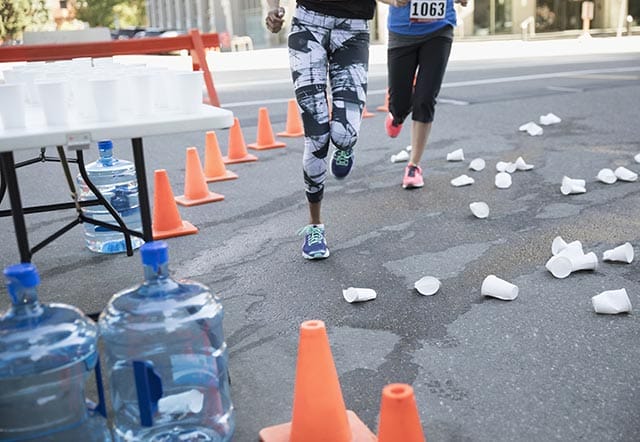
On modern marathons, there are enough points of refreshment and nutrition, and you will not be able to get the strongest dehydration. And if you miss one of the points, the next point will not be that far. In addition, you can always ask for help on the track.
Sports drinks and isotonic
In most cases, if we are talking about amateur running or cycling, then you do not need to use isotonic drugs. The only option is to work for a very long time in extreme heat with profuse sweating. But there is no need for regular consumption of such drinks.
What is isotonic
An isotonic drink is water with electrolyte salts necessary to regulate the acid-base balance in the body. Contains basic salts: potassium, magnesium. Sometimes sodium and calcium.
There is no need to buy isotonics, because they are easily prepared on their own, there are about a thousand recipes on the network. The cost of any sports drink is very high. Presumably, manufacturers use very expensive dyes and flavors.
What is a hypertensive patient
You can also add a bunch of carbohydrates and some vitamins to an isotonic drink. In this case, another type of sports drink is already obtained – hypertensive. It is, in essence, an energy cocktail. You don't need to buy it either. And advanced athletes, of course, prepare it themselves. Mineral water with honey or sugar is actually a hypertensive patient.
The main disadvantage of a hypertonic drink is that, unlike an energy bar or even a banana, it is not always clear how many carbohydrates you just put into the firebox.
All types of sports drinks can be purchased not in ready-made form, but in the form of semi-finished powders, like proteins and gainers. But, again, almost all amateur runners do not need such drinks and can get by with plain clean water. And under heavy loads, make the simplest isotonic from improvised products.
Best options
Simple clean water can be simple and clean only in appearance. But we just don't need a clean one. A certain amount of important salts is desirable for it to be present.
Among the water, too, now you have to carefully choose. For example, the same coca-cola Bonaqua is created from purified water from the central water supply, which is clearly indicated on the bottle. And next to it, on the shelf, there will be a less popular Lipetsk Pump-room at half the price, but from an underground source.
A knowledgeable athlete will choose the second option without hesitation, since natural water from a well containing potassium and magnesium is isotonic. In this case, natural, with a small amount of electrolytes. Another popular budget option is to buy mineral water and release all the gases.
The latter option is good for its simplicity and easily replaces the sports isotonic. But there are mineral water with completely different composition and saturation of microelements, up to medicinal, where their concentration is very high.
Excess salt sometimes correlates with kidney stones, so we do not recommend drinking special isotonic drinks at amateur levels of exercise.
Running tips when you need water?
Of course, it is worthwhile to understand that the supply of fluid will be different for a marathon athlete and a girl who wants to lose weight. If you listen to your body, you can feel the signals that it sends when there is a significant loss of water.
You can drink water while running, but in small sips, distributing it for a certain time.
ATTENTION! A large amount of water drunk while running can negatively affect the work of the heart, as this is an additional burden on this organ.
 It is best to prevent the onset of thirst in advance by taking a couple of sips while running. However, even here there is a contradictory opinion that one should drink only when thirsty.
The only opinion that all the experts agreed on was that you need to drink a little while running, a maximum of 200 ml for every 20 minutes.
Whether or not to take water with you for a run, this issue must be decided based on weather conditions, the duration of the distances and the intensity of sweating.
If an athlete runs in the sun, then the frequency of water intake should be doubled, and sometimes tripled.
However, you should not hold a container with a drink in your hands, it is worthwhile to foresee wearing a special belt where you can fix the water.
It is also worth considering the following fact: if a person, when running a long distance, decided not to drink water, then he can take the first sip after the end of the race only after 40 minutes, when the work of the heart and other organs returns to normal. If, however, during the marathon, liquid was consumed, then after the end of the run, you can drink water in small sips.
Drinking regime depending on climatic conditions
You need to drink in any weather. Only in heat and frost the body's need for water almost doubles, and in damp weather and rain, the feeling of thirst is suppressed. When you run in the cold, it may seem that you sweat less, but in fact, you have significant moisture loss, although you still need more energy than in summer. Therefore, in winter, it is recommended to consume drinks with a carbohydrate content (up to 25%). But in the heat, the proportion is reversed: a sports drink should have a carbohydrate concentration of no more than 7-8%.
When you are at altitude, the risk of dehydration increases due to dry climates, so you may need to change your drinking regime towards more drinking and replenishing carbohydrates.
Self-made drinks
Many experienced athletes do not buy isotonics, but make them on their own for their body. For example, if a very salty sweat comes out while jogging, then you need to replenish the salt balance and drink salted water.
When the energy breaks down, carbohydrates are important and the runner drinks sugary drinks. To do this, dilute 2 tbsp for one liter of water. l. honey. Another recipe is to pour 8 tbsp into 1.5 liters of water. Sahara. Lemon juice is often added to these two recipes. Someone buys ordinary mineral water without gas, which replenishes the loss of liquid and minerals. To secure drinks while running, special belts are available for sale.
It is important to bear in mind that drinking too much water is also harmful. Not only will the stayer find it much harder to run because of the gurgling drinks in the stomach, it can also lead to hyponatremia. It appears when the concentration of sodium in the blood drops below 135 mmol / L and is manifested by dizziness, vomiting, convulsions and even coma.
Fluid for the human body and especially the athlete is a vital element. Therefore, maintaining the water-salt balance within the required limits helps not only achieve better results, recover faster, but also maintain health.
Replenishing losses: water after the finish
Can I drink after intense aerobic exercise? Yes, but not at the finish line. At the end of the run, do not drink immediately, wait until your breathing is completely restored. To replenish your water balance, adhere to the following rules:
- During the 2 hours post-workout, drink approximately 700 ml for every 500 g of weight lost;
- Over the next 6 hours, replenish up to 50% of the lost weight with the appropriate amount of fluid.
The best drinks to drink after exercise are water or green tea. Lemonade, soda, cola are excluded.
After long sessions (1-1.5 hours ), it is appropriate to take isotonic drinks containing carbohydrates, salts and minerals.
If you drink, how much and how often?
As mentioned above, sprinting does not require drinking water. That is, if it lasts up to 40 minutes, you can do without liquid.
 But when running for long distances, you need to take into account the fact that every hour the body loses a certain amount of moisture, which needs to be replenished.
This is done every 15-20 minutes, do not wait until you want five. It is better to take several sips of water in advance, which should not exceed 150-200 ml.
If you drink more, then there will be discomfort in the stomach and it will become difficult to run.
ATTENTION! The calculation of fluid intake during running will also be individual, it is based on the athlete's body weight, his individual characteristics, weather conditions, etc.
Conclusion
Running is a full-fledged physical activity on the body. And it doesn't matter if a beginner is doing it or a professional athlete. Everyone needs to restore their strength in the future, and water helps in this first of all. However, it is necessary to adhere to certain frameworks, the liquid should not be cold, drinking in liters is also prohibited.
Sources used and useful links on the topic: https://WellnessPress.ru/telo/running-and-water/ https://mybegom.com/zdorove/polza-bega/obyazatelna-li-voda-vo-vremya-bega. html https://marathonec.ru/skolko-vodi-pit-begunam/ https://keeprun.ru/nutrition/kogda-pit-vodu-vo-vremya-probezhki.html https://www.cosmo.ru/ health / sport / trenirovalas-i-zamerzla-chto-delat-s-oshchushcheniem-holoda-posle-trenirovki /? from = main_big https://runiron.com/running-hydration/ https://go-fit.online/ blog / sorevnovaniya / travmy-i-sovety-vracha / pite-vo-vremya-bega
Post source: lastici.ru