
How to transport a dog on the subway. Rules for transporting dogs on the subway
Content
Mandatory conditions for transporting dogs on the metro
If we turn to the general rules, then during a trip to the subway, the dog must be in a special container or carrier bag. This requirement is due to the fact that this method of transportation reduces stress for animals, and is a guarantor of safety for passengers in case the dog gets scared and starts behaving aggressively.
This rule is obligatory for everyone, but dogs are not standard creatures. They differ not only in breed, but also in body weight and dimensions. Therefore, let's try to understand this issue in more detail.
Rules for the carriage of animals in electric trains
Small and medium breeds
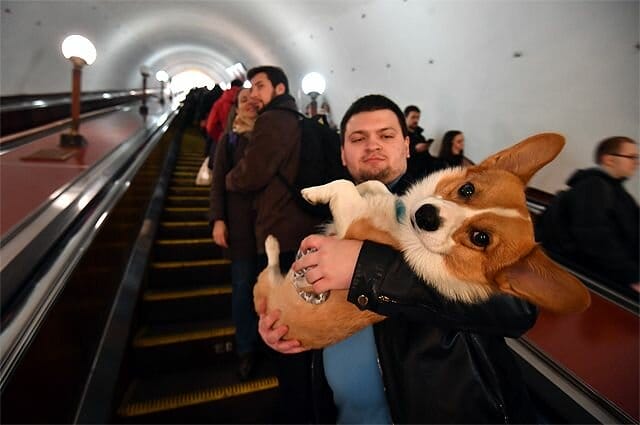
This definition includes dogs whose weight does not exceed 25 kilograms. The breed itself does not matter in this case. Such dogs usually fit into special carriers without any problems. In addition, for very small animals, for example, Chihuahua dogs, the metro workers make an exception, allowing them to be held in their arms while descending / ascending on escalators and passing through stations.
Note that in this case, the owner is fully responsible for the behavior of the animal, including its health. For example, a person neglected this requirement and allowed a small dog to run on a leash on its own. If your pet's foot gets caught in the moving parts of the escalator, you will not be able to sue the metro for causing harm. Most likely, a fine will be issued to the owner of the dog for violating the rules for transporting pets.
Note that transporting dogs by metro is free and paid. The first situation concerns cases when the size of the container or carrying bag exceeds the size of carry-on baggage. The current standard is 120 centimeters in three dimensions: length, height, width. Here it is necessary to clarify that the total value is taken into account. For example:
- The length of the container is 70 cm.
- Height – 30.
- Width – 20.
The total is 120 cm.
If the size of the carry exceeds the established values, the passenger will have to pay for an additional seat by purchasing a separate ticket.
Large breeds
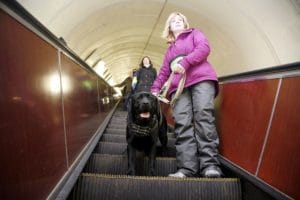
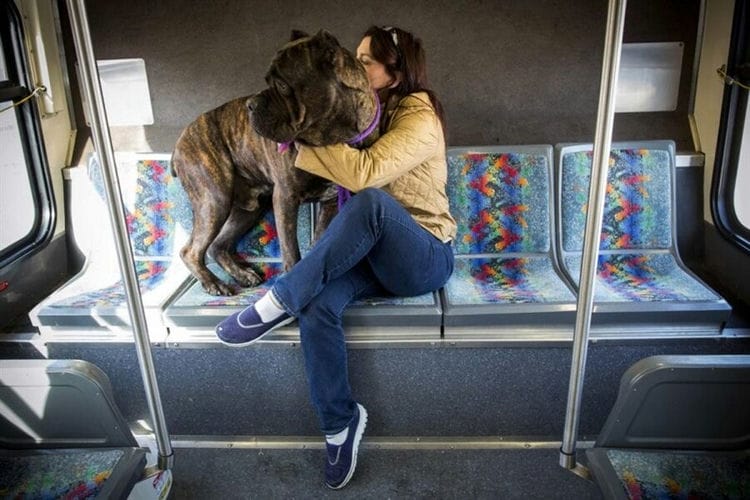
This category includes all dogs that weigh more than 25 kg, and the height at the withers exceeds 50 centimeters. In general, such a dog can also be stuffed into a container and taken with you as luggage. The problem is that pet food manufacturers don't make carriers of this size.
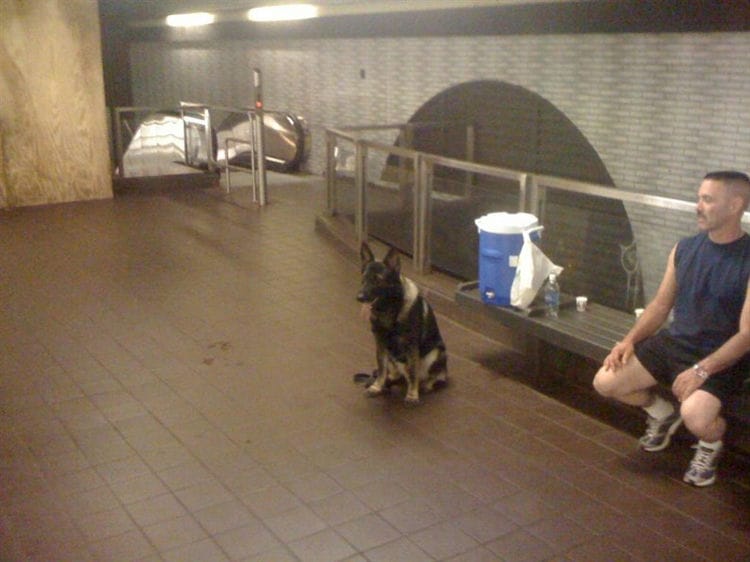
In this case, it will not work officially to take the dog on the subway. Another thing is to come to an agreement with the metro workers. Employees can let a dog on the subway without a container if the following requirements are met:
- The dog is wearing a muzzle, and the owner leads the pet on a short leash.
- The trip does not take place during rush hour when the stations are overloaded with people.
- There are good reasons to transport your dog by subway, for example, to participate in a show.
Here you need to understand that metro workers may not make concessions. It all depends on the specific person. In addition, even if a person with a large dog is allowed into the subway, he can be fined up to 2 minimum wages for violating the rules for transporting animals.
What documentation is required for transportation
- A medical document (veterinary passport) containing information about the vaccinations received.
- Animal health document (reference). You can get it at the state veterinary clinic. It must contain information about vaccinations based on the age of the animal. Important! The mark about rabies – they will look at it first of all, and the time is important – it should be made no more than a year ago, but no later than 2 months before leaving.
- On the territory of the Russian Federation, this is still optional, but if you are going to travel abroad (especially to the countries of the European Union), then it is necessary to put the chip under the skin of the animal in the clinic. For some countries, a readable brand will also work.
Mukhtar, in the bag!
The first step is to buy a bag or carriage. According to the rules, it is necessary to transport dogs of medium and small breeds in the metro.
A friend will not need to buy an additional ticket if it fits into a 120 cm container by the sum of its height, width, and length.
If, adding these three dimensions, you end up with more than 120 cm, then the owner will pay for the transportation of the pet.
Why might you be denied boarding?
Carriers often use the link to the baggage transportation rules, according to which it is not allowed to carry things that dirty other passengers in the cabin. If the dog is wet, with long hair, there is mud or something else outside, then be prepared to refuse, because the dog may begin to dust itself off, jump on the seat and get dirty with its paws. Therefore, when planting, be prepared to wipe the dog, put a bedding in place or put a jumpsuit on it beforehand. The same nuance can be remembered if the dog goes out of necessity in the salon, so in no case do not quarrel with the conductor and the driver, but calmly refer to the law, otherwise there may be a reason to drop you off in the middle of the road.
Non-standard solutions
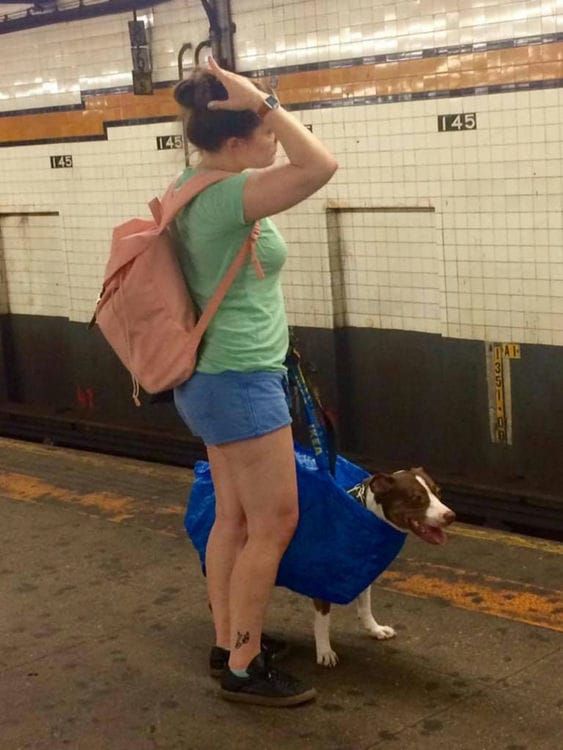
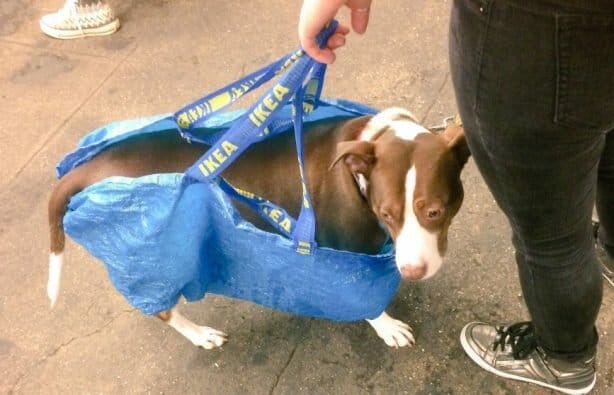
Some owners of large animals have found a way out of a difficult situation. They put a cover on the pet, which looks like a fashionable suit, but in reality is a bag with handles. In front of the escalator, a person lifts the dog, carries it and puts it on a moving mechanism, watches the tail (if it is not docked). When it comes time to get off the escalator, the procedure is repeated – the dog is lifted by the handles and carried to the floor.
A similar option is a dog suit, which turns into a backpack at the right time. Before passing through the turnstile, the owner puts on a backpack with the dog on his shoulders and calmly descends the escalator. You just need to practice in advance so that the passenger in the background is not afraid of the unusual position.
A less successful solution is to illegally transport the dog as baggage. The animal is placed in a large and sturdy bag made of “breathable” fabric and swept past the controllers. However, if the “luggage” moves at the wrong moment, the descent into the subway may be prohibited. There is also a risk that the bag will break or the dog will manage to unzip and break free, frightened by the rumble of trains.
An alternative to a regular bag will be a special container on wheels, which can be found in pet stores or in special online stores. Such transportation resembles a baby stroller. It has a handle, a spacious container and wheels. When using such a container, the rules for transporting children in strollers apply.
Carrying with all the comforts
A dog in a temporary home should be comfortable and safe, it should rise to its full height and turn in different directions.
The carrier must have air access. Fabrics that drown out sounds and do not collect static electricity are suitable.
There should not be any sharp corners in it. For the convenience of the dog, it is better to lay something soft on the bottom.
How to choose the right container for transportation
Riding any public transport and being in a crowd of people is always stressful for the dog. In order for the animal to feel as comfortable as possible and experience a minimum of worries, you need to choose the right bag – a carrier, where the pet can relax and feel protected.
The best option would be a container that meets the following requirements:
- made of high quality non-toxic materials;
- the size of the bag is suitable for the dog so that it can stretch out to its full height or stand in it;
- ventilation holes are on top, access to them is always open;
- does not contain sharp corners or parts that can harm the dog or hook (damage) the clothes of metro passengers;
- it is desirable that the container has good sound insulation.
You can also achieve more or less high-quality soundproofing of the container on your own: lay a blanket or a fabric made of dense materials on the bottom of the carrier. Such a measure will provide not only protection from external noise and a comfortable stay of the pet in a temporary house, but also heat preservation in the cold season.
How do kids ride?
Whether it is possible to take a dog in the metro is determined by the local authorities of cities where there is a metro – Moscow, St. Petersburg, Ufa, Volgograd, Kazan, Novosibirsk, Samara, Krasnoyarsk, etc. However, the rules for small dogs and representatives of large breeds are different.
For example, the rules for transporting dogs in the Moscow metro only allow dogs to travel, which fit into a container bag no more than 150 cm in size. That is, the metro is closed for St. Bernards, German shepherds and other “wolfhounds”.
Important! It is prohibited to carry a pocket dog under the arm. The animal must be in the container.
You will not have to pay for the transportation of the dog if the size of the container does not exceed 120 cm. If the dimensions are 121-150 cm, you need to pay for the travel of a four-legged friend in the same way as for yourself.
Innovations
Since 2016, there are some concessions for travel along the MCC (Moscow Central Circle). To travel for free, the dog must be muzzled and on a leash. Now you don't have to put your pet in an uncomfortable and rather bulky carrier. But this rule applies only to the MCC.
As for large breeds, it is also allowed to carry them in a muzzle and on a leash.
Now what can you answer the question: is it possible with a dog on the subway? It is possible with both small and large. But only at the MCC.
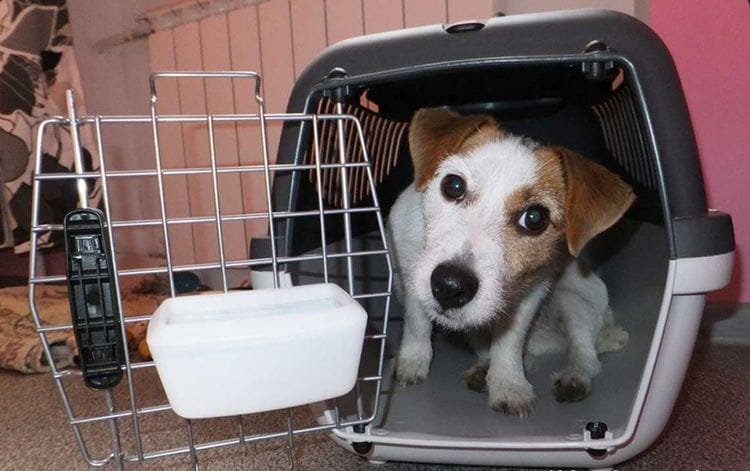
Requirements for containers for transportation
The basic rules are as follows:
- The dog should be as comfortable as possible inside the box. The dimensions should allow her, if desired, to rise and lie, stretched out to her full height.
- The shape of the carrier should be comfortable to carry in the hands, without sharp corners and notches, as well as bulging accessories that could potentially injure the dog or people passing by.
- The material of manufacture should be durable and of high quality, and the structure itself should be as strong and easy to use as possible.
- To ensure sound insulation, a soft mat should be placed on the bottom of the box.
- Make sure that the ventilation openings are always open to the unimpeded access of fresh air.
Alternative solutions

If you can't get your dog on the subway, you can consider other options. In particular, we are talking about buses and trolleybuses. For example, in the ground public transport of Moscow, it is allowed to carry dogs of any size, provided that they do not disturb other passengers. A muzzle and a short leash will help to fulfill this requirement. Small dogs can be transported in containers.
Note that if the pet is in a special box and the owner holds it in his arms, there is no need to purchase an additional ticket. Owners of large breeds will have to pay for their pet's travel at the baggage rate.
The zootaxi service can be singled out separately. Such calls are served by vehicles specially equipped for transporting animals. The dog is in a spacious trunk, so the trip is relatively calm.
It is not recommended to use minibuses for transporting animals. Firstly, there is limited internal space, which creates discomfort for the pet. Secondly, a lot depends on the passengers and the driver, who can express a sharp protest. In this case, you will have to give up the trip or wait for another minibus.
Interesting solutions of the owners
Instead of thinking about whether it is possible to take a dog on the subway or not, some owners find a very specific way out. Well, what can you do if your uncle needs to take the subway, and specifically with the dog? And his pet is not small, for example, a Labrador?
A large bag is taken that can support the weight of the dog. The dog is put in a bag and so transported. The ticket is bought as if it were luggage.
The method, of course, is unusual, but too dangerous. The dog can escape from the bag, frightened by the rumble of trains. Or the bag will not support the weight of the “luggage.” In the end, it is possible that vigilant metro employees will notice the catch and ask the owner to leave the subway with the pet.
Long-distance trains
To travel on long-distance trains, you will have to collect information for your pet.
What you need:
• A letter of vaccination (vaccinations must be made no later than 30 days and no earlier than 12 months before the date of travel) and treatment against ecto- and endoparasites.
• Veterinary certificate No. 1-vet. To obtain this document, it is necessary not earlier than 3 days before departure to visit the veterinarian at the place of residence and present the veterinary passport and the animal for examination.
• To transport the animal by rail, you will also need a baggage ticket.
Small dogs or puppies are allowed with you, but only in special containers. Payment for the carriage of dogs is carried out as for one piece or 20 kg of luggage. Transportation of dogs weighing more than 20 kg. paid according to their actual weight. Dogs are transported either in a container with an accompanying person traveling in the same carriage, or in the inoperative vestibule of the first carriage behind the locomotive (no more than two dogs). It is also possible to carry dogs in a separate compartment (however, no more than two dogs), but only except for luxury carriages. When transporting dogs in a compartment, the owner pays for the entire compartment. Care and feeding is carried out by the owner or an accompanying person.
Only guide dogs are allowed free of charge in wagons of any category on the territory of Russia.
From the “rules for passenger transportation”:
“Carriage of small animals, dogs and birds on trains of all categories is allowed in excess of the established allowance for hand luggage in all cars, except for cars with 2-seater compartments (SV) and luxury cars. In this case, it is necessary to have a veterinary certificate and payment for transportation. Animals are transported in boxes, baskets, cages, containers, which must be placed in places for hand luggage. During transportation, the owners or accompanying persons must observe the sanitary and hygienic regime. “
Note!
- Conditions for the carriage of animals in traffic with Western European countries (except Finland).
It is allowed to bring small pets (cats, birds) as hand luggage if they are transported in special vehicles (boxes).
Dogs are allowed in any class, i.e. in I and II class (but no more than 2 dogs per compartment). The passenger must pay the cost of the ticket and reserved seats according to the number of seats in the compartment, as well as, in addition to transporting a dog, half the cost of a ticket for travel in a second class carriage. - It is forbidden to carry dogs when traveling to Norway, Sweden, Yugoslavia, Croatia, Macedonia, Slovenia or in transit through these countries.
- Dogs of aggressive breeds are prohibited from entering Germany or in transit through Germany.
Dogs are allowed only in direct carriages. - Conditions for transporting animals in traffic with China, Mongolia, Korea and Vietnam.
The passenger has the right to carry small pets with him, unless prohibited by veterinary rules. Animals (cats, birds, etc.) are transported as hand luggage at the rate of 20 kg. a piece.
Dogs are transported for a fee. Transportation of dogs is possible only in class II wagons and no more than 2 dogs per compartment. In this case, it is required to pay the cost of a ticket and reserved seats according to the number of seats in a compartment, as well as additionally for transporting a dog, half the cost of a ticket for travel in a second class carriage.
If the railway does not have the opportunity to provide a separate compartment for transporting animals, such transportation is not allowed.
Who is right?
So who turns out to be right: the metro workers who do not let the dog pass, or the owner of the big dog? If we are talking about driving along the Moscow Central Circle, the owner of the dog is right. In all other cases, according to the rules for transporting dogs in the subway, the employees are right.
However, metro workers admit that they often let large dogs pass. If the owner asks very persistently. But in this case, only the owner is responsible for the life and health of the pet. And in the event of any emergency, he will not be able to make claims against the employees of the subway.
To pay or not to pay?
Now let's figure out in what cases and how much to pay for transporting an animal.
-
If the carrier or the cage is small (120 cm in the sum of three dimensions – length, width, height), it is equivalent to carry-on baggage and you do not need to pay for it. The only caveat is that you have to keep it on your knees.
-
A baggage ticket is required for a large dog riding in the back area.
-
You may also be offered to buy an additional ticket for 50% of the fare. He gives the right to put a cage with an animal in an adjacent place or tie a pet to it on a leash.
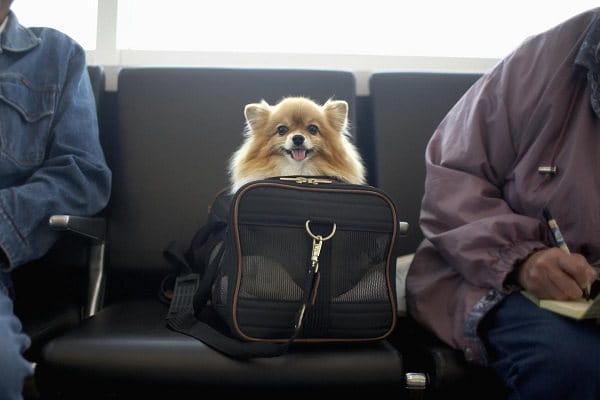 A separate ticket for the price of a child gives your pet the right to a seat on the bus
Where can any dogs be transported on the subway?
The rules for using the Nizhny Novgorod metro allow dogs to be transported in carriages without carrying bags if they are equipped with a collar and muzzle. In the Kazan metro, passengers have the right for a separate fee to travel with dogs, which are muzzled and on a leash, if all conditions are met that exclude the disturbance of passengers.
Hooray! Let's go!
So, all the ordeals with the landing have passed. Can the problem of transporting an animal be considered solved? Not really. On the bus, the owner is obliged to ensure that his ward behaves decently:
- observed sanitary and hygienic requirements;
- did not go to the salon;
- did not cause disturbance by barking (meowing, crowing);
- did not frighten passengers with inappropriate behavior.
In addition, the owner has no right to leave the animal unattended. And then after all, and on the road they can drop off.
And a few tips instead of a conclusion.
If you want to prevent the trip from becoming torture for you and your pet, prepare him for the road. Do not feed for at least 6 hours before traveling. In parking lots, take out (take out) to the street. Ask your veterinarian for prescription drugs for motion sickness, sedatives. Bring diapers and wet wipes.
If a friend is suddenly big and powerful
Large breeds are considered to be dogs heavier than 25 kg with a withers height of more than 50 cm.
Carrying for such pets is not available. And no one will give the owner an official permission to carry a big dog in the metro.
But … You can negotiate with the metro staff to let the dog through the impregnable turntable. In some cases, she will be given the green light
We accustom to transport
They begin to accustom a dog to the noise of vehicles from four months. To do this, periodically walk with your puppy along busy roads. When the baby stops being shy from the noise of the highway, you can go on the first trip. Do not forget about the muzzle, leash and collar – the rules also apply to puppies.
Keep the test drive short. One or two stops are enough. Keep the dog on a short leash slightly behind you to keep it from getting hit during hard braking.
Make sure that the dog does not disturb passengers. A frightened animal may bark or howl. Your task is to calm the poor fellow with a kind word and delicacy. For impressionable pets, it is recommended to purchase diapers before the first trip.

Take your dog on small trips every two to three days, gradually increasing the range. Do not forget to treat your pet with a treat after every successful trip. Let this become your good tradition, but only in those cases when the dog on the bus behaved well.
About transportation of dogs by land transport
The rules allow dogs to be transported in such vehicles on the back platform. Large individuals must be muzzled and on a leash. In this case, the owner of the pet pays for the travel of his pet as baggage. But representatives of small breeds are allowed to be transported in a special container. If its size does not exceed the allowed dimensions of hand luggage (120 cm), then the pet is allowed free of charge. We are talking about transporting dogs on a bus, tram, trolleybus. By the way, cats can be transported in a special carrier according to the same rules.
Experienced dog breeders recommend not to put the container with the animal on the floor, because on the back platform the vibration from movement is always felt much stronger. This can be intimidating for a dog that is forced to travel with the owner of public transport for the first time. And if we are talking about a trip to a veterinary clinic, then the dog receives additional stress, which before vaccination will only aggravate the condition of the animal. Drafts can also walk on the floor. Therefore it is better to hold the container in your hands.
Individual tickets for dogs are sold on suburban trains. Their price is fixed, regardless of the length of the trip.
Owners often have to travel with their dogs on long-distance trains. This type of travel requires a vaccination certificate from the owner, which is done 30 days before the trip. The owner must also have a veterinary certificate No. 1. Such a document must be obtained 3 days before the planned trip at the veterinary clinic at the place of residence, visiting a doctor with a dog and a passport for him. You will also need to buy a baggage ticket for your pet. Only the owners of small dogs, which are transported in a container, up to 120 cm in size, and guide dogs will not need it.
Payment for travel for representatives of medium breeds is carried out as for 20 kg of luggage, for large ones – in accordance with their weight. Some owners, in order not to inconvenience other passengers on the train, carry dogs in the compartment, paying its full cost. But it is not allowed to do this in luxury carriages.
So, in addition to the metro, dogs can be transported by various types of public transport, observing all the requirements and rules.
Subway rules
But in the metro, the transport of animals is allowed only in container transportation. Transporting a dog in the metro in any other way (just on a leash and in a muzzle, for example) is prohibited by the rules of using the metro.
As a matter of fact:
And here it all depends on the case – they may miss it, or they may not. For example, at metro stations where dog shows are held, dogs are most often allowed to pass. At other stations, they have every right not to let you in with your pet.
Recommendations: if you still plan to take your dog to the subway, put it in a box if it is small. If the dog is large, be sure to lead it on a leash with a collar. Beware of escalators! If possible, use the stairs. If not, be sure to take the animal in your arms on the escalator! Unfortunately, there are terrible cases when a dog's paws got stuck on an escalator and other similar situations.
How is transportation regulated?
The legislation is the same for everyone, however, this is exclusively on paper. In ordinary life, everything does not go as smoothly as you want. Difficulties may arise not only when boarding intercity buses, but also on city buses. In this case, it is useful to know that the regulations are the same for both commercial and public transport, and therefore it is recommended to have with you a printout of the existing regulations that apply to transportation in land transport.
It also makes sense to agree in advance with the carrier that the passengers of his bus will be not only a person, but also his pet.
Exceptions
The rules for transporting dogs on the metro do not only apply to guide dogs, which are intended to accompany people with disabilities. The animals are specially trained to “work” in the subway. After training, they have the skills to pass through turnstiles, are able to ride an escalator, and are adapted to the people around them even during rush hours. Passers-by, who are nearby, should remember that it is impossible to distract the dog in the process of performing “official” duties – the life and state of mind of people who need support directly depend on it.
Conclusion
The main purpose of the article is to shed light on the problem of transporting dogs in the subway. These aspects you need to know:
-
Travel on the MCC is allowed for dogs of all breeds. The pet must be on a leash and muzzled. A ticket is also bought for it.
-
As for the rest of the metro, there is a ban on the transport of large breeds of dogs.
-
Small canines must travel in a special container or carrier. Its length and width do not exceed 120 centimeters.
-
In the event that the size of the carrier does not meet the standards, you will have to pay for the pet.
-
The exception is police dogs and guide dogs.
Sources used and useful links on the topic: https://zakonoved.su/pravila-perevozki-sobak-v-metro.html https://VetManol.ru/obuchenie-i-vospitanie/kak-perevezti-shchenka-v-avtobuse .html https://zen.yandex.by/media/id/5e8dd8bef607e2739f216b60/kak-pravilno-perevozit-sobaku-v-metro-5ea0a1eeb6e0833eb9ee91ec https://www.ekzotika.com/sobaki/pravila_perevozki_sobak_avtobusom/ https: // zen .yandex.ru / media / subsidii / kak-proehat-s-liubimoi-sobakoi-v-metro-i-ne-najit-sebe-problem-5c79192b08fe6800b4650890 https://www.belanta.vet/vet-blog/mozhno- sobakoy-metro-pravila / https://FB.ru/article/396972/mojno-li-v-metro-s-sobakoy-nemnogo-o-nabolevshem https://usatiki.ru/mozhno-li-s-sobakoj -v-metro-pravila-perevozki / http://djilda.ru/articles/poleznoe/548-pravila-perevoza-zhivotnykh-raznymi-vidami-transporta.html https://prokamen.com/porody/mozhno-li-s-sobakoj-v-avtobus.html https://aif.ru/society/ptransport/kakih_sobak_mozhno_provozit_v_metro_a_kakih_nelzya https://pitomcy.net/story/kak-perevozit-sobaku-v-metro
Post source: lastici.ru