
Why and to whom to tip. Ethics expert advice. Tip. How much to leave and whether to leave at all?
Why tip
Tipping is the gratitude of the client to the service personnel, expressed financially.
In many countries, tea is left not only in cafes and restaurants, but also in taxis, hotels, beauty salons. In Russia, more often, drivers and delivery workers are given change, permanent manicurists and hairdressers are given gifts on holidays, maids, refuellers are left with a small bill, for example, 100 rubles. Basically, the question of tips arises when it comes to cafes and restaurants: should you tip and how much?
Financially thanking a waiter is not just a sign of good form. Tipping is often a significant part of his earnings.
Employees of establishments can officially receive a very small salary, and they need tips to pay for housing, to buy food. However, in this matter, it is important not to fall into a moral trap: you do not have to just give money to a person for doing his job. But if he does it well, why not thank him. It's a trifle for you, he is pleased.
Sometimes money received from customers in excess of bills is summed up and divided between waiters and other service personnel who do not interact with visitors.
It happens that the service charge is included in the invoice. It is indicated on a separate line, and it is easy to find it on the check. In this case, you do not need to leave additional money. Moreover, if you do not like the service, you can ask to deduct the excess from the check. Remuneration to the waiter is the right, not the obligation of the client, and it is illegal to impose it.
To give or not to give?
Tipping is a reward that is voluntarily given by a visitor to service personnel – waiters, parking attendants, cooks, receptionists, maids …
But there are exceptions to this rule that transfer tips from voluntary donations to mandatory ones. Very often in restaurants, tips include the final bill as a separate line – “10% service charge”.
4 reasons to tip
- In many countries, and Russia is no exception, tips make up half or even most of a waiter's earnings. They are a kind of compensation for the initially low salary. It turns out that the employer deliberately lowers the base rate of the waiter, knowing that he compensates for its insignificance at the expense of tips. Like, try, serve the client better, and you will be rewarded.
But, be that as it may, the tip is the income of the waiter and his livelihood, earned, by the way, by hard work. It's important to keep this in mind when your hand begins to tremble over the restaurant bill.
- In most countries, tipping is a sign of good manners, a sign of courtesy and gratitude for a quality job.
- Some governments levy a separate tax on waiters, bartenders and baristas based on the fact that these professions receive tips. And if they do not leave a tip, it means that they will be deprived of their income, from which they will still pay tax.
Note: in some establishments, the service staff combines all tips and then divides them equally at the end of the working day.
- There is a good sign: for money to come, you need, from time to time, to give it to others. And the tip method isn't the worst option. Agree!
Note: it has been noticed that people who have ever worked in the service sector and know firsthand the hardships of this work, always leave it to tea.
2 reasons against tip
- If the service was, to put it mildly, poor.
Perhaps this is the main argument of the client's unwillingness to leave monetized gratitude to the service personnel.
But, even in this case, you can show noble politeness and tip, nevertheless, to attach to the bill, but not in full.
Advice: in case of noticed omissions in the work of the waiter, you need to give him a chance to correct them by making a comment in a tactful manner.
If the comment did not result in an improvement in service. And rudeness, negligence, sluggishness remained unchanged, it is quite normal for the client to punish such an employee, depriving him of a tip.
Note: sometimes there is no fault of the waiter in the delay in the order or in the cold chop. It is possible that this is a kitchen slip or a mistake of the restaurant manager. Then it would be unfair to completely deprive the tip of the waiter, who turned out to be the last one.
- If the tip is included in the invoice amount.
A separate line in the bill – “For service” – indicates that the tip is already included in it. In this case, the client is not obliged to pay anything in excess of the total amount of the check.
Who is it customary to tip?
Often, the amount left for tea in catering establishments is added to a common “piggy bank” and then divided between all employees
The economic situation in Russia has developed in such a way that many people working in the service sector have a meager official rate. Therefore, their entire main income consists of the sums left by the client as gratitude – tips. This does not only apply to the waiters. You can leave for tea for cloakroom attendants, cleaners, bartenders, cooks, beauty salon masters, taxi drivers, refuellers, car wash workers, etc.
How much to tea
There are no laws that govern how much to leave for tea. Tradition determines the amount of gratitude. So, in Russia, it is customary to leave about 10% of the bill in cafes and restaurants. But this does not mean that the waiter will be upset if you give him more.
10% is a very convenient amount for calculating: no calculators, no sheet of paper and a pen are needed. Just take the number from the check without any characters after the decimal point and remove the last digit from it. For example, you ate 4 500 rubles. Remove zero and get a tip of 450 rubles. Then you went into a trendy coffee shop and left 1,734 rubles there. The tip will be 173 rubles, but the amount is usually rounded – more often, upwards.
However, no one will forbid you to count exactly 173 rubles or leave any other amount.
How to tip
There are only two ways to tip.
1 Cash
Regardless of how you pay – by card or cash, it is appropriate to put the tip in the folder with the invoice after you have paid it. Leave the bills and leave with a clear conscience.
You can also, if you pay in cash, put the amount including the tip in the folder and warn the waiter that you do not need change.
In some places without waiters, tipping jars are at the checkout. If you like the cafe, do not forget to at least sometimes thank the employees.
2 By bank card
You shouldn't count on this method especially: cafes and restaurants offer it extremely rarely. But sometimes you can ask to be charged not only the payment for lunch, but also a certain amount for tea. You call it a number or a percentage.
You can read about such a possibility in the menu or ask the waiter directly.
Method 1 of 3: Determine the Amount
-
![Why and to whom to tip. Ethics expert advice. Tip. How much to leave and whether to leave at all?]()
one
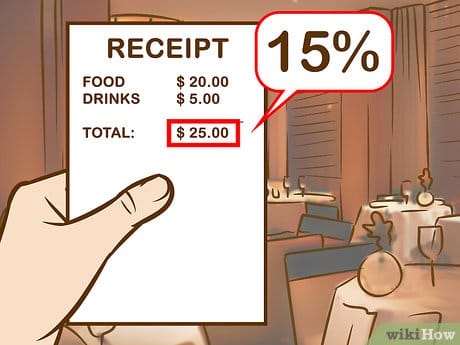
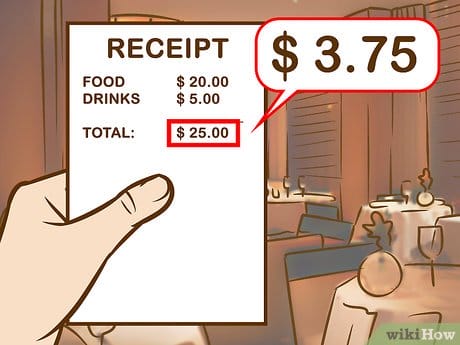
It is customary to tip 15 percent of the invoice amount. The basic tip level for a restaurant is at least 15 percent of the total bill. However, this amount is considered minimal. If you leave an amount less than this, most likely you will offend the waiter.
- Keep in mind that the base 15 percent seems to indicate that the service was ok. If you think the service was great, you should tip more.
- It is worth tipping 20% of the bill if the service was good, 25% if the service was excellent and 30% for perfect service. [1]
- Many people believe that it is worth setting aside a tip of $ 100 per person at the table if this amount is higher than the tip percentage.
-
![Why and to whom to tip. Ethics expert advice. Tip. How much to leave and whether to leave at all?]()
2
To calculate the amount of tips, it is worth using simple math rules. Some people try to calculate how much 15 percent of the bill will be. You can use mathematical equations to determine the amount to tip.
- To calculate the amount, it is enough to draw up a simple mathematical equation. Some suggest rounding off the bill to the nearest R100 before calculating the total tip. [2]
- Move the comma (or decimal point) to the left by the final bill amount – that's 10 percent. So, if your bill is 550 rubles, then 10% of the invoice amount is 55 rubles. To find out how much 15% will be, take half of 55 rubles and add another 55 rubles to it. Thus, 15 percent of the invoice amount is 82.5 rubles.
- To calculate 20% of the total bill, move the decimal point by the bill to the left. Round up. For example, 3584 rubles can be rounded up to 3580. Remember that you need to calculate 10% again, but then double the amount.
-
![Why and to whom to tip. Ethics expert advice. Tip. How much to leave and whether to leave at all?]()
3
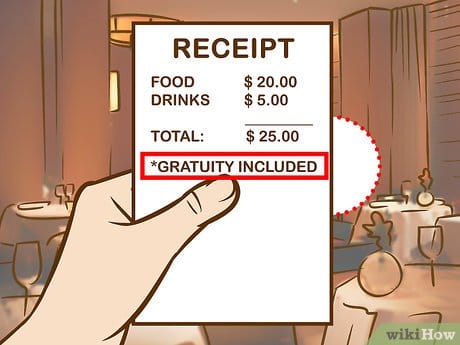
Check if the tip is included in the bill. In some restaurants, tips are included in the bill in advance. In this case, do not leave additional tips.
- Typically, the tip is 15 to 18 percent if it is automatically included in the bill. In some restaurants, a tip is included in the bill when an order is placed for a large group of people. In this case, the menu will say: “tip included”.
- This is due to the fact that even if one or two people do not want to leave a tip, it is unlikely that the waiter will be asked to change the final amount.
- Serving large groups of visitors takes longer and requires more work. Therefore, you need to find out in advance (or check the information on the website) if the tip is included in the bill.
Method 2 of 3: Tip Rules
-
![Why and to whom to tip. Ethics expert advice. Tip. How much to leave and whether to leave at all?]()
one
Leave a tip for other restaurant staff as well. If you were served by more than just your waiter (waitress), it is usually advised to tip other employees as well.
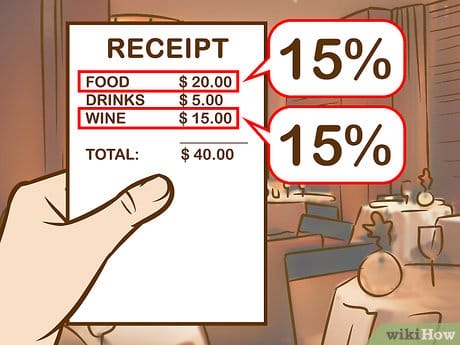
- For example, if you were served by a sommelier, it is customary to leave him 15% of the cost of a bottle of wine.
- You can leave the service personnel 100 rubles or 200 rubles for the parking space that you occupied for lunch. Less tip may be left if the food is served buffet style or if you are only served drinks. But you still need to leave a 10-15% tip.
- Some restaurants have cleaners, you can tip them 50 rubles. You might even want to tip the head waiter or chef. When you buy something over the counter, like your morning coffee, you don't have to leave a tip.
-
![Why and to whom to tip. Ethics expert advice. Tip. How much to leave and whether to leave at all?]()
2
Use the dedicated app. Download the application to your smartphone, which will calculate the tip of the total invoice amount, which you will need to enter.
- Most smartphones are equipped with a calculator function that will allow you to calculate the amount of tips yourself (depending on the amount you are going to leave).
- Various websites can also calculate the tip amount automatically. All you need to do is enter the invoice amount and the percentage of the tip you are going to leave. [3]
- In some cities the sales tax is around 5%. If so, you can multiply the sales tax on the invoice by three to get 15%
- If you are using special discounted coupons, calculate the tip based on how much you would pay for the service without the coupon. Otherwise, your behavior will be regarded as an insult to the restaurant staff.
-
![Why and to whom to tip. Ethics expert advice. Tip. How much to leave and whether to leave at all?]()
3
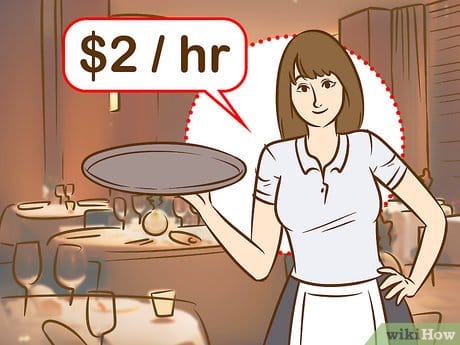
Understand why people tip. Many waiters (and other waiters) live off the tips they leave. The fact that they get a tip is primarily responsible for the low hourly wages.
- For most of the service personnel, it is quite normal to earn a little over 200 rubles an hour before they get a tip. They often earn less than the minimum wage. This amount varies in different cities, but basically the minimum wage for restaurant staff is from 750 to 3000 rubles per day. [4]
- In some establishments, it is customary to combine earned tips at the end of the working day, dividing them equally among all employees.
- You are not required to leave a tip, but you will be ugly towards your waiter if you do not. [5]
-
![Why and to whom to tip. Ethics expert advice. Tip. How much to leave and whether to leave at all?]()
four
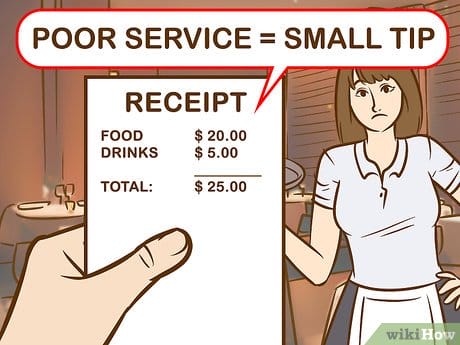
If the service was poor, you can leave very little tip. There is nothing wrong with leaving a small tip if your service was really awful. Don't feel obligated to tip the full amount.
- Try explaining to the waiter first why you didn't like the service so that the waiter could improve. Waiter advice is needed in order to improve the service.
- If the waiter ignored your advice, if he treated you rudely and without respect, served dishes for a very long time, it is quite normal to leave him a small tip. Evaluate whether the dish matched your order, whether the food was hot and fresh, how attentive and friendly the waiter was, how quickly and accurately empty dishes were removed from the table, whether the waiter was polite.
- You may want to explain the lack of tip on the bill when you pay the check by polite tone and constructive suggestions. Some people think that you should still leave at least 10% to the staff, even if the service was poor. [6]
- Try to understand if the poor service was the waiter's fault. For example, perhaps it was in the kitchen that the dish was prepared at the wrong time, perhaps the poor service is the restaurant manager's mistake.
-
![Why and to whom to tip. Ethics expert advice. Tip. How much to leave and whether to leave at all?]()
five
If the service was great, tell your waiter about it. You will definitely cheer him up if you say that he serves not just excellent, but impeccable! Why not let him know about it?
- Write a small note and attach it to the invoice when you pay it, explaining in the note why you enjoyed the service so much.
- Better yet, call the manager and praise the waiter's work.
- Always treat the waiter politely and friendly. The work of the service staff is quite stressful, especially if customers allow themselves to be impolite with the staff!


Method 3 of 3: Tipping in other countries
-
![Why and to whom to tip. Ethics expert advice. Tip. How much to leave and whether to leave at all?]()
one
Make sure tipping is accepted. In most establishments, tips are not only accepted, but also encouraged, because they are part of the staff's earnings. But in some other countries, tipping can be considered offensive or even inappropriate!
- There are a few places where tipping is prohibited. For example, some resorts in the Caribbean do not tip because the service charge is already included in the total bill.
- If you are attending an event that has already been paid for in advance by someone else (for example, if you are at a wedding), it is possible that the tip was paid in advance by the host of the event. [7]
- There is nothing wrong with leaving an extra tip if you can afford it. The staff will most likely appreciate this very much.
-
![Why and to whom to tip. Ethics expert advice. Tip. How much to leave and whether to leave at all?]()
2
Tip with caution in Europe. Europeans have a different attitude to tips than Russians. If in Russia it is customary to leave a tip, then in Europe, more often than not, they are not expected. [8]
- Start by looking at the restaurant menu to see if the tip is included in the bill. If the tip is not included, you can leave a 5-10% tip. In some countries, it would be strange to leave more.
- The difference is that service personnel in Europe are often paid better than in Russia. This means that they do not need tips so much, which is why Europeans treat tips as a pleasant and unexpected bonus.
- It's a good idea to tip the waiter personally rather than leaving it on the table. An additional 12.5% tip can be seen on some London menus.
-
![Why and to whom to tip. Ethics expert advice. Tip. How much to leave and whether to leave at all?]()
3
In other countries, tip wisely. Views on tips differ from country to country. Therefore, before going on a trip, it is important to know in advance the attitude of this culture to tea.
- In the Middle East, tips are prized in small amounts. For example, in Dubai, a 10% fee is charged for service in a restaurant. In Egypt, the tip is simply included in the bill, but you can add another 5-10%.
- In Israel and Jordan, tips are usually included in the bill.
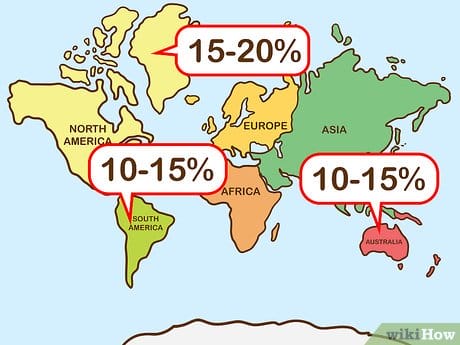
- In Canada (as well as in the USA) it is customary to leave a 10-15% tip.
- In some South American countries, such as Chile, a 10% tip is required by law.
- In Mexico, cash is preferred and the tip is around 10-15%.
- In Australia, it is customary to leave a tip of 10-15%.
-
![Why and to whom to tip. Ethics expert advice. Tip. How much to leave and whether to leave at all?]()
four
Tipping is not available in most Asian countries. In some Asian countries, they are considered a sign of disrespect. Therefore, find information about local tip traditions in advance to make sure your tip is not taken as an insult.
- Tipping is not customary in China, although you can tip at a hotel or restaurant that serves foreigners.
- In Japan, the owner may be offended by your tip – he may take it as a sign that he is not paying the staff well enough.
- However, in some Asian countries, tipping is quite normal. For example, in Thailand, it's nice to leave about 50 rubles ($ 1) for serving a waiter.



Tipping in Turkey
Tipping in Turkey is moderate – within 5-10% of the bill. Above may be a tip in a prestigious restaurant (about 15%, if not already indicated on the bill) when visiting a hammam (15-20%), if you wish – a tip to the guide and the bus driver. For hotel staff, porters and maids, it is appropriate to leave 1–2 dollars as a thank you. Tipping boxes are also common in restaurants and hotels.
Tipping in Cyprus
The common tip in Cyprus is 5-10% of the order value at the discretion of the client. Carefully study the received invoice: the service may already be included in it, and then no additional payment is required. Tipping in hotels is also voluntary: 1-2 euros for the maid and 5 euros for the administrator, and it is advisable to transfer money personally, not everywhere the staff accepts change or bills left on the bed.
Tipping in Thailand
When deciding on a tip in Thailand, you can safely trust your own sympathies and thank only for a well-specified service. Demonstrative generosity is useless, the classic 10% for tea remains the benchmark. Who should you tip? Waiters, maids, porters and hotel administrators, guides, masseurs.
Tipping in Vietnam
There are no customs and rules regarding financial gratitude in Vietnam. “Corridor” for tips – 3-10%, it is appropriate just to pay more than the bill presented. It is advisable to hand over money personally, and not leave it in a conspicuous place in the room.
Tipping in Tunisia
Additional payment for service in Tunisia is optional, but desirable as a token of gratitude to waiters (10%), porters (1 dinar), maids (5 dinars per week), guides (group excursions) and drivers – 3-5 dinars each.
Tipping in Israel
For good service, waiters in Israeli restaurants and cafes will be happy to receive 10-15% over the bill, although tips in the country are mostly voluntary. In some locations, service charges are already included in the bill. A good form for foreigners in taxis is to round up to the nearest shekel. The remuneration for porters, maids, couriers in Israel is from 5 to 10 shekels.
Tipping in Bali
On the popular tourist island of Bali and in Indonesia in general, the size of the tip is very modest by international standards. It should be borne in mind that in Balinese restaurants the surcharge for the service is already included in the bill and is usually up to 5%. It is considered normal to leave the maid $ 0.50 (about 7,000 local rupees) and the porter $ 0.2 per suitcase. Change is left in the taxi.
To whom and how much should I give tea at the hotel?
Hotel porters – $ 1-2 for each suitcase.
Hotel room cleaners – $ 1-2 can be left daily on the dressing table.
It is not necessary for the receptionist at the hotel to give tea, only if you really want to thank a particular person for the excellent work. Nevertheless, in some third world countries (in particular, in inexpensive hotels in Egypt and Turkey), your tip can very favorably influence the decision of the receptionist to give you a better room – in this case, you must give it immediately upon check-in approx. 20 dollars.
In the restaurant
In all-inclusive restaurants, you do not need to leave a tip, however, you can leave a couple of dollars to the distinguished waiter in your eyes to separately thank him for his work.
Waiters in restaurants where you pay for the order are usually left 10% -15% of the order value. However, in some countries the tip is added to your bill by default, so always pay attention to what is written on the check. The size of the tip included is indicated on the SERVICE line.
You can find out whether a tip will be added to the bill either from the waiter or from the menu – usually restaurants indicate all additional fees at the bottom of each menu page.
Also, do not forget that in restaurants, tipping is also an indicator of how satisfied you are with the service and food. Therefore, if a restaurant leaves a tip at your discretion, you have every right to reduce the amount of tip (down to zero) if you did not like the service or food, or, on the contrary, increase the amount of tea if the restaurant exceeded all your expectations.
On excursions
During excursions, it is customary to leave a tip to the drivers (buses / boats / horses / etc.). If the excursion is a group, then it is enough to give from 1 to 3 dollars at your discretion (and your tour guide will most likely remind you of this). If the excursion is individual, then the driver deserves an amount of 5-10 dollars, depending on the type of transport and the duration of the excursion.
It is not necessary to tip the tour guides, but if you really liked your guide, you can safely thank him for his work. Just keep in mind that guides usually make good money, so either tip at least $ 20 or just don't give anything. Believe me, the guide is more likely to be offended by a tip of 1-2 dollars than by its complete absence.
Tipping on the cruise
Tipping on sea cruises usually means a service fee, which is mandatory for most international companies: it is counted by day, and can be debited both daily and on the last day of the cruise, or paid in cash (optional). Since tips can be a significant amount even in comparison with the cost of the cruise, you need to clarify the conditions for their accrual in advance.
At the end of the cruise, you can opt out of paying the tip by filling out an application at the reception. However, to do this, you will need to indicate what exactly in the service did not suit you. Since the service on cruise ships is generally high, passenger tip refusals are minimal and considered bad form.
Tipping a food delivery courier?
What about a food delivery courier? There is no such full-fledged practice in Russia. It all depends on the personal desire of the person. Yet we do not live in America. Where, for any meal, it is customary to leave 20% for tea. And try not to do this – at least they will make a remark to you. And it will be very lucky if – in the correct form.
“Initial” customs of different countries
In developing countries, tips are the main source of income for a waiter. Therefore, the visitor to the bar will definitely be reminded of the need to pay extra. So, tip is very much awaited in Morocco, Egypt, Turkey, Namibia, South Africa, Tanzania, Tunisia, Cuba.
Bakshish on bakshish and bakshish drive
In advanced economies, people are very practical, and therefore leave mostly small coins or round the check to the nearest whole. Such a gesture is a sign of good form.
In general, it is not customary to thank money in Germany, Iceland, Switzerland, New Zealand, Sweden, Estonia, Japan, Australia, Iceland, Norway, Denmark, Finland and Great Britain. The waiters will not refuse to take the money, although they will be sincerely surprised. Russian and American tourists, not knowing this, always leave “for tea”.
Tipping may also be irrelevant due to the high enough average salary in the industry or if the service charge is already included in the check. This phenomenon is common in countries such as Belgium, Australia, El Salvador, Costa Rica, Denmark, Switzerland, Finland, Norway, etc.
Everything is individual
Customs may vary within one state. In France, for example, tips are only accepted in Paris (usually they are included in the bill). However, if you don't like the service, you don't have to pay. A dissatisfied guest can leave only half a tip or a coin. In other French cities, it is not customary to overpay for services.
There are exceptions – in New Zealand, the salary of service personnel is quite high and does not depend on tips. But companies save money on students who get a job, so tips for them become the main source of income.
Life hack for tourists in Italy: tips are included in the bill only for visitors at the tables. Therefore, those sitting at the bar usually spend a third less.
Where to tip is bad taste
Tipping is prohibited in China, Japan and Hong Kong. In China, there is no concept of tip at all. Leaving money is rude, an offense. The Chinese are thrifty and always pay exactly according to the bill!
The Japanese, on the other hand, consider tip an absurdity, an insult, meaning that the service was poor. You can only thank them with a souvenir or talisman. The money left on the table will be returned if they manage to catch up.
Likewise in an English bar: a tip on the bar is a sign of bad taste. But a satisfied guest has the right to treat the bartender with a drink at his own expense or just have a friendly conversation with him.
The largest tip in the United States, depending on the state, is up to 18-20% of the check amount
Giving is a duty
In the United States, tip is paid for all services – to porters, masseurs, concierges, electric car drivers, taxi drivers, dry cleaning workers, etc. Waiters are left 15% of the check (10% for slow, 20% for excellent work), regardless of level institutions.
Was the service awful? Don't pay, just warn the administrator about it. For “forgetfulness” can be sued.
Social Psychologist Dr. Michael Lynn (USA): “People tip mainly to avoid disapproval. In 96% of cases, wanting to appear polite, they do not associate the amount of remuneration with the quality of service at all. And many, moreover, subconsciously strive in this way to get rid of the feeling of guilt for being served … “
In Russia, tip in the shade
Tipping does not exist in the Russian legal field. Therefore, the law does not officially permit the inclusion of a service charge in the check. “Tea” is left voluntarily, expressing gratitude for the quality of the service provided. More often – in catering establishments. And usually every second or third visitor does this.
- In restaurants and bars with high quality service, the tip is + 10% on the bill.
- In coffee shops, cafes – round the bill up, throwing about 50 rubles.
Representatives of other professions are not ignored either. Drivers, taxi drivers, couriers of delivery services are given change. Manicurists and hairdressers are presented with gifts for the holidays. Hotel employees, maids and gas station workers are given small bills – for example, 100-ruble.
How to tip when there is no cash
Even if a guest pays for a restaurant bill by card, it is customary to give tea anyway in cash. There are few places where you can list tips by bank transfer. You can ask to drive the amount of remuneration into the check, but the institution has the right to refuse. In this case, it is especially convenient to use the 2tip.ru service. Any employee of the service sector can register in the system and receive a unique QR code. It can be printed on a business card or sticker and unobtrusively offered to a client who can safely translate a tip in gratitude for a well-rendered service.
Tipping as a reason for scandal
In many countries, tipping is a must and must be left, even to the point of scandals. In 2004, in New Jersey, a man was arrested for failing to pay a tip at the Sopranoʼs Grill. As a result, the judge decided that the person was detained illegally, because the tip is a voluntary gratitude, if the check does not say that it is a mandatory service fee. In general, in New York, for example, this is a painful and complex process when you come and look at the price, add sales tax in your mind and calculate 18 percent, count the change in your pocket and, God forbid, you miscalculated and left a little less for you. are already running with the words: “What's wrong?”
The great Danny Meyer, restaurateur extraordinaire, the man who invented Gramercy Tavern, Eleven Madison Park and Shake Shack, a significant player in the New York restaurant scene, tells in his interviews how he repeatedly saw sobbing waitresses who worked all evening for a large group of Germans who left and left no tip because it didn't occur to them. Simply because the Germans or the Japanese are not used to tips. In Japan, the highest degree of offense is to leave money on the table. This implies that you were poorly served.
The oblique tip economy
The tip system creates an unnatural economy. The restaurant bought food, prepared it, spent energy, sold the food to the consumer, who first paid for it, and then suddenly paid a separate tip. This is an extremely annoying factor for me. Because the question arises: does this employee work for me or for himself? In general, the main imbalance lies in the fact that it is not clear who works for whom and who pays whom. In theory, the restaurant would have to pay in full for the work of the employees, and the consumer should pay the bill to the restaurant. There should be no additional payments.
I remember well the times when they said: “Your waiter will come up now”, and you were latently waiting for service from a certain “your” person. How did he get me as a consumer? Fifteen years ago, in restaurants, almost fights broke out when a company of pot-bellied people in good suits came in, and the waiters began to push their elbows behind them, they divided tables by lot: this table is good, that is bad. This was all too often and monstrously corrupt the waiters, because they stopped thinking about the restaurant altogether. They only thought about how to sell the most expensive dish and get the maximum profit.
It is highly unnatural to calculate the price of a service as a percentage of the value of the product. You spend as much effort on serving a steak as on serving chips: take it and bring it. The essence of the sale is exactly the same. We tried to work differently at Delicatessen. We spent two years in a regime where all the tips were taken to the cashier and then shared as a bonus between the employees. As a result, they still had to increase the fractionality of this distribution, because the system so far is such that most of the waiters come to work with the “we live one day” complex: this week it’s earned, next week we’ll see what happens.
In addition to the “oblique” economy, tips as an institution create quite serious inequality and provoke a kind of discrimination. It is known that pretty girls get more tips than the unsympathetic young man. And that doesn't mean they sell better or serve better. And preference is given to people of a certain skin color or nationality.
How to determine the tip size?

The question does not have an unambiguous answer, because we are talking about remuneration, the amount of which is not stipulated by law.
Tip size is usually influenced by 4 factors.
- Quality of service.
- The status of the institution is an ordinary cafe, an elite restaurant, etc.
- The personal opinion of the visitor – whether he is in the mood or not, stingy or generous …
- The size of the check is a daily lunch for 500 rubles or a festive banquet for 100 people.
Important: in Russia, it is customary in restaurants to tip 15% of the total bill. Moreover, this is considered the minimum “tip rate”. Everything below it looks like the client's dissatisfaction with the service and is a “stone in the garden” of the waiter, in most cases, very painful.
If the client is satisfied with the service, then the waiter has the right to expect a more generous reward from him – 20% -30%.
In the case of small companies, for example, of 4-6 people, there is a practice when everyone gives a tip of 100 rubles. But! It does not look stingy only if the amount received is higher than 15% of the invoice.
4 ways: how to calculate 15 percent?
- The way is mathematical
Without scaring a relaxed restaurant customer with mathematical equations, we offer a simplified way of calculating 15%.
We round off the total amount of the account, removing pennies and other minor “inconveniences” for the account from it. For example, we turn 1403 rubles into 1400.
Find out how much 10% of this amount will be – shift the comma to the left by one digit. So, 10% of 1400 will be 140 rubles.
We calculate the remaining 5 percent – divide 140 by 2, we get 70 and add it to 140 (10%).
In such a simple way, we get 210 rubles – 15% of 1400 – the average tip.
If the amount seems “frivolous”, and the service is more than satisfactory for you, you can leave 20% to a good waiter. To do this, 10% is doubled: 140 and 140, it turns out 280 rubles. Round up to 300 and add a grateful smile to the bill. Be sure that in return you will receive an equally grateful smile from a satisfied waiter.
- Automatic method
Before embarking on mathematical calculations, you need to check the account. Many restaurants today include tips in the grand total. By paying such an invoice, the client automatically makes his grateful financial contribution for the service.
Note: this practice is also used by restaurants when serving large events and feasts with a large number of participants. This is done to eliminate misunderstandings when paying a bill when customers are not unanimous about tips.
- Electronic method
There are dedicated smartphone apps and websites to help you calculate your tip percentage. To use them at the right time, you need to download the application to your phone in advance, and connect the Internet to access the site.
In addition, all modern telephones have a calculator function, with the help of which any percentage of any amount can be easily calculated.
- Tax method
It is only valid if the city where the restaurant is located is subject to sales tax. It is 5% and is indicated on the invoice. With its help, it is easy to calculate a 15% tip by multiplying the tax amount by three.
Tip: when calculating tips, the percentage is taken from the net amount – no discounts or bonuses. Otherwise, gratitude for the service will look like an insult.
How do the waiters divide the tea?
In the city, I came across two models for dividing tea – a common pot and personal tea. The common cauldron is quite clear to everyone: tea is thrown off in one place, then in the evening it is divided in certain proportions into a hall, a kitchen and ancillary staff. This model is acceptable only at the initial stage of the establishment's work, when guests are still looking closely and do not visit a new place much. After a couple of weeks of work, you need to change the model immediately.
In essence, tips should be individual, because the guest leaves gratitude to the very person who served him, someone else plays little role here, a good waiter, even with a lousy dish for 200 rubles, can get 500 for tea. As for the kitchen workers, technical staff and managers, in the case of personal tea, either the waiter himself shares at his discretion, or they enter a “bribe.” The amount of the obligatory payment is set individually for each institution, for example, 100 rubles. This amount is transferred to the administrator from each waiter and at the end of the month he divides it into everyone who works in a restaurant or cafe and does not actually receive tea.
Guests don't leave tea
Guests do not like to leave tea. It is a fact. According to statistics, recently people are increasingly going to establishments. They try to spend any major holidays in a restaurant or cafe, so as not to suffer with dishes and cooking. It is very convenient when they do it for you. The local consumer loves to fit in with the low cost and also bring their own alcohol. But I'll talk about this a little lower, now about the general trend.
In general, people are not ready to leave a tip with us, for some reason, some of them believe that this is not necessary, because the waiter already receives a salary, but I have already described above that tea is the main part of the salary.

“Your rights, sir”: the guest is not always right
How to Become a Good Waiter?
A guest arriving at an institution mistakenly believes that he is the most important character in the whole process and must be provided with perfect service. The minimum set of services that are spelled out in the legislation can provide, but this will be an option for a dining room, but if a guest comes to a restaurant, then he wants something more than just getting food, he wants an appropriate attitude towards himself, and in fact this is same service.
People do not understand the very basics of catering, they do not understand that they are visiting the team and the only thing they have the right to demand is that they be given a product of proper quality and not violate the consumer protection law, where it is not specified that you should smile. But in order to get the atmosphere, so that you are accepted as dear guests and wanted to see again, meeting each time with a smile, you need to be grateful. Nobody thinks about it.
Photo: fb.com/ostrovcafe
Naturally, if a plate flopped on the table and did not go to your table even once, then you can not thank, but if one waiter served you all evening, smiled, told fascinating stories, changed plates on time, poured wine, indulged your whims, in in general, he created all the conditions for raising your mood, on the wave of which you then write an amazing review, with a bill of 5-6 thousand rubles, leaving 200 is not right, because be sure that next time this waiter and everyone else in the institution will treat you very differently. And if the guest likes to leave zero tea with enviable regularity, then the whole catering will soon find out about this. Believe me, every city has its own blacklist of guests and Sevastopol is no exception, both the staff and the owners know all the outstanding ones.
It is especially exciting when banquets, which I wrote about above, are held. When several people serve you for several hours, you are sitting with your alcohol, which has turned you from just a company into an intrusive and rather restless, you simply have to leave the tea. And you should immediately understand that even if your bill is 100 thousand rubles, the tea should be appropriate, and I'm not talking about one thousand
There are many reasons for the lack of culture, from ignorance of the guest to lack of money. Moreover, tea is not left not only in public catering. Almost all the taxi drivers with whom I spoke say that they do not leave tips, only occasionally throw off a change. And we are not talking about would-be drivers. This culture has not infiltrated the hospitality industry. Small hotels rarely receive tips from guests, and even in large hotels this does not always happen. Tipping is also not given to couriers of delivery services, even if he brings the order much earlier.
I believe that the culture of tips will appear only when our guests finally learn how to go to establishments, when the guest begins to understand that he is not just called a guest, when it’s not clear where the “we should” disappear from provincial heads and be replaced by awareness the very concept of “mutual respect”.
Start by including a tip every time you go to the establishment and plan to spend.
How to accept a tip correctly
After serving your guests well in a restaurant, you need to calculate them correctly. By the way, a note about service, I recommend that you study:
Basic rules for serving guests
When asked for an invoice, you need to fill it out beautifully (no mistakes, deletions and dirt) and serve to the guests. As a rule, the invoice is submitted to the guest who asked for the check. If you do not know who exactly asked for the check, then the folder or book with the account should be placed in the middle of the table.
After that, you need to watch the guests from the side, and when the money is deposited to you, come up and, with the permission of the guests, take a book with money. If you are given an account with money, they say “Thank you!”, Then the change can not be attributed.
If you put the money in and did not say anything, then you are obliged to take out the change on the account. There is no need to play hide and seek with guests after you have taken the money from the account and there is more money than you need. If visitors want to thank you, they will do it, and if they intend to take every penny, then they will.
Moreover, when you take out the change, then put it on the table with a smile and with words of gratitude to the guests. There is no need to bow or kiss your hands, as in tsarist times, you just need to say “Thank you!”
If the guests immediately put money in your account with a tip, then all the more you need to come up and thank you for the reward.
If you want to teach too greedy visitors a lesson, give them change, but this is unlikely to help. As I already wrote at the beginning of the article, if a person is among the 20-25% of guests who don’t give money to the waiter in principle, then there’s nothing you can do about it. The visitor has settled on the account, you no longer have the right to demand from him.
You can be as nervous as you want, spit saliva, freak out if you have not left a tip, but this will not help you. It is necessary to endure the change and see the guests with dignity. Accept the fact that not all people give generous tips and you do not need to wait 10-15% from each table on top of the bill. It's much nicer when generous tips are given by guests from whom you don't expect it, right? Surely, each of you had such cases.
How to tip properly – tip rules
There is nothing unnatural in tipping a person who has served you well. Another question – if the service was, to put it mildly, far from ideal. Here you can give the very minimum of what is required. So you will show that you know about the rules, but the waiter (or other employee) did not deserve more.
- The usual tip size is the smallest denomination in the country. In the case of Russia, this is 10 rubles.
- If the order amount exceeds 100 rubles, the tip is usually equal to 10 percent of the order. But in Russia it may be 5 percent.
- The porter at the hotel should get 1-2 dollars for moving one of your suitcase. Money can be put into his hands.
- As for the tip for the maid, you may not even intersect with her. So just leave your money in bed. You should not leave a tip on the table: if the maid is conscientious, she will not take it (what if you forgot this money?).
- It is not customary to leave large tips in bars. But you can give 10 percent of your order amount or not take the change you gave for change.
Does the waiter have to serve every guest well, whether tipped or not?
As stated above, some countries believe that any job should be done well at no extra cost. And rightly so, because doctors or builders do not get a tip for doing an MRI better than in another hospital, or building a house of better quality than others. However, the service sector is a completely different area of business, and it has its own rules. “Tipping” appeared a long time ago, it is an unwritten rule that has become established in the heads of many people, and therefore it is difficult to ignore this phenomenon.
But at the same time, tip is not an obligation. Official legislation does not restrict either customers in rewarding or waiters in receiving additional money for service. Since this contradiction is difficult to lead to an unambiguous solution, it is necessary to act the way you want.
– Yes, I believe that a waiter, like anyone who strives to become a professional in his field, should work a priori without additional incentives. However, the waiter must understand that his efforts have a rare opportunity to be rewarded literally immediately. Believe me, this knowledge is an excellent incentive. Those who have worked in line positions in a restaurant will understand me. Personally, my record of tips as a bartender per day in a well-known entertainment complex in Odessa in the late 90s was a dozen average monthly salaries. For the sake of this, we treated the Guests very attentively and respectfully, – says Alexey Noskov.
Do I need to tip at business lunches?
Since the format of a business lunch implies a relatively small fixed payment (as a rule, it is 250-350 rubles), the issue of tips is very relevant in this case. 10% of the check for a business lunch is equal to 25-35 rubles, which in our time can only be given in a trifle. The amount is not so large, it will seem more like an insult than a gratitude for the good service. The same rule will apply here as with a regular dinner in a restaurant – pay as you see fit. Dinner was brought quickly and hot, quickly calculated and even given “chewing gum”? You can leave 50-100 rubles and leave with a clear conscience. Was bad? Ate quickly and left – and next time look for another place.
It is one thing when the waiter only brings food and ensures a comfortable stay in the establishment, it is another thing when the bartender prepares drinks, serves and accepts money, and communicates. However, the approach to tips is the same: 10-15% of the order, if the bartender served quickly, served correctly and heard about the next problems, as is usually shown in films.
We asked Kirill Tkachenko, a former bartender from The Lost Society, about how much he received tips in relation to the official salary:
– It all depends on the season. In summer, salary prevails over tip, in winter it's the other way around. Guests more often come to warm up with strong drinks and sit down at the bar, and, accordingly, can already reward you with a tip for the work done. Or tip for a good dialogue. Spring and autumn are almost always 50-50, says Kirill.
There is such a belief that the bartender will serve faster than the one who gives the most tips. In fact, it happens in different ways:
“It didn't really affect me, everything was done in turn, everyone was served the same, always tried to work as quickly as possible, and did not forget to monitor the quality of service and preparation,” replied Kirill, the bartender.
Here, again, everything depends both on the country and the institution in general, and on the bartender in particular: in the USA there is such a practice, since there are usually a lot of visitors, and first of all, those who pay are served. We do not have a developed culture of tips, so it is stupid to hope that the client will give money for the speed of serving the drink. This is the mentality. Remember yourself: “if the bartender works, then let him do it equally well for everyone.”
Are waiters offended when they don't leave a tip?
All the waiters we interviewed answered roughly the same: “you get used to it.” Again, in our country, tips are more of a rarity than a rule. And many do not know how to do this, although there is a desire. The most frequent wish from the waiters is: “There is no need to turn a tip into a manifestation of Christ to the people.” I wanted to thank with money – left as much as needed, thanked and left. If you want, but you can't – said “thank you” and left. And once again to arrange a circus and ask for the laurels of a generous donor is not worth it. This offends both the waiter and the establishment as a whole. Therefore, there is no better gratitude than respect for the work of any person, regardless of social status or well-being.
Conclusion
How much to tip in a restaurant, everyone decides for himself, depending on many factors. You just need to be a person and understand that everyone earns their own way and if it is customary to leave a tip for a waiter for good service, then you need to do it. As a rule, people who work or have worked previously in the service sector will always leave money in excess of what is indicated on the check.
There is also a good rule that in order for money to come to you, you must sometimes part with it, giving it to others.
Sources used and useful links on the topic: https://Lifehacker.ru/chaevye/ https://eventmarket.ru/chaevyie-v-restorane-po-pravilam-davat-ili-ne-davat/ https: // 2tip. ru / blog / kak-pravilno-ostavlyat-chaevie https://ru.wikihow.com/%D0%B4%D0%B0%D0%B2%D0%B0%D1%82%D1%8C-%D1%87 % D0% B0% D0% B5% D0% B2% D1% 8B% D0% B5-% D0% B2-% D1% 80% D0% B5% D1% 81% D1% 82% D0% BE% D1% 80 % D0% B0% D0% BD% D0% B5 https://www.tourister.ru/tips/4735 https://summer-life.com/2015/06/kak-pravil-no-davat-chaevy-e / https://cultura.menu/kultura/chto-my-ne-znaem-i-boyalis-sprosit/kak-pravilno-davat-chaevye/ https://sweet-express.ru/blog/kak-pravilno-davat -chaevye / https://daily.afisha.ru/eating/4834-vse-o-chaevyh-pravila-proishozhdenie-i-vozmozhnaya-revolyuciya/ https://zen.yandex.ru/media/id/5bfc55367d716900aa72e506/chto-takoe-chaevye-i-pochemu-ih-ne-ostavliaiut-5f15b378ea5e8d6686183cb9 https://oficianty.com/chaevyje.html https: // www. colady.ru/gde-v-rossii-prinyato-ostavlyat-chaevye-i-kak-ix-pravilno-davat.html https://ChelRestoran.ru/materials/reviews/11-aktualnykh-voprosov-o-chaevykh-kak -skolko-i-zachem-davat-za-obsluzhivanie /
Post source: lastici.ru