
Sports calves: how to build calf muscles at home. We swing the calf muscles on our own at home.
Anatomy
Calf consists of two large muscles – soleus and gastrocnemius. The calf muscles are visible, as they are located high, just below the knee. They are responsible for raising the heels from a standing position. The soleus muscles are located deep in the lower leg under the calf muscles. It is necessary to raise the body from a sitting position. It is these two muscles that need to be trained in order to get a beautiful calf shape.
Genetics
There are two main types of muscle fibers:
- Slow fibers. They have lower growth potential and strength, but are resistant to fatigue.
- Fast fibers. They have much higher potential for growth and power output, but tire quickly.
Research shows that the composition of the muscle fibers in the gastrocnemius muscle can vary significantly from person to person. For example, some people have 60% fast fibers, while others have only 15%. People in the first group will find it easy to add mass to their muscles (they may not even need to worry about training their calves separately), while people in the second group will not be able to quickly pump up their calves, they will have to fight with all their might for every millimeter. progress. However, do not despair: with proper nutrition and training, everyone can achieve results. It's just that some take longer than others.
The role of genetics in the development of the calf muscles
I think you know these people with massive, beautifully shaped calves who rarely train them. While you train three times a week and still see minimal results. What's the matter?
“Genetics play a role in the shape and size of your muscles due to the distribution of type 1 and type 2 muscle fibers. While type 1 is more responsible for endurance, it has less growth potential than type 2 muscle fibers – providing explosive strength and more intense growth in volume. All people have a different percentage of type 1 and type 2 fibers. This means “someone with a genetically dominant type 2 can build muscle better and faster than people with a dominant type 1,” says Cody.
Even if by nature you have very small calves, you should not worry. “Genetic predisposition does not block your path to strong and beautiful calves. You just need to work harder to achieve results, “says Brown. The
right workout and diet will help you build strong, beautiful athletic calves, no matter where you start.
Based on this, I recommend that you create the following training regimen:
- 3 workouts per week (between workouts at least 1 day of rest)
- Exercises to perform in 6 approaches
- In the first set, pull the socks of your feet forward, in the second – tilt towards yourself at an angle of 20 degrees, in the third – tilt more towards yourself. For the remaining 3 sets, repeat the sequence.
- Use the “2-1-2” method: 2 is the number of seconds it takes to complete the exercise, 1 is the pause (1 second), and 2 is the number of seconds it takes to return to the starting position.
- Add weight as you exercise.
Workout A
Rest 2-3 minutes between sets
- Standing Calf Raises – 3 sets of 10-12 reps
- Seated Calf Raises – 3 sets of 10-12 reps
Workout B
Rest 1-2 minutes between sets
- Leg press – 3 x 12-14
- Calf raises with additional weights – 3 x 12-14
Workout C
Rest 1 minute between sets
- Standing Calf Raises – 3 x 14-18
- Seated Calf Raises – 3 x 14-18
Simple enough. For example, I do workout A on Monday, workout B on Wednesday, and workout C on Friday.
It is very important to follow your training plan completely. If you feel sorry for yourself, reducing the number of repetitions, then the effect of training will be low.
You also need to do the exercises correctly. Here is the ideal form of execution: when lifting, strain the muscles, until painful sensations in the lower leg, and also rise as high as possible; when lowering – also keep the muscles in tension.
Some novice bodybuilders prefer to use heavier weights when exercising, they find that this is how they increase the intensity. But they do not take into account that, due to the weight of the weights, they cannot be lifted onto the socks with the maximum height. And then they are surprised and upset why they do not grow caviar. Don't make this mistake!
Why do they pump caviar
- if these muscles are inflated, then it looks very beautiful not only in men, but also in women;
- if you regularly visit the gym or work out at home, then you need to strive for the proportional size of the muscles of your body, in other words, for a balanced result, otherwise the inflated torso and gluteal muscles will look funny and ridiculous on thin legs.
In time, such training should be given once or twice a week. After all, it is quite difficult to pump up the calf muscles, tk. they are put under stress every day when walking. Therefore, you must perform exercises for the calves to victory, remembering that you must do the last approaches with as much effort as possible, perhaps even through pain, in order to achieve the desired result.
Quite often, coaches hear the question: “Is it possible to pump caviar every day?” In general, such a training plan does not prohibit doing calf exercises every day, but knowledgeable athletes do not recommend doing this. As we wrote above, calves are already subjected to daily stress, so you should not force your muscles.
Yes, and even in a month, your legs will not become ideal from the frequency and number of approaches, because muscle growth takes only its own, as much as needed, the rest is a waste of time, effort and energy.
How to properly swing your calves – your coach will explain in detail to you, but we also decided to touch on this topic.
Immediately, we draw your attention to the fact that you will not see the result soon, pumping up the calf muscles is a difficult and long-term business. Although, according to some athletes, it is a little easier for a girl to pump up her calves, because she walks in heels, and this is a double load on the muscles, i.e. some kind of start for their growth is present.
General principles
Guided by the basics, you can quickly build calves both at home and in the gym.
- Before any workout, muscles require warming up and stretching. Warming up the calf muscles is quite simple with a massage. After warming up, stretch your ankles (sitting and standing) and toes.
- Calf exercises can be performed on any training day, but it is better to include them at the end of the leg workout complex.
- Start by working out the soleus, and then move on to exercises to work out the calf muscles.
- 20 minutes is enough to train the calf muscles. This is 3-4 sets of 15-20 repetitions. Focus on caviar 2-3 times a week.
- In exercises for working out the muscles of the dorsal surface of the legs, the main thing is not speed, but the maximum possible amplitude.
- Take a short pause at the top of the amplitude.
- To increase the load, do exercises with weights; on one leg, then on the other
- Place your feet parallel with your toes or heels together. Different positions of the feet will provide a comprehensive study of all muscle bundles. But when working with heavy weights, keep your feet parallel, this will save you from injury to the tendon.
- No amount of intense workout will work if you don't adjust your diet. Eat the required amount of protein (2.0 g per kg of body weight per day), which will go towards building muscle mass.
Calf exercises, are they needed?

There is an opinion among athletes that you should not bother too much with calves (as well as with the press). That if you do enough squats and deadlifts every day, that's enough. I disagree with this.
You are lucky if you have powerful calves from birth. Then you only need to maintain their shape so that there are the necessary proportions with the hips and arms. And if you, like me, have weak and loose calf muscles (and squats with deadlifts here turned out to be powerless), then you have to work long and hard. But it's worth it.
Since we started talking about genetics, then you probably wondered why some people do not grow caviar, despite all their efforts and unthinkable loads, while others do not even need to do something purposefully for their growth.
The answer to this question lies in the composition and structure of the muscle fibers of the calves.
There are two main muscle groups: type 1 is known as “slow” fibers, and type 2 as “fast twitch” fibers.
- Type 1 has a rather low potential for growth and accumulation of strength, but they are unusually dense in structure, have a large number of capillaries, rich in mitochondria and myoglobin. This makes this type of muscle immune to fatigue.
- Type 2 muscles, on the other hand, are extremely prone to growth and development, but are prone to rapid fatigue.
Numerous studies have shown that muscle fibers can vary in composition from person to person.
For example, in one bodybuilder they are 65% Type 2 fibers, while in another they are only 15%. Thus, it will be much easier for the first athlete to increase his calf mass than the second (my case).
In addition, scientists have found that the ratio of muscle types 1 and 2 directly depends on which muscles we use most often. For example, if the muscles are more involved in low-intensity loads, but aimed at high endurance (walking, running, cycling), then there is a greater need for type 1 muscles than type 2.
However, all of the above is not the ultimate truth. Don't be discouraged if you have a genetic predisposition for small calves. With the right approach, almost anyone can build calf muscle. It's just that, depending on your predominant muscle type, it will be clear whether the result will come quickly or you have to work hard.
I will tell you about the exercises that help me achieve my goal.
Gait and shoes affect calves!
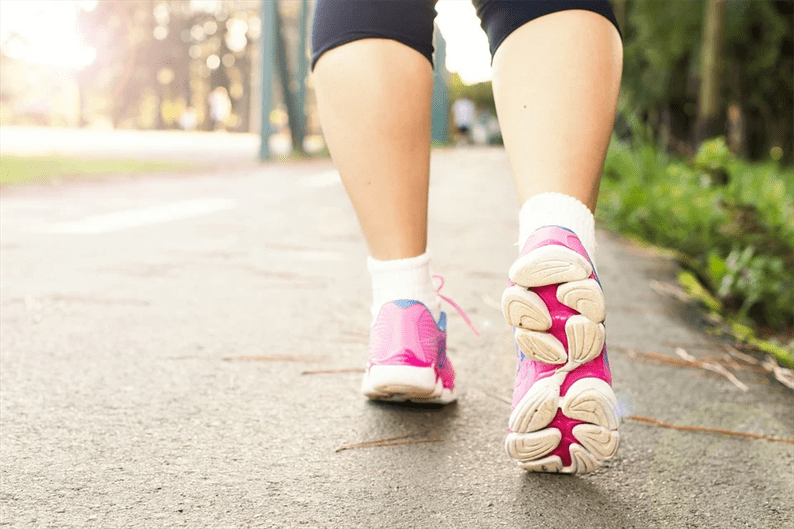
 Few people know that the effect of posture and gait on the development of the lower leg is much stronger than the effect of training. Flat feet, if not taken into account and not compensated, also interferes with bringing the volume of the lower leg in accordance with the BB standard (the volumes of the neck, biceps and calves should be equal or close in value). To pump up calves without exercise machines, you can simply choose the right shoes and adjust your gait.
The habit of placing a bent leg on the heel leads to underdevelopment of the calf. If the leg is on the toe, the calf will be voluminous even without training. This is explained by the fact that the size of the calf depends not only on the triceps, but also on the muscles that provide the mobility of the fingers. If the fingers are not actively involved in walking, their flexors and extensors are underdeveloped. Naturally, their participation in the increase in volume is negligible.
Flat feet or shoes that exclude the work of the fingers and ankle, forcing the walk so that the foot drops to the heel, and then put the entire surface without rolling, also lead to underdevelopment of the calf.
How to Strengthen Your Shin Without Training or Increase Your Workout Effect
Compliance with these rules in itself leads to the beginning of the growth of lagging eggs – make it a habit.
- The gait must be correct. The step is wide, the foot is placed on the toe, then, with a roll, it is lowered onto the heel. You need to walk more, at least 5-6 km a day, preferably at an interval pace.
- The shoe should allow the toes to move in it while actively participating in the walk.
- If possible during the day, it is worth rocking from heel to toe or standing on your toes.
- Walk barefoot more often.
- The best running is a slow, barefoot run on a grassy lawn, sand, or forest dirt path. The foot should be placed on the toes and the outer part of the foot with a roll. Running in sneakers has almost no effect on the development of the muscles of the lower leg.
- Prevention of flat feet is relevant at any age, as with age, it can occur in any person. Training from this complex removes the risk of flat feet, and always leads to the growth of calves.
- Special workouts are performed on the same day with the training of the biceps and quadriceps of the thigh, but after them, or the next day – so that large tired muscles do not intercept the load from the periphery.
- The training should take into account the habit of the Achilles tendon to unload the triceps. Therefore, the movements are slow, with full control, with static at the highest point of tension or extension. A springy effect should not be allowed when the abdomens of the muscles are not working.
- The set of exercises for the lower leg must necessarily include exercises that involve the toes.
- Sedentary work mechanically injures the biceps of the thigh and impairs the blood supply to the triceps of the lower leg (the popliteal blood vessels are pinched). Therefore, it is very important to get up and stretch your legs (a “farmer's walk” or climbing stairs with support on toes and active ankle extension are ideal).
- Be sure to follow the sleep schedule: if you sleep for less than 8 hours, and the day after training you spend on your feet or sit motionless all day on the priest, you can not hope for hypertrophy. You need to eat right.
If the calf muscles are very lagging behind in development
If, even before the start of training, there is a disproportion of the lower leg and thigh, this indicates that there are problems with gait and posture.
Until the muscle traction of the antagonists is normalized and the defect in posture or joint flexion is corrected, general training does not lead to correcting the imbalance, but only to its strengthening: normally a stronger muscle that takes over the main load grows faster than a weak assistant during strength training, this is further widens the gap between them. Therefore, training from the very beginning focuses on correcting the defect.
The training is built with an emphasis on special exercises for lagging calves, slightly restraining the development of the thigh, and at the same time taking measures to ensure that the lifestyle does not interfere with the hypertrophy of the calves and the normalization of proportions.
In case of asymmetry of the calf muscles, before performing the exercises, we strongly recommend that you consult a doctor, and if the examination does not reveal contraindications, a professional trainer specializing in this matter.
Features of doing exercises for calves
Calves are naturally hardy, they are constantly stressed and used all the time. That is why it is difficult to quickly pump up caviar – they grow rather slowly. You will have to practice intensively and regularly. In order for your classes to be effective, adhere to the following recommendations :
- Exercising regularly is the foundation of your success.
- Warm up your joints and muscles with a little warm-up before moving on to the main exercises.
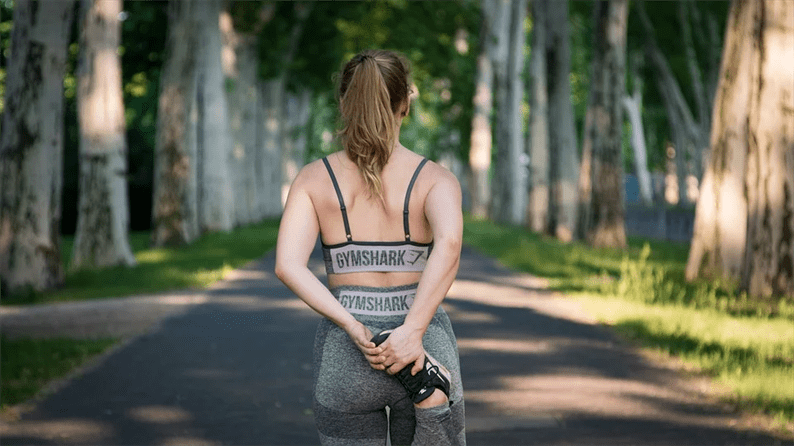
- When you're finished exercising, stretch to help relieve tension. Step back wide, place your heel on the floor and bend your whole body forward. Stretch this way to each leg for 15-20 seconds.
- So that the muscles do not get used to the stress and do not stop developing, alternate between different exercises.
- Calf exercises are quite traumatic, so the muscles need to be given time to rest and recover.
- Movements should be smooth, avoid jerking. Remember that any sudden movement increases the risk of tendon rupture.
- If the program includes aerobic exercise, have it at the beginning of the session.
Warm up before calf workout
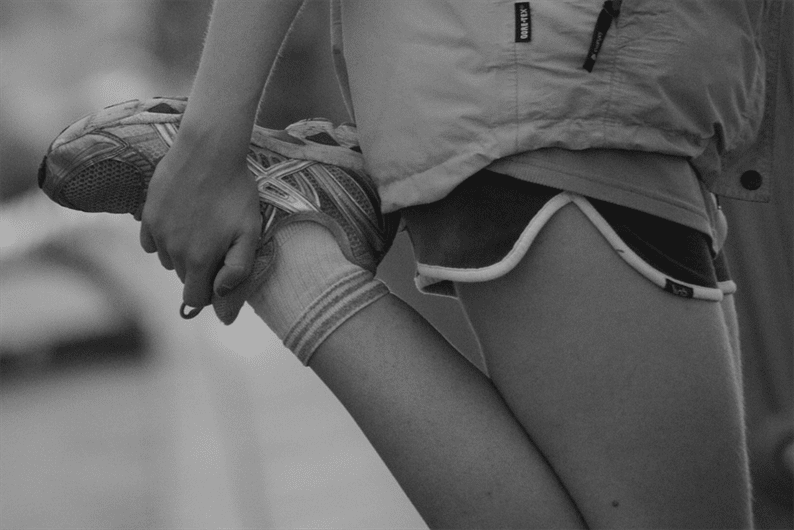
 To increase blood flow, warm joints and reduce trauma, a warm-up is necessary. You should not neglect it, even if the lower leg does not swing on a separate day, but after other exercises.
Ideally, the warm-up is done lying down (synchronously on both legs) and standing (you will have to work out the joints alternately: stand on one leg, flexing the other). A sitting warm-up is undesirable. Movements are performed 4-5 times.
- squeeze and unclench, spread your toes;
- stretch your toes away from you, then pull the socks towards you, and the heel away from you;
- move your feet left and right;
- rotate with both feet simultaneously: first to the left, then to the right, then multidirectional rotation
- bend and unbend the knees;
- while sitting, take the leg by the shin, shake the relaxed foot. Repeat for the other leg;
- while sitting, take the leg above the knee, shake the relaxed lower leg. Repeat for the other leg;
- standing: sitting down a little, perform rotational movements with your knees – first to the right, then to the left;
- standing, hands on hips, swing on the hip joints, then rotate the pelvis so that the torso is motionless, and the pelvis writes out a horizontal “eight”;
- standing, alternately, holding on to the support, shake each leg, completely relaxing it;
TOP-8 exercises to competently pump up calves
Training is recommended not earlier than an hour after eating. A rhythmic melody or a sports video will be the best assistant at home.
Rise on tiptoe
This is a simple exercise that physically untrained women need to master first of all. It can be done on a flat floor, but to increase the range of motion, it is better to use any stand you can find at home, such as a door sill. Stand with your heel protruding beyond the edge of the support.
With dumbbells in hand, rise on your toes, then slowly lower yourself onto your foot. In this position, the outer side of the gastrocnemius muscle is mainly involved. To deeply work all areas of the calf, do lifts with open or closed toes.
A complicated position is to rise on only one leg, changing them alternately. This technique will noticeably pump up your calves, even without weights. If you experience intense pain in your foot while lifting, try standing on a flat surface. Soreness may be associated with flat feet.
Raise your knees from a sitting position
For this exercise at home, a regular chair is suitable. If you have a fitball at home, you can use it as a support. Sit down and place your hands with dumbbells in your lap. Lift your heels off the floor and hold this position for a few seconds, then return your feet to the floor.
Squat on toes
If with the help of traditional squats you can pump your hips, then squatting on toes, we perfectly pump calves. Try to maintain balance by pulling your pelvis back. If squatting with dumbbells is difficult, just stretch your arms forward while lifting.
Basic rule of calf pumping! If your goal is to reduce the size of the calf muscles, you need to do the maximum number of repetitions with small weights. This technique is used by athletes to “dry out” muscle mass. If your ideal is to build athletic calves, do fewer reps, but with heavier weights.
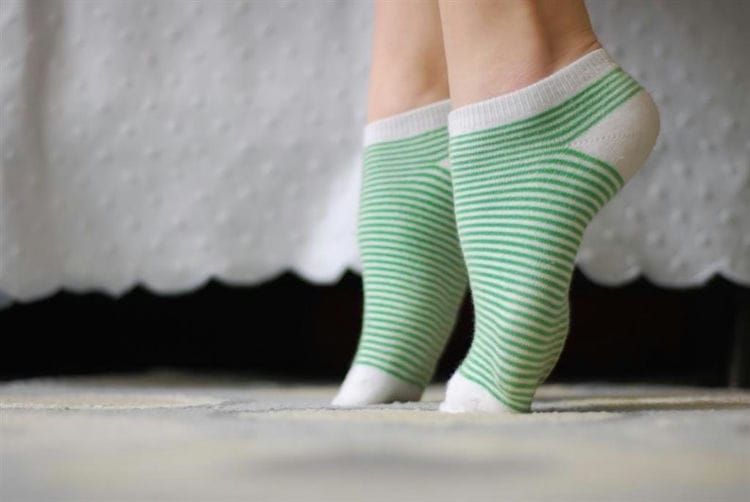
Walk on tiptoes
This boring action can not only be included in the home complex, but also be adopted in everyday life. Climb on your toes and slowly walk around the house, holding dumbbells in your hands. When doing this, try not to bend your knees.
We jump up
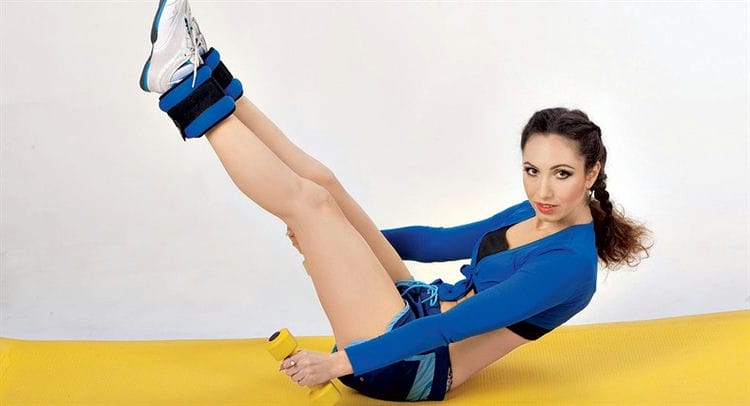
A great workout that allows you not only to pump up calves, but also to lose unnecessary pounds. With regular exercise, it acts productively even without the use of dumbbells. Just sit down and jump up. Take a starting position while standing. Repeat 10-20 times. Instead of dumbbells, you can use weighting cuffs that are tightly attached to the lower leg.
We walk up the stairs
Any staircase will work for this exercise, including a staircase in a residential building. Grab suitable dumbbells, go downstairs and head up the stairs on tiptoes. Do the exercise in one set until you get tired.
“Pistol”
This exercise, familiar from childhood, also does not require large weights. With a dumbbell in one hand, lean on a chair or the ledge of furniture. Squat with your leg extended forward. Then change your working leg and shift the dumbbell to your other hand.

Jump rope
Jumping rope is a great workout for the heart and calves in particular. And if you jump on your toes, it instantly turns into an isolated load on the calf muscles. A well-deserved bonus is gaining stamina. This is not counting the hundreds of calories that are burned along the way. By the way, it is the jump rope that is the favorite subject for calf tone among boxers and gymnasts. You need to jump until you feel tension or burning in the legs.
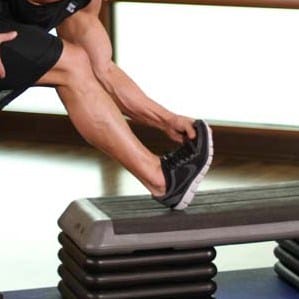
Step platform
Instead of a platform, ladders can be used.
Initial position
Keeping your back straight, stand on the edge of the platform or on a step with your toes.
Performance
First rise on tiptoes as high as possible, and then lower your heels all the way to clearly feel the stretch of the ankle. You can lean with one hand against the wall and take a dumbbell in the other hand.
General recommendations
Change the position of your legs. Keep your feet parallel, then move your heels or move your toes. The combined approach to the exercise will allow you to work out the different parts of the calves. The parallel position of the feet is aimed at developing the midsection, the shifted heels on the inside, and the toes on the outside.
Jumping with dumbbells
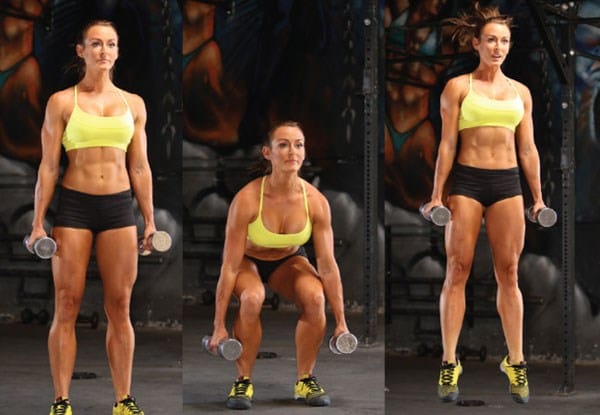
A very difficult and difficult exercise with a high load.
Initial position
Sit down, pick up dumbbells.
Performance
Jump out of the accepted position as high as possible.
Calf workout in the gym
If you consult with experienced athletes with developed calves, they will say two things:
- Caviar responds well to a combination of low-repetition and multi-repetition work.
This can be said for all muscle groups, but periodization is a training principle for experienced athletes, not beginners. This does not apply to calves. There are many assumptions about why this works. Probably because calves already do a lot of work in everyday life, like the abs. Therefore, a serious incentive is needed for growth.
- Calves need volume training for growth.
We'll have to work hard. Several workouts a week, each set to failure, a lot of reps.
At the dawn of his career, Arnold Schwarzenegger had to fight for every millimeter of calf volume to be competitive in international bodybuilding tournaments. Not shying away from hard physical work, the “Austrian oak” solved the problem very simply: he carried out several calf workouts a week and did a large number of repetitions. It worked.
Shin training options:
- Calf rise, standing in the simulator – 3×4-6;
Calf rise, sitting in the simulator – 3×4-6;
Rest between sets – 2-3 minutes.
- Press with socks in the leg press simulator – 3×8-10;
“Donkey” or raising toes while standing in the simulator – 3×8-10;
Rest between sets – 1-2 minutes.
- Calf rise, sitting in the simulator – 3×12-15;
Raising toes, standing in the simulator – 3×12-15;
Rest between sets – 1 minute.
How to optimize your training process:
- Rest at least one day between workouts. It is most convenient to do three workouts per week: on Monday, Wednesday and Friday.
- You can use three options for setting the foot: parallel to each other, with the institution inward or outward by a few centimeters. Each position loads the calves differently.
- Calves can be pumped while resting between sets. Do not postpone your calf workout to the very end, when you will no longer have the strength. Instead, train your calves while resting in your core workout.
- Full range of motion! At the lowest point of the amplitude, you need to lower the heels as low as possible in order to feel a strong stretch of the calf muscles. At the top point, we stand on our socks as much as possible and completely contract the muscles.
- Increase your working weights. For example, if you are doing standing calf raises with a weight of 100 kilograms for 6 reps, the next time you try to work with 105 kilograms. Able to complete 6 reps – add weight.
Train according to these principles, and soon you will be pleasantly surprised at how much your calf muscles can grow, even if they previously stubbornly did not give in to training.
What sports nutrition will help you gain weight?
Sports nutrition is far less important than proper nutrition and exercise. Unfortunately, the entire sports nutrition industry is built around pseudoscientific theories and marketing gimmicks. Many products contain harmful impurities, and the dosage of the necessary substances is underestimated.
Only foods that have been scientifically proven to be effective in increasing strength, gaining muscle mass, and burning fat will work. Finding a high quality, effective product at an adequate price is difficult.
Creatine for Muscle Gain and Strength
Creatine is a naturally occurring substance found in the human body and foods like red meat. Probably the most research has been directed to this sports nutrition product. But its benefits are scientifically proven. Creatine
- accelerates the set of muscle mass and the growth of strength;
- improves anaerobic endurance;
- reduces muscle pain during recovery.
You may have heard the myth that creatine is harmful to the kidneys, but research has disproved it. In healthy people, creatine does not have any harmful side effects in both short and long term use. However, people with kidney problems are not advised to take creatine. If everything is in order with your kidneys, feel free to use creatine. It is safe, inexpensive, and effective.
Whey Protein For Muscle Growth & Recovery
Protein is not necessary for gaining muscle mass, but it can be difficult to get the required amount of protein from natural foods in a day. Protein has also been shown to promote recovery from strength training.
Pre-Workout Energy & Endurance Complex
Undoubtedly, a pre-workout complex can energize you for training in the gym. However, there are also disadvantages and potential risks. Many pre-workouts are filled with non-working ingredients and minuscule dosages of working substances. Many of them do not contain stimulants at all.
Some popular foods are potentially dangerous because they contain the powerful (and currently banned) DMAA stimulant. Sometimes even chemical analogues of methamphetamine are added. It is difficult to find a pre-workout complex that does not contain equine dosage of stimulants, but is rich in beneficial natural ingredients such as beta-alanine, betaine and citrulline.
Typically, pre-workout supplements contain the following components:
- Caffeine. It energizes well and also increases stamina and strength.
- Beta Alanine. It is a naturally occurring amino acid that reduces exercise fatigue, improves anaerobic performance, and promotes muscle growth.
- Citrulline Malate. It is an amino acid that increases endurance, reduces muscle pain and improves aerobic performance.
- Betaine. A natural ingredient found in beets that increases strength, endurance, and the secretion of growth hormone and insulin-like growth factor from strength training.
- Ornithine. It is an amino acid found in large quantities in meat. It reduces fatigue from prolonged exercise and enhances fat oxidation.
- Theanine. It is an amino acid found in tea that reduces the effects of mental and physical stress, increases nitric oxide production, which increases blood circulation in the muscles. It also improves alertness, focus, memory, brain activity and mood.
It is desirable that pre-workout complexes be free of artificial sweeteners, colors and flavors, excess carbohydrates and other harmful ingredients.
Calf Pumping in the Gym: The Best Effective Calf Pumping Exercises
In the gyms, there is a large number of various strength simulators, including those for training the calf muscles. The design of such simulators may differ depending on in which position (standing or sitting) the calf raises are performed. The rest is a metal construction with a counterweight consisting of discs of various weights.

Standing Calf Raises
To perform lifts for the work of the calf muscles, a simulator is used with support on the shoulders, which creates a downward pull with a previously adjusted weight. This fixes the position of the body in the simulator and creates the effect of additional burdening.

Execution technique:
- Position yourself on the machine with your feet elevated and your shoulders under the upper platform.
- The heels should be hanging, the toes on the dais.
- Straighten your back, grab the holders with both hands.
- Begin to push the platform on your shoulders upward, lifting up on your toes.
- Then lower yourself slowly, keeping your heels as low as possible.
The number of approaches and reps: 3 × 8-10.
Seated Calf Raises
Another option for working with the simulator is seated calf raises. The design of the machine is different here (with a horizontal frame and platform), but the meaning of the exercise is the same as in the previous case. Before direct classes in the gym, learn the technique of exercises for the development of the calf muscles in this power machine.
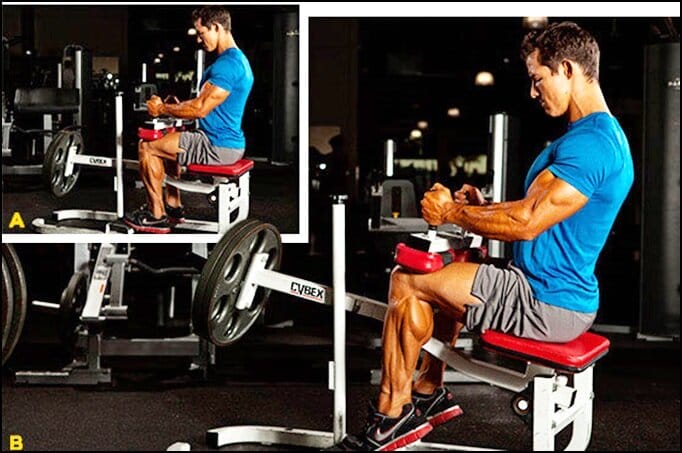
Execution technique:
- Adjust the weight on the machine.
- Sit in the simulator, put your feet on a special elevation so that the heels remain unsupported.
- Move the counter balance rollers from above to the knees.
- With both hands, grasp the handles in front of you.
- Raise your shins on toes, pushing the rollers up.
- Then lower your knees as low as possible so that your heels are at the opposite angle to the floor.
Repeat the exercise 10 times in 3 sets.
IMPORTANT! Match your weight to your physical ability. If you are using heavy weights, the reps can be reduced.
Smith Machine Barbell Calf Raises
The Smith machine can be considered a universal machine for performing completely different exercises for different muscle groups. In the case of calf muscle training, this simulator can also be used as an alternative to special machines and exercises with free equipment. The peculiarity of the Smith simulator is in its rigid clamps that hold the bar or bar in one plane.
Execution technique:
- Set the bar weight (or use an empty bar), define the sock rest. If you do not want to do the elevation exercise, do not use it.
- Stand in relation to the machine so that the bar is on your shoulders.
- Slowly rise on your toes, pushing the bar up (both ends of the equipment will be firmly fixed in the machine, which will allow you to maintain balance at the peak of the exercise).
- Then slowly lower yourself onto your heels or, if using an elevator, bring your heels down.
Approximate sets and reps: Amateurs 3 x 10, Beginners: 3 x 8. Based on your own strengths and the weight you use.
Tips for proper calf pumping at home
To obtain pronounced results, experienced bodybuilders recommend changing the elements, as well as gradually increasing the weight of the weights. Exercises of the same type with a constant weight will eventually become addictive, and the calves will stop responding to the load.
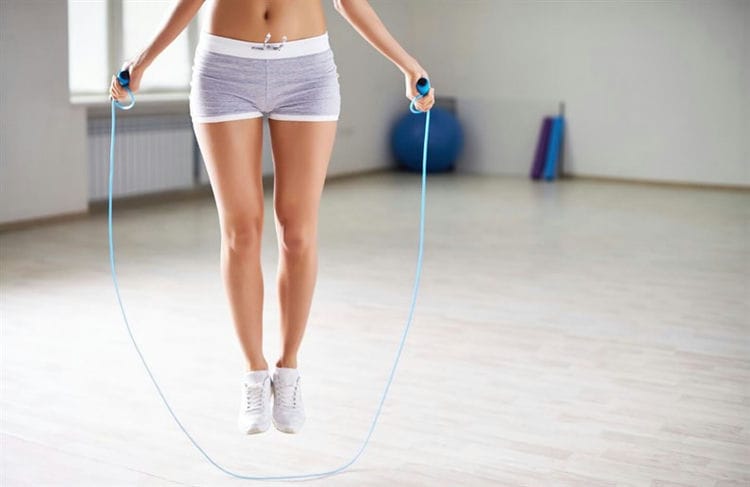
Be sure to do a five-minute warm-up before class. It is needed to warm up muscle fibers and joints, to prepare the body for intense work. At home, articular gymnastics, several dance steps can be an ideal warm-up.
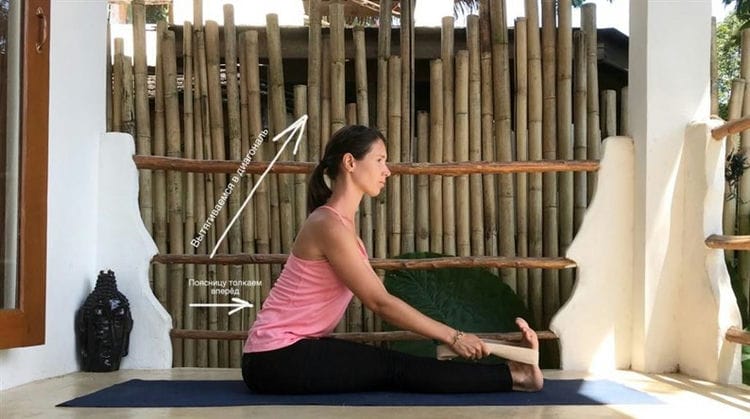
Don't forget to stretch after class. It will give the calf tufts the impetus for an athletic transformation. For example, lunge with one foot forward, press your heel to the floor, and pull your calf. Another good way is to sit on the floor with your hands around your socks and pull them towards you. Just five minutes of stretching will help prevent the soreness and cramps that overextended calves are prone to. Remember to stretch your legs after each workout to build up your calves without discomfort.
Some more helpful tips:
- Perform all movements with concentration, at a slow pace. Feel the calf muscles tighten.
- To quickly pump up calves, move with maximum amplitude.
- In the upper position, for example, when lifting on toes, it is advisable to take a short pause.
- Be sure to give the calves time to rest, otherwise the muscle fibers will not have time to rebuild.
- Overloading from excessive calf inflation is fraught with sprains and injuries that take a long time. Be careful, especially when jumping and walking up stairs.
- Do not forget about a protein diet, because muscles need building materials. Its best sources are lean meats, cottage cheese, lean fish, seafood, and eggs. It is advisable to limit sweets and flour.
The importance of calf stretching
“Doing these exercises every day is a great habit to get better flexibility in the ankle muscles, which will help improve ankle mobility and will be beneficial for complex leg exercises like squats,” Brown continues.
If your calf tightness interferes with ankle mobility, Cody recommends using a massage roller in addition to stretching. Doing in this order: first the massage roller, then stretching, after an intense workout on the legs. This will help relieve muscle tension and recover quickly.
General recommendations
 Remember to train any muscle regularly, not just your calves
- Before a set of exercises for the development of calves, be sure to knead the joints of the ankles, fingers and warm up the muscles themselves.
- Remember to stretch your calf muscles after exercise. To do this, take a wide step back with your heel on the floor, tilting your body forward. Stretch for 10-20 seconds with each leg.
- The range of motion during exercise should be maximized.
- The load needs to be changed. Vary the exercise and load, otherwise addiction will set in, which will reduce the effect of the exercise.
- You need to train your calves two or three times a week, giving your muscles time to recover.
- Aerobics should be at the beginning of the workout, and the workout should be completed with strength load on the calves. This is the only way to achieve the growth of calves.
- If you transfer weight to your thumbs when lifting, then the load on the muscles will be of higher quality.
- To further complicate the exercises and pump up the male calves, a five count delay at the top of the lift is suitable.
- When pumping calves, the main thing is not to overdo it and not overwork the muscles, otherwise you can bring yourself to cramps. And this is at least unpleasant.
The main mistakes when training calves
Consider the main mistakes that athletes make when they are puzzled about how to quickly pump up calves at home or in the gym:
- Doing calf exercises at the end of your leg workout. The pumping of this muscle group is often neglected or left at the end of leg workout when there is no strength left. Muscles cannot grow unless they are under significant stress. Therefore, if you really want your calves to be prominent, you should start training them the way you train your back or chest: from all sides and until you are completely exhausted. If you can start your leg workout with your calf muscles and train them at the same intensity as your quads or glutes, do so. If your leg workout is too hard, add the calf workout to another workout.
- Limiting the range of repetitions to 10-15. During your workout, do at least 20 repetitions per set in each exercise. A higher rep range forces you to use slightly less weight, which allows you to fully contract and stimulate muscle growth.
- Identical training. Most people train their calves the same way in every workout. Often they are the ones who wonder how to pump up caviar, increase them in volume. If you perform the exercises only while sitting or standing, then you are not equally affecting all the muscle heads. When you do the exercises while standing, most of the work is done directly by the calf muscles. The soleus muscle, by contrast, is activated when doing exercises with bent knees. Therefore, try to add variety to your training program.
- Weights are too heavy. When working with too large weights, the execution technique suffers. In turn, the load is transferred to other muscle groups, for example, the quads or the back of the thigh. Thus, it is better to give preference to multi-repetitive training with small weights.
- Failure to isolate and completely compress calves. Like any other muscle, the calves benefit most from exercise when done with full contraction, slow and full stretch. Many people like to lose weight or just do partial reps without allowing full contraction. Optimize the compression you get at the peak of each rep by standing on your toes and lifting as high as possible. Once you are at the top, tense your muscles hard. It takes conscious effort and focus. The work does not end once you reach the peak of the contraction. Maintain tension in your muscles as you slowly return to the starting position. At the end of each rep, gently, without sudden movements, stretch your calves as far as possible without shifting the focus of the stretch to the Achilles tendon.
- Using incorrect positioning of the legs. With a different setting of the legs, the calves are worked out from different sides. With the legs pointing straight ahead, the inner and outer calf heads will work in the same way. Turning the socks inward will shift the focus to the inner heads, and the outward direction of the toes to the outer ones. However, too much deviation not only impedes the achievement of maximum muscle activation, but also creates excessive tension in the ligaments and connective tissues of the ankles and knees. For best results, do not play at a steep angle.
Calf training myths
Many gym visitors (especially beginners) believe that they do not need to pump their calf muscles separately, because calves work in:
- Heavy squat.
- Deadlift (and deadlift with straight legs).
- Jogging and other cardio exercises.
This is true, however, in the case of these exercises, the calves perform a stabilizing static load, which increases their strength, but not volume. Only genetically gifted people can pump up calves without performing exercises directly on them. Everyone else will have to try hard.
Conclusion
The muscles of the calves are difficult to pump, because we use them all the time, and by nature they have great endurance. They respond slowly to stress and do not immediately give a tangible increase in volume. For consistent results in the growth of these muscles, you will have to work hard.
But how beautiful the well-formed calf muscles look in both men and women! Especially if you start to form them from childhood.
Sources used and useful links on the topic: https://kachaemmyshcy.ru/kak-nakachat-ikry-nog/ https://tony.ru/473043a-kak-nakachat-ikryi-nog-v-domashnih-usloviyah-uprajneniya- dlya-ikronojnyih-myishts https://AthleticBody.com/kak-nakachat-ikry.html http://gym-people.ru/massa/programms/doma/kak_nakachat/golen.html https://www.fitnessera.ru /sportivnye-ikry-kak-nakachat-myshcy-goleni-v-domashnix-usloviyax.html https://mamsy.ru/blog/kachaem-ikry-nog-v-domashnih-usloviyah/ https://builderbody.ru/ kak-nakachat-ikry / https://best.fit/trenirovki/kak-nakachat-ikry-luchshie-uprazhneniya-i-programma-trenirovok/ https://zen.yandex.ru/media/id/5e7b340df72eb86cfa8a1d3c/kachaem ikronojnye-myshcy-samostoiatelno-doma-5e908c32faa668570a79e01c https://stroy-telo.com/domashnij-trening/silovye-uprazhneniya/kak-nakachat-ikry-nog-v-domashnikh-usloviyakh.html https://cross.expert/programmy-trenirovok/uprazhneniya-na-ikry .html
Post source: lastici.ru