
Deaf language in pictures: how to say thank you, sorry and love. Sign language interpreter. Hear the inaudible.
What is deafness
So, among people with hearing impairment, deaf, hard of hearing, deaf and implanted are distinguished. Deafness is talked about when persistent bilateral (in both ears) significant hearing impairment is found, in which intelligible speech perception is impossible.
Deafness can be congenital or acquired, which is much more common. By the time of occurrence, they distinguish between early (under the age of three years) and late deafness (which appeared after speech was formed). Deafness, congenital or acquired, makes it impossible for a child to master speech without special training. If speech has already begun to form, then early deafness leads to its decay. However, one should be aware that it is not ethical to use the term “deaf and dumb” for such or other cases of hearing impairment.
Deaf (late deaf) – people who have lost their hearing, but retained their speech. The degree of preservation of their speech depends on the time of onset of deafness and the conditions for its development. Children who become deaf between the ages of three and five and who have not received special assistance most often retain a small vocabulary by the time they enter school, which is usually pronounced distorted. With a later onset of deafness, children almost completely retain their speech reserve (especially children who have already mastered writing and reading). With special pedagogical influence, speech can be preserved completely even with earlier hearing loss.
Implanted children and adults are people who have undergone cochlear implantation surgery (from the Latin cochlea – snail), i.e. an operation to implant electrode systems into the inner ear, into the cochlea, followed by electrical stimulation of the auditory nerve, which makes it possible to send signals to the brain that cause auditory sensations.
The overwhelming majority of people with hearing impairments use an individual hearing aid – a behind-the-ear (located behind the auricle) or an in-the-ear (specially made individual earmold).
How deaf and dumb people communicate: sign language
From the outside, it seems that this is an improved pantomime, since facial expressions, body movements and the surrounding space are also actively used there.
It is also called the language of pictures, because some gestures resemble the appearance of the objects they represent (for example, to show the word “house”, two palms are connected in the form of a roof). True, both opinions are correct only partly. the fact that most gestures do not in any way resemble the objects in question, especially abstract concepts. For example, to say “thank you” in Russian Sign Language, you have to touch your forehead with a clenched fist and then touch your chin.
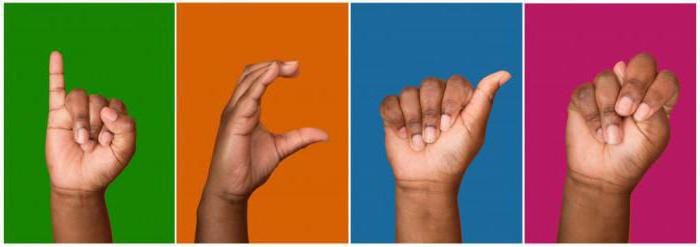
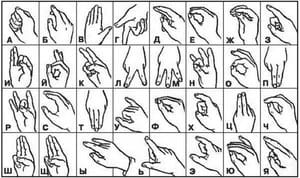
A special dactyl alphabet has also been developed – a system of hand signs corresponding to letters. If each word is conveyed with its help, then in this case the expression of thought takes a lot of time.
There are such kinetic languages (Cuban, Portuguese, Spanish), where facial expressions play a major role, it is even too expressive. Usually this is inherent in those nationalities that are in themselves more emotional in their psychotype. But mimicry also mainly performs a grammatical function. With its help, you can distinguish a question from a command, a conditional mood from a statement.

Geographically, the areas of use of sign and oral languages do not always coincide. Russian kinetic speech is widespread on the territory of Ukraine, Belarus, Israel. In Puerto Rico, deaf people communicate using American gestures, although Spanish is the primary language of hearing.
How do deaf and dumb people from different countries communicate? After all, for someone who speaks British sign language, American is the same as foreign. Therefore, scientists from all over the world have developed a universal notation system, which includes about 1500 concepts.
In addition to vocabulary, each kinetic language has its own grammar. For example, in its American version, as well as in Russian, the subject of discussion is indicated at the beginning of the sentence, and then something is reported about it. If in oral speech the definition usually stands before the subject, then in sign language it is the opposite. The main feature of many of these languages is also the construction of events exclusively in chronological sequence.
Eyes instead of ears
The human desire to communicate is very strong and capable of overcoming any obstacle. In people who are deaf, the function of language learning is usually taken over by sight. Life brought such people together, and they themselves developed a special way of communication, known as sign (kinetic) language. Over time, it acquired new vocabulary and represented a whole linguistic system. Of course, many of us have seen deaf and dumb communication at least once.
Previously, deaf people in many schools were forbidden to use gestures, at the same time they were forced to read their lips and express their thoughts in writing. But those of them who at first mastered kinetic speech, coped with their studies more easily and quickly learned to read and write.
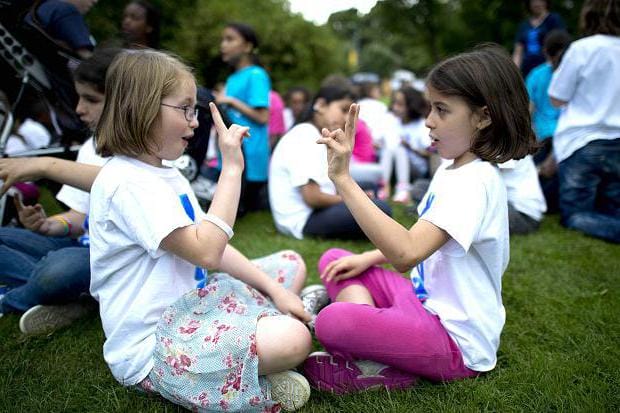
What language do deaf and dumb people think? In his own language – sign. Hearing people formulate their thoughts in their heads in the same language in which they communicate. It is the same with the deaf.
Many people mistakenly think that the deaf cannot speak. But as a rule, their sound apparatus is not damaged, it is simply not designed.
Do deaf people understand the written text?
Reading is very closely related to auditory memory. That is, the hearing child knows the sound of the phoneme “a”, and when they show him in the primer how it is indicated in the letter, it is quite easy for him to remember this connection. It is difficult for the deaf to compare graphic images with the sounds of spoken speech. The difficulty also lies in the fact that in sign languages there is a completely different structure of sentences, there are no cases and declensions. But despite such difficulties, most of the deaf still master the technique of reading and can express their thoughts in writing.
Features of oral speech of the deaf and hard of hearing
People with hearing impairments tend to have voice changes. It can be too high (up to falsetto) or low, nasal, muffled, slightly changing in height, strength, timbre. Moreover, a pattern is observed: the more the hearing is impaired, the more, as a rule, the voice is impaired. Individual sounds can be mispronounced – most often, consonants S, Z, W, F, U, H and C, because they are more difficult to perceive with impaired hearing. Because of all these impairments, deaf people tend to feel embarrassed to speak out loud when they see negative reactions to their speech.
Also, people with early or congenital deafness have mistakes in the use of words, the usual order of words in a sentence is violated (for example, “the plant is difficult, weak, little money, no” can be interpreted as “I am very tired after work, for which, moreover, pay almost nothing “).
Features of the perception of sounds and speech
Complete deafness is rare. Most often, the remnants of hearing are preserved, allowing to perceive individual sounds of speech and some well-known words that are pronounced at the auricle. Low-frequency sounds, such as the whistle of a locomotive, drums, knocking, are much better heard by most deaf people. Hearing impaired and implanted people have a wider and more varied perception of everyday and natural noises. But even if a person with a hearing impairment hears a clock ticking on the wall, he may experience great difficulty in distinguishing someone else's speech. Often this happens in implanted children and adults who have not completed a course of special psychological and pedagogical rehabilitation.
Sounds of normal volume are perceived better. Too loud noises or screaming can cause pain in a deaf person. In this case, he covers his ears with his hands, frowns. This is due precisely to discomfort in the ear, and not to unwillingness to communicate and listen to the interlocutor.
People with hearing impairments perceive spoken language visually – both by reading lips and using residual hearing. However, the accuracy of understanding the meaning also depends on the deaf's own efforts: on his ability to hold attention, ask clarifying questions, on the level of development of semantic guesswork, when the entire phrase is mentally completed from the “heard” fragments according to the context. Therefore, if speech is related to the current situation, it is easier for a person with a hearing impairment to understand the context and meaning of what was said. But an abstract story about what happened before or will be later will be much more difficult for him to understand. Particularly difficult is the understanding of cause-effect, space-time and other grammatical relations, as well as phrases with passive participles: “cured diseases”, “found peace”, etc. Accurate perception (i.e.
What is sign language
Russian Sign Language (RSL) is an independent language used by people with hearing impairments to communicate.
It consists of not only static shapes, but also a dynamic component. Hands move in a certain way, take a certain place in relation to the face. During gesticulation, it is customary to additionally “speak” words with the lips.
In GL, any details are important, including where the gesture is shown (the same movements are interpreted differently at the forehead and chest), the nature of the movements (turning the body and head, facial expressions). We can say that the whole body is involved in the conversation.
When communicating in sign language, every little thing plays a role, so you need to monitor your posture and involuntary hand movements. All of your actions can be misinterpreted.
Origin story
It is not known for certain who created the sign language; it has existed for many centuries. But only in the 18th century they began to systematize it.
During the industrialization of European cities, groups of the deaf were concentrated in them, who needed training.
The Italian doctor J. Cardano was the first to volunteer to teach deaf children with gestures. The languages of the deaf and dumb with national characteristics were used as a basis. They became the basis for the foundation of gestural interpretation.
In the modern world, sign language is developing, transforming and popularizing. More and more people want to learn sign language in order to communicate with colleagues, friends or relatives.
There is an international sign language – sign language, which is used during international events.
Where can you learn rigidly?
Roughly in Russia it was not popular and there were only 3 sign language interpreters for every 100 deaf and dumb in Russia, while in the West there are 30 such people. In 2012, amendments to the Law on the Protection of Persons with Disabilities helped develop sign language. In addition to obtaining official status, training began in relevant institutions to train and retrain interested people. As a result, the percentage of those wishing to teach harshly increased.
There are many ways to learn rigidly. One of them is that training is carried out in special classes. You can get the necessary knowledge in the following ways:
- In deaf and dumb communities in your city, where free classes are provided for everyone. A few months will help you learn the basic aspects of gesture and test your existing knowledge in a practical way.
- Institutes and colleges often have a sign language subject in their curricula. Most often these are the specialties of linguistics and sociology. Those who are or are planning to be a student can read the stipulations free of charge.
- If you could not find free courses, then there are professional paid courses that are held on the basis of institutes, medical centers and special schools for the deaf and dumb.
Having learned about the places where training is carried out in a rigorous manner, we will move on to the structure of teaching the language of the deaf and dumb.
The structure of teaching the language of the deaf and dumb
Next, you should understand what these courses are and what is acquired at the end of the training.
There are 3 levels of hard learning with the following skills:
- At level 1, all beginners understand the basics, alphabet, vocabulary norms with practical exercises;
- Level 2 is suitable for those who already have basic skills and wish to acquire the skills to translate from stiff to ordinary;
- And already the 3rd level allows you to improve your skills in linguistics and study translation in depth in a simultaneous and sequential form.
Each level lasts 3 months or 50 academic hours. At the end of the course, you will have on hand a special certificate confirming your level. However, it should not be regarded as evidence of the qualifications of a sign interpreter, for whom a special commission must be passed. You can try to go through this after the second course.
How to learn a deaf and dumb language yourself
In addition to the previously listed methods, there is an opportunity to study in a rigid manner with the help of a self-instruction manual. The following resources will help here:
- Sign language learning websites, most popular Sign City. A lot of useful information can be found in social networks, where specialized groups are strictly located. With their help, theory and practice are worked out together with like-minded people.
- Applications with alphabets and pictures in sign language are created especially for mobile devices. It is enough to download the program and work with the necessary information in your free time.
- Books perfectly help in studying rigidly, but only for those who are ready to make additional efforts in their studies and endure. After all, there will not be a teacher nearby who will give hints. This means that it will take more time to analyze the material.
- A good option in this case is videos with the speeches of the teachers, but no one will correct you. The main advantage is that the material is diverse, understandable and clearly explained.
Each person independently chooses one way or another. But most of the people, due to lack of time, prefer to learn sign language on their own.
An example of a video tutorial on learning sign language.
Start an independent study
There is one peculiarity in the study of rigidly: I often confuse it with the image of individual letters with my hands. Dactylology is used for proper names, for example, cities, names of people, areas, or for a word without a special gesture. This is important to consider when starting classes.
After choosing a certain option for self-study, you need to find information resources and choose the ones that are optimal for your level.
The first step is to learn the alphabet. Once you gain confidence in the dactyl alphabet, you can switch to non-verbal sign language. Plan your activities based on specific difficulty levels. Gradually, you will improve your own gesture skills.
The most effective way to learn a language is to communicate with a native speaker. Even self-study involves finding a companion. Thanks to this, you will be able to competently express your thoughts and begin to understand the thoughts of a person.
Cruel is by no means the easiest language to learn. In addition, it can be easily confused with the dactyl alphabet. But after a certain time, you will be able to achieve significant success. The main thing is not to forget about training and supplement practice with theoretical knowledge. Sign language is no more difficult than foreign language. We wish you to gain strength and patience, because after that you can get the desired result!
How to start self-study
You can learn sign language on your own, but it is better to practice speaking skills in the process of communication
Study plan:
- The main thing is to study the dactyl alphabet – 33 gestures corresponding to a certain letter of the alphabet. In reality, the alphabet is rarely used, but knowledge of it is useful when learning new words for which there are no special gestures, for proper names when using letter gestures.
- As soon as the theory is mastered, the alphabet is learned, and a basic vocabulary is acquired, communication with native speakers is necessary to train speaking skills. This can be done on thematic forums, specialized sites where the audience is hearing impaired and deaf people.
Important! It is unrealistic to master the language of the deaf and dumb without practice. Only in the process of direct communication are language skills acquired. Then the understanding of sign language and the ability to explain in it is possible.
Acquaintance with fingerprinting
Getting familiar with sign language, you need to understand that it is not universal for different countries. Each region has its own, not the same alphabet and dictionary. This is the whole difficulty, since often in non-verbal communication, a gesture does not mean a letter, but a word or even a whole phrase. Therefore, knowledge of dactylology is necessary – a peculiar form of speech that includes the dactyl alphabet. In it, each letter has its own sign (dactylam), folded from fingers.
It is difficult for beginners to distinguish between sign language and dactyl alphabet, meanwhile dactyls spell words, and gestures – whole words.
Finger placement technique
Dactylology is a manual alphabet, many gestures in it begin with a letter, for example, a teapot – the letter h. You need to study the dactyl alphabet step by step, without rushing, it is important to work out the technique of setting your fingers well. The hand will fatigue at first, but with constant exercise, the fingers become more flexible. For beginners, at first, wooden gestures are observed. Flexibility is acquired through stretching exercises and developing the hands.
To master dactylology, it is important to understand that this is a manual alphabet, for it the main thing is to set your fingers
The clarity principle in the GL is the following explanation:
- fingers not involved in the configuration remain straight;
- in configuration, each finger acts independently;
- there are no intermediate configurations between dactyls;
- fuzzy, blurry configurations are defects.
Study sequence
FAL dactylology is different in each country; there is no single language for the deaf and dumb. Therefore, when studying on your own, you should adhere to certain rules:
- When mastering dactyl, you need to remember the basic words, names, titles.
- It is advisable to immediately master the account, the simplest numbers. This will help to consolidate the SE.
- Then they learn the language itself – about 2000 different designations.
- Learning gestures starts with simple words: thank you, please hello.
- You need to memorize words gradually, learn several gestures in one lesson.
ZL is an informative way of communication that is perceived better than verbal communication. By learning to control non-verbal cues, you can interact more effectively with your interlocutors.
Sources used and useful links on the topic: https://www.miloserdie.ru/article/kak-obshhatsya-so-slaboslyshashhimi-pravila-i-etika/ https://FB.ru/article/254239/kak-obschayutsya- gluhonemyie-lyudi https://legkonauchim.ru/yazyki/kak-nauchitsya-yazyku-zhestov https://LivePosts.ru/articles/culture-society/other/yazyk-zhestov-gluhonemyh-obuchenie-po-kartinkam-i- azbuke-v-samouchitele https://srazu.pro/razvitie/yazyk-zhestov-kak-uchit.html
Post source: lastici.ru