
Who is called an intelligent person. What is intelligence: definition, examples. Educated, cultured and intelligent person

Content
Who is this – an intellectual?
If you ask people about who an intelligent person is, you will not get a clearly formulated answer. Some argue that the level of education, knowledge and the presence of a “crust” about the received education are more important for this person, others say that this is a good upbringing and manners.
It is curious that both of them will turn out to be both right and wrong. D. Likhachev in his work “A Man Must Be Intelligent”, in the opinion of the majority, gave a reliable characterization of an intelligent person. He argued that this is a quality given by nature, which education and upbringing only hone.
A person who was born and raised in a family of miners may be more intelligent than someone who was born into a professor's family. Intelligence does not imply the fact of knowledge of sciences and human values, but a person's desire to learn them. By bringing together all the statements of the author of the article, we can conclude that tolerance towards the world is the basis of intelligence. A fanatic by nature is not an intelligent person. These are radically opposite personalities.
Smart face
A team of scientists from Charles University in Prague used static photographs of 40 men and 40 women to test the relationship between calculated intelligence, perceived intelligence, and facial shape.
Both men and women accurately determined the intelligence of a man by looking at photographs of his face. The same could not be said for photographs of women.
Research has shown that there is no link between intelligence and attractiveness or face shape.
People can easily tell if a man is smart but not a woman. This may be due to the fact that attractiveness often cloudes judgment, and women are often judged for attractiveness.
Persons who are perceived to be smart are most often elongated with a large distance between the eyes, a large nose, slightly raised corners of the mouth, a pointed, less rounded chin.
Conversely, low intelligence is associated with wide, round faces with close-set eyes, a short nose, drooping corners of the mouth, and a rounded and heavy chin.
Types of intelligence
However, scientists did not find a link between morphological traits and true intelligence, as measured by the IQ test in men and women.
The researchers argue that two factors of general intelligence are associated with perceived intelligence: fluid intelligence and figurative intelligence.
Agile intelligence is the ability to logically solve problems regardless of the knowledge gained.
Figurative intelligence describes the ability to handle objects such as images, patterns, and shapes.
Why should a person become an intellectual?
The statement that an intelligent person is educated and engaged in mental work is not true. There are many people in the world who do not have a higher education, while they are distinguished by innate intelligence. An intelligent person must:
Respect the opinions of others;
Be as tolerant as possible Do not offend or humiliate the interlocutor, as, indeed, no one else;
Understand the opponent, etc.
So, is it possible to achieve intelligence on your own? If this is an innate quality, then how do you get it to become your second self? This is a long process that requires some effort on yourself. Unfortunately, neither schools nor universities have lessons that provide the basis for intelligence. Because, rather, it is a moral concept that testifies to a person's constant striving for ideals, self-control and self-education.

And yet, an intelligent person must be educated. To do this, it is not necessary to have a diploma of higher education, which, as we know today, is not a criterion for a great mind. Better to educate yourself. All the wisdom and truth of life is contained in books. Not in those love and detective novels that we “absorb” in tons of in the subway and “in order to defuse the brain”, but in the works of the classics:
A. Pushkin;
M. Lermontov;
A. Chekhov;
A. Blok and others.
You can endlessly enumerate poets and prose writers who themselves were deeply intelligent people and taught this to humanity.
Reading books will teach you to think for yourself, reflect and learn to “weed out the wheat from the chaff.” You will learn to treat with understanding the world around you and the people around you. People who know how to share the breadth of their soul can change a lot in this world.
Sometimes people use the word “intellectual” in relation to someone who is reputed to be a conflict-free person, or who is too sensitive, gentle, gentle and kind to people. Or, he is so subject to his own beliefs that he even follows them to his own detriment. But, is it possible to be “too” zealous in kindness and understanding? How can you love “too” or “too” sorry? We love and pity ourselves loved ones as much as necessary. The intellectual is distinguished by the fact that he treats the problems of others in the same way as he treats his own. He understands that the scratch that causes him a lot of inconvenience and pain hurts other people just as badly. Knowing about his own suffering, this person will not agree to hurt another.
Intelligent people act according to the principles:
Give in, but don't step;
Give, but do not delay;
Share, but don't hide;
Do not show, but reach out and let me try;
Do not shout, but let the person speak;
Don't break, but help glue.

We too often pass by someone else's misfortune, believing that this does not concern us. An intelligent person will not do this. He will certainly help the unfortunate person, because his morality demands it. If he does not do this, then his conscience will torment him for a long time. He will not cause grief to another, will not hurt. Intelligence is akin to sincerity. Such people do not put their interests above the interests of other people, they do not seek benefits in their actions, and do not lie. In our difficult time, being an intellectual is a great work and merit, but they are there. It is pleasant to communicate with them, it is easy and simple to live in the world.
To live life is not a field to cross! This wise phrase says that surprises and obstacles await a person in life. We cannot protect ourselves and our loved ones from problems that sometimes cause resentment, insults, and pain. However, one must not forget what made someone unhappy. Try not to hurt others, do not ask for the impossible, and do not lie. The most disgusting thing in this life is to realize that you have been deceived. Therefore, do not hurt others. Don't think that the person you deceived is stupid, he just trusted you too much. A lie will not only destroy your relationship with a person, it will backfire on you after a while, when the truth becomes known to everyone. The main thing is not to lie to yourself. There can be nothing more dangerous than this lie. By deceiving yourself, you lose the boundaries of reality, and begin to believe in your own lies. Distorting reality
After reading this article, many can say that they do not need to become intellectuals, too much effort and responsibility. There is no need to climb anywhere, proving the truth, to risk anything, to compromise your own interests. However, this decision is made by people on their own, no one is forcing or forcing them to become intellectuals. This desire is dictated by the heart and mental impulses.
And while a person's heart is working, it is able to respond to what is happening around.
Yet, the word “intellectual”, which comes from “intellect” or mind, must have come from the word “cardio” or heart. Then it would have a more correct meaning and would be interpreted by society in a different way.
The simplest definition of intelligence
One of the greatest minds of the Silver Age gave a very short but capacious definition of the concept of intelligence: “This is the highest culture of the human spirit, aimed at preserving the dignity of one's neighbor.”
Such intelligence is that daily work is constant self-improvement, the result of a huge educational process over oneself, one's personality, which, first of all, fosters in a person the ability to be attentive and empathic with respect to another living being. An intellectual, even if he commits a dishonest act under the will of circumstances, will suffer greatly from this and suffer from remorse. Rather, he will act to harm himself, but will not be tainted by low things.
Human values inherent in the intellectual
According to the results of the social survey, most people indicated the importance of education and good manners. But the great Faina Ranevskaya said: “It is better to be reputed to be a good, but swearing obscenity, than a well-bred bastard.” Therefore, higher education and knowledge of etiquette does not mean that you have an old school intellectual in front of you. The presence of such factors is more important:
- Compassion for someone else's pain, it doesn't matter if it's a human or an animal.
- Patriotism, expressed in actions, and not shouts at rallies from the rostrum.
- Respect for other people's property: therefore, a true intellectual always pays debts, but takes them extremely rarely, in the most critical cases.
- Politeness, compliance and gentleness of character are required – they are the first calling card of the intelligentsia. Tactfulness is at the top of their relationship with people: he will never put another person in an uncomfortable position.
- Ability to forgive.
- Lack of rudeness towards anyone: even if the impudent pushes the intellectual, he will apologize first for the inconvenience caused. Just do not confuse this with cowardice: a coward is afraid, and an intellectual respects all people, whatever they may be.
- Lack of intrusiveness: out of respect for strangers, they are more often silent than they are frank with just anyone.
- Sincerity and unwillingness to lie: again, because of decency and love for the people around, but more out of self-respect.
- An intellectual respects himself so much that he will not allow himself to be uneducated, unenlightened.
- Craving for beauty: a hole in the floor or a book thrown into the dirt excites their souls more than the absence of dinner.
From all this it becomes obvious that education and intelligence are not related concepts, although interacting. An intellectual is a rather complexly structured personality, therefore, he is never loved by the lower strata of society: against the background of an esthete who has a fine feeling of the world, they feel flawed and do not understand anything, and this is why malice leading to violence is manifested.
Modern intellectual
What is intelligence at the present time? Is it even possible to be like this in the arena of total degradation and dullness from the mass media, social networks and television shows?

All this is true, but universal human values do not change from era to era: at any time, tolerance and respect for others, compassion and the ability to put oneself in the place of another are important. Honor, inner freedom and the depth of the soul, together with a sharp mind and craving for beauty, have always had and will be of paramount importance for evolution. And today's intellectuals are not much different from their brothers in the spirit of the century before last, when a person – it really sounded proudly. They are modest, honest with themselves and others, and always kind from the heart, and not for the sake of PR. On the contrary, a spiritually developed person will never be proud of his actions, achievements and actions, but at the same time he will try to do everything possible to become at least a little better, knowing that by changing himself, he changes the whole world around him for the better.
Erudition is not equal to intelligence
 School education is based on the principle “must know from now on,” and the program is constantly being replenished with new material, new subjects, new information, without which it is unthinkable to call a person literate.
At the same time, formally setting itself the task of developing independent thinking and self-education skills in the child, the modern program forces the teacher to work in a directive, authoritarian style, since it greatly limits it both in time and in the choice of topics. Hence the common phrase that still sounds from the mouths of school teachers: “I chewed everything up for you – you just have to swallow it.” Does anyone want to swallow what another person has chewed?
The school curriculum is designed in such a way as to make an erudite out of a person, not an intellectual. The set of knowledge she offers is the common truths of science, crystallized, verified, approved. Yes, in a sense, this is, of course, the basis for the development of intelligence. Having mastered the chewed truths (having learned and learned to operate with them and within their framework), the student of the school becomes an excellent student. The popularization of the role of the polymath is now going on on a wide front through mass media channels, ranging from the simplest questions in the Taxi program (TNT) to the most “expensive” ones in Svoy Igry (NTV). All these questions test the erudition of a person, while an erudite person is called smart, and the idea that erudition will help to earn is implicitly carried out.
A new mythology of the information society is being created before our eyes.
First, erudition in the overwhelming majority of cases helps not to make money, but to impress the interlocutor. Sometimes this experience is beneficial.
Secondly, the concept of erudite is equated with the concept of smart. In fact, a stupid person (with a low IQ) may well be a polymath! The opposite is also true: a person with a high level of intellectual potential may be ignorant. And – instantly learn what is required of him.
 In accordance with the school curriculum and state educational standards, the Unified State Exam and entrance exams of any Russian university, when assessing, are guided by the level of erudition.
And then something that was not warned about begins. If school education is based on memorization, then teaching at a university is based on the ability to compare facts and draw conclusions. The student is not always required to “know” anything. Often this is simply not possible due to the incredible amount of information in any particular field of science. The student is expected to be able to correctly set a goal, formulate a hypothesis, outline research objectives, find information, conduct a critical analysis, formulate a working definition of concepts, etc. That is, just an intellectual activity. And also skills of self-organization and self-education are required – the ability to act not on orders, but on one's own initiative, skills in using dictionaries, reference books, catalogs, searching for books and articles, organizing a large amount of collected information,
Exam – meeting with scientists
Often a question on the exam that begins with the words “What is your opinion …” reveals its complete absence or, which is not better, the complete absence of ideas about this subject outside the learned program. For ten years, a schoolchild has been developing a habit of passive consumption of information, forming an image of science as something academic, frozen, resolved, where everything is already open and understandable and all that remains is to “swallow” what someone has chewed. But at the entrance exam at the university, the applicant meets with living people of this science – they are looking for the truth, have their own opinion, value the competition of ideas, are ready for fundamentally new proposals and thoughts. Answering a ticket question, a young man often touches those areas in which specialists are sitting in front of him.
It turns out funny every time an applicant tells about Takovsky's scheme to Takovsky himself, without knowing it. Moreover, sometimes he claims that this Takovsky died. Well, take an interest in the individuals who are part of the selection committee. Find out what their research interests are; maybe they themselves or in co-authorship wrote the textbook; read at least the abstracts or summaries of their books. Perhaps you can find their articles on the Internet. And it will be easier for you to talk to these people.
“Scientists have proved”
 The most common mistake on the exam is when an applicant says something that sounds something like this to a specialist: “Recent research by scientists has proven that twice two is four.” Involuntarily, the examiner has slightly mocking questions:
In what sense are “the last”? It seems that the scientists you referred to are alive. Could you clarify the date of this study? On what basis, where and by whom was this study carried out? What were the initial premises of the study, because in non-decimal number systems this statement is false?
Be extremely specific and correct in your answers. Pay attention to the year of publication of the literature you are using, as scientific ideas undergo significant changes over time. Take the time to look for a modern point of view on the question that is asked in the ticket. Take an interest and criticism of this modern point of view.
“I discovered it”
Another, no less frequent, option: the applicant does not refer to scientists at all, but immediately presents the ready-made “truth” as if he had discovered it himself. It is clear that alternative ideas were not taught at school: there simply would not be enough time for them – but the specialist taking the exam may be a representative of … a different concept. Knowing full well the weaknesses of the presented “truth”, he will ask a couple of questions – and the “truth” will remain a wet place. Why would he do that? Maybe just out of principle, or maybe – so that next time the applicant does not plagiarize and refers to the real author of the idea that is announced.
Try to refer, if not to the author of the idea, then at least to the author of the book from which you took the information. If you speak on your own behalf, then by doing so you open up the scope to argue with you; and if you are only passing on what an already accomplished scientist has written, there will be no unnecessary questions for you.
How to become smart in 1 day, overnight
If you assess the situation realistically, then you will not be able to dramatically grow wiser in 1 day or night. However, in the social circle, you can be known as an intellectual if you follow the following tricky recommendations:
- According to statistics, 99% of people consider themselves smart. If you are silent and agree with what they say, on a subconscious level, those around you will decide that you are not lagging behind them in mental development.
- Seek advice from intelligent people or those who think of themselves as such. It won't seem like ignorance. On the contrary, they will think that you are smart if you take their opinion into account.
- Chat with erudite people. Seeing in their company, you, too, will be registered as clever. Plus, you can learn something new from them.
- Communicate with those who are intellectually less developed than you. Against their background, you will noticeably stand out. But you need to be careful with this. Being in the company of fools for a long time, you can stop intellectual development.
- Repeat the thoughts and sayings of smart people. But be careful with that too. If there is a dispute and discussion, and you do not know the premises of what was said, you will find yourself in an awkward situation. Therefore, before you say something, delve into the words.
- Watch intellectuals, repeat their demeanor. Often, those who have life experience, common sense, act wisely are called smart. Maybe these qualities are present in you, you just do not know how to apply them.
- Before you do something, think about what the action will lead to. How will everyone around him perceive him, will you spoil your relationship with them after that.

Be open to everything new
The first and most important thing is not to close. Many people have been building their value system for many years, developing a certain line of behavior, filling themselves with some knowledge. But the main problem is stiffness. If you are faithful to only one certain knowledge, you will not be able to broaden your horizons. It is very important to be able to see and hear new things.
It is very easy to arrange people to you. You should be interested in whatever they say. Even if at first glance it seems to you that this is some kind of nonsense. Try not to think in conventional terms. Learn to look at simple things from a new angle. Indeed, even in the most ordinary cup, you can see a wonderful work of art.
Don't argue. Do not persist in your righteousness. Learn to hear something useful for yourself in the speeches of another person. Every person is different from the others. We all have certain beliefs. Know how to look for something new for yourself, even in the old.
When you learn to hear other people without being influenced by your beliefs, then a wonderful world will open up to you. Look for new things in everything. In books, in films, in nature, in people. Look at things with a childish way. After all, it is the children who watch with interest the falling snowflakes, play with just a stick. Wake up your curious child inside. I think you might really like the article “How to start living in a new way”.
How to become the smartest person in the world
If you set yourself this difficult goal, the following recommendations will help you achieve it:
- Start moving in small but confident steps. A long and difficult path can be divided into several stages. In case of failure, you will always know at what stage it overtook you, and you can correct the situation without analyzing the entire step-by-step process.
- Focus your attention only on the important things. Some people read hundreds of books and can't stand anything from them. While much more useful information can be learned from just one small publication. It is impossible to learn everything at once, you need to choose what is most important to you.
- Develop the necessary skills regularly. The less time passes between classes, the better the brain will absorb information, you can become the smartest person on the planet.
- Try different ways to achieve your goal. This will help you determine which tools are best for you to get what you want. If there is no progress in development or regression is observed, choose another method and continue to move towards the task at hand.
- Work on bugs. Often people perceive their mistakes as an accident and do not try to figure out why this happened. Because of this, mistakes are repeated, interfere with the achievement of the goal. Feel free to admit mistakes and consult with more experienced people, this will help you get the desired result faster.
How to become a well-read person
Do you always sigh with envy when you realize that you are talking to someone who seems to have a quote for all occasions? Or maybe look at the girl who grabs attention by being able to keep up a conversation on any topic by saying, “I've read about this before.” Such people are called well-read – they are probably also charming, they know how to maintain a conversation, but their charm and ability to maintain a conversation is based on literacy, or well-read. Being well-read means not just knowing how to read, but knowing what to read and how to speak about it when the opportunity presents itself. Want to know their secrets?
How to get smarter at school, at school, in the classroom
You need to be attentive in the classroom. This will allow you to capture information that others are missing.
There are many different exercises for developing mindfulness. For example:
- Follow the usual route, paying attention to objects that were previously seen in passing.
- It is good to see flower beds and trees.
- Remember the maximum number of little things: how many hatches came across on the road, how many people walked towards you, etc.
Another effective super training to quickly become the smartest boy or girl in school, class:
- Ask someone to write a set of letters on paper and “hide” the words in them.
- Highlight encrypted in a minimum amount of time.
- Such tasks are also in magazines with crosswords.
If something is not clear in your studies, there is no need to be afraid or ashamed to ask the teacher again. This is not a sign of stupidity.
If you seem to be smarter than your peers, you shouldn't put yourself above the rest.
All people are equal. Nobody wants to communicate with arrogant, debaters. Therefore, be more modest, do not try to show and prove to everyone that you are the smartest.
What to focus on

What skills can help you achieve your goal? I think everyone will agree with me that it will be extremely useful to develop your eloquence. There is no urgent need for this, but it is very useful to be able to speak beautifully and correctly. Thanks to modern technology, you don't even need to leave your home for this.
Today there are a huge number of apps for phones and tablets that can give you direction to develop your eloquence. If this is not enough for you, then you can always enroll in courses with a live teacher.
Another thing that will undoubtedly be useful is logic. Buy or download yourself a logic textbook, solve puzzles, build logical chains, learn to find logical reasons for your thoughts. It is very important to be able to see the whole picture as a whole.
Studying psychology and sociology will help you understand people. Don't be afraid to start small. You should not pounce on the whole psychology at once. Start by examining yourself. Find out more about your character, take several psychological tests, for example, the Cattell test. And gradually delve into those areas of science that are most interesting to you.
In addition, films and books are very helpful in understanding what is happening. Collect images of people through literature and cinema. Study the situations that happen to the main characters. Question their choice and fantasize about what you would do.
Exact sciences help to put everything in its place. Mathematics, physics, chemistry will be useful to you in life, do not hesitate. An acquaintance of mine practically saved the whole company when we went camping. One of the comrades lingered, and he had all the supplies for the fire. We began to freeze, but there were no lighters or matches at hand. Then the young man took out the batteries from the camera and asked for chewing gum. Thanks to these same batteries and foil, we were able to warm up by the fire. Do not neglect such knowledge.
In order to develop, you need to have willpower. After all, many acquaintances and friends constantly call to the bar, TV shows destroy a huge amount of priceless time, the entertainment industry distracts a person from really important things. In this matter, the article “How to develop a core” will be very useful to you.
I hope my article has brought you a lot of new ideas and thoughts, thanks to which you can achieve what you want. Share the link to the article with your friends if you want them to think about their lives too.
Books to get smarter
List of books to improve your intelligence:
- Fiction – the heroes can gain life experience. By their example, they show how to act in a particular situation, what consequences may entail the mistakes made.
- Science fiction is food for reason and imagination.
- Humorous publications – help to distract from problems, to look at life easier. They also develop a sense of humor in their readers.
- Physics – helps to understand the laws of nature: from simple trifles to global and large-scale phenomena.
- Math – at the very least, prevents you from short-circuiting in the store, let alone more important things. No wonder they say that she is “the queen of sciences”.
- Chemistry – it is impossible to imagine our life without it. It is used everywhere: in everyday life, medicine, industry, agriculture, etc.
- Biology – everything that is on our planet is connected with this subject. This science affects all aspects of human existence.
- History – without knowing the past, one cannot consider oneself an intellectual.
In general, all books on subjects that are taught in schools and universities are necessary for intelligence. They are included in the training program for a reason. It is also useful to read publications on psychology, self-development, etc. A well-read person can be identified immediately by a conversation.

Wake up your logic
Logical thinking is an important component of intelligence. Therefore, it is necessary not to let logic fall asleep in the daily hustle and bustle. To do this, solve logic puzzles. There are many books for the development of logic starting from the age of 3. Train yourself and with your children by solving interesting tasks.
Remember and don't forget
In other words, try to train your memory – this is the best way to increase your intellectual abilities. To do this, look for tasks to memorize the location of figures, points, words and phrases. Then check yourself immediately, after a certain time. There are other ways to develop memory.
Communicate by answering difficult questions
By formulating answers to difficult questions, you develop analytics. For example, among your like-minded people, you can organize a discussion on the topic “why people need 2 eyes” or “how to start a business with small capital”. Many people consider this to be empty chatter, but, as practice shows, in such chatter people find a lot of useful things and still really start a business from scratch!
Love math
What really helps to develop IQ is doing math. matching numbers, understanding digital combinations, solving various problems develops strategy, analytics and logic.
There are many rules of mathematics that operate in everyday life, but we have no idea about them. For example, the “optimal stop” rule applies when you need to make a choice from several quantities (objects, person, etc.). According to this rule, one should immediately consider 36.8% of the presented values, reject them and choose the first one that seems better than the rejected ones.
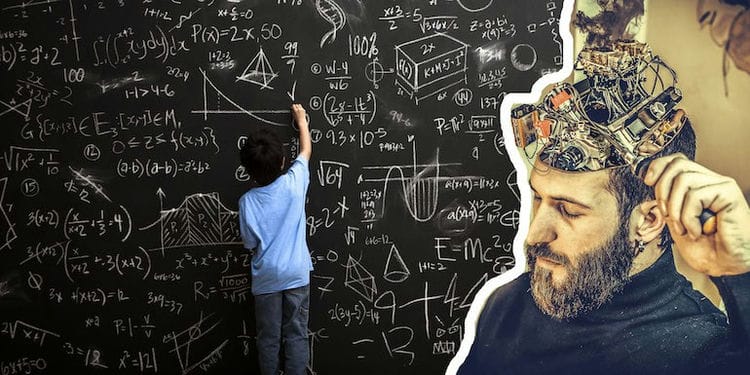
Mathematics for the development of intelligence
Playing a musical instrument
There has been a lot of research on how music affects the brain and develops intelligence. In addition to the fact that a person who listens to and reproduces classical music becomes kind and calm, he also develops.
IQ develops not listening to music, but playing the instrument. Especially on instruments such as piano, violin, guitar, accordion, bandura and others, where the hands perform different movements.
Be creative
Creative, creative thinking is now in the price. Try to be creative in solving different problems. For example, when making a decision, draw a problem, examine each squiggle, and write down any associations you have. Then match all the words, find a solution, a new approach to the problem.
This method is not new. This is how Leonardo da Vinci acted. It was he who began to make sketches of his world famous works in this way.
Start learning foreign languages
This should be done not only to be educated, but also to develop your brain and intelligence. Read books in a foreign language, try to speak in the simplest phrases. Ideal if you find a native speaker.
Intelligentsia and intellectuals in various countries
In many languages of the world, the concept of “intelligentsia” is used quite rarely. In the West, the term “intellectuals” is more popular, which denotes people who are professionally engaged in intellectual (mental) activities, without pretending, as a rule, to the role of carriers of “higher ideals”. The basis for distinguishing such a group is the division of labor between workers of mental and physical labor.
People who are professionally engaged in intellectual activities (teachers, doctors, etc.) already existed in antiquity and in the Middle Ages. But they became a large social group only in the era of modern times, when the number of people engaged in mental labor increased sharply. Only from that time on can we talk about a socio-cultural community, whose representatives by their professional intellectual activities (science, education, art, law, etc.) generate, reproduce and develop cultural values, contributing to the enlightenment and progress of society.
Since creative activity necessarily presupposes a critical attitude towards the prevailing opinions, persons of mental labor always act as carriers of “critical potential.” It was the intellectuals who created new ideological doctrines (republicanism, nationalism, socialism) and promoted them, thereby ensuring a constant renewal of the system of social values.
Love for one's people is a fundamental and almost identifying trait of the intelligentsia. Almost – because part of the intelligentsia still disliked the people, aroused in them disbelief in the “village” spiritual potential. And the relationship between the intelligentsia and the people was built in contradictory ways. On the one hand, she went to self-denial (the feature that we deduce in the 7th sign of the intelligentsia and introduce into the author's definition): she fought for the abolition of serfdom, for social justice, sacrificing her position, freedom, and life. The people seemed to have received and felt support. On the other hand, to a simple peasant, the tsarist power seemed more understandable than the slogans of the intelligentsia. The “going to the people” of the 1860s was not crowned with success, at least the intelligentsia did not manage to unite with the masses. After the assassination of Emperor Alexander II, the idea failed altogether. Narodnaya Volya did not get it right with the “people's will”. A. Volynsky, pondering about that intelligentsia on fresh tracks in his articles, found in her a one-sidedness of political ideas, too distorted moral ideals. V. Rozanov was of the same opinion. Fighters for the liberation of the people – from freethinkers to direct figures – were exposed for delusion, dangerous propaganda and fanatical morality. This intelligentsia was distinguished by intolerance to those and those that contradicted their views. It was characterized not so much by the concentration of knowledge and achievements of mankind, by spiritual wealth, as, we believe, by a fanatical desire to change the world order. Change radically. Plus – sacrificing yourself. The end was noble, but the means … They were really cruel. And in the modern sense, they do not fit in with the intelligentsia. But the inconsistency of this social group still persists.
The love of the people of the intelligentsia can be explained by the reason for the withdrawal of many of its representatives from the masses already in our time, given the relative availability of education. However, individual Russian minds and talents traveled this path back in the 18th and 19th centuries. The fate of Lomonosov immediately comes to mind. This is one of the pioneers. Nowadays there are a lot of scientists, writers, artists with national roots who feed the intelligentsia and pull it towards the people – with their way of life, customs, and distinctive cultural heritage.
Of course, Western intellectuals cannot be completely denied love for the people or respect for the people. But their reverent attitude towards the people cannot be called their root feature either. It, this feeling, can make itself felt among the units of the intellectual community of the West, in which, by and large, everyone is for himself. No mutual help. No mutual support. The pragmatism of a sharp mind is aimed at personal self-affirmation, superiority, material well-being. Intellectuals are people of intellectual labor. Everything! Nothing extra. The intelligentsia is a spiritual and moral group. It is no coincidence that in the British Encyclopedia the dictionary entry of the concept “intellectual” comes with the subsection “Russian intellectual”. In the West, the concept of “intelligentsia” is not accepted, but in the Western scientific world it is understood as a Russian phenomenon, somewhat close to intellectualism.
– From the book by Vitaly Tepikin “The intelligentsia: a cultural context”
Russian intelligentsia
Peter I can be considered the “father” of the Russian intelligentsia, who created the conditions for the penetration of Western enlightenment ideas into Russia. Initially, people from the nobility were mainly engaged in the production of spiritual values. DS Likhachev calls the noblemen-free-thinkers of the late 18th century, such as Radishchev and Novikov, “the first typically Russian intellectuals”. In the 19th century, the bulk of this social group began to come from already non-noble strata of society (“raznochintsy”).
The mass use of the concept of “intelligentsia” in Russian culture began in the 1860s, when the journalist P. D. Boborykin began to use it in the mass press. Boborykin himself announced that he had borrowed this term from German culture, where it was used to refer to the stratum of society whose representatives are engaged in intellectual activity. Declaring himself the “godfather” of the new concept, Boborykin insisted on the special meaning he put into this term: he defined the intelligentsia as persons of “high intellectual and ethical culture”, and not as “mental workers.” In his opinion, the intelligentsia in Russia is a purely Russian moral and ethical phenomenon. In this understanding, the intelligentsia includes people of different professional groups, belonging to different political movements, but having a common spiritual and moral foundation.
In Russian pre-revolutionary culture, in the interpretation of the concept of “intelligentsia”, the criterion of engaging in mental labor faded into the background. The main features of the Russian intelligentsia were the features of social messianism: concern about the fate of their fatherland (civic responsibility); striving for social criticism, for combating that which hinders national development (the role of the bearer of public conscience); the ability to morally empathize with the “humiliated and insulted” (a sense of moral belonging). Thanks to a group of Russian philosophers of the “Silver Age”, authors of the sensational collection “Vekhi. A collection of articles on the Russian intelligentsia “(1909), the intelligentsia began to be defined primarily through opposition to the official state power. At the same time, the concepts of “educated class” and “intelligentsia” were partially divorced – not every educated person could be attributed to the intelligentsia, but only one who criticized the “backward” government. The critical attitude towards the tsarist government predetermined the sympathy of the Russian intelligentsia towards liberal and socialist ideas.
The Russian intelligentsia, understood as an aggregate of intellectual workers who opposed the government, found themselves in pre-revolutionary Russia as a rather isolated social group. The intellectuals were looked upon with suspicion not only by the official authorities, but also by the “common people”, who did not distinguish between intellectuals and “masters”. The contrast between the claim to messianism and isolation from the people led to the cultivation of constant repentance and self-flagellation among Russian intellectuals.
A special topic of discussion at the beginning of the 20th century was the place of the intelligentsia in the social structure of society. Some insisted on a non-class approach: the intelligentsia did not represent any special social group and did not belong to any class; being the elite of society, it becomes above class interests and expresses universal human ideals (N. A. Berdyaev, M. I. Tugan-Baranovsky, R. V. Ivanov-Razumnik). Others (N.I.Bukharin, A.S. Izgoev, and others) considered the intelligentsia within the framework of the class approach, but disagreed on the question of which class / classes it should belong to. Some believed that people from different classes belong to the intelligentsia, but at the same time they do not constitute a single social group, and it is necessary to talk not about the intelligentsia in general, but about various types of intelligentsia (for example, bourgeois, proletarian, peasant and even lumpen intelligentsia). Others attributed the intelligentsia to some very definite class. The most common options were the assertion that the intelligentsia was part of the bourgeois or proletarian class. Finally, still others singled out the intelligentsia as a special class.
In the 1930s, a new, already immense, expansion of the “intelligentsia” took place: according to the state calculation and obedient public consciousness, millions of civil servants were included in it, or rather to say: the entire intelligentsia was enrolled in civil servants, otherwise it was not said and it was written then, this is how the questionnaires were filled out, this is how bread cards were issued. By all strict regulations, the intelligentsia was driven into the official-bureaucratic class, and the very word “intelligentsia” was abandoned, it was mentioned almost exclusively as a bad word. (Even the liberal professions through “creative unions” were brought to an official state.) Since then, the intelligentsia has been in this sharply increased volume, distorted sense and diminished consciousness. When, from the end of the war, the word “intelligentsia” was partially restored to its rights,
In the pre-war years, the party and state leadership, the ruling class, did not allow themselves to be confused with either “employees” (they remained “workers”), much less with some rotten “intelligentsia,” they were clearly fenced off as a “proletarian” bone. But after the war, and especially in the 50s, even more in the 60s, when the “proletarian” terminology also faded, changing more and more to the “Soviet” one, and on the other hand, the leading figures of the intelligentsia were more and more admitted to leading positions, according to the technological needs of all types of government, the ruling class also allowed itself to be called “intelligentsia” (this is reflected in today's definition of the intelligentsia in the TSB), and the “intelligentsia” obediently accepted this expansion as well.
As far as it was monstrously thought before the revolution to call a priest an intellectual, it is so natural now to call a party agitator and political instructor an intellectual. So, having never received a clear definition of the intelligentsia, we seem to have ceased to need it. This word is now understood in our country as the entire educated stratum, everyone who received an education above seven grades of school. According to Dahl's dictionary, in contrast to enlighten, to educate means: to give only an outer gloss.
Although this gloss is of a rather third quality, in the spirit of the Russian language it will be true in meaning: this educated stratum, everything that is self-styled or recklessly called now “intelligentsia”, will be called educated.
– From A. Solzhenitsyn's article “Education”
Ushakov and the academic vocabulary define the word intelligentsia as “characteristic of the intellectual” with a negative connotation: “on the properties of the old, bourgeois intelligentsia” with its “lack of will, hesitation, doubts.” Both Ushakov and the academic vocabulary define the word intelligent as “inherent in the intelligentsia, intelligentsia” with a positive connotation: “educated, cultured.” “Cultural”, in turn, here clearly means not only the bearer of “enlightenment, education, reading” (the definition of the word culture in the academic dictionary), but also “possessing certain skills of behavior in society, educated” (one of the definitions of the word cultural in that the same dictionary). The antithesis to the word intelligent in modern linguistic consciousness will be not so much an ignoramus as an ignoramus (and, by the way, an intellectual is not a philistine, but a boor). Each of us feels the difference for example, between “intelligent appearance”, “intelligent behavior” and “intelligent appearance”, “intelligent behavior”. With the second adjective, it is as if there is a suspicion that, in fact, this appearance and this behavior are feigned, and with the first adjective, they are genuine. I remember a typical case. About ten years ago, the critic Andrei Levkin published an article in the Rodnik magazine under a title that was supposed to be provocative: “Why am I not an intellectual.” VP Grigoriev, a linguist, said on this occasion: “But he did not have the courage to write:” Why am I not intelligent “… and with the first adjective – authentic. I remember a typical case. About ten years ago, the critic Andrei Levkin published an article in the Rodnik magazine under a title that was supposed to be provocative: “Why am I not an intellectual.” VP Grigoriev, a linguist, said on this occasion: “But he did not have the courage to write:” Why am I not intelligent “… and with the first adjective – authentic. I remember a typical case. About ten years ago, the critic Andrei Levkin published an article in the Rodnik magazine under a title that was supposed to be provocative: “Why am I not an intellectual.” VP Grigoriev, a linguist, said on this occasion: “But he did not have the courage to write:” Why am I not intelligent “…
– From the article by M. Gasparov “Intellectuals, intellectuals, intelligence”
The Russian intelligentsia was a transplant: Western intellectualism transplanted onto the Russian barracks soil. The specificity of the Russian intelligentsia was engendered by the specificity of the Russian state power. In backward Russia, power was undivided and amorphous, it demanded not specialists-intellectuals, but generalists: under Peter – such people as Tatishchev or Nartov, under the Bolsheviks – such commissars who were easily transferred from the Cheka to the People's Commissariat of Railways, between generals who were appointed to command finance, and no one was surprised. The Russian opposition of all trades, the role of which had to be assumed by the intelligentsia, turned out to be a mirror of such Russian power. B. Vakhtin's “The Tale of a Prosperous Village” begins approximately like this (I quote from memory): “When Empress Elizaveta Petrovna abolished the death penalty in Russia and thus laid the foundation for the Russian intelligentsia …” That is, when the opposition to the state power ceased to be physically destroyed and began, for better or worse, to accumulate and look for a pool in society more comfortable for such an accumulation. This pool turned out to be that enlightened and semi-enlightened stratum of society, from which the intelligentsia later emerged as a specifically Russian phenomenon. It might not have become so specific if Russian social melioration had a reliable drainage system that protects the basin from overflow, and its surroundings from a revolutionary flood. But neither Elizaveta Petrovna nor her successors took care of this for various reasons … This pool turned out to be that enlightened and semi-enlightened stratum of society, from which the intelligentsia later emerged as a specifically Russian phenomenon. It might not have become so specific if Russian social melioration had a reliable drainage system that protects the basin from overflow, and its surroundings from a revolutionary flood. But neither Elizaveta Petrovna nor her successors took care of this for various reasons … This pool turned out to be that enlightened and semi-enlightened stratum of society, from which the intelligentsia later emerged as a specifically Russian phenomenon. It might not have become so specific if Russian social melioration had a reliable drainage system that protects the basin from overflow, and its surroundings from a revolutionary flood. But neither Elizaveta Petrovna nor her successors took care of this for various reasons …
… We saw how the criterion of the classical era, conscience, gives way to two others, the old and the new: on the one hand, this is enlightenment, on the other hand, this is intelligence as the ability to feel an equal in one's neighbor and treat him with respect. If only the concept of “intellectual” does not identify itself, blurring, with the concept of “just a good person” (Why is it already inconvenient to say “I am an intellectual”? Because this is the same as saying “I am a good person.”) Self-satisfaction is dangerous.
– From the book of M. Gasparov “Notes and extracts”
Sources used and useful links on the topic: https://sunmag.me/sovety/29-03-2014-chto-znachit-byt-intelligentnym-chelovekom.html https://www.infoniac.ru/news/Um-muzhchiny -mozhno-opredelit-po-licu.html https://www.syl.ru/article/334188/chto-takoe-intelligentnost-opredelenie-primeryi-obrazovannyiy-kulturnyiy-i-intelligentnyiy-chelovek https://edunews.ru /school/usefull-materials/stat-intellektualom.html https://gudi1991.ru/rasstrojstva/razvitie-intellektualnyh-sposobnostej.html https://levelself.ru/navyki/kak-stat-umnee-i-povysit-uroven -intellekta.html https://dic.academic.ru/dic.nsf/ruwiki/940828
Post source: lastici.ru