
The child does not eat anything: what are the reasons for this and is it possible to avoid it? the child does not eat anything at all what to do
Content
Tried methods
Most often, articles are full of tips for feeding babies aged 4-5 years. There is no question of how to force elders to eat. Probably it is understood that tougher methods can be applied to older children. For the purity of the experiment, I decided to use all the recommendations.
Decorate your food
This was the first recommendation we reviewed. Dima has personal dishes with his favorite cartoon characters, which, however, does not add to his son's appetite.
Therefore, breakfast porridge turned into a funny face made from fruits and jam. The experiment failed as soon as it started – even the bananas were intact, because they had particles of the hated food on them.
To spice up cocoa semolina, passing it off as a “chocolate dessert”, also turned out to be an empty idea. Having barely tried, Dmitry made a displeased face, declaring that it would be better to go to school hungry. This surprised me because he loves chocolate.
Things were better with the soup. Instead of regular vermicelli, I used butterfly pasta of different colors. What was my surprise when I found an empty plate! The son even gave up the habit of picking potatoes out of the broth and ate everything clean.
Now I try to decorate the table with multi-colored napkins, forming peculiar bright spots that attract attention. Making food look appealing helps me feed my baby.
Pedagogical complementary foods
This method of introducing food into the life of a baby is known to mothers of children under one year old. But I decided to try it on my over-aged lover to go on a hunger strike. After serving lunch or dinner, I put the youngest child's chair to the table, sat down to eat myself and showed with all my appearance how delicious it was to us. The elder lazily nibbled on cucumbers, ignoring buckwheat and stew.
I tried to implement the method several more times, changing the proposed dish. But chicken and steaks with a variety of cereals remained unloved. Somewhat interested in pilaf – just a couple of spoons.
Probably “advertising” products on the table will make someone's children appetite. It didn't help in our case. Perhaps the fact is that I was trying to feed food that my son had never touched.

Have a meal together
It seemed to me a great idea to involve the child in the process in the kitchen. We have been baking cakes and muffins together for a long time. Dima enthusiastically uses a mixer or blender.
The first time I asked him to heat the pasta and fry the sausage on his own. We used a multicooker. The child turned on the device and the required program.
I showed you how to wield a knife. Whining: “What if I cut off a finger?”, The cub coped with “Doktorskaya”. Every last crumb was eaten. I believe that the method gave a result, since sausages and sausages have always evoked negative emotions in Dima, and it has never been possible to feed him with them.
A few days later, a “control shot” was carried out – she invited me to cook cutlets. The “real man” was entrusted with turning the meat into mince. The products were also formed together. The classic mashed potatoes and cutlets for dinner were consumed without a single exclamation of displeasure. The child was proud of himself, boasted to relatives how he himself controlled the meat grinder.
I think this way of feeding will be firmly entrenched in our family. And the guy is already an adult – it's time to teach simple manipulations, like cut – wash – stir. And it is obvious that the food cooked with his own hands tastes better to him.

Magic taste!
But in the arsenal, parents have more tricks. The kid does not want to eat ordinary soup or vegetable stew, then they throw a bouillon cube into the concoction – and a simple dish in the blink of an eye turns into a fragrant miracle. One has only to smell it – and already drooling. And if you try it once, you won't drag it by the ears. What is this secret?
Yes, just a flavor enhancer. Many modern products, especially fast food, contain salts of glutamic acid – glutamates, in particular monosodium glutamate (E-621).
For the sake of fairness, it should be said that this is not exactly “chemistry”, since glutamic acid is found in many natural products: fresh meat, vegetables just picked from the garden, freshly picked fruits and berries …
Spoon for mom, spoon for dad. Common misconceptions about baby food
By the way, this is why fresh food has the most vivid taste and smell. But as it is stored and cooked, the amount of this amino acid decreases. Accordingly, the addition of glutamates returns to the finished products their taste lost during the production process. This is why foods with these additives are so popular.
Many children, once having tasted the soup from a bag with a flavor enhancer, turn up their noses at homemade borscht and simple chicken broth. Therefore, it is better for them not to try “fortified” food at all. The safe amount of monosodium glutamate for adults is no more than 1.5 g per day or 0.5 g at a time. For adolescents, the daily dose should not exceed 0.5 g. But for babies, such food, apart from harm, will do nothing.
Appetite secrets
But what should you do if your baby doesn't eat well? Try the following:
-
Follow the feeding regimen. Feed your baby every 3.5-4 hours.
-
Do not give your child anything other than plain water between meals. And right before lunch or dinner, it is better not to drink liquids.
-
Sweets and fruits can be given only after meals, and it is better to teach your child that you can eat sweets only at the table, and not wherever you have to.
-
Observe the eating ritual. The baby should have his own place at the table, his own dishes (ideally, the child should choose it to his liking). Children are great conservatives, they love it when everything goes the way they used to.
-
Don't put an excited toddler at the table. After active games, read a book for 10 minutes before you start eating.
-
To whet your appetite, you can give your child a small amount of light vegetable salad or sauerkraut before meals. Or a pickled cucumber.
How to feed a child on vacation? Pediatrician Secrets
-
It is best not to serve the same dish for several days in a row. Children with poor appetite need the most varied food. As a rule, children do not like to chew for a long time, so try to cook thinner soups and cereals, and instead of meat, often give cutlets.
-
Cook together: homemade food is always tastier.
-
Little ones need physical activity and fresh air. However, it will not hurt all the other babies.
The kid does not want to eat anything: what are the reasons?
The subjective definition of the norm is fundamentally wrong. It is necessary to clearly understand that the desire to eat is determined not by universal norms, but by the desire of the body, which depend on the constitution, energy expenditure, and the child's mood.
• Negative feelings while eating:
– physical sensations: stomach ache, painful swallowing, chewing, etc., which are associated with a specific disease.
– negative emotions: quarrels of adults or other seven members during the meal, remarks, punishments, threats, fear. Many children with decreased appetite due to psychogenic factors complain of abdominal pain during meals.
• Decreased appetite during an illness not associated with the digestive system. The activity of the food glands is inhibited with every disease. The situation is aggravated if anxious mums and dads force their children to eat at this time.
• The child will not eat anything when he protests, manipulates adults (for example, “eat everything if you buy a toy”), or wants to “take revenge” for an unfair punishment from the child's point of view.
• The child never gets hungry. This situation occurs if there is a habit of “biting” between meals, more often sweets. Or when anxious mothers themselves endlessly “cram” food into their child, and believe that their child does not eat anything. As a result, the stomach is constantly loaded, what is eaten without desire is not really digested.
Wrong tactics of behavior of parents when the child does not eat anything!
• Feed “at any cost”. The options are different: persuasion, the promise of a reward, or the distraction of attention from the meal itself: fairy tales, TV, toys.
• Violent food and even threats and punishments. Such actions of the parents are absolutely unacceptable, since as a result, a spasm of the stomach and intestines, vomiting, and neurosis may occur. The more adults make such “efforts” to feed the child, the less he eats.
• Lack of consensus on nutrition in the family. The situation when mom forces you to finish eating, and dad allows you to leave food on the plate, or parents prohibit sweet snacks, and grandmother treats you to sweets, will only lead to the child trying to manipulate adults. The disputes and scandals of adults arising on this basis will lead to a nervous overload of the baby, which in turn will turn out to be negative on food.
• Anxiety and constant complaints from adults. It has been noticed that the third or fourth child in a family is rarely a “baby”. Why? Because mom has no time to watch every spoon, and in matters of nutrition, an experienced mom is calmer. Therefore, the first advice to parents is to stop fussing, getting nervous and asking friends and doctors “why the child doesn't eat anything, what to do?”
See a doctor
The first step is to check the health of the child. One of the main reasons for low appetite is feeling unwell. Children are often reluctant to eat when they have a fever, tummy ache, or teething. If refusals to eat are episodic during illness, it's okay. But when the baby constantly complains of discomfort and does not eat well, be sure to visit the pediatrician. Low appetite can be a symptom of a disease.
Children also eat poorly when they are nervous, too tired, or have recently had a lot of stress. What can be done in this situation? In a calm atmosphere, talk to your baby, find out what worries him, most likely, you can help him find a solution to the problem that worries him. Teach him to manage his emotions, increase his self-esteem and self-confidence. If he does not learn to do this as a child, it will be difficult for him as an adult.
How much food does a child actually need?
Psychologists and pediatricians advise to look at the current situation in a new way. For example, find out if your child is actually eating too little. According to statistics, among children under 7 years old, only 20% are true babies.
A small child, until he has formed eating habits, asks for food only when he is hungry. His appetite is driven by instinct. If the baby is doing well with health, then he will eat exactly as much as his body needs, and extra portions will only harm. When he gets older, he begins to focus not on the body's need for food, but on the socio-psychological situation, life experience, emotions.
How to determine how much food a child really needs? Pediatricians and psychologists advise to be guided by a simple rule: the baby must definitely eat as many spoons of each dish as he is full years old. In other words, a two-year-old toddler must eat at least two tablespoons of soup and two tablespoons of the second for lunch. If the child begins to be capricious, agree with him to focus on this rule. This will make eating more predictable and more comfortable for both baby and mom.
In matters of baby food, mothers often forget to count calories, and yet this is very important. If you carefully analyze the baby's diet, it may turn out that he is getting much more calories than he needs.
- At the age of 6 – 12 months, the baby needs 800 kcal;
- In 1 – 3 years, 1300 – 1500 kcal is required;
- At 3 – 6 years old, the daily rate is up to 2000 kcal;
- At 6 – 10 years old – up to 2400 kcal.
Now check how many calories are in baby cottage cheese, fruit, porridge, cutlet and other foods that your baby usually eats. It is possible that you are forcing him to eat too much, and he refuses instinctively.
1 Do not put pressure on the child
Children are sensitive to emotions of adults, especially negative ones. Take a half-eaten meal calmly: if you haven't eaten it, it means you're not hungry. If this is not an important problem for the baby, then you should not sound the alarm either. Do not seek to feed him at any cost.
- Never try to force-feed a child, do not threaten (like “Don't eat it – pour it on your head”) – do not break his will.
- Never scold your child when he eats for poor appetite, a stain on clothes, or behavior – eating will be associated with negative emotions.
- Never shove a spoon if the child stubbornly closes his mouth and pushes the plate aside, he is full and there is no need to overfeed him.
- Never punish your child with food.
Learn to distinguish whims from satiety. Keep calm. It is better to put a dish in a prominent place with healthy snacks – fruits and chopped vegetables. When the child is hungry, he will come and eat. The instinct of self-preservation cannot be fooled.
Should the child be forced to eat?
Nutrition is one of the basic needs of the human body. Sleep, going to the toilet, eating – these are the basics.
Of course, starving a child is by no means necessary. This is a drastic way to regain your appetite. The instinct will take its toll if you do not deprive the child of food, but simply set a framework for acceptable behavior, but both you and the child will spend a lot of nerves.
We will go on a smoother path.
Two-year-olds do not eat well for two main reasons:
- physiological (they are now growing less than before a year);
- and psychological (studying the world around us is more interesting than sitting over plates).
In addition, each of them has its own weight, height, metabolic rate, energy consumption. Consider this.
And further. A child of this age perfectly understands whether he is satiated or not.
Know! Therefore, if something constantly remains on the plate, just reduce the portion a little: perhaps you just think that your child at 2 years old has a poor appetite.
But, if you start a war for volume, feeding him, because “he is small and thin”, then this will only cause a violent protest.
2 Make meals a family ritual
Rituals that are repeated day after day help children feel safe. How to make a tradition out of a regular lunch? Very simple. Lay a colorful tablecloth or oilcloth on the table, put beautiful dishes, lay out napkins. Sit down for dinner or lunch with the whole family. Turn off the TV to avoid distracting your child. Talk at the table: how was the day, what interesting things happened, plans for tomorrow. Let the child see that eating is something interesting, calm and pleasant, of course, he himself will want to take part in the family meal.
3 Set a positive example
Do you want your child to eat right and at the same time? Then do the same yourself:
- eat yourself only when you are hungry – after sleep, at lunch, after a walk
- try to have breakfast, lunch and dinner at a certain time,
- limit food intake by time – 20-30 minutes, portions should be small;
- try not to snack between meals, and if you do, then choose fruits and vegetables;
- give preference to a healthy variety of food, it is not necessary to bump into fashionable food “religions”;
- make sure that the child gets enough vegetables, meat, fruits, fish, cereals;
- Offer products according to age, prepare new dishes regularly.
Agree, it is dishonest to demand from a kid that he eats a bowl of soup completely when you yourself have dinner with an appetizing sandwich or kill your appetite with chocolate. Our eating habits are formed in childhood, and what they will be in a child depends only on you.
Why can't you force feed your children?
A negative attitude towards food intake will be fixed in the mind of the child and can subsequently lead to neurotic disorders and diseases of the gastrointestinal tract. In addition, scientists have proven the psychological harm of force feeding. Children raised by such methods often grow up as dependent people, unable to adequately assess their own needs and desires.
Adults should forbid themselves to force-feed their children. The need for food is inherent in every person, including children, and as soon as they get hungry, they will immediately ask for food.
Baby 1-5 months old does not eat well
Newborn babies adapt for a long time to the shape of the mother's nipple. Each woman has her own anatomical features: the nipple can be inverted or weakly expressed. In addition, there are often problems with lactation, a weak milk flow, a specific taste is possible. Therefore, babies refuse to eat, accompanying dissatisfaction with “hungry crying”.
In this situation, the mother needs to revise her diet, excluding fatty, salty, smoked, spicy foods. It is also important to do breast development by hand or with a breast pump.
Other likely causes of starvation:
- abdominal pain, colic;
- temperature increase;
- teeth began to erupt;
- worried about thrush in the mouth.

Thrush may be the reason for refusing to eat
For a baby on artificial nutrition for a balanced diet from 4 months, they begin to introduce the first complementary foods: juices and fruit puree. Babies with breast milk require an additional source of energy from 6 months. In some cases, when there is not enough milk or the crumb is underweight, the pediatrician decides on an earlier introduction of complementary foods.
Compliance
Not many parents calmly accept the child's reluctance to eat whatever is offered to him. Usually, dads normally treat a child's poor appetite at 2 years old. They are not often involved in feeding the baby. Therefore, for them, the reluctance to eat crumbs does not look like a frightening and alarming signal. Unlike mothers, who, although they try to adhere to the principle “do not force feed,” are very upset if they do not please the taste preferences of their baby. norms that have long outlived themselves, they turn food intake into a real cult and begin to count everything that the child ate in a day.
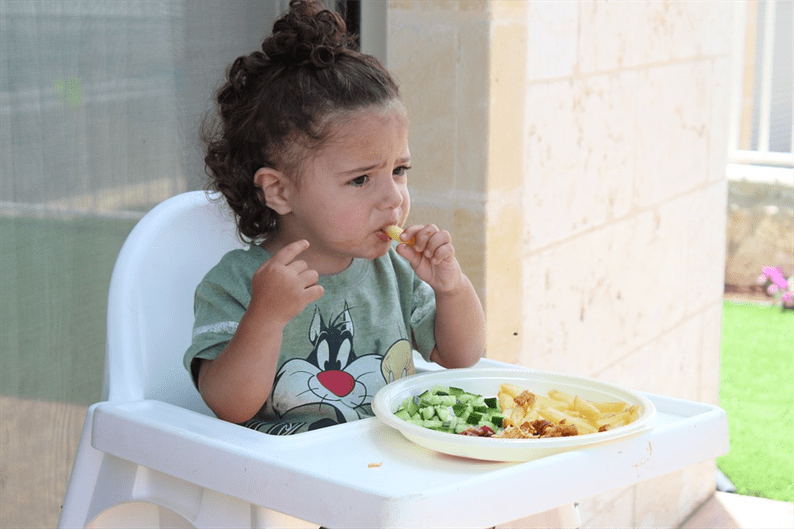
Pediatricians say that a child aged 1-3 years should have four meals a day – breakfast, lunch, afternoon tea and dinner. Moreover, he should eat about 50% of the daily allowance for lunch. But the other 50% must be distributed over the remaining meals. The daily energy value of products should not exceed 1400 kcal.
The reasons for this behavior
Some parents wonder why the child does not eat anything. It is important to understand what causes this behavior. The whole group of reasons can be divided into two: those related to the state of health and to the peculiarities of character. If your baby refuses to eat, you need to pay attention to his health, perhaps, loss of appetite is one of the many symptoms, and all together they indicate the presence of some pathology in the body. It is possible that the reason for refusal to eat may be a simple unwillingness to eat something that is not to your taste. This behavior is especially typical for the case when a child for 3 years does not eat anything. This is a turning point, babies at this age go against everything.
However, in this situation we are talking about a partial refusal of food, that is, the baby eats, but not everything, or refuses one feeding, but agrees to another. If the toddler does not want to eat food for the whole day, then we are talking about a pathological process, the child must be immediately shown to a specialist.
Let's look at the main reasons that can affect the lack of appetite in a child of two to three years:
- Individual intolerance to a particular dish.
When I was at that age, I could not stand semolina porridge. And my mother constantly tried to feed me with it and thought that I wasn’t eating well. In fact, it took her not a week to realize that it was dairy products. The fact is that she tried every day to cook either porridge or pasta in milk. As it turned out, I was lactose intolerant. It turns out that the body defended itself.
- The child's reaction to new meals in the diet. It happens that the baby is difficult to perceive a new type or aroma of food. In such a situation, parents should be patient, in no case do not force the baby to eat forcibly.
- The toddler may refuse to eat if it is very cold or hot, of the wrong consistency.
- Often, the child may have no appetite because he has already eaten enough. In such cases, it is important to know what a single portion of food the baby has, so as not to stuff it in excess of the norm.
- The kid may refuse to eat because he has not had time to get hungry. Such situations are typical if there is no clear daily routine, not enough time passes between meals.
- A child may refuse to eat because they are being fed snacks. Especially if these are not fruits, for example, an apple, but some kind of sweets, cookies.
My niece is almost three years old, I had the opportunity to be with her for several days. This is the very case when the child really eats poorly due to constant snacking on sweets. In fact, this way of eating makes you wary.
- Toddlers may have a low need for food as a source of energy. Here we are talking about sedentary children. They do not have time to waste their energy, so there is no need to replenish it.
- Lack of appetite can be caused by a bad mood, the child can experience nervous situations, something worries him, perhaps the situation in the family oppresses him.
- The appetite of the toddler also changes depending on the time of year or day. Perhaps your baby just eats little in winter, but a lot in summer, or vice versa.
- If a child starts eating with pleasure, but then suddenly loses interest, most likely, he is tormented by some problems in the organs involved in the digestion process. So, perhaps, the baby has candidiasis in the oral cavity or stomatitis, angina or an early stage of gastritis, enterocolitis develops.
- Do not forget about viral, infectious diseases. If a child has a fever or an infectious process begins, in almost one hundred percent of cases, the appetite will be completely absent.
- Unwillingness to eat may indicate the presence of parasites in the baby's body. Although there is also the opposite picture in the presence of helminthic invasion.
- If there is a suspicion that the little one is not eating due to an illness, then it is necessary to urgently seek help from a doctor.
- If you notice that your child eats less than the neighbor's, this is not a reason to panic. It is possible that your baby has increased excitability, and, therefore, significantly less saliva is secreted, which makes it difficult to eat dense foods.
Parents should understand what the lack of adequate nutrition is fraught with, in particular, it can lead to vitamin deficiency and anemia. That is why it is necessary to timely identify the cause of such a condition in a child and begin to act in time.
We eat right!
If there is a problem with appetite, parents should approach the nutritional process differently.
- Breakfasts, lunches and dinners should gather the whole family at the table to chat, talk and have a good time. The meal will be associated with a pleasant event, and the child will be happy to wait for this hour.
- It is necessary to eat in a favorable environment, so you should not react with shouting and coercion if the child refuses to eat. Better praise him when he ate well, learn to negotiate with him. It will take not a year, but only a couple of weeks – and you will learn to loyally approach this issue and do everything right, most importantly, not with a scandal.
- Not all children eat the same – some need more, some less. Physiological features are also worth considering.
- You should not force the kid to finish eating everything that is on the plate, but let him try each of the offered dishes – potatoes, cutlets, salad and more.
- Put food in small portions – it is better to add a supplement later.
- Do not compare your child with his brothers and sisters or other children.
Useful: Introducing New Products into Complementary Feeding for Breastfeeding
Psychologists recommend involving babies in cooking, so they will have a healthy interest, and they will definitely eat what they themselves did. For example, a three-year-old can easily pour pasta into boiling water or cereal with soup. An older child can already cut a salad or help mom bake a cake. Don't be afraid to involve your children in cooking – they will enjoy the process and will improve their appetite by itself.
Sources used and useful links on the topic: https://EdaKarapuza.ru/pitanie/menu/kak-nakormit-rebenka.html https://aif.ru/health/children/1123881 https: // beremennost-po-nedelyam. com / rebenok_nichego_ne_est_kakiye_na_eto_prichinyi_i_vozmojno_li_etogo_izbejat / http://karkusha.su/rebenok-ploho-est-sovetyi-psihologa/ https://uroki4mam.ru/plohoj-appetit-u-rebenka-v-2-goda https://PitanieMalysha.ru / rekomendacii / rebenok-ploho-est-v-chem-prichina-i-chto-delat / https://vseozozh.ru/pochemu-rebenok-ne-est/ https://FB.ru/article/434159/rebenok -v-goda-nichego-ne-est-chto-delat-nujno-li-zastavlyat-rebenka-est https://zdorovyemalisha.ru/zdorovye/rebenok-nichego-ne-est-v-2-3-goda. html https://agushkin.ru/kormlenie/rebenok-otkazyvaetsya-ot-edy-pochemu-i-chto-delat.html
Post source: lastici.ru