
Some of the best ways to learn English! How to Learn English: Proven Techniques and Ways for Self-Study

Learning English by the method of Dr. Pimsler
This is a very popular technique for learning English, which is tied to the regular repetition of already learned material while learning new one.
The main feature of the training program according to the Pimsler method (sometimes mistakenly called the “Pilsner method”) is the presence of a constantly speaking speaker with whom the student can start a dialogue or just scroll through.
Courses using this system still involve active contact with pre-recorded speaker lines. In addition, each lesson lasts half an hour, and after one lesson it is recommended not to start a new one right away.
Among the advantages of this teaching method:
- consistency of material;
- ensuring that the student has mastered the material completely before moving on to the next topic;
- length of individual lessons;
- the ability to download a playlist, call it “Dr. Pimsler's English” and listen to it while traveling by metro or bus.
But there are also disadvantages:
- the length of the entire Pimsler course is on average 45 hours (90 lessons of 30 minutes each);
- at the recommended pace of listening to the course, it is very easy to forget the material in between classes;
- how quickly a student can learn English depends not only on himself, but also on the speaker, which can seriously slow down the systemic learning process.
Training by the Ilona Davydova method
This system is tied to learning by memorizing the key points of learning through the impact on the subconscious levers of human psychology. The author is psychologist Ilona Davydova.
This means that each step in the course is not accidental and has some basis behind it (on paper, of course). First of all, a person's memory is activated by emotional perception, subject matter and pace.
How effective this technique is is difficult to say. And to understand whether it is suitable for a particular student is difficult without buying it. An English course costs 5900 rubles, which is its main drawback (you can find equally effective methods for free).
In addition, the method first appeared in the nineties, when it received tons of positive reviews. Now it is difficult to see the real look of the product behind them. It follows from all that it is far from among the best methods of learning English.
Oxford and Cambridge ways
These systems of teaching English were developed by British professors (it's easy to guess: both Cambridge and Oxford are in Britain), because of this, students have a much higher trust rating. In addition, these systems have existed for over 60 years and have managed to prove themselves to people all over the world.
The differences between them are fundamentally minimal. In both cases, the teacher is a person who knows English perfectly, in most cases – a direct native speaker. Teachers do not just tell children the rules, they immerse them in an oral environment, encourage them to speak and write in English on their own. Therefore, it is one of the best methods of learning English.
The only significant difference is that the Oxford system exclusively encourages speaking and hearing. Of course, the child will know how words are spelled.
But, first of all, he will learn to use them in conversation, logically build sentences and independently build verbal expressions. The Cambridge system doesn't ignore writing that much.
Reading by the method of Ilya Frank
This method of learning English is based on delimiting the whole text into separate segments and interspersed with the same fragments, but already translated, between them.
Since many people decide to learn English, starting with reading books in this language (this is how you can learn the language at home and on the street), the method can already be regarded as good. Usually, to understand the plot, you have to look away from the book and look into a dictionary or translator, while losing focus.
Books rewritten with the introduction of this method allow not only not to break away from reading (which causes great relief), but also to see how the whole thought is translated, and not individual words in it. Thanks to this, many phrases, idioms, and vocabulary in general are easily remembered.
The method is very useful in that it deprives a very common way of learning English on your own most of its disadvantages.
However, Ilya Frank's system also has drawbacks: for example, the lack of transcription, the ability to feel direct speech. But these deprivations can be compensated for by other methods.
ESL
It is more of a theory of instruction than a program or course. ESL stands for English as a Second Language and is used by many online courses as well as schools. This is a communicative principle of learning English, which is very similar to Cambridge and Oxford.
A beginner student who is trained in this theory will receive not just a dry theory, he himself will participate in communication in a foreign language and apply the rules in practice.
The difference between ESL and its more well-known counterparts is that, first of all, the student is taught how the English-speaking society works. Specifically, American, because most of the ESL courses teach exactly the American version of English.
Special services methods
Under this phrase lies many different systems for quickly learning foreign languages, each of which somehow takes its roots in the programs that were once taught to scouts and spies. The phenomenon is far from new; such programs have been known since the 60s.
It is not possible to find out exactly whether any special service used one of these learning methods, but now express courses in learning English with associative methods are called “methods of special services” in one way.
The training program is different, for example:
- separate words are built together in any sentence, henceforth being associated with each other;
- foreign words are remembered in conjunction with relatives in sound or spelling;
- whole sentences are memorized for the sake of a few words.
Many people think that this is the best method available, but it is not. It is difficult to judge how effective this method is, since the average student already remembers most of his vocabulary thanks to associations.
And such an “accelerated” course also deprives the student of writing and spelling. Such methods may be suitable for service agents, but hardly for the average person.
Dmitry Petrov's method
Dmitry Petrov is a well-known linguist, translator and public figure who speaks more than 15 languages. He developed a course of 16 video lessons that can be found on the Internet in the public domain (episodes of the “Polyglot” program on the “Russia Culture” TV channel). You can watch video tutorials.
In addition to the video tutorial course, there is a free mobile application for learning English using the Dmitry Petrov method.
The effectiveness of Dmitry Petrov's method: the material is presented in a very simple and understandable form, due to which the fear of tenses, verb forms, etc. is quickly dispelled. In a short time, you will gain communication skills, plus you will work out the basic algorithms of the language to automatism.
Duolingo.com Platform
Free international language learning platform without premium packages, ads and webinars, which was launched in 2011. The learning system is built in the form of interesting lessons based on gamification, as they progress through which students help to translate websites, articles, etc.
The basis of training is the Dualingo skill tree, along which users progress by completing tasks and earning experience points. The platform has many functions, for example, completing a task for a while, etc. Besides the web project, Duolingo has a mobile app. On Dualingo, you can study not only English, but German and French, and soon Spanish and Swedish will also be available.
Duolingo's Effectiveness: Research shows that 34 hours of classes on Duolingo provide the same reading and writing skills as a semester of study (130 hours) in higher education. Nowadays, many teachers in schools use the Dualingo program. The project provides excellent skills for speech recognition and translation.
Filmmaking with subtitles
The method is based on watching your favorite movies and TV series with double subtitles, but in English voice acting. It turns out that you simultaneously hear English speech and see the spelling and translation.
The main nuance lies in the correct choice of TV series and films. Beginners need to watch tapes in which there are simple dialogues and there is no use of specific words. Many people call the famous TV series “Friends” ideal for watching with double subtitles.
The effectiveness of the method: quickly memorize new words and phrases, master the pronunciation. However, to feel the effect, you need to watch a lot of episodes or films.

Ilya Frank's method
This method involves learning a language by reading books in English without a dictionary. You read and memorize due to the repetition of words in the text of books.
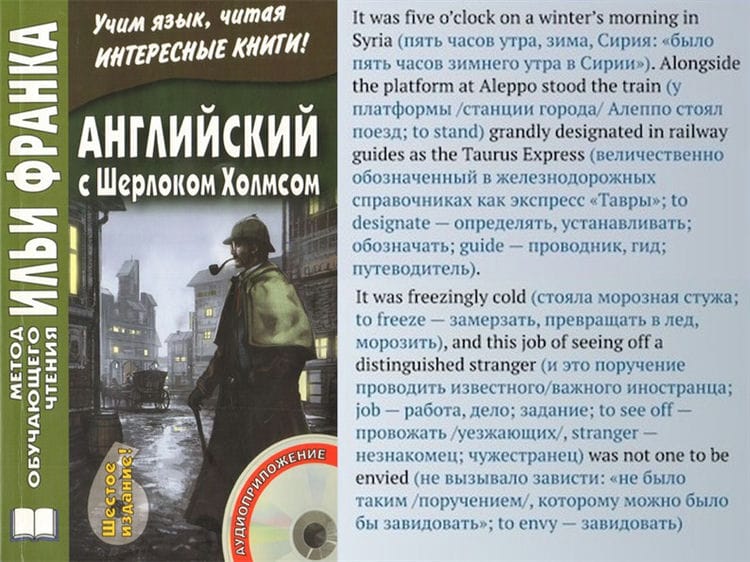
In addition, for an interesting reading, it offers explanations with the translation of each sentence. Just download Ilya Frank's books and read them at any time convenient for you. You can see how the text in the book looks in the picture below.
The effectiveness of the Ilya Frank method: learning according to Frank is ideal for memorizing words. You read the book, and as you learn, you start to skip the explanatory boxes. According to reviews, it is said that if you read 1-2 hours a day, then in a year you will be able to read English books in the original without any problems.
Alexander Dragunkin's method
Alexander Dragunkin developed his own methodology for teaching English, in which he abandoned the traditional classical study of the rules for reading words, replacing them with Russified transcription.
In his method, he also developed 53 “golden” grammar formulas that differ from the classical ones. Dragunkin offers his vision of language learning and understanding of grammar that will be simple and understandable for beginners.
To begin with, we recommend that you look at the 3-hour, under which you will find a link to many teaching materials and Dragunkin tables that help in training.
Effectiveness of the Dragunkin Method: The main advantage of the Dragunkin Method is that the material is presented in a very accessible form for “dummies”. All material (tables, rules) by Dragunkin is systematized, making it easy to remember.
Dr. Pimsler's method
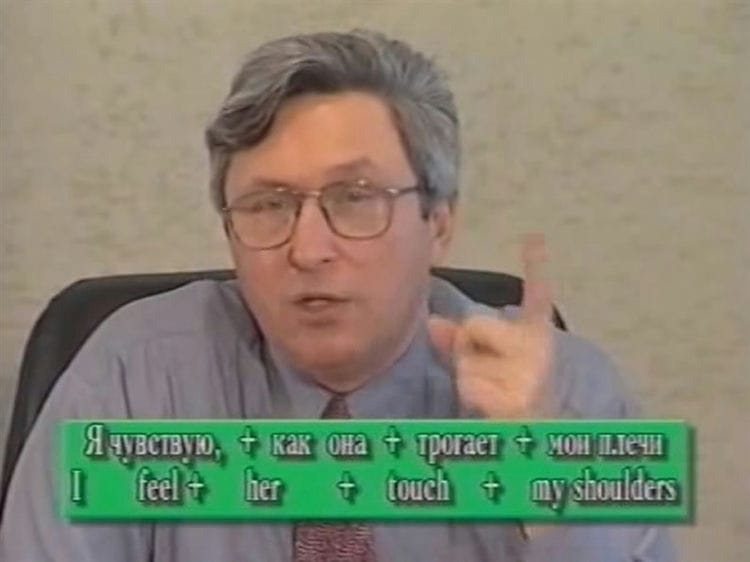
Dr. Pimsler's method is based on listening, when the student listens to dialogues, constructs phrases and reproduces them from memory. The training course consists of 3 parts, each of which has 30 lessons (audio material + text).
The important point is that learning according to the Pimsler method needs to be very focused. In particular, it is impossible, for example, to combine training with being in public places, because often, within the framework of training, it is necessary to repeat after the speaker.
Effectiveness of the Dr. Pimsler Method: Learning using this method is perfect for those who have poor pronunciation. The course by Dr. Pimsler's method perfectly develops memory and promotes good recognition of English speech (especially dialects).
Memorization of words. Mnemonics.
Popular wisdom says: “It is better to see once than hear a hundred times.” A person quickly and effortlessly remembers vivid pictures. Mnemonics teaches us to use this feature of our memory to memorize various information: historical dates, numbers, shopping lists, etc. Mnemonics methods They are excellent for memorizing foreign words, they are many times more effective than cramming, because cramming ignores the principles by which human memory works, while mnemonics, on the contrary, uses these principles to ensure the most effective memorization of words.
How does mnemonics work? Young children memorizing the order of the colors of the rainbow using a mnemonic phrase:
“Every hunter wants to know where the pheasant is sitting.”
the phrase is easy to remember, especially if you imagine how it will look like – a hunter with a gun looks at an advantage over a bright iridescent pheasant sitting on a branch.
In one of Sergei Lukyanenko's novels, the protagonist uses a killer mnemonic phrase as a password to a top-secret computer system:
“Forty-nine monkeys put a banana in the j_pu.”
Such a password cannot be forgotten. Especially if you imagine a picture of how it happened, it will be memorization from the first time for life.
We are interested in memorizing English words. Here is an example of how this is done using mnemonics. Word
eagle [needle] – eagle
we memorize with the help of the phrase “The claws of the EAGLE are 10 hellish needles”. Imagine an eagle – what a huge powerful bird it is, imagine its feathers, imagine that it is above you and that its claws pierce your shoulder, but instead of claws the eagle has 10 syringe needles, and there is a red cross on its side, imagine the pain you are experiencing. Have you presented? Now you have memorized this word for a long time, you can check it.
So, mnemonics will teach you how to translate foreign words into mnemonic phrases and vivid, memorable images. You can master this technique on your own in a few hours. You will be able to memorize foreign words at a speed of 10-30 words per hour.
Memorization of words. Method of cards.
Mnemonics will allow you to memorize a word for weeks and months. In order for the word to be kept in memory for years, it is necessary to repeat it periodically. But repetition is not cramming, there is a much more effective method – the method of cards.
The card method is very simple. You will need to buy small pieces of paper from a stationery store, about 5 by 5 centimeters in size. Let's say you have prepared 20 words that you need to remember. You do the following:
- Write the word and transcription on one side of the piece of paper, and the translation on the other. One word – one leaf. This makes a stack of 20 cards.
- Memorize all 20 words using mnemonics.
- A week after memorizing, the words need to be repeated. Take a stack and for each card do the following:
- look at the word written on the card, trying to remember the translation.
- Turn the card over and check that you have translated it correctly.
- If you have forgotten a word, put the card aside.
- Similarly, check the translation of a word from Russian into English.
- After a while, you will have accumulated a whole pile of cards that you put aside. You need to work with them more carefully, repeat them until you remember.
Aside from the effectiveness of this method, I like the fact that you can carry the stack of cards with you at all times and repeat the words wherever you go. There is always something to do in line or on the way to work. A minimum of free time is spent – only on the preparation of cards.
You may ask: “Why is the flashcard method more effective than the usual cramming?” There is a rigorous scientific explanation for this.
The fact is that a person has two types of memory: short-term and long-term. The characteristic of short-term memory is quick and easy memorization and the same quick forgetting. With long-term memory, the opposite is true – and remembering and forgetting takes a long time.
If we repeatedly extract information from short-term memory, then this information gradually begins to pass into long-term memory. Cramming is based on this principle. Mnemonics immediately throws information into long-term memory, which is more effective.
If we repeatedly extract information from long-term memory, then this information becomes less prone to forgetting. The card method is based on this principle. Cramming does not use long-term memory, so it is ineffective for repeating information.
Grammar. Milashevich's method.
Milashevich's method is a real gem that few people know about. This is a super technique that will teach you to translate grammatical constructions of any complexity in 30 minutes.
For example a sentence:
He will have been asked.
looks pretty scary. It has only two significant words:
he – he
ask – ask
Everything else: will, have, been, -ed are official words that are not translated in any way, but only carry information on how to connect the subject and the predicate into a sentence.
Milashevich compiled the decoding of all the service words (there are about 30 of them in total) into a compact table. According to this table:
will – grammatical feature of the future tense
have + (-ed) – perfective grammatical attribute
been + (-ed) – grammatical feature of the passive voice
Milashevich's second ingenious find is the formulation of a question, the answer to which will be the translation of a sentence.
In our example, the subject is “he”, so we start with the question
What is he doing?
And step by step we add to this question the grammatical features that we identified earlier. Let's add a passive voice:
What are they doing to him?
Let's add the future tense:
What will they do with him?
Let's add a perfect look:
What will they do to him?
By answering this question and substituting the verb to ask, we will receive a translation of the sentence:
He will be asked.
So, Milashevich's method will teach you to determine the time, type and voice in any English sentence by formal signs. You will also learn how to formulate a question, the answer to which will be the translation of a sentence. In just 30 minutes, you will learn how to translate the most difficult English sentences. The method will be useful to everyone, and if your goal is to learn how to read English texts, then this method is a real find for you.
Grammar. Dragunkin's method.
Unlike Milashevich's method, which is applicable only for reading English texts, Dragunkin's method is comprehensive, it allows you to understand English grammar in all its diversity. At the same time, the form of material supply differs sharply from traditional methods. The author of the technique rejected the outdated, often just artificial “rules” and gave his own description of English grammar – simple, logical and understandable.
Dragunkin uses his own terminology – functional, clear, absolutely transparent and understandable. Many original parallels with Russian grammar and their own transcription are used, with the help of which any beginner can easily read and learn English words! In addition, the author of the method has systematized the words-exceptions, solved the “problem” of articles and “irregular” verbs. And what is especially important, the most difficult “times” are mastered according to Dragunkin's method in a couple of days.
If your task is to master English grammar in full in order to write and speak in rich English, then the Dragunkin technique will allow you to achieve the result in the shortest possible time and without unnecessary effort.
The right training program is the foundation of success.
If language learning starts from a basic level, then it is better to involve professionals. In this case, tutoring via Skype is a flexible and fairly cost-effective way. Find your teacher, including a native speaker, on educational platforms such as buddyschool.com.
With self-study, you should not learn and repeat everything without a system, as it often happens. Rarely does anyone succeed in this case. How to be? It is much more effective to determine your level of language and identify gaps in knowledge with the help of professional tests, and, based on the results, already form an individual training program.
For an interesting lesson, time flies by.
 A person is so made – if he likes something, then it comes easily. For those who like to watch films, shows or educational programs, it is a great idea to watch them in the target language. If the level does not yet make it easy to understand the speech, you can find a movie with subtitles or first watch it in Russian.
Lovers of reading can turn their attention to books and magazines in a foreign language. Those who like to surf the Internet, studying interesting topics – welcome to profile foreign sites. This makes it possible to spend time with pleasure, and studying and listening to non-adapted texts allows you to get used to correct pronunciation, expand vocabulary, memorize the correct use of words and phrases.
In addition, a huge number of online seminars in different languages of the world are now available. You study for free, meet like-minded people from different countries, and even get a certificate! Cool? Certainly! Those who are interested should pay attention to the MOOC projects.
The StudyMOOC.org project allows you to get acquainted with various MOOC platforms that offer free academic courses from various universities in the world, as well as with the MOOC resources (mooc-university) of the universities themselves and choose the course you are interested in. Separate platforms have now begun to issue certificates based on the results of completing courses, which, apparently, will eventually matter in the eyes of the employer.
Regular vocabulary development.
It is extremely effective to memorize 10-20 words and phrases daily. It is advisable that the words relate to the same topic, although this is not required. It is better to learn words immediately in fixed expressions.
The moment will come when suitable expressions will begin to pop up in memory exactly when necessary.
Constant communication with native speakers destroys the language barrier.
Only the experience of live communication can break the language barrier. Where to look for native speakers if you live in Russia? Do you know foreigners? Excellent. If not, then you can meet interesting people on social networks, at international professional Internet forums, through the above-mentioned MEP project and other projects. Modern technologies allow not only to carry out correspondence, but also to talk live via Skype and other communication programs. In addition, in this way you can find friends in the intended country of study, this is just a good experience in developing your communication skills.
Systems approach.
It is important to choose a suitable learning rhythm (one hour a day, three hours a week) and practice regularly and responsibly. It sounds simple, but in practice it turns out to be more difficult, since there are always reasons (or reasons?) To skip a lesson, especially if you study on your own.
Intensity.
It is important not how long you study the language, but how intensively. You can practice for ten years to no avail, you can achieve dizzying results in six months. It all depends on the intensity and consistency.
Stage 1. Self-study lessons.
First you need to find a good tutorial. Personally, I like the series “Language without Borders” – I have passed through it three of my languages. There is a clear structure, a lot of entertaining material and often give comparisons with English.
But you can choose a tutorial and reviews on the Internet. Most importantly, it must contain audio and keys. I advise you to take the paper version with the ability to complete tasks right in the textbook: it's more efficient this way.
You need to trust the chosen tutorial and do everything that it offers – right in a row, without missing anything. Listen to audio, read texts, repeat aloud behind the speaker where required. In general, strictly adhere to the system.
Stage 2. Learning words – in parallel with the tutorial.
“You don't learn new words = you don’t learn the language”, I suggest that you take this as a given and not feel negative emotions about it. Plus, when you know some of the rules, word learning becomes quick and effective.
Where to get words from
New words will begin to appear in the tutorial, and, more often than not, they are there for a reason. I propose to take all of them, with the exception of completely unused ones (a la “desman”).
How to learn words
I use and willy recommend the spaced repetition method. This is when the algorithm generates words with different frequencies, based on your previous answers. I love the Anki Droid app dearly, despite the complex and not very beautiful interface. But the ability to customize algorithms, display methods and convenient import is one love.
By the way, I always learn words from foreign to Russian, but I repeat – from Russian to foreign. It is more difficult, but in my opinion, more useful: this skill is required in speaking and writing.
How to memorize words
I am using the association method. On this topic (as well as on any of the points, probably) it would be possible to write a separate article, then I will try to outline it briefly.
We have the word bizarre (strange, eccentric). I imagine a picture that I can describe with consonant Russian words: for example, I imagine a strange biz she who looks at me strangely and says: ” aaaaaaaaar “. As a result, when I remember something strange, this picture pops up in my head. Bizon, “aaaaar”: “Biz-aaaaar”.
Opponents of this technique usually say that this association is long to remember each time. That's right, but we only need to remember it the first few times. Then the process will go automatically and the word will be remembered directly.
Step one and only
Complete. Comprehensive. Conscious immersion in the language. Everyday.
The latter is especially important. If on the way to mastery there are 10,000 hours of deliberate practice, then you will have to practice every day.
Perhaps you have already heard this from who can and cannot. Another question is how to make it so that it is every day and not broke. Well, here we are ready to help a little.
Life hacks for self-study
Interest is your best tool.
Start watching movies in the original. Books and articles in English. Listen to English and American podcasts. You translate your favorite songs. You watch an English-language YouTube. You google your hobbies and keep an English diary. And everything in this spirit.
Several Resources You Can Use
Ororo – Movies and TV Shows in English and with Subtitles
Podcastsinenglish – Podcasts in English for All
Skills Wikihow – How to Do Anything Articles
Free-ebooks –
Genius Ebooks – English Song Lyrics
Alternate between activities
Write a training program. If you read the article yesterday, write the text today, and watch the video / film tomorrow. Everything is like in a simulator: chest + shoulders + triceps – back + triceps – legs.
Set mini-goals
A small goal provides as much certainty and motivation as a large one. And satisfaction – no less. Small goals, for example, might be:
• Chat with someone in English 5 times a week
• Listen to a 3-minute conversation from Harry Potter, record the entire conversation to learn how to understand that damn British accent
• Learn 20 words from the topic “Advertising “And shoot a commercial about the old chair in order to consolidate the vocabulary, and may already sell this chair abroad.
Stop using Google Translate.
You don't need a translator, but an explanatory dictionary. Don't read a blank translation, but memorize the definition. Here is a list of top dictionaries:
English-English dictionary / thesaurus
• – if you don't know what to choose from the list, choose it
• – the best for learning slang and modern language
• – utterly exhaustive
• and – dictionaries from two of the world's leading resources for learning English
Russian-English dictionary
• – good for translating and learning specific and professional vocabulary
• – ABBYY dictionary, simple and straightforward, suitable for beginners
All these resources have applications for smartphones. Install and use.
Practice Every Day
Even 15 minutes of reading will keep your brain tense.
You may have side effects. Dreams will start dreaming where you speak perfect English. Or you will remember English definitions of words instead of your native language. All in all, this is a good sign.
In addition to three times a week classes and electives, we give students homework to provide more practice. We recently launched a Telegram channel, in which tasks for practice are laid out every day. They are aimed at developing all skills, and the content is aimed at self-development. If you need a ready-made tool, then welcome to
Classic ways of learning
Let's start the analysis with standard language techniques, and then move on to individual methods.
Learning a language in a group
Acquaintance with a foreign language takes place in kindergarten or school. And here we are presented with the first method of teaching English – group lessons.
The scheme of work here is simple: the teacher explains the material and consolidates it with assignments for pairs / groups, occasionally working personally with each student. Having got used to this approach to science since childhood, an adult subconsciously chooses this method of learning English and goes to enroll in a group course. However, this learning technology has its pitfalls and is not suitable for everyone. We will describe the pros and cons in the table below.
| Learning English in groups | |
| + | – |
| Study under the guidance of an experienced teacher. | All students are at the same level.
The better you learn the material or worse – the group will not adapt to you. |
| The ability to communicate in groups, i.e. creation of a language environment. | Interviewing each student takes up a lot of class time, reducing individual learning outcomes. |
| Competent and varied teaching materials. | Team relationships can develop in different ways. |
Thus, the effectiveness of group lessons depends on the nature of the student and the interest in the lessons. For this method to be effective, you need a sociable student, an experienced and capable teacher who is able to interest the subject, as well as a well-chosen team.
Lessons with a tutor
Another way to learn English, familiar from school. In principle, it is similar in everything to the previous one, only it is devoid of “collective” shortcomings, since. here all attention is directed to one student.
The disadvantages of this technique are the very high cost of classes and dependence on the qualifications of the tutor. Not everyone comes across a good specialist who can not only explain the material in an accessible way, but also psychologically find a common language with the student. But if you are lucky with the selection of a teacher, this method of teaching will be the most effective. A competent teacher will be able to deliver a speech in the shortest possible time and will carefully monitor the constant progress in linguistics.
Selfeducation
In the age of high technologies and quick access to information, all opportunities for self-development have been created. In terms of linguistics, this is expressed in the availability of teaching aids (including audio and video files) and the ability to communicate with foreigners.
The success of self-study depends only on the chosen methodology for self-study of the English language. And here beginners have a vast field for experimentation: there are so many ways to learn English that everyone will definitely find their own method among them. The author's methods of learning English are devoted to independent work. Let's take a look at some of them.
“Polyglot” by Dmitry Petrov
“Polyglot” by Dmitry Petrov
It is worth paying attention to the experience of famous linguists and polyglots. For example, Dmitry Petrov's technique “Polyglot” directly on the air of one of the TV channels has proven its effectiveness. In 16 lessons, 8 people step by step master the language from scratch. The main requirement and condition is communication in English. From the very first lesson, students try to speak a foreign language, along the way learning new words and grammar.
At each subsequent lecture, new most used words and expressions, tables of verbs, pronouns, adjectives, tenses, numerals and other grammatical categories are added. At each lesson, live communication and consolidation of the passed material are practiced.
The group learns to build dialogues, talk about their hobbies, profession, family, talk on the phone, communicate on the Internet. By the end of the course, they can freely communicate with native speakers.
Schechter's method
This is a completely new emotional and semantic approach, asserting that mastering a foreign language should be similar to learning one's native speech. This method belongs to direct playful interactive methods of active learning. Politicians, cosmonauts, famous persons studied according to this method. Even Western private linguistic schools took notice of Schechter's method.
His methodology is based on a person-centered approach, where it is important to pay attention not to what to do with English, but to what to do with a person in order to facilitate his learning process. A positive atmosphere, friendliness, learning without fatigue and stress are the main and obligatory components of each lesson.
The purpose of each individual lesson and teaching as a whole is to encourage the student to express their opinion in their own words, and not to reproduce memorized patterns and phrases from textbooks. Therefore, lectures are organized in the form of active participation of a person in the changing events of business and city life.
Also, speech correction and grammar, which students study in the higher cycles of the course, are of great importance. This technology is also used to memorize new material without memorization and mechanical repetition.
Berlic
Methodology for learning English BERLITZ
Another popular technique is the BERLITZ technique, which polyglots have been using for 200 years. It is based on the study of a foreign language abroad. There are more than 400 BERLITZ language schools around the world. You can choose both classes in groups and individual training. Read the article How to study English abroad.
This method assumes strict adherence to the basic principles:
- First you need to learn to speak, and then master the skills of reading and writing.
- Grammar and vocabulary should be learned through natural, entertaining conversation, in a conversational context.
- Only native speakers should teach the language
- The student must take an active part in the learning process
- Native speech is not used at all, is excluded from training
- Such a concept as translation is also excluded
Rosetta Stone
Roseta Stone's English learning method
The Rosetta Stone method is also recognized as one of the best – a convenient program for those who are going to emigrate. Language learning from scratch. The user follows the same path as when learning their native language: words and images, pronunciation, grammar and syntax. The difficulty level increases gradually.
The flash method allows you to learn English the same way you learned your native language from infancy – without rules. Mastering English occurs through repeated repetition, immersion in the language environment, and the formation of associations. This program teaches you to automatically perceive and reproduce the most common colloquial constructions.
There is no translation in the course, instead there is an associative array. Vocabulary, syntax and grammar are learned in the course of modeling various life situations. The main focus is on visual memory. As a supplement, I will advise you to read a lot on your own.
The non-translation method means:
- No rules and no translation
- Words are given immediately in context
- Memorization is achieved through multiple repetitions
An excellent program for those who want to learn the basics of the language on their own without going too deep into the details. Pictures make the technique interesting, and learning happens without stress.
Lex!
Lex! – a well-known way of enriching vocabulary. Sitting at the computer, the user memorizes words, phrases, speech patterns that periodically appear on the screen. The ability to delete and add vocabulary, edit it, change levels of training intensity and time parameters is supported. The features of human memory, attention and perception are taken into account.
The user can set and separately configure a variety of translation modes: direct, reverse, written translation, their random alternation. The student independently determines the number of correct translations, which is an indicator that the word has been learned. Lex! – accompanied by a detailed guide, which will allow you to quickly find answers to all your questions.
Muller's method
Stanislav Müller's methodology consists in the harmonious interaction of conscious and subconscious thinking. To increase learning and memory, the latest developments in Russian and Western science are used – super-learning and holographic memory:
- Super trainability – helps to master any skills several times faster. At the same time, you get tired much less and maintain a high level of performance.
- Holographic memory – helps to systematize life experience, increases memory capabilities, allows you to restore the ability to master the language
During the passage, exercises are performed to improve the imagination, which contributes to the memorization of lexical material. The course solves the problems of understanding colloquial speech, free reading, writing and speaking.
Group English lessons

| pros | Minuses |
|---|---|
| average price |
The reasonable price is due to the large number of people in the group. However, you will have to spend extra on teaching materials.
| A large number of students in the group
Think of the pool lanes: it is difficult to choose any of them if you are average. On one, slow turtles are engaged, on the other, swift sharks. The same with group courses: you always have to wait for someone or keep up with someone. Everyone has a different speed in learning, and knowledge even at one level is different. If there are up to 7 people in a group, this is still acceptable, but if there are more, it will be difficult to learn the language.
|
| Communicative environment
Studying in a group, you immerse yourself in an English-speaking environment – you communicate with a large number of people, each of whom has his own experience and knowledge of the language. This allows you to build a future model of communication with foreign colleagues, residents of other countries, employees of foreign online stores.
| Lack of personal attention
You will not always get an opportunity to speak. While the group is going through a topic that is familiar and clear to you, you may get bored. And if something is unclear to you, no one will work it out personally with you, you will have to figure it out on your own. It may also happen that some students will constantly interrupt you and cause discomfort.
|
| Healthy competition
Group courses provide additional motivation for development. The best results from other students will motivate you to study harder to compose dialogues and write essays on par with excellent students.
| Socio-psychological barrier
Some people find it difficult to talk even in their native language, let alone a foreign one. It is psychologically difficult to endure the public expression of one's opinion.
|
| The ability to learn from other people's mistakes
Group lessons allow you to learn not only from your mistakes, but also from others.
| Waste time
You will have to wait for the teacher to sort out other people's mistakes in homework – he may not even get to yours due to lack of time. In addition, you will spend a lot of time from the lesson on collective tasks: repeatedly listening to audio recordings, reading texts by role, etc. In individual lessons, you do only those exercises that are useful to you.
|
| Diverse class format
A large number of students in a group allows the teacher to diversify the tasks: dialogues in pairs, speeches in front of other students on a topic and even English-language games (associations, “Dixit”, “Scrabble”, etc.)
| Informal atmosphere
Often times, participants in group courses become close friends and even become friends. This is good, but sometimes it hurts discipline, as classes turn into friendly get-togethers.
|
| | Influence of external factors
You are unlikely to be delighted with the need to go to another area of the city and put up with bad weather, traffic jams or crowded minibuses.
|
| | Inconvenient schedule
You will have to adjust to the schedule of most students. If they work until 5 pm, and you work until 7, no one will meet you halfway. In addition, you need to get into the group of your level: if you have Intermediate, and the others have Beginner, you can wait a long time until the group is formed.
|
| | Missed classes are not compensated
Most language centers are non-refundable. If you get sick, go on vacation, or simply do not have time to come to class, then the money will not be returned to you and there will be no opportunity to take these lessons. And the missed material will have to catch up on your own.
|
Who is suitable for :
-
Sociable people
If you have something to share with others, welcome to the group courses.
-
Children from 6 years old
The easiest way to start learning English is to immerse yourself in a communicative environment, study with other children.
Who is not suitable for :
-
Introverted people
It will be difficult for you to talk in a large group. Save your money for one-to-one English lessons, otherwise more active people will speak at your expense.
-
Always busy
Group lessons – this way of learning English is definitely not about saving time.
Cost :
- Moscow. A month of classes (8 lessons) in groups of 7-12 people with a Russian-speaking teacher costs from 6,000 to 15,000 rubles, with a native speaker – from 13,000 to 18,000 rubles. A month of classes (8 lessons) in mini-groups of 2-6 people with a Russian-speaking teacher costs from 22,000 rubles, with a native speaker – from 24,000 rubles. One course lasts on average 4-8 months.
- St. Petersburg. A month of classes with a Russian-speaking teacher in groups of 4-10 people costs from 3,000 to 8,000 rubles, with a native speaker – from 6,000 to 10,000 rubles.
- Yekaterinburg. A month of classes in groups of 4-7 people costs from 3,000 to 4,000 rubles, in groups of 2-3 people – from 4,000 to 6,000 rubles.
Where to start :
Study the ratings of English courses in your city, read reviews, ask friends for recommendations. Make a list of the most suitable language centers for yourself and then choose the best one based on your criteria. We advise you to focus not only on prices and geography, but also on the number of students in the group: if you are cheap and study with ten people, there will be little sense from such classes.
Private English Tutor

| pros | Minuses |
|---|---|
| Personal lessons |
The main plus is no stereotyped standards. Topics that you know well can skip quickly. And if something causes difficulties, you will disassemble the complex material for as long as it takes.
| Influence of external factors
Getting to the teacher on the other side of the city is a dubious pleasure. In addition, not everyone is ready to put up with other people's cats, dogs and everyday life. Having to host a teacher at home can also be uncomfortable.
|
| Your learning pace
You don't have to adapt to anyone – not too fast or slow. Together with the teacher, you choose the speed of learning and the amount of homework. For example, if you are going to take an exam soon, push it, not waiting for people from the group to catch up with you.
| Isolation of the teacher
Not all private tutors teach using modern materials, monitor changes in the language and are ready to spend time and energy on professional growth. This is because no one controls the work of a private teacher, as a result, you will have to completely trust the teacher's experience and knowledge.
|
| No socio-psychological barrier
If you do not understand something, you can always openly ask the teacher. You can also freely express your opinion on any topic, without fear of hearing the disapproval of classmates.
| Long search for your teacher
In a small town, it can be difficult to find a good teacher who will really help you achieve your goal, and not just “improve your English”. In addition, there is a risk that contact with the teacher will not work out, then you will have to spend time looking for something new.
|
| | Limited selection of tutorials
You will have to study according to one of the textbooks that the teacher has. If you need any specific allowance, you will have to look for it yourself and spend additional money on it. The teacher simply cannot afford to buy another textbook for the sake of one student.
|
| | Unsystematic classes with native speakers
English-speaking teachers do not always carefully prepare for the lesson and compose a personal program for the student. There are exceptions to each rule, but more often than not, native native tutors just talk to students about different topics – and that's it. There will be no sensible preparation for exams or practicing grammar topics.
|
Who is suitable for :
-
This is the easiest way to learn English for those who value personal contact and psychological support.
-
Busy people who need a flexible class schedule.
-
Children from 9 years old.
The teacher's pedagogical education will allow you to interest the child and keep his attention throughout the lesson.
Who is not suitable for :
-
Economical
This is the most expensive way to learn.
Cost :
- Moscow. Lesson 45-60 minutes with a Russian-speaking teacher costs from 1,000 to 3,500 rubles, with a native speaker – from 1,500 to 4,000 rubles.
- St. Petersburg. A lesson with a Russian-speaking teacher costs from 500 to 1,500 rubles, with a native speaker – from 800 to 2,500 rubles.
- Yekaterinburg. A lesson with a Russian-speaking teacher costs from 300 to 800 rubles.
- Online. A lesson with a Russian-speaking teacher costs from 500 rubles to 2,500 rubles, with a native speaker – from 1,200 to 3,000 rubles.
Where to start :
Check out teacher profiles on aggregator sites that host private tutor profiles. Based on good reviews and reasonable prices for you, you can choose the best one for yourself.
Online English school

| pros | Minuses |
|---|---|
| Ability to find your teacher |
You can choose your future teacher yourself or ask the school managers for help: they know everyone and will be able to choose a teacher according to your requirements. Take introductory lessons with those you like and practice with the best! Schools value their reputation, so you won't run into amateurs.
| Technical difficulites
We all have power outages sometimes, cats throw routers off tables, and Skype refuses to sign in. No one is insured against technical difficulties, as well as against traffic jams, bad weather, diseases or other factors. But most schools are prepared for technical problems. The lesson can be rescheduled or you can add unused time to the next lesson.
|
| Personal approach
The teacher will make an individual program based on your goal and wishes. You can practice late at night before bed, early in the morning before work, or on weekends. You will do as much homework as you master, take as many lessons as your wallet allows.
| Lack of computer literacy
Online classes are technically pretty straightforward: taking a video call and completing an assignment in Word isn't too difficult. However, if this is frightening or difficult, it is best to avoid this method.
|
| Classes from home
Weather, traffic jams, natural disasters and even human laziness are not a hindrance to you. All you need to do is be online a couple of minutes before class and enjoy the lesson.
| Self-discipline addiction
Some people find it difficult to force themselves to study seriously if they do not need to go to an offline lesson. The comfortable environment at home, in a cafe or in a park is suitable only for motivated students who can agree with themselves and understand that an online lesson is the same lesson in which the teacher is waiting for you.
|
| Systematic training
School instructors develop courses that will help you achieve your goal: pass the exam, prepare for an interview, travel freely, etc. The effectiveness of the courses is proven very simply – the real positive experience of school students.
| Isolation from classmates
If it is important for you that several people participate in the conversation, each of whom can discuss with you, then personal online training is not for you. But usually online schools provide services such as conversation clubs, where you can talk a lot.
|
| Affordable price
The prices in the online school are lower than in the classes with private tutors. In addition, various bonuses and discounts are often provided when paying for lesson packages.
| The need for personal contact
The online format is not for everyone. Someone needs the personal presence of a teacher for productive activities, which gives a lot of emotional support. And that's okay – all people are different.
|
| Own training platform
Some schools provide training via Skype, others use their developed online classes, in which you can both communicate with the teacher and use text, video and audio materials, and do homework.
| |
| Immersion in a communicative environment
Many schools give you the opportunity to chat in conversation clubs, watch webinars, read blogs, study apps and online simulators – all without interrupting your English. Teachers also constantly communicate with colleagues, take exams and improve their qualifications.
| |
| Classes with native speakers
Many schools provide an opportunity to study with a teacher from the UK or the USA – you can hone your pronunciation, master the grammar and vocabulary that foreigners really use. At the same time, methodologists and school managers control the work of native speakers, and lessons with them will not turn into conversations for life.
| |
Who is suitable for :
-
Lean
Online school is usually more expensive than group courses, but cheaper than private English tutors.
-
Time-conscious
Something will always demand your attention more, be it work or children. The online school adjusts to your schedule, not the other way around.
Who is not suitable for :
-
Small children under 9 years old.
Their restlessness requires the personal presence and attention of the teacher.
-
For those who are distrustful of new technologies and prefer familiar ways of learning a language.
Cost :
Lesson 45-50 minutes with a Russian-speaking teacher costs from 500 to 800 rubles, with a native speaker – from 1,200 to 1,400 rubles. Many online schools provide different bonuses and promotions: you can get lessons at a substantial discount or even for free.
Where to start :
You can look at reviews, ask around, and sign up for free introductory lessons at various online schools. So you can make your choice.
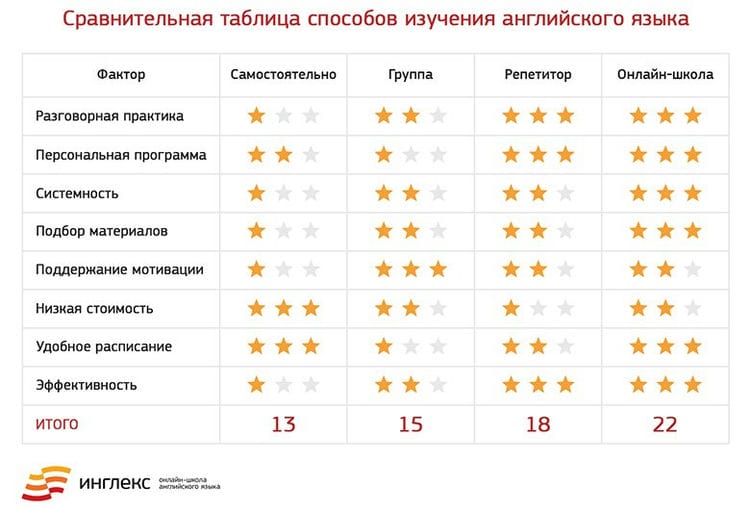
Let's recap and take a look at a comparison chart of ways to learn English. Each factor is evaluated here on a scale of 1 to 3 points.
Sources used and useful links on the topic: https://www.PamyatiNet.ru/izuchenie-yazykov/anglijskij/metody-izucheniya-anglijskogo-yazyka.html https://topovik.com/technologies/7-luchshix-sposobov-izuchit -anglijskij-besplatno http://pcards.hreminder.com/supermetodiki/7-5-supermetodik-dlya-bystrogo-izucheniya-anglijskogo.html https://gradstudyabroad.ru/educational-resources/how-to-learn-a -foreign-language https://vc.ru/education/96096-kak-vyuchit-inostrannyy-yazyk-poshagovyy-plan-c-nulya https://vc.ru/flood/37864-edinstvennyy-vernyy-sposob-vyuchit -angliyskiy https://speakenglishwell.ru/metody-izucheniya-anglijskogo-yazyka-rpopulyarnyh-metodiki/ https://EnglishFull.ru/kursy/metodiki-izucheniya-anglijskogo.html https://englex.ru/3-ways-to-learn-english/
Post source: lastici.ru