
Types of international examinations in English. International exams in English

Exams for Study Abroad
How many tempting prospects are opening up for us studying abroad! Have you already chosen where to enter the magistracy? The only thing left to do is to pass the exam. European countries and the United Kingdom most often require an IELTS (International English Language Testing System) certificate from the University of Cambridge in the list of documents for admission. If you are applying to a university in the USA or Canada, then most likely you will have to present a certificate of the American TOEFL (Test of English as a Foreign Language) exam. You can read more about choosing an exam in our article “Which exam to take: IELTS vs. TOEFL “
In many ways, these exams are similar. They confirm your current level of knowledge and do not imply any passing scores. The question is, will you be satisfied with a certificate that indicates the Pre-Intermediate level? Most likely not, because universities require Upper-Intermediate and higher. TOEFL and IELTS certificates are valid for two years after passing. And this is logical. First, the level of knowledge of the language changes. Secondly, such a certificate helps to solve the problem here and now: go to university, get a job, etc.
There are two types of IELTS exam: General and Academic. For study, you need Academic. It is more difficult than General: the writing and reading sections are based on complex texts with topical vocabulary and advanced grammar. And General will come in handy for any purpose other than education (immigration, work).
Exams for emigration and self-development
Have you been studying English for a long time and would like to prove that you have a decent level of knowledge? Then choose the exam among B2 First (FCE), C1 Advanced (CAE), C2 Proficiency (CPE).
The main advantage is that the certificates of these exams are valid for life. Only not everyone will receive it. Unfortunately, if the examinee fails to achieve a passing grade, then he will be given a certificate at a lower level. It's simple: if you passed the CAE and did not score the required minimum points, you will receive a document with the Upper-Intermediate level. Strictly but fair.
Exams for work
Have you been offered an interesting job in an international company? Great news! One thing: you need a certificate that confirms your high level of English proficiency. What is the best English exam to take for work? Choose: TOEIC, IELTS (General), B2 First (FCE), C1 Advanced (CAE), C2 Proficiency (CPE).
TOEIC is ideal if you are career-oriented and want to work for an international company. The test is based on vocabulary taken from real-life situations in the business world. The exam consists of two parts: TOEIC Listening and Reading and TOEIC Speaking and Writing.
Types of international examinations in English
All tests to determine the level of English are designed for those who are studying the language as a foreign language and are not native speakers. Typically, the choice of test will depend on the choice of the country in which you want to study or work.
The most popular international exams are TOEFL, TOEIC, IELTS and Cambridge tests.
TOEIC (Test of English for International Communication)
An exam to determine your level of proficiency in Business English. The TOEIC certificate is valid for two years, therefore it is better to take the test on the eve of your official employment or admission to a foreign university.
TOEFL or IELTS: which one to choose?
We have already talked about the IELTS (International English Language Testing System) exam and its American counterpart TOEFL (Test of English as a Foreign Language). We just want to draw your attention once again to the fact that the choice of exam will depend on the country: in the USA and Canada the TOEFL results are recognized, in the UK and Australia they prefer IELTS or Cambridge exams.
The IELTS certificate, like the TOEFL certificate, is valid for 2 years from the date of the test results. This is where the University of Cambridge exams differ from IELTS and TOEFL, as they do not have a limited duration.
Without deliberate preparation, it will be difficult to pass the exams. We have compiled a list of schools in Moscow that will help you prepare for IELTS and TOEFL.
Looking for courses in another city? Enguide service will help you choose training courses in your city for free.
KET, PET, FCE, CAE, CPE
Objectives: for work abroad, for admission to many colleges and some universities in the UK
Distribution: in the UK and in many countries of the world, more precisely, look at the official website of the Cambridge exams cambridgeenglish.org.
Requirements for candidates: no requirements
Views
- KET – level of English A2 (Pre-Intermediate)
- PET – level B1 (Intermediate)
- FCE – level B2 (Upper-Intermediate)
- CAE – level C1 (Advanced)
- CPE – level C2 (Proficiency)
The KET and PET exams are “for school” types – KET for school and PET for school.
KET and PET have three parts:
- Single section for reading and writing: 5 tasks for reading and understanding the text and 3 tasks for writing, including a short essay.
- Listening: 4 tasks on audio recordings.
- Speaking: 4 questions to which you need to give detailed oral answers.
FCE, CAE and CPE are divided into four blocks:
- Reading and Practical English: Comprehension tasks from fiction, newspapers and magazines.
- Writing: 2 tasks – an essay or a choice of feedback, report, article, official or unofficial letter.
- Listening: several short and long monologues and dialogues, to which questions are proposed.
- Spoken language: interview, individual task on the card, joint task with other candidates, discussion of the exercise.
Ratings:
For each part, a certain number of points are set, which are summed up and divided by the number of parts. For the entire exam, you can score up to 190 points. Depending on the number of points, the score is given: A, B, C.
If you have not reached the threshold score, it means that your level of English is lower than the level of the exam. In this case, you will not receive a certificate.
Grade A corresponds to a higher level than the exam level. For example, if you passed FCE (level B2) and received A, the certificate will write a higher level – C1.
Features:
- Speaking tasks are conducted in pairs: two examiners and two candidates.
- The Cambridge Exam Certificate is perpetual, valid for life.
- All exams in this category assess General English.
YLE
Goals : motivate children to learn English and prepare for more serious exams
Requirements for candidates : age from 7 to 12 years old
Views
- YLE Starters – Beginner Level
- YLE Movers – Elementary level
- YLE Flyers – Pre-Intermediate Level

The YLE exams are comprehensive and test all basic language skills: listening, reading, speaking, writing. They are perfectly adapted for childhood. The tasks are accompanied by vivid pictures. Examiners create a friendly environment, motivating to further study the language.
Evaluations
The exam is evaluated from 1 to 5 points, it is impossible not to pass it – every child who passes the exam receives a diploma.
BEC
Objectives: to work abroad or in a branch of a foreign company
Distribution: in the UK and in many countries of the world, more precisely, look at the official website of the Cambridge exams cambridgeenglish.org.
Requirements for candidates : age from 16 years
Views
- BEC Preliminary – Intermediate level
- BEC Vantage – Upper Intermediate level
- BEC Higher – Advanced level
You can also choose the format for passing the exam: written or computer.

The BEC Preliminary consists of three parts:
- Reading and writing – tasks of the type multiple choice, matching, right / wrong and others, there are seven parts in total.
- Listening – consists of four parts, each of which presents different tasks based on audio recordings: short and long dialogues and monologues, telephone conversations, discussions, interviews. The recordings can be listened to twice.
- Speaking – consists of three parts: meeting the examiner, a short presentation on the proposed topic and assignments paired with other candidates.
The other two levels BEC Vantage and BEC Higher consist of four parts, Reading and Writing are independent separate blocks.
Evaluations
The BEC Preliminary has four assessment categories:
- Pass with merit – 80-100% correct answers
- Pass – 65-79%
- Level A2 (previous level) – 40-64%
- Fail – 0-39%
The last result means that you did not pass the exam.
BEC Vantage and Higher are assessed slightly differently: A – 80-100% correct answers
- B – 75-79%
- C – 60-74%
- D – 55-59%
- AND – 0-54%
The last two marks mean that you have failed the exam.
Features of the
- All assignments are based on business situations, and the ability to use the language in a business context is assessed.
- The BEC certificate has no expiration date.
BULATS
Objectives: to work abroad or in a branch of a foreign company
Distribution: in the UK and in many countries of the world, more precisely, look at the official website of the Cambridge exams cambridgeenglish.org.
Requirements for candidates : age from 16 years
Views
BULATS is not categorized into types. This is a diagnostic exam, which is not divided into levels, but tests the level of knowledge. Only rented online.

BULATS consists of three parts:
- Speaking. There are several tasks you need to do aloud: answer questions, read sentences, write a presentation, describe a schedule. The candidate's speech is recorded on a microphone; personal conversations with the examiners are not held.
- Letter. The block consists of two tasks: write a short e-mail and a choice of a larger letter or report.
- Reading and listening. You are offered seven tasks based on audio recordings or texts of about 250 words. In some cases, the test ends earlier if the candidate has answered enough questions to help determine his level.
Evaluations
BULATS cannot be failed – in any case, you get a certificate with your level of English. The result is set in points, which can be translated into traditional names of levels:
- 90-100 points – Upper Advanced
- 75-89 points – Advanced
- 60-74 points – Upper Intermediate
- 40-59 points – Intermediate
- 20-39 points – Elementary
- 10-19 points – Beginner
Features of the
- The exam is usually not conducted on an individual basis, but by organizations for employees.
- You receive your reading and listening grade immediately upon completion of the test, the rest of the results come later.
- The exam tests business English.
- The exam is adaptive, the complexity of the subsequent tasks depends on how the candidate answered the previous questions.
5 mistakes when preparing for international exams
Preparation for international exams is a long and expensive business. And the exams themselves are not cheap, so this kind of work should be taken very seriously. Think about why you need a certificate, how and when you will use it. Decide which exam you need to take. Take into account and do not repeat the mistakes that many have already made before you, namely:
- Do not delay the choice. There is a preliminary registration for exams, on average, somewhere in 2-2.5 months you need to submit an application and pay. You cannot jump into the last carriage and apply for participation immediately before the exam. This is especially important for regions in which examination sessions are held only twice a year – if I didn't have time for the summer session, wait for winter.
- Do not expect to “slip through for free”, it will not work. You cannot buy an international certificate, you cannot ask someone to hand over it for you, and so on. International certificates are personalized, have several degrees of protection against counterfeiting, and IELTS also has a photograph, so you won't be able to use someone else's certificate either.
- Moreover, these exams cannot be “learned” – you cannot memorize some material, go and pass it. Exams test all skills, so you can immediately see whether a person understands the subject or not. It is not enough to learn words or grammatical structure, you still need to learn how to use them, it takes time. So, get ready in advance, at least a year in advance.
- It is very difficult to prepare for the exam completely on your own. Yes, there are a huge number of resources on the Internet, any search engine produces hundreds of results – textbooks, tests, articles, etc. But Speaking and Writing should be given to someone for verification, it is difficult to evaluate yourself. For example, when I was preparing for CPE, I did all the tasks myself, and my colleague checked the essays. She also helped prepare for Speaking.
- Don't choose a teacher because of the place of work. It doesn't matter if it is a school teacher, a university teacher or a private tutor. As you know, it is not a place that paints a person, but a person a place. But if your teacher does not have an international certificate, I would definitely not recommend paying a lot of money, especially for preparing for exams. International certificates at least indicate that a person is aware of current trends and requirements. And it certainly confirms the language qualifications, that is, the level of English proficiency. Ideally, the teacher should be certified for the exam that you need to take (or higher in level). But if, for example, a teacher has a good IELTS score, say, 8, then he can be entrusted with the preparation of any exam, of course. In the end, only the format is different.
Whichever method you choose, remember that success on the exam is 90% hard work. Follow the plan carefully, exercise at least 3-4 times a week. The international certificate in English opens the door to prestigious organizations and gives an advantage when entering the best universities. So it is definitely worth the work.
Major differences
In addition to the fact that these exams are conducted in different versions of English (British and American), TOEFL implies a choice of an answer from several proposed options, while the format of IELTS answers is much more varied. Here and short answers (True, False, Not given – “true, false, unknown”), and substitution of the missing word, and writing small essays on a given topic.
Taking IELTS takes much less time – 2 hours 40 minutes versus 4 hours for TOEFL. But TOEFL is taken in one day, and IELTS in two (the Speaking module is taken separately).
There is only one computerized version of the TOEFL exam, while IELTS has 2 versions (general and academic), available in paper format.
More by modules:
Reading
TOEFL – 3-5 reading passages, 20 minutes each. Reading materials on academic topics. The questions asked for the passages involve choosing an answer from several suggested options.
IELTS – 3 reading passages, 20 minutes each. Reading materials are also academic. Questions suggest a different answer format (substitution of the missing word, matching, etc.)
Listening
TOEFL – The audition passages are quite noticeably different from those included in the IELTS. The TOEFL offers 40-60 minute passages ranging from lectures to conversations on campus. During the exam, you can take notes, and after its completion – answer the questions, choosing from several proposed options.
IELTS – The biggest difference between the two exams is the listening module. The questions asked after listening have several different formats. You see the questions from the very beginning and you can answer them as you pass the test.
Writing
TOEFL – Required to complete two written assignments (on a computer). The first task is to write an essay consisting of 5 paragraphs (from 300 to 350 words).
The second “integrated” task involves reading the text and listening to a lecture on the same topic, followed by their comparison. As you progress through the assignment, you can take notes that you can use to write a written summary of 150-225 words.
IELTS – Also involves completing two assignments. The first is to write a short essay of 200-250 words. The second is to describe the infographic (graph or chart).
Speaking
TOEFL – You will have to listen to short fragments of text or dialogues and orally answer 6 different questions to the listened passages, writing down your answers on the computer (the answer should be no shorter than 45 and no longer than 60 seconds).
IELTS – In the IELTS version, this module takes 12-14 minutes and involves personal communication with the examiner.
The first preparatory exercise involves a conversation on general topics (a story about yourself, about your family, about a hobby, etc.) in a “question-answer” mode (this will take approximately 4-5 minutes).
The second exercise is longer and involves a story on a given topic (the topic itself and the theses of your future story are determined randomly). Your story should take 1-2 minutes, after which you will be asked one or two questions about the topic.
In the third part of the module, the examiner will ask more general questions. Your discussion will last 4-5 minutes.
Scoring
In TOEFL, the Speaking and Writing modules are assessed based on the overall impression you made on the examiners: your vocabulary, writing style and grammar are assessed.
These IELTS modules assess your logic, storytelling, grammar and fluency.
For example, an essay (essay) with a logical plot development, but numerous grammatical errors will be rated higher on the TOEFL, while an essay without grammatical errors and with more varied vocabulary, but less clearly expressing the main idea will receive a higher score in the IELTS …
IELTS is assessed on a nine-point system (from 1 to 9). In this case, the final score is calculated as the arithmetic mean of the scores obtained for all four modules (in half-point increments). There is only one final grade in TOEFL (maximum 120 points).
International exams by level
To make it easier to determine what knowledge you need and for which exam to prepare, it is enough to find out the relevance of a particular certificate in certain situations.
The table below summarizes the test types for different learning objectives and their results – including the levels of the Cambridge English exams.
|
The purpose of learning English |
Exam |
Level |
|
|
Study in foreign colleges and universities |
IELTS (Academic) (for UK) TOEFL (USA) |
Exams determine any language level, but at least Upper-Intermediate is required for admission |
|
|
Moving or learning a language for self-development |
FCE FALLS OFF CPE |
B2 C1 C2 |
|
|
Work in international companies, professional development |
TOEIC IELTS (General) FCE FALLS OFF CPE BULATS (The Business English Testing System) |
B2 C1 C2 Based on the results, a level from A1 to C2 is assigned |
|
|
Business English |
BEC Preliminary Vantage Higher |
Intermediate Upper-Intermediate Advanced |
|
|
For English teachers |
TKT (Teaching Knowledge Test) CELTIC DELTA |
Confirms proficiency in the methodology and theory of teaching English Proof of proficiency in practical teaching |
|
|
Baby |
7-12 years old |
YLE (Young Learners Test) Starters Movers Flyers |
Pre-A1 A1 A2 |
|
high school |
KET for Schools |
A2 |
|
|
High school students |
PET for Schools FCE for Schools |
B1 B2 |
There are enough English exams, which are considered prestigious around the world, and a certificate from any of them confirms your success in learning English.
Even in the process of preparing for the test, you can learn a lot of new things that you can later apply in practice.
If you intend to take tests of this level, you have the opportunity to try different methods and ways of preparing for the exam you have chosen:
- using special online courses;
- with a tutor who specializes in preparing for international exams;
- independently according to paper textbooks issued by the organizers of the tests.
Once you have found the most comfortable way for you to study the information you need for the exam, try to practice regularly and consistently, as well as learn as much as possible about the organization of the test.
In this case, you will be completely confident in your abilities and will be able to prove, first of all, to yourself that your English is at an excellent level!
How does TOEIC ® differ from TOEFL?
The tests were developed for different purposes: TOEFL – as a test for admission to universities in the USA and Canada, TOEIC – as a test for those who want to find a job abroad and receive a certificate confirming their proficiency in business English at a sufficient level for this purpose. The scores for both exams can be compared using the table with the international levels of English as a basis.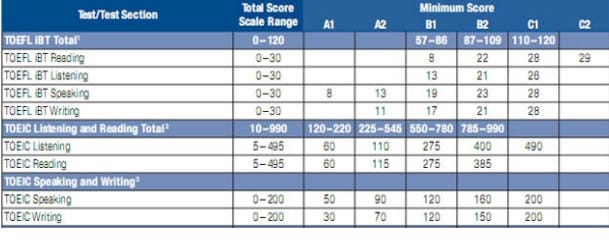
Exam structure
The Test of English for International Communication is not one but two different exams: TOEIC Speaking and Writing and TOEIC Reading and Listening. They surrender independently of each other, although, of course, you are supposed to pass both.
TOEIC Reading and Listening takes about 2.5 hours. Consists of two sections with 100 questions each. The answers are given on paper, there is no electronic version of the test.
TOEIC Speaking and Writing is also divided into two sections. Speaking consists of 11 questions and takes about 20 minutes. The examiner asks questions that approximate real-life business situations that you will need to answer. Writing is written answers to 8 assignments and takes about an hour.
Assessment system
TOEIC is impossible to fail – everyone who comes to take the test will receive a certificate. However, the points for each of the four modules are crucial – these are the points that the potential employer will pay attention to.
The TOEIC scoring system is quite complex. The ETS tried to develop a grading scale that would objectively reflect the examinee's skills in various aspects of business communication. Therefore, the assessment is tied not to the level of language proficiency, but to its practical application in work. We will not present the entire cumbersome system of points here – it can be found on the official ETS website or in Google by request “TOEIC scores”.
Self-preparation for passing tests
The first resource to bookmark while preparing for TOEIC is the official ETS website. There you will find practice tests and a list of recommended reading. There are two main tutorials: Tactics for the TOEIC Listening and Reading Test and Tactics for the TOEIC Speaking and Writing Tests. But we advise you not to limit yourself to a couple of textbooks – it is better if you involve different sources for preparation.
ETS themselves advise to integrate English into everyday life as a preparation, for example:
- listen to songs and podcasts in English, watch movies and TV shows, try to catch the logical stress, memorize idioms. By the way, we also wrote about learning English from films and TV series;
- read English-language periodicals, books and blogs – not only silently, but aloud;
- keep a diary in English to learn how to express yourself freely;
- of course, speak English as often as possible. You can find a company in the Skyeng conversation club
- leave comments on English-language sites and forums, or write reviews in English.

On our own, we advise you to train as much as possible to pass trial tests. To successfully pass international exams, it is often more important to understand the format of tasks and answers than to be fluent in the language. You can find practice tests for preparation on the 4 tests website. The main thing is to make sure that you are using not outdated materials, because the exam format is updated periodically.
International exams and certificates in English
Since not all British universities and organizations willingly accept American certificates in English and vice versa, there are also international exams in English proficiency.
PTE (Pearson Test of English) was developed by the British educational center Pearson PLC group in cooperation with the American ETS and the largest European educational centers.
TELC (The European Language Certificates) was developed by the German Adult Education Association, DVV (Germany) in accordance with the recommendations and requirements of the Council of Europe.
TOEIC (Test of English for International Communication) was developed in 1979 by the American testing service ETS in cooperation with the Ministry of Trade, Economy and Industry of Japan.
IELTS (International English Language Testing System) is an international English language testing system. Exam Organizers – IELTS is owned by three organizations – Cambridge ESOL Examinations, British Council and IDP: IELTS Australia. The IELTS certificate is indispensable today: it is accepted as an official confirmation of knowledge of the English language by almost all educational institutions in the world, any international company or organization will credit it when hiring. It must be passed to those who intend to immigrate to the UK, Canada, Australia, New Zealand. This is the most common exam in geography.
Certificates for children
For an objective assessment of the knowledge of the English language among schoolchildren, to motivate them to study it, the world's largest linguistic centers have developed children's exams and certificates in the English language. You can pass such an exam at least from the age of 3, the tasks are designed taking into account the age of the students and in such a way that the children are interested. For example, for the smallest, it is proposed to take English through song, theater or poetry. Older students are encouraged to solve grammatical problems, but still more attention is paid to speaking skills. Each child will receive his certificate, no one will leave without beautiful paper with a large seal, but the level of each child will correspond to his real knowledge of the language.
Certificates for children are offered to receive:
- PTE Young Learners
- TOEFL: Primary tests, Junior tests
- TELC School
- Trinity Stars Young
- Cambridge ESOL: YLE, PET for Schools, FCE for Schools
Sources used and useful links on the topic: https://englex.ru/which-english-exam-to-choose/ https://enguide.ru/magazine/vidy-mezhdunarodnyh-ekzamenov-po-angliyskomu-yazyku-kakoy- vybrat https://lingua-airlines.ru/articles/obzor-mezhdunarodnyh-ekzamenov-po-anglijskomu-yazyku/ https://urokangl.ru/mezhdunarodnye-sertifikaty/ https://skyeng.ru/articles/ielts-ili -toefl-vybiraem-ekzamen-na-znanie-anglijskogo https://lim-english.com/posts/mezhdunarodnye-ehkzameny/ https://enguide.ru/magazine/vse-ob-ekzamene-toeic-kak-podgotovitsya- i-uspeshno-sdat-test https://skyeng.ru/articles/podgotovka-k-sdache-testov-po-angliyskomu-yazyku/toeic https://www.education-medelle.com/education/language_courses/international_certificates/ english /
Post source: lastici.ru