
How to weigh yourself correctly and when to check your weight. Weighing secrets on the scales. How to weigh yourself correctly while losing weight
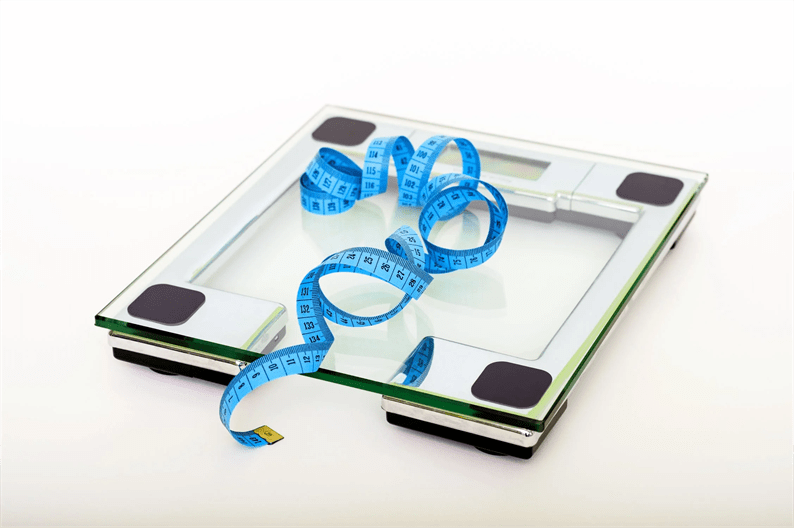
Content
Lose weight to be happy
Of course, there are times when even the most absurd relationship with the weights does not prevent you from staying slim. In my practice, there were a mother and a daughter who for years weighed themselves 2, and sometimes 3 times a day … And not only when they wanted to lose weight, but also at normal times.
At the same time, finding themselves outside the home at the time appointed for weighing, they began to get nervous, feel discomfort and could no longer think about anything, except that they missed their date with the scales … Can you imagine what kind of life it is when any excommunication from at home without weights (!) threatens with constant stress? ..
And it doesn't even matter – whether they remained thin or fat at the same time. Because such a scheme for tracking the results of weight loss is only suitable for those who are willing to voluntarily replace obesity with neurasthenia. Most of us want to lose weight in order to be happy, not unhappy, like these two poor ladies.
When is the most accurate weight?
It is best to weigh yourself in the morning, immediately after waking up, on an empty stomach, after the morning toilet. At night, food was not received and the stomach is empty, respectively, the weight is minimal.
The maximum weight is observed by 17 – 19 hours, so you don't need to weigh yourself in the evening, no matter how you want. You will get nothing but frustration. Also, do not weigh yourself (in the morning) if you had a hearty dinner the day before, ate fatty, salty, or consumed alcohol.
The woman's weight will be more in the second phase of her period. By about 1.5 – 2 kg due to fluid retention in the body due to the action of the hormone progesterone.
Optimal weighing frequency for weight loss
To adequately assess the rate of weight loss, it is enough to weigh yourself once a week. Of course, no one forbids those who are losing weight to weigh in every day, but the data may turn out to be inaccurate.
The weight of a losing weight can fluctuate every day, depending on the time of day, the amount of food eaten and water drunk, diseases and various conditions of the body.
Even weekly weighing may not provide accurate data (for women, for example), since there are temporary gains of + 1-2 kg in weight on the eve of the CBA, which can be upset and confusing.
It is worth assessing the progress in reducing excess weight by the result per month. If within 4 weeks more than 1 kg does not go away, then the wrong methods of losing weight have been chosen.
You recently ate a heavy meal
It makes no sense to weigh yourself immediately after a heavy meal. Remember: food is digested for up to eight hours, and until the process is completed, extra pounds will remain in you. In addition, sodium and sugar can cause fluid retention and bloating, so take a day off in such cases.
Meal time
After eating, your body has a lot of both the food itself (in the stomach) and energy (glycogen, which contains water). Therefore, naturally, the body weight will increase.
And even if you thought of weighing yourself only in the morning, before eating, you need to keep in mind that you will see the difference on the scales depending on when you had dinner – at 8 or 11 pm.
Minimum clothes when weighing
The simplest and most obvious factor in the accuracy of determining the weight is clothing, or rather, the minimization of its quantity at the time of weighing.
And it is better to weigh yourself without clothes at all. So the numbers will be as accurate as possible, and you can easily track the dynamics of weight gain.
Don't worry, this is the norm! It is important for women to consider the timing of their menstrual cycle and remember that before and during critical days, the body is often prone to edema and weight gain.
Salt – pain for losing weight! Remember! The consumption of salty food and alcohol can lead to an increase in weight indicators even the next day, since most of the fluid will be retained in the body.
Weighing after exercise
Weighing after training, jogging is a big mistake, since during these physical activities an average adult easily loses up to one liter of fluid. Liquid is not fat, the knowledge that you have become lighter “per liter” will not give you anything useful.
Is it worth replacing weighing with measurements
Weight is not the first factor to focus on when working with your body. When we talk about a person's appearance, we mean, first of all, his figure. First of all, the ratio of muscle to fat mass is important, which is measured in various ways: bioimpedance, caliperometry. If the goal is “to add here and decrease there,” losing weight or gaining weight will not say anything. The figure can change noticeably externally, but the weight remains unchanged. In this case, it makes sense to focus on the reflection in the mirror and measurements.
With the establishment of a normal balanced diet, even in a person who does without physical activity, the restoration of the normal, natural amount of muscle tissue will begin. Fat tissue becomes less, the level of basal metabolism increases. After a month or two of normal nutrition, you can find that the weight has remained practically the same, and the volumes have changed a lot. After all, muscle tissue is much heavier than fat. In my practice, there was a client who in three months lost only two kg, and the measurements in the hips changed from 120 to 108 cm! And this is in the absence of any rigid restrictions.
The nutritionist clarifies that measuring yourself every day is also not worth everything for the same reasons as with weighing: swelling, a crowded intestine, and so on.
How body weight changes
After all, there is a big difference between people who have a body fat percentage of 10-12% and those who have 20% or more.
Note.
In general, body weight may be within the permissible range and not talk about obesity, but, of course, an excessive amount of body fat requires adjustment.
Especially this fact needs to be understood by those people who, in the process of losing weight, consider it necessary to weigh themselves every day and repeatedly.
Human body weight changes throughout the day. This parameter depends on many factors:
- the amount of food taken;
- the amount of fluid taken;
- presence / absence of activity;
- visits to the water closet.
In fact, there are many other factors, and even stress levels can have their own effect.
The weight of an ordinary person during the day can easily change in the range of 2-4 kilograms.
Therefore, when you compare evening and morning weights, you really don't know anything special besides how the weight fluctuated throughout the day.
In the morning or evening?
It is better to weigh yourself in the morning for one simple reason – this is the only time of day when you are in approximately the same conditions every day, or, more precisely, in comparable conditions.
During the day, various metamorphoses can occur to you: you overeat, you do not eat, you sweat (or did not drink for several hours) and lost a lot of water with sweat (breathing) and other moments. At night, it all comes to about the same denominator, unless, of course, you spend the night hugging the refrigerator)))
And to make the conditions even more similar, weigh yourself in the morning after using the toilet and having a bowel movement.
Factors to Consider to Weigh Yourself on the Scale Correctly
There are some variables that affect weight. Consider each factor to avoid confusion. Here are the main factors:
- temperature. Some bathroom scales become less sensitive at very low temperatures and show inaccurate readings.
- surface. A very popular question is where to weigh yourself to find out the correct weight. The answer is – choose a hard and flat surface. Placing the scale on carpet or linoleum will result in inaccurate measurements.
- weight distribution. Try to stand in the middle of the scale without jerking or moving. Changing the position of the body can change the number on any type of scale – from mechanical to electronic. Also, always go barefoot on the scale.
- Clothing. As we already said, you need to weigh yourself completely without clothes. Even a small piece of cloth can lead to inaccuracies in weight.
If you are weighing in at the gym, wear lightweight cotton sportswear and remove your sneakers if possible. During training, be sure to drink water so that the body can tolerate physical activity well.
Why are frequent weighing dangerous?
In short, it is dangerous with breakdowns, both food and nervous.
The fact is that those who weigh themselves too often (1 or more times a day), often, seeing an increase on the scales after a day of strict abstinence in food, simply break down.
The next frame is the following: “Yes, it all went, no sense!” – approach to the refrigerator and comfort yourself with the most forbidden foods.
Another option (no less sad) is even greater dietary restrictions, extreme diets and fasting days.
In both cases, nothing good happens. Spoiled mood and nerves for the whole day. And the unfortunate scales, which showed “plus 300 g”, are to blame.
Attention! Provided that only 2 factors are observed – proper nutrition and competent physical activity – the process of fat burning will go on as usual. And the readings on the scales do not always accurately reflect this process.
In just a day, I repeat, the weight can fluctuate by 1 kg or more. There are a lot of reasons: shifts in the water-salt balance in the body, muscle swelling after exercise, hormonal surges, irregular bowel movements, etc.
Water retention
In this case, it is not associated with carbohydrates, but with a hormonal response to stressors. In addition to all the others, diet and physical activity are also stress factors in our life.
Therefore, if you fanatically eat too few calories and force yourself to exercise too much, you will definitely have increased cortisol – the stress hormone that provokes water retention in the body.
As with carbohydrates, this is also a completely natural mechanism that is difficult to influence. The best thing you can do is not to worry about it and not add unnecessary stress to yourself.
Long-term and purposeful work
Large weight loss takes longer and more energy than you might imagine. You can't just reduce the portion or start walking in the evenings. Only a holistic approach to present a rapid weight loss. Nevertheless, no one canceled the control. Chances are, you also weigh yourself from time to time. And for many, this is the scariest part of your day.
According to official statistics, 75% of people who have successfully lost weight and maintain the result weigh themselves weekly. In addition, a 2012 study found that people who lose weight are less likely to gain weight if they weigh themselves regularly. Therefore, it is good practice to have a scale at home and regularly mark the increase and decrease on the graph.
What factors determine weight loss
The actual loss of extra pounds consists of two components: a calorie deficit and strength training, which will ensure weight loss is due to stored fat, not muscle.
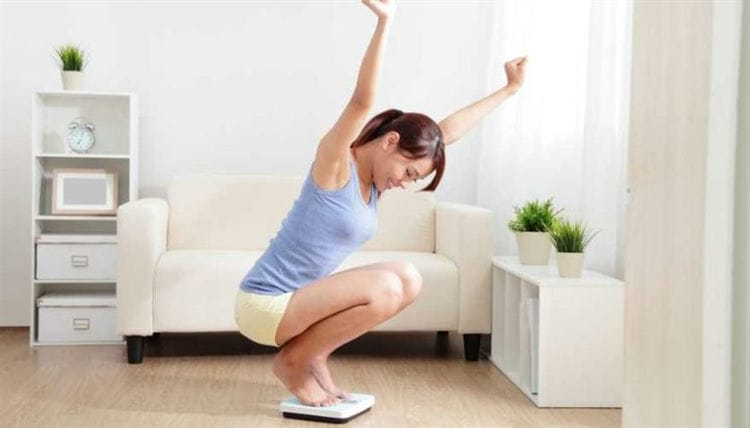
If you limit only nutrition, then the numbers on the scales will certainly go down, but, unfortunately, there will be no beauty in flabby muscles.
If you started going to the gym, but did not adjust the nutrition, then the weight will most likely display an increase in kilograms. The muscles will become stronger and heavier.
First of all, anyone in the process of losing weight wants to get rid of fat. But weight loss doesn't always mean that it's fat that's been lost.
The final figure is influenced by muscle loss, natural processes (contents of the bladder and intestines), and the amount of water in the body.
You can also determine the effectiveness of weight loss measures using:
- centimeter tape,
- consecutive photographs,
- old clothes.
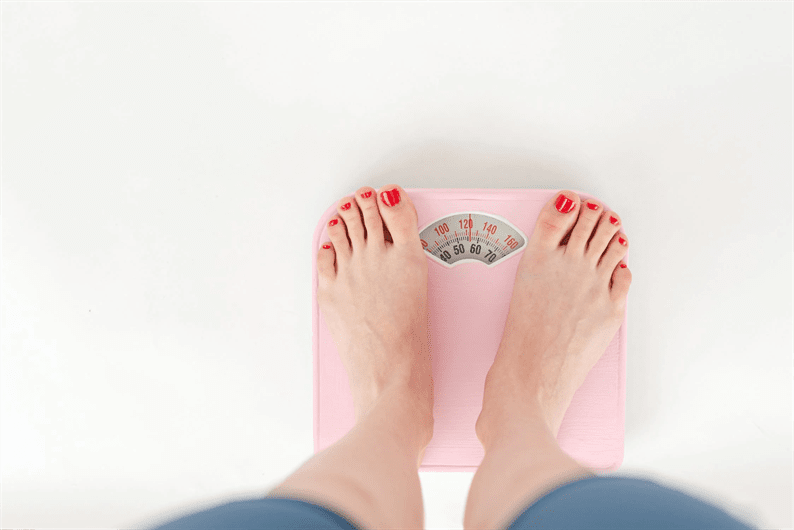
Muscles have less volume, but they are heavier than fat. If the weight disappears slowly, but the volume of the body decreases, then you are on the right track.
Baseless accusations
-
The scales are junk, something is wrong with them – you really need to check the operation of the mechanism, but you should only go to the master if the device shows a frankly incorrect result, subject to all the recommendations that we give.
-
We drink too much water, we need to drink less – but this is not worth doing. The daily rate is from 1.5 to 2 liters. If you deliberately reduce it or completely refuse to replenish fluid reserves in the body, you will provoke a slowdown in metabolic processes. We remind you: slowing down your metabolism is easy, but overclocking it is much more difficult. So don't try to decide for a nutritionist or nutritionist how much to drink. Better come to us to get answers to all your questions and get rid of extra pounds without harm to your health.
Weighing is a complex process. Imagine that this is a ritual that must be performed this way and not otherwise – in this case, it will be easier to get used to the new rules. And do not make mistakes, so as not to be upset when you see a number that is too large.
A little about Mondays
 When people ask me how to weigh yourself correctly, I, in addition to everything I mentioned above, recommend avoiding weighing on Mondays. Over the weekend, we inevitably “gorge” too much. Alcohol also contributes to swelling, which can be mistaken for being overweight. Even if all days of the week are approximately similar to each other, on weekends the whole family gathers at home, guests drop in, we ourselves go out. The result is an extra pound on Monday. But such Sunday “loads” are needed in order to feel like a man, and not a hostage of a cabbage leaf, the main thing is to bypass the scales on the tenth road on Monday morning.
Alcohol consumption
Alcohol itself dehydrates the body, so you feel lighter. But, on the other hand, it provokes hunger. And chances are good that you will eat a bunch of carbs and salt (like chips) and you will have water retention in the morning.
Water-salt balance
Mineral salts, incl. common table salt, contain sodium. And the higher the sodium content in the cells of your body, the more it (the body) seeks to balance the sodium concentration with water.
Simply put, more salt means more water retention. This does not mean that you need to limit your salt intake, but it must be borne in mind if you want to deal with weight surges.
Weigh yourself naked
This rule even applies to your underwear. Any clothing adds weight, albeit insignificant. Of course, if you have a special set of clothes that you wear all the time, you can leave it on. But such a situation is hardly possible. So measure your weight naked to avoid inaccuracies.
How we deceive ourselves
Getting on the scales, we have two main goals:
- we want to control objective indicators;
- we are looking for motivation for ourselves, getting satisfaction from the lost kilograms or mobilizing ourselves with reproaches that the weight does not change.
If you weigh yourself more often than you actually gain or lose weight, then there can be no question of any objective indicators: the result will be the same.
Therefore, with frequent weighing, we get false results: weight fluctuations will simply be temporary, associated with the balance of consumption and excretion of liquid and solid food, hormonal monthly fluctuations, etc.
Thus, the first goal with frequent weighing is no longer attainable.
You hit the second goal 50/50, because if you can only be motivated by the gingerbread, and you saw that the weight has not gone away, then getting up on the scales once again, you do not help yourself, but aptly put the footboard.
If you are arranged in such a way that you can be pushed to take decisive action, only by scaring you, then the pounds that have gone will not inspire you to lose weight …
That is, we see that frequent weighing can be an assistant only in rare cases. And then – if you suddenly (!) Are lucky.
For the majority, weighing yourself often means, at best, just wasting time, and at worst, voluntarily receiving an additional nervous irritant and preventing yourself from losing weight.
How can I make the scales show less?
Are you seriously?! Move more and eat less! In general, if the number is so important to you, there is one trick – the least weight happens after a grueling workout, visiting a bath and a sauna, when you sweated a lot and for a long time, as well as after taking laxatives and diuretics. And also after vomiting. We hope you won't find this useful.

Basic weighing rules
1 The balance must be placed on a firm, level surface. A “hard” surface means tiles, linoleum, laminate, parquet. Rugs, carpets, or carpets, however, are not suitable for the scale. An exception is special scales for fluffy surfaces. Violation of this principle leads to a very large error – up to 5 kg.
2 Refrigerators, televisions and other emitting devices must be at least 80 cm away from the balance. If a nearby washing machine spins out the laundry, then you should not weigh yourself at this time.
3 Step on the scale so that your feet do not move to one of the edges, as shown in the illustration below.
4 Stand straight, do not lean forward or to the sides – this introduces an error in the measurement.
5 Do not touch the wall or any other object with your hands. It is very important. It seems to you that you are slightly adhering, but in fact you are reducing your weight by half a kilogram.
6 Stand still. Don't try to consider the weight by leaning forward. Wait for the weight to lock, then bend over to read the weight.
7 Weigh yourself barefoot, without clothes.
8 Always weigh yourself at the same time of day. Optimally – in the morning, on an empty stomach, after using the toilet.
9 Do not drink water before weighing.
10 Do not weigh yourself after exercise.
Consider your menstrual period
Obviously, the cycle affects weight every month. In some women, the abdomen swells and the entire body swells. These processes lead to weight gain due to water retention in the body. If you swell during your period, it is better to wait until it ends so as not to confuse the previous data.
We fix the indicators of body weight
It is useful to keep a diary (notebook, application on the phone), and write everything down: weight measurements, meals and calories, physical activity during the day, etc.
This will help not only keep statistics of your weight, but also gain discipline in understanding the most important parameter of your life – health.
Weigh yourself after using the toilet
Go to the toilet and shower before measuring your weight. A simple rule will save you from small errors. A full bladder and bowel can add up to 500 grams of weight, depending on your body size and percentage of water in your body. Minor fluctuations in weight can constantly hinder your progress, especially if you are losing weight or playing professionally.
Additional indicator
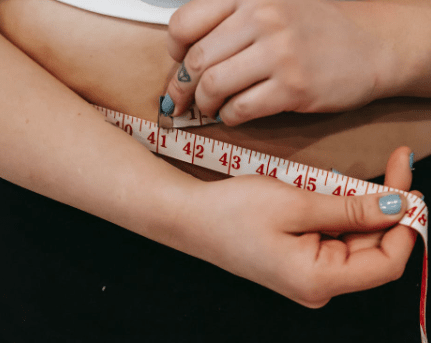
In general, the readings of the scales, as you already understood, are an insidious thing, relying only on them is a big risk to ruin your mood. Therefore, I always recommend that once a week, not only get on the scale, but also measure your waist. The most common measuring tape (tailor's or sewing meter). The rules are generally the same as for weighing.
1 Unity of time and conditions (Sunday morning on an empty stomach).
2 Do not change the measuring “device” (tapes have different levels of elongation, which happens to steal half a centimeter, and they are sometimes oh, how important).
3 Do not draw in or protrude the abdomen, maintain a neutral position.
4 Men measure their waist at the level just below the navel, women at the narrowest point. But the most important thing is to always measure exactly at the same level.
In practice, the weight can remain unchanged, but the waist in the same week will become thinner by a centimeter (sometimes more). Of course, this suggests that the fat layer is thinning, and this is our main task! It happens, and vice versa, the indicators of the waist do not change, but the weight is gone. Also good. It is perfectly ideal if the “minus” is both there and there. But this does not always happen. Very often these indicators will play catch-up. But for us, a safety net is important so that the readings of the scales do not spoil our mood and do not take away the much-needed motivation to continue.
By the way, if you choose between the scales and the tape, I definitely vote for the latter. So you can try to save some money. Both nerves and money (initial models of scales with a fat tissue analyzer are a couple of thousand rubles and more, a tailor's meter – 200 rubles).
Little life hack. And the waist circumference can quickly tell whether it's time to lose weight or you can still “walk”. If the measurement result is less than half of your height, then everything is not so bad. Was there more? Well, as an option, you can try to grow up.
How to weigh losing weight correctly?
It is recommended to get on the scales after a night's sleep, on an empty stomach, without clothes (you can leave your underwear). This is the method recommended by doctors for a more accurate determination of body weight.
As a rule, a person can gain 1-1.5 kg per day, so if you weigh yourself in the evenings, consider this point.
Choose a convenient time of day, and always weigh yourself at the same time. This will give a more correct result when comparing the previous and current state of body weight.
How to please yourself without weighing yourself

What to do if you still want to delight yourself with the feeling of losing weight more often, without weighing yourself too often?
Try one easy, enjoyable exercise. It is better to do it before falling asleep, in a state of semi-sleep.
- Take two A4 sheets and write in large bold marker on one of them your last real weight, and on the other – your real weight. The difference between the numbers should be chosen individually, experimentally: for someone, 5 kg is enough, and for someone 10 kg may be imperceptible. It is necessary that during the exercise you physically feel that there is a difference.
- Put a sheet with a real weight written on it on the floor and stand on it with your eyes closed, feet without shoes, but in socks. Listen to the sensations.
- Now place the second sheet – with the desired weight. And get up too.
Feel the difference? Now enjoy it until next time and remember how pleasant it is: to lose at least a little weight – and to really feel it. Be healthy, slim and happy!
Be patient
But what if the weight and waist measurements have not changed over the week?
No panic! It must be remembered that the body is not willing to part with fat reserves. Therefore, it is worth waiting another week. If even then the process of losing weight has not budged, then it is worth making adjustments to the load and nutrition.
In general, when dealing with your own health and body, you should not rush and chop off the shoulder. You did not gain weight in 1 month and often not even in 1 year, so give your body time to lose weight and remember what it is like to be slim, fit and beautiful.
Is it necessary to control weight daily?
If you get up on the scales daily or even several times a day, you can notice a significant fluctuation in weight (up to 3 kilograms).
Weight rises despite diet and intense training, or drops significantly and then recovers.
Does a change in readings on the scale really indicate a decrease or increase in body fat? Of course not. Weight fluctuations occur due to changes in water content.
If you measure your weight on a daily basis, then the numbers will tell nothing about changes in adipose tissue. It takes time to break down fat, and changes in adipose tissue that have occurred per day are minimal.

But fluid level fluctuations are significant. The device reacts to them during daily weighing.
What the indicators react to during daily weight control:
- Eating food and liquids.
- For bowel and bladder emptying.
- For fluid retention. The use of carbohydrates and table salt leads to the accumulation of water in the body.
Important! For 1 g of carbohydrates, the body retains 3 g of water.
Loss of fluid. A decrease in the amount of water in the body occurs as a result of intense training, physical labor or illness (vomiting, diarrhea, high fever).
Sources used and useful links on the topic: https://pitanieives.ru/chtoby-pokhudet-nuzhno-perestat-vzveshivatsya/ https://simpleslim.ru/kak-pravilno-vzveshivatsya/ https://zen.yandex.ua/ media / beauty_nutrition / kak-chasto-nujno-vzveshivatsia-pri-pohudenii-otvechaet-nutriciolog-5efecdc1d4c89925f5cb931c https://Wi-Fi.ru/news/TOIit5cxLdNz-7-vescheyn- kotzotorye- -vstat-na-vesy https://spb.aif.ru/health/advice/na_diete_vzveshivatsya_vredno_kak_pravilno_izmeryat_rezultaty_pohudeniya https://yurijprosolupov.ru/poleznye-sovety-at-sovety-at-pveshivves-voypro -sekrety-vzveshivaniya-na-vesah / https://jirabas.ru/kak-pravilno-vzveshivatsya-vo-vremya-pohudeniya/ https://news.tut.by/go/607315.html https://diet-tips.ru/sbros-vesa/kogda-nuzhno-vzveshivatsya-pri-pohudenii.html https://www.cosmo.ru/health/diets/kak-i-kogda-pravilno-vzveshivatsya-chtoby-uznat-tochnyy-ves/ https://zen.yandex.ru/media/beauty_nutrition/kak-chasto-nujno-vzveshivatsia-pri-pohudenii-otvechaet-nutriciolog-5efecdc1d4c89925f5cb931c https://www.syl.ru/post/recreation/143859 https://VapeAdept.ru/5-pravil-vzveshivaniya-dlya-hudeyushhih/ https://www.championat.com/lifestyle/article-3653415-kak-chasto-nuzhno-vzveshivatsja-vo-vremja-pohudenija-dieta-pohudenie-fitnes.html
Post source: lastici.ru