
Diphtheria – symptoms, causes, treatment and prevention of diphtheria. Home treatment for diphtheria – 7 tips

Content
What is diphtheria?
Diphtheria is an infectious disease caused by the bacterium Corynebacterium diphtheriae. Signs and symptoms usually appear 2–5 days after infection and range from mild to severe. Symptoms often develop gradually, starting with a sore throat and fever. In severe cases, the bacteria produce a toxin that causes a thickened grayish or white plaque to form in the throat. Plaque can cause airway obstruction, making it difficult to breathe and swallowing and causing a “barking” cough. Swelling of the neck is possible, in part caused by swollen lymph nodes.
The toxin can also enter the bloodstream, causing a variety of complications, including inflammation and damage to the heart muscle, inflammatory nerve damage, renal dysfunction, and bleeding with low platelet counts. Damage to the muscles of the heart can lead to irregular heart rhythms, and inflammatory lesions of the nerves can cause paralysis.
Diphtheria of other localizations
- Ear diphtheria is a secondary pathology that develops when there is a focus of diphtheria infection in the body. The skin of the ear canal and the eardrum become inflamed, and fibrinous plaque appears on their surface.
- Diphtheria of the eyes is manifested by intoxication, unilateral or bilateral conjunctivitis, purulent yellowish-gray discharge. Fibrinous films often appear on the surface of the hyperemic and edematous conjunctiva. The skin around the eyes becomes wet and the eyelids swell Diphtheria of the eyes occurs in one of three clinical forms – catarrhal, toxic or membranous.
- In men, with diphtheria of the genitals, the foreskin is affected, and in women – the labia, vagina, perineum. Symptoms of the disease are swelling, hyperemia and cyanosis of the vulva, ulceration of the mucous membrane and off-white plaque.
- In newborn babies, diphtheria infection can affect the umbilical wound.
Types of diphtheria
The classification of diphtheria is as follows.
How diphtheria is transmitted from person to person
Diphtheria belongs to anthroponous infectious diseases. This means that its causative agent – Leffler's bacillus (bacillus) multiplies and parasitizes only in the human body.
Therefore, the answer to the question of how diphtheria is transmitted is obvious: the virus passes from person to person.
Moreover, infection can occur in two ways:
- From the patient. It is worth noting that the more sick a person is and the brighter his symptoms appear, the more bacteria he spreads around him.
- From a healthy person carrying the bacteria.
During research, scientists have found that there are many carriers of diphtheria bacillus among healthy people. Such a number of healthy carriers does not allow doctors to make optimistic forecasts about epidemiological outbreaks.
Researchers have found the diphtheria microbe in some domestic animals, as well as in the waters of some bodies of water, despite the fact that the infection is considered anthroponous.
In countries with hot climates, skin infection is common, and, as a result, more frequent skin forms of diphtheria. While in regions with a temperate climate, the bacterium is more common on the mucous membrane of the pharynx and nose.
2 Diphtheria croup
Diphtheria croup most often develops in adult patients and is usually associated with oropharyngeal diphtheria. It develops during 3 stages, each of which is characterized by different clinical manifestations. Let's consider them:
- The dysphonic stage is accompanied by a rough barking cough and a hoarse voice. The duration is 1-3 days in children and up to 7 days in adults.
- The stenotic stage is accompanied by aphonia, soundless cough, anxiety, pallor of the skin, cyanosis, difficulty breathing with noise, prolonged inhalation, tachycardia, retraction of the rib cage protrusions.
- The asphyxia stage is accompanied by frequent and superficial, and after rhythmic breathing, threadlike pulse, low blood pressure, cyanosis. Further, the patient's consciousness is disturbed, body cramps appear, after which the patient dies of asphyxia.
Diphtheria croup is also subdivided into the following forms:
- Localized croup – develops only within the larynx.
- Widespread croup – capable of simultaneously affecting the larynx and trachea.
- Descending croup – in the inflammatory process, in addition to the larynx and trachea, the bronchi are involved.
1 Oropharyngeal diphtheria
Diphtheria of the oropharynx is diagnosed in 95% of all cases. Symptoms of diphtheria of the oropharynx are a sharp increase in body temperature to 38-39 ° C, plaque on the tonsils and surrounding tonsils of the mucous membranes, general malaise, weakness, headache, slight sore throat when swallowing, hyperemia and swelling of the tonsils, palate and arches, slight pain in cervical lymph nodes.
Oropharyngeal diphtheria is subdivided into the following forms:
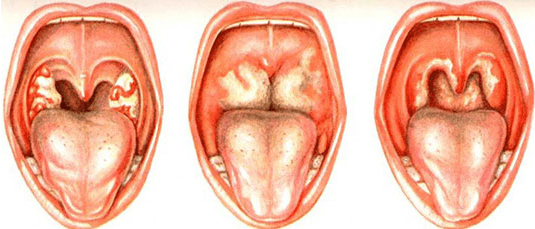
Localized diphtheria – occurs in 75% of patients with oropharyngeal diphtheria, characterized by an easily removable plaque on the tonsils, which can be present for about 6-8 days, a sharp rise in body temperature, which returns to normal after a few days. It is subdivided into the following types:
- Islet – the plaque on the tonsils is uneven, in the form of islets of various sizes.
- Film – the tonsil is torn with a dense, whitish-grayish fibrous film, when removed, the mucous membrane begins to bleed, and in place of the removed film, a new plaque appears the next day.
- Catarrhal – characterized by slight redness and swelling of the tonsils, slight discomfort in the throat when swallowing, subfebrile body temperature. It is rarely diagnosed.
Common diphtheria – characterized by the formation of plaque outside the oropharynx, while the symptoms of intoxication are more pronounced, there is an increase in lymph nodes and their sensitivity to palpation, sore throat. It usually develops from a localized form of the disease.
Subtoxic diphtheria is characterized by the same symptoms as the common form, but differs from the onion by local edema of the subcutaneous tissue in the neck, above the cervical lymph nodes, often of a one-sided nature.
Toxic diphtheria(1, 2 and 3 degrees) – characterized by an acute onset of the course of the disease, a sharp increase in body temperature (up to 41 ° C), headache, drowsiness, lethargy, sore throat, and sometimes in the abdomen. In the oropharynx, in the first stages, there is hyperemia, swelling and a jelly-like, easily removable plaque, which after a couple of days becomes a dense fibrous layer of a whitish-grayish hue, when removed, the mucous membrane begins to bleed. The plaque completely covers the tonsils, palate, and arches. At 2 and 3 degrees of the disease, edema almost blocks the lumen of the pharynx, periadenitis may develop. Other signs include nasal congestion, change in voice, sweetish-cloying odor from the oral cavity, swelling of the neck, nausea, vomiting, tachycardia, cyanosis of the lips, lowering blood pressure. The higher the degree of the disease, the more swelling of the neck, even reaching the area below the collarbone, and the symptoms become more pronounced. Most often, toxic diphtheria is observed in adults, and in about 20% of all patients with this disease. Sometimes it is combined in nature, combined with damage to the nose and larynx.
Hypertoxic diphtheria – characterized by a severe course, is the most complex and life-threatening form of the disease. It usually develops against the background of other diseases and pathologies – alcoholism, hepatitis, liver cirrhosis, diabetes mellitus. It is characterized by a sharp onset and rapid development of the inflammatory process, which is expressed in symptoms such as high body temperature (up to 41 ° C), chills, low blood pressure, weak pulse, weakness, pallor, dizziness, headache, skin and intraorgan hemorrhages, bleeding. The patient is dominated by signs of infectious toxic shock, which can lead to death as early as 1-2 days from the first symptoms of the disease.
Hemorrhagic diphtheria – characterized by extensive bleeding (mainly from the nose, gums, digestive organs), multiple hemorrhagic rash, bloody diphtheria plaque.
Infection routes
There are three ways of getting a diphtheria infection:
- Airborne.
- Contact and household.
- Food grade.
How is diphtheria transmitted by airborne droplets
Diphtheria is transmitted by airborne droplets along with particles of saliva from a sick or healthy carrier as a result of sneezing or coughing. This happens especially often in schools, kindergartens in public places. That is, where there is a large crowd of people in a small space.

How is diphtheria transmitted by contact
You can get infected if you use the same objects with a sick person. This applies especially to towels, dishes, personal hygiene items.
Transmission of infection can occur through personal contact with a sick person or a carrier. This can be a handshake, kiss, or sexual intercourse.

The causative agent of diphtheria
The causative agent of the disease is the rod-shaped gram-positive bacterium Corynebacterium diphtheriae.
It can persist in the external environment for a long time, being in dust and on the surface of objects. The source and reservoir of such an infection is a person who suffers from diphtheria, or who is a carrier of toxigenic strains. Most often, people with oropharyngeal diphtheria become sources of infection. The infection is transmitted by airborne droplets, but still, in some cases, it can also be transmitted through dirty hands or household items, linen, dishes. The occurrence of diphtheria of the skin, genitals, eyes occurs due to the transfer of the pathogen through contaminated hands. Sometimes outbreaks of diphtheria are also recorded, which occur as a result of the multiplication of the pathogen in food. The infection enters the human body mainly through the mucous membranes of the oropharynx, in more rare cases – through the mucous membrane of the larynx and nose. It is extremely rare that infection occurs through the conjunctiva, genitals, ears, skin.
How can you get infected?
The source of infection can be a sick person (one who has obvious signs of the disease) or an asymptomatic carrier (a patient in whose body there are diphtheria corynebacteria, but there are no clinical manifestations of the disease). It is worth noting that with an outbreak of diphtheria, the number of asymptomatic carriers in the population can reach 10%.
Asymptomatic diphtheria carriage can be:
- Transient – when a person releases corynebacteria into the environment for 1 to 7 days.
- Short-term – when a person is contagious for 7 to 15 days.
- Long-term – a person is contagious for 15 to 30 days.
- Prolonged – the patient is contagious for a month or more.
From a sick or asymptomatic carrier, the infection can be transmitted:
- By airborne droplets – in this case, corynebacteria pass from one person to another along with microparticles of exhaled air during a conversation, when coughing, when sneezing.
- By household contact – this route of spread is much less common and is characterized by the transmission of corynebacteria through household items contaminated by a sick person (dishes, bedding, toys, books, and so on).
- Food – Corynebacteria can be spread through milk and dairy products.
It is worth noting that a sick person is contagious to others from the last day of the incubation period until the complete removal of corynebacteria from the body.
Can I get diphtheria again?
Recurrent diphtheria diseases are possible. This disease does not leave behind strong immunity.
After diphtheria, the titer of antibodies is high in the blood, which protects against re-infection. But their level is gradually decreasing. On average, re-diphtheria can occur after 10 years. However, the second time, the disease is much easier. This is due to the fact that the body produces antitoxin faster and more efficiently.
General information
Diphtheria is an acute infectious disease of a bacterial nature, characterized by the development of fibrinous inflammation in the area of introduction of the pathogen (mainly the upper respiratory tract, the mucous membrane of the oropharynx is affected).
Diagnosis of diphtheria
When establishing a diagnosis, a specialist first of all pays attention to the presence of symptoms characteristic of diphtheria. If there is a membranous variant of the disease, then diphtheria is much easier to diagnose due to the presence of the fibrinous nature of the plaques. At the same time, it is most difficult to diagnose the insular variant of oropharyngeal diphtheria, since the symptoms in this condition are similar to the signs of angina of coccal etiology. In the process of diagnosing toxic diphtheria of the oropharynx, it is important to differentiate the disease from necrotizing angina, paratonsillar abscess, candidiasis… To make a diagnosis, laboratory blood tests are carried out, as well as bacteriological studies. For this, the causative agent of the disease is isolated from the focus of the inflammatory process, after which its toxigenicity and type are determined.
Diphtheria treatment
If a patient is diagnosed with diphtheria, then it is imperative that he be hospitalized immediately. Depending on how severe the disease is, the duration of the process of inpatient treatment of the patient is determined. The main point in the treatment of diphtheria is the administration of antitoxic anti-diphtheria serum to the patient. Its effect is to neutralize the toxin that circulates in the blood. Therefore, the action of such a serum is most effective if it is introduced as early as possible. If there is a suspicion that the patient is developing a toxic form of the disease or diphtheria croup, then such a serum should be injected immediately. A positive result of a skin test (the so-called Schick test) in the patient is a contraindication to the use of such a serum in localized forms of diphtheria. In other cases, serum is administered, in parallel with the appointment of antihistamines and glucocorticoids. This drug is administered intramuscularly and intravenously. Sometimes, in the case of severe and prolonged intoxication, the drug can be re-administered. For detoxification treatment for diphtheria, crystalloid and colloidal solutions are used intravenously. Sometimes, in especially severe cases, the administration of glucocorticoids is also added to these drugs…. The complex of treatment also includes vitamins, desensitizing drugs. With toxic diphtheria II and III degrees, severe combined forms of the disease and hypertoxic diphtheria, plasmapheresis is performed. In addition, for some forms of the disease (subtoxic, toxic), antibiotic treatment is used. As auxiliary methods of treatment for diphtheria of the larynx, it is important to regularly ventilate the room where the patient lies, give him a warm drink, do steam inhalation, for which it is advisable to use soda, chamomile, hydrocortisone, eucalyptus. If there is a manifestation of hypoxia in patients with diphtheria, humidified oxygen is used through a nasal catheter to eliminate this phenomenon, and films are also removed by electric suction. If a patient has a number of phenomena indicating his serious condition, it is possible to use surgical intervention (tracheal intubation, tracheostomy ). These are tachypnea more than 40 per minute, tachycardia, hypercapnia, cyanosis, hypoxemia, respiratory acidosis. If a patient develops an infectious toxic shock, his further treatment is carried out in the intensive care unit.
Symptoms
The incubation period before the first symptoms of diphtheria appear in adults is from 2 to 10 days.
The course of the disease is subacute (i.e., the main syndrome appears 2-3 days from the onset of the disease), however, with the development of the disease at a young and mature age, as well as with concomitant pathologies of the immune system, it can change.
Diphtheria Syndromes:
- syndrome of general infectious intoxication;
- tonsillitis (fibrinous) – leading;
- regional lymphadenitis (maxillary);
- hemorrhagic;
- swelling of the subcutaneous fat.
The onset of the disease is usually accompanied by a moderate rise in body temperature, general malaise, then the clinical picture diverges according to the form of the disease.
-
Atypical form (characterized by a short fever for two days, mild discomfort and pain in the throat during swallowing, an increase in the maxillary lymph nodes up to 1 cm, weakly sensitive to light touch).
-
Typical form (quite noticeable heaviness in the head, drowsiness, lethargy, weakness, pallor of the skin, enlargement of the maxillary lymph nodes from 2 cm or more, pain when swallowing):
- widespread (primarily common or developing from localized) – an increase in body temperature to febrile digits (38-39 ° C), noticeably pronounced weakness, weakness, pallor of the skin, dry mouth, sore throat when swallowing moderate intensity, painful lymph nodes up to 3 cm;
- toxic (primarily toxic or originating from common) – characterized by severe headache, apathy, lethargy, pallor of the skin, dry mucous membrane of the mouth, possible occurrence of abdominal pain in children, vomiting, temperature 39-41 ° C, sore throat with swallowing, painful lymph nodes up to 4 cm, edema of the subcutaneous fat around them, spreading in some cases to other parts of the body, difficulty in nasal breathing – nasal voice.
The degree of edema of the subcutaneous fat:
- subtoxic form (unilateral or parotid edema);
- toxic grade I (up to the middle of the neck);
- toxic grade II (up to the collarbones);
- toxic grade III (edema passes to the chest).
In severe toxic forms of diphtheria due to edema, the neck visually becomes short and thick, the skin resembles a jelly-like consistency (a symptom of “Roman consuls”).
The pallor of the skin is proportional to the degree of intoxication. The deposits on the tonsils are asymmetrical.
- hypertoxic – an acute onset, a pronounced syndrome of general infectious intoxication, obvious changes at the site of the entrance gate, hyperthermia from 40 ° C; joins acute cardiovascular failure, unstable blood pressure;
- hemorrhagic – the soaking of fibrinous deposits with blood, bleeding from the nasal passages, petechiae on the skin and mucous membranes (red or purple spots formed when capillaries are damaged).
If, in the absence of adequate treatment, the body temperature returns to normal, then this cannot be unequivocally regarded as an improvement – it is often an extremely unfavorable sign.
Distinguish between rare diphtheria in vaccinated (similar to atypical diphtheria) and diphtheria in combination with streptococcal infection (there are no fundamental differences).
Development of diphtheria
The source of the causative agent of diphtheria (diphtheria bacillus – Corynebacterium diphtheriae) is the carrier of the infection – a sick person.
Routes of transmission – airborne (through sneezing, coughing, talking at close range), contact-household (through cuts, injuries, abrasions, conjunctiva of the eyes), food (eating infected food).
The incubation period (from the moment the infection enters the body to the first signs of the disease) is from 2 to 10 days.
The most common site for infection is the oropharynx. Other places include the trachea, bronchi, nasal cavity, skin surface, eyes, genitals.
The development of the disease. After getting diphtheria bacillus on the mucous membranes of the oropharynx, it releases exotoxin and other pathological enzymes that form a focus of inflammation in this place – epithelial necrosis, vascular hyperemia and increased permeability of their walls develop. Further, the focus of infection and the surrounding tissues are covered with a fibrin film, which at the initial stages looks like a jelly-like plaque and is easily removed, but as it develops, the plaque thickens, stains a grayish tint, and when you try to remove it, blood flows from the inflamed mucosa. However, it should be noted that with a mild course of the disease, fibrous plaque does not cover the mucous membranes.
The spread of infection throughout the body occurs through the blood and lymphatic vessels, poisoning the body and causing signs of intoxication, regional lymphadenitis, tissue edema, cardiovascular and nervous disorders, kidneys, adrenal glands and other organs and systems are affected. At the same time, the body temperature rises, nausea, general weakness appear, the nose is stuffy.
With a severe course of the disease, edema of the uvula develops, the arches and tonsils narrow the passage of the pharynx.
It is very important to pay attention to the disease in time and prevent the binding of the toxin secreted by the diphtheria bacillus with specific cell receptors, because in the later stages, the administration of antibodies can no longer neutralize the toxin in the body.
After diphtheria, immunity does not always protect a person from re-infection and the development of the disease.
Features of diphtheria
Diphtheria is a disease that directly depends on the level of immunization of the population. To date, periodic rises in the incidence are recorded, which occur when the level of vaccine prevention is poor. Currently, there is often a shift in the disease from childhood: adults are sick with diphtheria, especially those who, by virtue of their profession, have to intersect with a large number of people. With the deterioration of the epidemiological situation, the disease occurs in people in a more severe form and at the same time the number of deaths increases. However, in people who have previously received vaccinations against diphtheria, the disease is mild and is not accompanied by complications.
Echinacea decoction

An auxiliary effective remedy that helps fight diphtheria and strengthen the body is a decoction of echinacea. To make it, you need to take 30 g of the roots of this plant, ground to a mushy state, and pour 750 ml of cold water over them. The solution is placed in a water bath and simmer for half an hour, avoiding boiling. After that, the mixture is set aside and kept under a lid until completely cooled. The finished product is filtered and used for medicinal purposes, 30 ml 3 times a day before meals in a warm form.
Chernogolovka from diphtheria

A medicinal plant such as blackhead can help relieve diphtheria symptoms, speed up the healing process, and restore the immune system. To do this, 15-20 g of grass and flowers of this plant are pre-dried, brewed in 1 liter of boiling water, and then kept in a steam bath for about 20 minutes. The finished product is cooled to body temperature, filtered and used for rinsing the mouth to reduce inflammation and swelling of the larynx.
Medicinal mixture with onions

In order to get rid of diphtheria, along with drug therapy, you can use a healing mixture. To prepare it, 400 g of onions are ground in a blender to a mushy state, add 250 ml of sugar, 1 tablespoon of liquid honey and pour this mass with 1 liter of water. All ingredients are thoroughly mixed and put on low heat. Simmer the mixture for 3 hours, stirring constantly, then cool. The resulting liquid is filtered and consumed 15 ml 3 times a day before meals. You need to store the finished solution in a cool place to preserve its medicinal properties.
Healing collection of herbs
An infusion of medicinal plants will help to cope with a diphtheria bacillus, strengthen the strength of the body and get rid of unpleasant symptoms. To make it, you need to mix 20 g of raspberries and leaves of coltsfoot, add another 10 g of oregano to this mixture. All ingredients are crushed and mixed thoroughly. For 2 tablespoons of this collection, you need to add 2 cups of boiling water, cover the solution with a lid and keep it warm for about 10 minutes. After that, the liquid is filtered and drunk warm.
Aspen bark for rinsing

Gargling with a broth based on aspen bark is recommended when treating diphtheria when the larynx or oral cavity is infected. Such a remedy soothes inflammation, removes pain and other unpleasant symptoms. For its preparation, 1 tablespoon of chopped bark is poured with 1 glass of water and simmered over the fire for 5 minutes. Then the solution is cooled and filtered thoroughly. It can also be taken orally 3 tablespoons three times a day for atypical forms of diphtheria.
Poplar buds decoction

To make a medicinal decoction, take 2-3 teaspoons of poplar buds and pour them with 1 glass of water. Put the solution on fire and bring to a boil, then insist for another 1.5 hours in a warm place. Drink a strained drink 1 tablespoon 3 times a day.
Calla from diphtheria

An effective remedy for diphtheria is a decoction of calla roots. To do this, 2 tablespoons of rhizomes crushed into powder are brewed in 1 liter of boiling water and simmered over low heat for about half an hour. Then the broth is cooled and filtered. Used as a gargle to relieve swelling, inflammation and to relieve pain.
Sources used and useful links on the topic: https://www.who.int/features/qa/diphtheria/ru/ https://doctor-365.net/difteriya/ https://medicina.dobro-est.com/ difteriya-simptomyi-prichinyi-lechenie-i-profilaktika-difterii.html https://def4onki.ru/2019/11/12/kakperedaetsa-difteriy/ https://www.KrasotaiMedicina.ru/diseases/infectious/diphtheria https: //medside.ru/difteriya https://prirodushka.ru/bolezni/d/difteriya
Post source: lastici.ru