
What is toefl? TOEFL preparation: as easy as shelling pears or mission impossible?

What is TOEFL
TOEFL (Test of English as a Foreign Language) is a standardized test of knowledge of English as a foreign language, which you will have to take if you want to study at a foreign university in English (popular in the USA, Canada, as well as Europe and Asia). Today, the Internet version of the exam (TOEFL iBT), for which I was preparing, is considered the most preferred in many universities.
The exam consists of four parts: Reading, Listening, Writing and Speaking. Each of them must be prepared separately.
“Do I need to prepare for the exam if I speak English fluently?” I hear these kinds of questions from time to time from friends. And my answer is always yes.
TOEFL cannot be compared to any English exam that we took at school, university or in courses. It has its own structure, specific logic and tasks. In addition, special attention should be paid to vocabulary, since the exam tasks include texts on topics from different fields, for example, history, biology, geography, etc.
That is why your result largely depends not on your general knowledge of English (although you should have a good level), but on how well you prepared for this particular exam.
PBT and iBT – two versions of TOEFL
The test is developed in two versions: TOEFL Paper Based (PBT), TOEFL Internet Based (iBT). At the time the TOEFL was introduced, a personal computer was a rare thing. The organization of the test event included printouts, circling answers and writing tests in pencil. Today the “paper” version of the exam (PBT) is practically out of use and is held only in areas where it is impossible to use the Internet (African and island states – Micronesia, Congo, Rwanda and some Central Asian countries – Kazakhstan, Turkmenistan).
When personal computers became quite common, it became possible to pass the CBT (computer-based test). And since 2005, this test is in the iBT format (i.e. internet-based test, internet test). Now TOEFL iBT can be taken in almost any country, test centers are located in many major cities. By the way, in large countries, including Russia, only the iBT version of the test is available.
Difference between TOEFL and IELTS: what to take
IELTS is an exam that is more popular in the UK and Australia. If you are going to enroll in a university in England, do not even hesitate, take the IELTS. The TOEFL certificate will most likely not be accepted there.
If you want to study in the USA, check which exams are required at the universities of your choice. If universities are equally supportive of both IELTS and TOEFL, look at which test will be more comfortable for you.
The structure of the exams is approximately the same: each consists of 4 stages and tests your level of English proficiency in Writing, Reading, Listening and Speaking.
But there are 5 main differences:
- IELTS involves writing short answers to questions, while TOEFL will have a list of ready-made answers from which you can choose the correct one.
- IELTS is mostly paper-based. If you are more comfortable writing by hand than typing answers on the keyboard, this is your choice. But for everyone who has problems with handwriting, it will be easier to pass the TOEFL.
- IELTS uses different texts in the Reading section. You may come across not only scientific papers, but articles from newspapers and magazines, which often use simpler vocabulary. So getting a good result will be easier.
- IELTS is also different in terms of Speaking. Here you will need to go through an oral interview and talk with a specialist from the examination center. If it's easier for you to speak into a microphone than to talk to a real person, choose TOEFL. In addition, the oral part of IELTS can be taken a week before or one week after the main exam. If you find it easier to prepare in two stages, IELTS may be worth considering.
- The last point is recommendations for the length of the essay in the written part. IELTS is more democratic. In 60 minutes you need to write a text of at least 400 words. TOEFL gives you 10 minutes less to write an essay, but requires a text of at least 500 words. Of course, your essay will be accepted, even if you cannot produce the required amount of text, but, most likely, the grade for it will be lowered.
Test structure
The exam format includes four sections, testing such basic language skills as Reading, Listening, Speaking, Writing. Each aspect, in turn, contains a number of questions of a peculiar format, which you need to familiarize yourself with in detail, if you want to pass this test. On the exam itself, the sections are presented in the same order as mentioned above: first there is reading, then – listening, then the examinee is given a break – 10 minutes – then you need to demonstrate speaking skills and at the end you need to complete written assignments. The test duration is only about four and a half hours.
Grading system
The overall score is from 0 to 120 points (the test does not provide for an “excellent” or “satisfactory” grade, each university sets the limits of the passing score independently);
Each of the four aspects is rated on a scale from 0 to 30 points.
The assessment of oral speech is carried out on a gradation scale from 0 to 4 points.
Writing skills are rated on a scale of 0 to 5.
Then the points are converted on a scale from 0 to 30 points.
Features and difficulties of TOEFL
The main purpose of testing is to test the knowledge of the English language required by the student, both in the learning process and in everyday life. TOEFL exam is designed for people who speak English at a conversational level, who are able to freely discuss everyday problems. But the proposed material contains academic vocabulary, many scientific terms, abstract concepts and synonyms – this is one of the difficulties.
It should be remembered that the examinee is in contact only with the computer. For many people who are accustomed to taking exams in the presence of a teacher, this may not seem very convenient and even stressful.
Another difficulty has to do with scheduling the time allotted for completing tasks. At the top of the monitor, there is a timer relentlessly counting down the time. It takes a lot of practice to complete all tasks in a given time frame.
TOEFL tests not only the level of knowledge of the English language, but also the ability to analyze information and highlight the main, the exam provides an assessment of the skills of generalization, argumentation, drawing conclusions, and the like. Therefore, it is extremely important for the examinee to understand what is required of him in this or that task. Learning strategies for completing assignments and answering questions will help with this.
How long to wait for results
When you register for testing, a personal account appears on the site, to which the results will come. Verification usually takes about 2 weeks. After that, your points will appear in your personal account. They can already be sent to selected universities without waiting for a certificate.
The electronic certificate will come in another week. If you want to receive a paper version, you will need to inform about it when registering for the exam.
The certificate will arrive by mail in about a month. However, you will not need it to enroll.
If the results do not suit you, you can retake the test as many times as you like, but not more often than once every 12 days. The results of all passed tests will be stored in your personal account for 2 years.
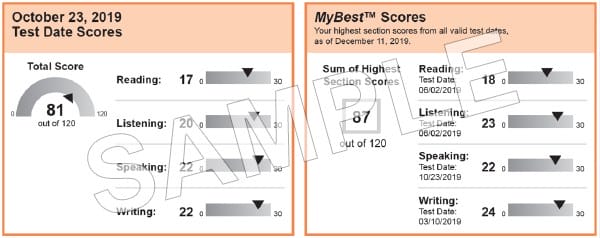
Since August 2019, ETS is introducing a new system – now the admissions committee will see not only the results of the last attempt, but also My Best Score – the best scores for each of the stages received over 2 years. ETS recommends that universities focus on these results as the most objective ones.
This is how the certificate that your chosen universities will receive:
How is the exam
To sign up for TOEFL, you need to register on the website. Please note that the name that you enter during registration must exactly match the name on the passport that you bring with you.
Next, you choose the date, time and center where you will take the test and pay for it by credit card.
Where and when you can take TOEFL in Russia
You can view the exam centers and timetables on the ETS website. On average, they are held 4 times a month on Saturdays or Sundays.
There are 4 centers in Moscow – on Arbat, on Leninsky Prospekt, on Varshavskoye Shosse and in the building of the Moscow Institute of Physics and Technology in Dolgoprudny. There are centers in other large cities of Russia.
If there is no examination center in your city, the system will prompt you to sign up for the nearest one. So, for example, if you are from Anapa, you will be offered to be tested in Krasnodar.
Is it possible to independently prepare for TOEFL in a month
ETS, the company that has been organizing the exam since 1964, cites 8 weeks as the optimal time for self-study if you are willing to practice daily. True, you will still have some gaps.
If you study with a teacher, you can keep within 30 days, but your English level must be at least B2 (Upper Intermediate).
The Instructor-led TOEFL Preparation course is an additional opportunity to learn about the scoring criteria and gain the skills you need to take the test.
TOEFL preparation from scratch
If you decide to enter a foreign university, and your level of English is B1 (Low Intermediate), you need to start preparing with a teacher at least 18 months in advance.
This time will be enough to pass the TOEFL 90 points and above. At first, the main focus of classes will not be on preparing for the exam, but on increasing the level of English to Upper Intermediate, and then – studying the test format.
If you came to the courses with an initial level of B2, in a year you can increase it to C1 and apply for 115+ points on the TOEFL, with this result they enter the top US universities.
Thus, you should start thinking about entering a foreign university and preparing for TOEFL already in high school. Then there are excellent chances to get into a prestigious specialty in the best universities in the world.
TOEFL preparation – where to start?
Start with planning. Estimate the time you will have before passing the test and make an action plan.
Remember that preparation must include work for each part of the exam. In addition, it is very important to create your own Ideas Bank – a set of data and facts about the world that will allow you to judge the breadth of your horizons.
After all, TOEFL questions assess not only your ability to speak and write in English, but also your erudition and ability to analyze and synthesize information.
Write out important facts and interesting observations in your bank of ideas. Taking a few notes a day will make it much easier to answer questions and write an essay for the exam.
Install the official TOEFL preparation app or download PDF planning. It is designed for 8 weeks and contains a checklist for each week, which describes what skills you need to develop.
Format, shapes and format again.
The first thing you need to do is familiarize yourself with the format. Special videos, which are presented in abundance on youtube, will help you with this. I constantly repeat to both my students and readers that you should always know what awaits you in the next task of the test, how you should answer and how your answer is assessed. The Videos section of our website also contains a selection of videos that will help you master the exam format.
Develop individual skills.
Someone is strong in writing essays, someone perfectly understands speech by ear, someone is better to read ten volumes in English than to connect ten words. What am I doing? Moreover, taking the TOEFL, you will have to demonstrate all four skills. Therefore, it is important to identify your strengths and weaknesses. If you are not given listening, try to write down what you are listening to, try to “recognize” every word, to get into the details. If you are not given reading – the advice is predictable – read as much as possible and do the translation at the first stage. Try to understand the main point of each sentence and ignore irrelevant information.
Speaking is considered by many to be the biggest challenge in preparation. How to Develop Speaking Skills for TOEFL? Need to speak, of course. But what about? For those who suffer from a lack of speaking skills, remember that speaking is directly related to listening. How do we start speaking our native language? First we listen to the speech, and then we reproduce what we heard! The same is with preparation: listening to lectures and conversations and making notes – already think about how you would retell them and retell them after listening! Such an exercise, firstly, will save you from choosing topics for discussion. You will always have something to discuss and tell about. In addition, you will speak based on the material you listened to, and you can immediately test yourself by opening tapescript or listening to the recording again. Plus, it's a good workout for the Speaking Section assignments. And to top it all off, the use of new vocabulary!
Practice is the key to writing an essay. There are tons of tutorials that walk you through writing assignments step by step. If you suffer from punctuation, do all vocabulary exercises in writing (that is, in a text editor).
In addition to the basic language skills, there are also minor ones. These include vocabulary, grammar and pronunciation.
Expand your vocabulary with the right words.
A very important task is to expand your vocabulary! The TOEFL feature is its vocabulary. You may come across a text on history or literature, where everything is clear, only two or three incomprehensible words, or maybe chemistry, botany or archeology with a bunch of incomprehensible vocabulary. You do not need to cram highly specialized terms from various branches of science, but you need to know the basic concepts. In fact, TOEFL has a certain lexical set, this can be traced even in preparation textbooks. This “list” includes abstract nouns, adjectives, verbs that can be used in different contexts and applied in different sciences. Having this “basic set” will make your exam task much easier.
To expand your vocabulary, it is better to use special aids. There are more than enough of them on the Internet. If you go through one unit every day, plus a repetition of what you have learned, the result will be mandatory. Work with a dictionary. Preferably monolingual. Memorize synonyms and cognate words.
However, the implementation of vocabulary exercises alone is not enough, therefore, the words that you will learn may not be useful to you in everyday speech and “settle” in a passive vocabulary. So read and listen. Read and listen to TOEFL texts. Download past tests and run them. When you see that the words you learned actually appear in the assignments, your motivation will increase!
And again, listen as much as possible. It is especially useful to watch documentaries such as Discovery, as they cover a wide variety of topics and use vocabulary from a variety of backgrounds.
Pay attention to grammar.
It's no secret that the grammar used in TOEFL is not particularly difficult. However, you shouldn't write it off. Activities such as Speaking and Writing assume that you will construct your own utterances, so try to vary your answers with different constructions, but don't get too carried away. If grammar is your weak point, bring it up to at least the Intermediate level, that will be enough. Single “minor” mistakes, such as articles, may not greatly affect your score, but if the error is repeated systematically, distorts the meaning of the statement, or makes the thought incomprehensible and confusing, this will not affect the result in the best way.
One month before TOEFL
One month is a rather short time to prepare for a test as difficult as TOEFL, so you should work intensively and practice at least 4 times a week. We advise you to sign up for a crash course or hire an experienced tutor so as not to waste time on your own acquaintance with all the intricacies of the test.
Although you don't have a lot of time, don't try to cram everything, but try to practice doing all types of TOEFL tasks as often as possible. Your task is to study well the grammar and expand your vocabulary, as you will not have enough time to improve your level of English proficiency. Use your time wisely: choose tasks that will allow you to develop several skills at once.
Start by preparing for the Reading and Writing sections. As we said above, these two sections complement each other perfectly.
Learn to read for speed and comprehension and expand your vocabulary. Learn vocabulary commonly found in TOEFL.
Write your essay based on the texts you used to prepare for the Reading section. Learn to write an essay outline that will save you time on the test. Pay close attention to grammar because it plays an important role in all assignments.
The sections “Listening” and “Reading” evaluate your ability to convey your message to the interlocutor and understand what has been said. Don't worry about pronunciation at this point (no time!). Instead, make the most of your grammar and vocabulary knowledge. As you listen to online lectures or discussions, take notes and tell your imaginary friend what you heard. Rephrase what you hear, make squeezes out of it, write down and repeat the key words of the lecture. Make the most of the resources available to you – and, if possible, hire a tutor to help you develop your speaking and listening skills.
If you want to prepare for a test in just a week, then you are probably very confident in your abilities. Of course, it can be different, and not everything can be predicted.
If you only have a week left, buy the official TOEFL preparation textbook online and be ready to give your best. The scheme of such training is similar to the one that is used with a time margin of six months – but here you will have to learn everything in a day that is better for a month. Naturally, you will have to study every day.
- On the first day, you need to quickly become familiar with the test format, remember grammar and take a practice exam in order to quickly get professional advice on how to improve your results.
- On the second day, practice the reading exercises from the TOEFL prep.
- On the third day, do the listening tasks using the data from the textbook.
- On the fourth day, focus on speaking and writing down your answers to various questions (the topics of the oral part can be found both in the textbook and online).
- Take days 5 and 6 with a letter. Here you need to allocate two whole days, since the essay takes much more time than all other tasks. Make sure your grammar and vocabulary knowledge is up to date. Write as much as you can. Ask someone to read your essays and explain the mistakes.
- The seventh day will be spent looking at your records and the last practice test.
The textbook will be of great help to you, as well as a friend to help you prepare for the TOEFL.
Reading
As soon as the text appears in front of you, read the first sentence of each paragraph to understand what you are about to read. You will immediately understand what type of questions you may be asked, just take a look. This is about one to two minutes. Your task in TOEFL reading is not to assimilate the text from beginning to end, but to answer questions. Therefore, we looked at the text quickly and proceed to the questions. The first most important thing to know is that the questions are all in order. That is, your first question will be in the first paragraph, the second in the second. There will never be jumps, there, the first question was in the last paragraph, and so on. Everything goes in order.
Listening
Next on the listening part – the main advice for this part – try to write everything down as much as possible, but at the same time listen carefully to the text. It is better that you write down less than hear every detail, than while you are recording, you miss some important points from the text. I had this when I practiced a couple of times, I finish writing something, at this moment I miss important information.

It is important to take notes, but listen carefully to the text. I can say from experience that I hardly used my notes when answering a question. For every 4 question, I only used notes, the rest of the questions are so intuitive and simple that if you listened carefully to the text, you will understand how to answer them. There are no tricky questions like in reading, when you need to think out something, to understand something, there are enough such questions in the forehead. That is, at first there the teacher says: “we will start with the test, and then we will go through the animals in Africa”, then the question will be like this: “where did the lesson begin?”. You will answer that with the fact that the children wrote the test.
Speaking
Moving on – part of speaking. This part I was most afraid of, because I looked, listened to examples of answers, how people respond to the highest scores, and I realized that I would never say that in my life. I would say that Speaking took up the bulk of my time preparing for the TOEFL. When I read various analyzes of students, there was a drop in the score for the fact that he spoke with a delay and did not reveal his idea coolly enough. I thought speaking would be my biggest problem, although I spoke completely calmly and fluently. As I understand it, even native speakers are confused by this part, so the only thing I can advise is to practice as much as possible.

I constantly told my young man, when we were driving somewhere, that give me any topic, I will tell you two reasons why you don't like rock music, why, I don’t know, you don’t want to go to Antarctica to live. Some such completely straightforward topics that you never really discuss.
You just need to be ready for this process when you come up with completely idiotic reasons, because in your life you have never even thought about these topics. In general, the creators of TOEFL recommend not to lie, because you can hear it in your voice, you start to stutter. I believe that lie, come up with, the main thing is to name these unfortunate two reasons for answering the first question and the second. The main thing is to express your opinion as clearly as possible.
Writing
In the first part of writing, you will have a text that you will read, listen to the professor's lecture, remember that the professor will deny everything that you read in the text.
For example, the text will say that mobile communication is bad, because there are radiation, because people communicate less live and some other argument. The professor, in turn, will say that mobile communication is cool, because you can communicate with everyone, from anywhere in the world. In general, he will deny every paragraph of the text. Your task is simply to tell about it.

And the last essays are a free topic, such a moment is important, you should have more than 500 words, that is, try to enlarge your text, and check that you do not have stupid mistakes – you do not need to chuck your text with clever words in which you in doubt, it is better to write simply, but correctly, it is better to avoid mistakes.
Avoid abbreviations, that is, “don't” You write “do not”, “haven't” you write “have not”, because these are still academic standards, and no familiarity is needed in the texts, some kind of ” lol “or some phrases. There should be an academic essay that you can imagine what the professor will read, not a friend – some kind of informal person, so write as formally as possible. Divide the text into paragraphs – five paragraphs. Make sure that they are about the same size, because each paragraph is your separate thought, and some of your thoughts on this topic. If some of the paragraphs are too short, they are likely to write that they have not developed enough thought in this short paragraph.
Best books and textbooks for TOEFL preparation
For self-study and for classes with a teacher, we recommend how many textbooks.
- Longman Preparation Course for the TOEFL is suitable for the initial stages of preparation. A lot of time is devoted to each type of question here, so that you can study them effectively.
- Cambridge Preparation for the TOEFL Test are great exam examples. Suitable for those who expect high scores.
- Oxford Preparation Course for the TOEFL is an option for those who speak English at a high level. Here you can find all the topics that will be on the exam and expand your vocabulary, as well as watch and take practice testing.
Sources used and useful links on the topic: https://EnglishFull.ru/znat/podgotovka-k-toefl.html https://EnglishFull.ru/znat/chto-takoe-toefl.html https: //www.studylab. ru / digest / ekzamen-toefl-chto-eto-takoe https://www.studylab.ru/digest/podgotovka-k-toefl https://enginform.com/article/toefl-preparation
Post source: lastici.ru