
What to cook in a yogurt maker besides yogurt. What to cook in a yogurt maker besides yogurt
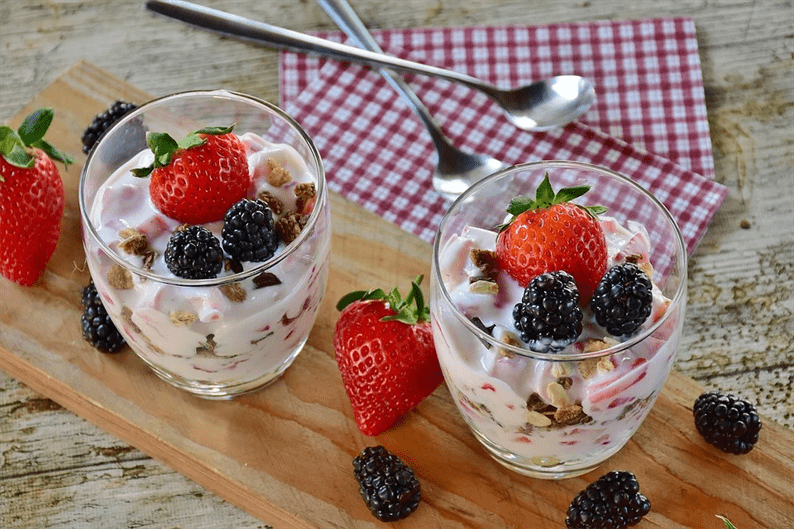
Yoghurt makers and homemade yogurt: the nuances of making a treat
Now you can buy various models of yogurt makers, which differ in the brand of the manufacturer, power, availability of additional functions (indicators, timer), volume. However, the general technology for making a homemade fermented milk dessert will be the same for fermenting yogurt in a Mulinex yogurt maker, and for any other.
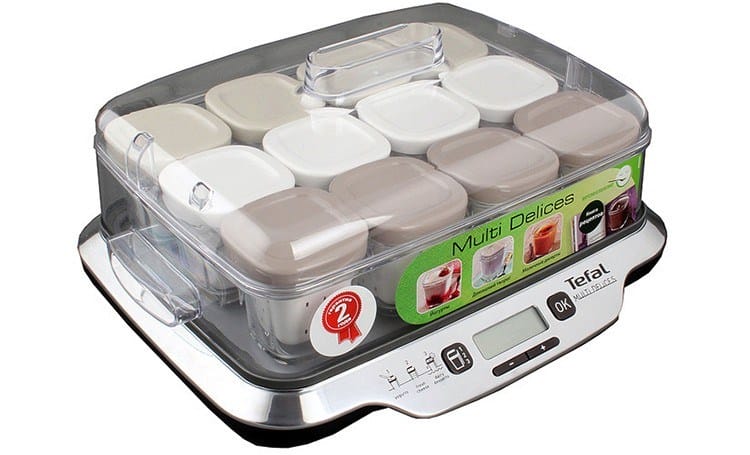
When the device is used with one container, designed for 1-1.5 liters, all the milk starter is poured into this bowl. If the yogurt maker has several small plastic or glass jars, usually from 6 to 12 pieces with a volume of 100-220 ml, then the milk sourdough is poured into them in equal proportions. Moreover, in both cases, the containers have lids, which do not have to be screwed up at all. Their presence or absence will not affect the final result.
When looking for an answer to the question of how to make yogurt on your own, you need to take into account a number of nuances that are relevant for Tefal, Delfa, Redmond, Moulinex yogurt makers and for any other similar devices from other brands.
- The power of the yogurt maker, usually in the range of 6 W to 20 W, directly affects the fermentation time and energy consumption.
- The process of making yoghurt in a yogurt maker most often takes 6 to 10 hours. The longer the container with lactic starter culture is heated, the thicker and more acidic the resulting product can be.
- Setting the right time on the timer or setting the alarm clock, it is important to remember that overdoing it, you can get not yogurt at the exit, but cottage cheese, fermented baked milk, yogurt. Indeed, with the help of this household appliance at home, it is possible to prepare various fermented milk products.
- The milk chosen for yoghurt should be fresh and heated to 35-45 degrees. Pasteurized milk will need to be boiled, and then slightly cooled to successfully create homemade yogurt in a yogurt maker. If the temperature of the liquid is higher, then all the necessary and beneficial bacteria will simply die.
- Powdered milk is not suitable for making a homemade fermented milk dessert.
- It is not necessary to add sugar to yogurt in advance, this can provoke unnecessary fermentation, absorption of sucrose by bacteria and, as a result, cooking yogurt in a yogurt maker will end with an incomprehensible mass at the exit. For the same reason, you should not add fresh fruits or berries in advance, it is permissible to use dried fruits, soaked or boiled berries and fruits, as well as concentrated foods and sugar syrup.
- Before starting the procedure, it is imperative to sterilize a single bowl of a yogurt maker or small jars in it. This is necessary in order to destroy pathogenic and unnecessary microorganisms that can negatively affect the process and result of making homemade delicacies.
- If a yoghurt maker is used, designed for several jars, then you must always fill all of them with future yoghurt. Inside the device, during the entire cooking time, the containers should fit as tightly as possible to each other.
- While the homemade sourdough is in progress, the household appliance must not be touched, moved, or repositioned.
- It is required to store the resulting yogurt at home in the refrigerator, under a tightly closed lid and no more than 5-8 days.
Sterilization and selection of starter culture
When planning to make yogurt in a yogurt maker, the entire device must not only be thoroughly washed and dried, but also home sterilized containers. How to do it? There are several options.
- Taking jars or a bowl, pour hot boiled water halfway inside. After that, put the container (or containers) in the microwave oven, choosing not the highest heating power. As soon as the water boils, giving steam, remove the bowl or jars, remove the liquid and leave to dry for 30-40 minutes. You should not wipe sterilized containers; you do not need to close them with a lid, sending them to the microwave.
- The easiest way: pour over the necessary containers with boiling water several times and leave to dry.
- You can also use a double boiler by placing a bowl or jars in it, blowing hot steam for 10-15 minutes.
When all the nuances of how to make yogurt are taken into account, and the sterilization process is left behind, it is necessary to figure out the options for starter cultures that can be used for homemade treats.
Popular fermentation options for fermented milk dessert
- Natural yogurt or kefir, sour cream.
- Activation.
- Natural curd.
- Vitalakt, acidolakt, simbilakt.
- Streptosan.
- Bifivit.
- Acidophilic milk.
Pharmaceutical preparations are suitable as the desired acidic ingredient:
- Linex;
- “Biform”;
- “Narine”;
- “Acepol” and other drugs with live bacteria.
Depending on which version of the fermented product is chosen, the final taste of the homemade fermented milk delicacy will differ. Pharmacy preparations, the use of which helps to make yogurt in a yogurt maker, will give a more sour or bland taste to the product.
Classic yogurt at home: what you need and how to make it
The classic version of a fermented milk product can be made in absolutely any yogurt maker, using a number of essential components and without adding sugar or sugar syrup.
How to make homemade yogurt: the right ingredients
- A liter of selected milk with a fat content of at least 3.5%.
- One pack of dry or liquid starter culture.
Step-by-step instructions for classic sour yogurt
- Pour the milk into a saucepan or ladle, put it on the stove, heat it to the desired, most often room temperature.
- Add one small spoonful of warm milk to the sourdough bottle, shake well. If the component is used in sachets, pour the leavening powder into a small container, pour in a spoonful of milk, beat.
- Pour the prepared fermenting agent into a saucepan or ladle with milk. Mix well.
- Gently pour the resulting mixture into a container or containers.
- Put the jars or bowl on the tray of the yogurt maker, close the device with a lid.
- Set the required amount of time on the timer (from 6 to 10 hours) or set an alarm.
- Leave the yogurt to cook.
- As soon as the term expires, remove the bowl or jars with the ready-made sour milk from the household appliance. Cool by covering with lids. And then refrigerate for 2.5-4 hours.
Applying pharmaceutical preparations for fermentation, they must be diluted with 2-3 teaspoons of warm milk, insist for 10-12 hours inside a yogurt maker turned on at minimum power. Then you need to cool the existing mixture and send it to the refrigerator for another 1.5-2 hours. Only then apply in order to prepare yoghurt yourself.
Homemade yoghurts with flavors
A wide variety of products can be used as additional flavoring elements that eliminate sour tastes and make homemade yogurt a sweet dessert. However, most of them are added at the last stage, before sending the cooked product to infuse in the refrigerator. Or the flavoring additive is kneaded into yogurt just before use.
What can be added to homemade fermented milk desserts?
- Fruits and berries in different forms.
- Nuts, cereals, bran.
- Honey, coffee, melted chocolate, cocoa.
- Condensed milk.
- Preserves and jams.
- Vanilla, vanilla sugar, vanillin.
- Fruit puree and natural juices, syrups.
- Candied fruits.
Types of milk for yogurt
Yogurt can be made from almost any milk:
1 Pasteurized or UHT milk.
It is quite convenient to cook fermented milk products from it, since it does not need preliminary boiling.
2 Sterilized milk.
If you want to make yogurt, you can buy milk with a long shelf life, which also does not require boiling.
True, many housewives prefer not to cook fermented milk products on this basis, since they doubt the usefulness of such milk and do not like its specific taste too much.
3 Draft milk.
Whether you buy natural milk from the market, homemade or farmed, it is also great for making delicious yoghurt.
True, before using it, it is imperative to boil it, and then let it cool to a temperature of about 40 degrees.
4 Baked milk.
In principle, any milk can be used to make yoghurt, and if you want to get yoghurt with an original taste, try using ghee as a base. You do not need to boil it additionally, you can immediately mix it with the sourdough.
5 Cream.
Those who love a rich creamy taste will surely enjoy making yoghurt with 10-15% fat cream.
Depending on your taste, you can dilute the starter culture directly in the cream, or you can mix the cream with milk in different proportions.
In addition, for the preparation of fermented milk dishes in a yogurt maker, powdered cream is sometimes added to milk – they also make the product thicker.
Important characteristics of milk
1 Fat content of milk.
It is important to know what the fat content of milk affects when making homemade yoghurt.
Milk is from 0.5% to 6% fat. This choice is determined by your taste, age, and goals.
For small children, the optimal milk is 2.5% -3.2%. It makes yoghurt rather liquid and sourish.
If you are making yogurt with the aim of losing weight, it is better to take skim milk – 0.5% -2.5%.
To get a thicker product, it is better to use 6% fat milk. The yogurt is also fatty, like sour cream. This is not for everybody.
2 Homemade or store-bought.
It is believed, and quite rightly, that homemade milk is much healthier. Indeed, this is so if you have your own, healthy cow that is well fed. Unfortunately, this is rare. Homemade milk bought from my grandmother at the bazaar is more harmful than useful.
As for store-bought milk, it can be farmed (not processed), pasteurized (usually milk in soft bags) and ultra-pasteurized (milk in Tetra Pak packaging). This milk has a plus – that it passes safety control, and it shows the composition of proteins, fats, carbohydrates and calories.
3 The benefits of milk.
The most important points are considered: the amount of protein, the content of vitamins and essential trace elements.
If vitamins and minerals are not always indicated on the package, then the protein content is required. The more protein milk contains, the healthier it is. This means that the more useful the yogurt will be.
It is difficult to judge the composition of homemade milk, since it depends on many factors.
4 Boiled or not boiled.
Milk, before adding a high-quality starter culture, must be sterile. Those. this milk should be free of any bacteria. This is the only way to guarantee a normal yoghurt fermentation process.
Super-pasteurized milk is sterile, which means it does not need to be boiled before fermentation. All the rest of the milk must be boiled for 5-10 minutes, cooled to 38-40o and only after that you can add sourdough to it and make yogurt.
What Happens During Yogurt Making: A Chemical Reaction
Traditional Greek yogurt is known to have first appeared. What modern yogurt is not made of in production. In the process of making the dessert, a chemical reaction takes place: a controlled process of curdling fresh milk under the influence of high temperature takes place.
During the reaction of milk, large fat particles are broken down into smaller ones, which are subsequently enveloped by the proteins contained in the milk. After this stage, the milk is subject to mandatory heating, which will help to exclude all harmful bacteria from the product. At this time, the unfolding of stuck together protein enzymes occurs. Then they spread throughout the entire volume of the product, forming a reliable molecular lattice, which will be the basis of the yoghurt mass.
NOTE!
The heating temperature for milk should be no more than 76 ° C. This will help to keep the future yogurt taste alive, which will not hide the notes of fruits and berries.
How does a yoghurt maker work? The rules of its functionality
Agree that homemade yogurt is much tastier and healthier than the one that is produced in industrial production. In addition, the finished product has a delicate aroma and unforgettable taste. This can only be achieved if the home yogurt maker is working properly.
The principle of its functioning is based on one simple rule: to maintain the temperature regime in the range of up to 40-44 ° C for some time (depending on the device model). If the milk in the yogurt maker is exposed to higher temperatures, the lactic acid bacteria will begin to die.
To prepare the product, it is necessary to pour milk at room temperature into glasses that are installed on the device platform, and add a special starter culture to each of them (the amount is determined in accordance with the recipe). Then the device is closed with a lid, its tightness is checked and connected to the electrical network for a certain time (controlled by the type of starter culture). By heating the milk is fermented with sourdough, as a result of which a perfectly tender yoghurt of the desired consistency is obtained.
After the device finishes its work, the finished product must be moved to the refrigerator so that lactic acid bacteria stop developing.
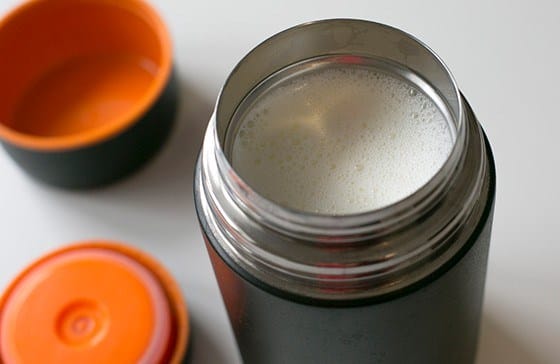
Preparing ingredients for yoghurt
To make yogurt at home, you need to have basic foods:
- fresh milk, preferably natural rustic;
- sugar or refined sugar;
- sourdough (purchased or prepared by hand);
- fruits and berries. For yoghurt, you can use blueberries, peaches, bananas, strawberries, apricots, and dried fruits.
Please note that when adding dried fruits to a dessert product, they must first be doused with boiling water in order to soften and eliminate the presence of pathogenic bacteria.
Choosing milk: natural or pasteurized
It is ideal to use pasteurized store milk for making homemade yoghurt in modern electrical devices, since a product with a low fat content (about 2.5-3.5%) is better for these products.
If desired, you can apply natural fresh products from a dairy or agricultural farmers. Pre-boil the product and cool to room temperature. Otherwise, you risk getting fermented baked milk instead of hearty and tender yogurt of dubious quality.
Recommendations for choosing a starter culture
There are two options for yoghurt starter: dry and liquid. You can buy yoghurt starter at a pharmacy or specialty stores. For homemade yoghurt, it is ideal to purchase starter cultures from manufacturers that fall into the rating.
- Bulgarian sourdough “Genesis” is famous for its quality and gains positive reviews among housewives.
- “Narine” sourdough from Armenia is produced in dry and liquid form. Ideal for preparing homemade fermented milk products.
- Vivo starter culture on a bacterial basis is produced in Ukraine. Perfectly ferments fresh milk.
- The “Good Food” starter culture has recently entered the market, allowing you to quickly prepare homemade sour milk for breakfast or afternoon tea.
- You can also make your own yoghurt starter at home with Activia or another yoghurt on your own.
Which is better: dry or liquid sourdough
Starter cultures for making homemade yoghurt differ in consistency: dry or liquid. Dry yoghurt starter has a longer shelf life and gives the finished product a special taste.
Liquid sourdough is stored less than dry and is considered alive. It is used as a preparation for yoghurt as often as the previous one. Regardless of the type of preparation for homemade sour milk, the products are equally useful for humans, have satiety, and also have a beneficial effect on immunity. For homemade yoghurt, you can use any type of starter culture, provided that it is not expired.
How to make a yogurt starter at home?
To make yoghurt at home, you can use dry starter culture or cook live in milk and store in the refrigerator.
It must be remembered that it is recommended to prepare live starter only 1 time from dry, which is sold in the store. Then it is advisable to use a new dry concentrate.
Dry starter culture for yoghurt
The advantages of dry starter culture are long shelf life, which is at least 1 year from the date of manufacture. To get homemade natural yoghurt, it is chosen in a pharmacy or in a store, and then stored in a dark, cool place. During the preparation of the yoghurt, the sourdough is added to warm milk and the composition is kept for 6 – 8 hours at a temperature of 36 to 38 degrees. Ready-made yogurt is stored in the refrigerator for no more than 5 days.
Live yoghurt starter
To prepare a live starter culture, dry starter culture is added to warm milk. Milk is taken half as much as for ordinary yogurt (1 g – half a liter of milk).
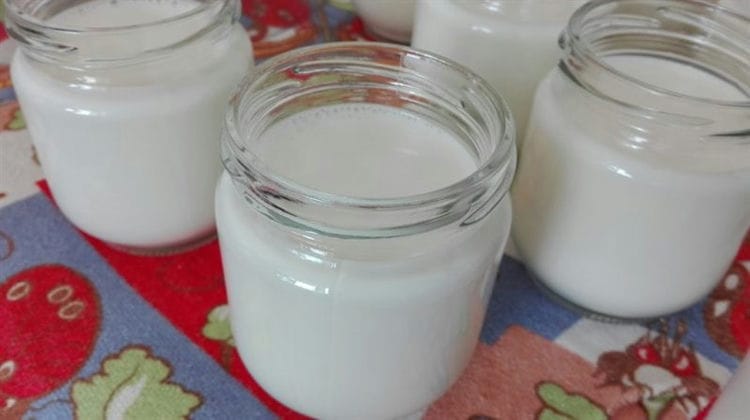
To prepare live starter culture:
- The milk is boiled.
- Then cooled to 38 degrees.
- Sourdough is added and the composition is kept in a yogurt maker or a warm place for 8 hours.
The resulting viscous mass of slightly acidic taste is a living starter culture that must be stored in a clean, tightly closed jar in the refrigerator for no more than 5 days. To make yogurt out of it, take 2 tbsp. l. working starter culture for 1 liter of milk. The cooking time will be about 8 hours.
general information
Before telling you about where to buy yoghurt starter, you need to tell why it is generally made at home.
Fermented milk products have always been distinguished by a huge number of useful properties. They improve digestion well, strengthen the immune system and stimulate the absorption of vitamins.
However, it should be noted that yoghurts sold in stores very often contain dyes, preservatives and other harmful additives. In this regard, we suggest that you try to cook such a product yourself. To make it tasty and tender, you should use only suitable yogurt starters at home.
Useful properties of yogurt
The composition of yoghurt determines its beneficial properties. The main functions of such a product are as follows:
- an obstacle to the reproduction of putrefactive microorganisms in the intestine;
- improving digestion and stomach function;
- cleansing the intestines from toxins, toxins and feces;
- destruction of streptococci and staphylococci, typhoid bacillus;
- improved assimilation of food;
- prevention of infectious diseases;
- increased immunity;
- facilitating the process of weight loss.
The composition of the yoghurt depends on the sourdough used to prepare it. A quality product can be obtained due to the presence of the following substances in it:
- saturated fatty acids;
- organic acids;
- disaccharides;
- monosaccharides;
- trace elements;
- macronutrients.
Yoghurt starter culture, as well as the mentioned product itself, are an excellent source of calcium. According to experts, two glasses of fruit yogurt can contain ½ the daily dose of this micronutrient for children and about 30% for adults.
It should also be noted that in terms of potassium content, such a fermented milk product is in no way inferior to bananas. In addition, the unique benefit of homemade yogurt is that it promotes better absorption of vitamins and other substances that enter the body along with other foods.
A fermented milk product with the addition of fruits and berries is able to quickly restore the intestinal microflora, as well as block harmful substances that come with food or drugs.
Due to the fact that the starter culture is added to milk, this product is better and faster absorbed.
Regular consumption of yogurt promotes the rapid elimination of toxins and toxins through the digestive system and excretory organs (feces, urine, sweat).
Indicators of calorie and nutritional value of yogurt
Homemade yogurt, cooked in a yogurt maker or multicooker, may have different calories. It depends on the basic fat content of the milk. On average, the calorie content of such a product is 68 energy units per 100 g. It should also be noted that homemade yogurt contains 8.5 g of carbohydrates, 5 g of protein and 3.2 g of fat.
As for the vitamins contained in such a fermented milk product, their list is very, very extensive: vitamin A, B12, B1, B3, B2, B6, C, PP, choline.
It should also be noted that homemade yogurt, prepared in a yogurt maker or multicooker, includes the following minerals: magnesium, potassium, calcium, sulfur, sodium, iron, phosphorus, fluorine, zinc, manganese, chlorine, chromium and iodine. Thanks to them, this product is often used to eliminate the deficiency of micro- and macroelements in the body.
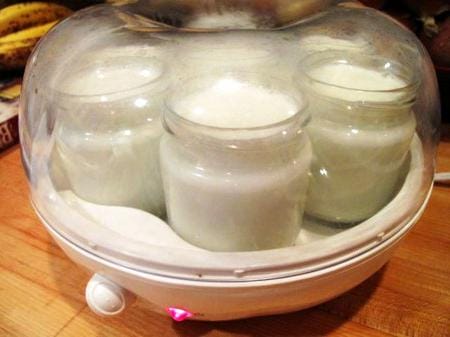
From the above, it can be noted that a good yogurt starter is an excellent natural antibiotic. The calorie content of such a product is low, and the taste is always at the highest level.
Selection of starter culture
Yoghurt makers and multicooker are wonderful devices that are very often used to prepare a tasty and healthy fermented milk product. However, those who purchased them are immediately interested in what yogurt starters should be used at home.
The possibilities are different here. You can go to your nearest store and buy natural yogurt without preservatives, dyes and other additives. It is quite easy to identify such a product among the rest. As a rule, its shelf life is 1-2 days. This ingredient makes an excellent yoghurt starter. Its price is not very high (30-60 rubles), so everyone can make this delicacy at home. However, natural yogurt is not sold everywhere and not always. If you could not find such a product, then you can go to the pharmacy. It contains the following yoghurt starter cultures at home:
- Evitalia sourdough;
- sourdough (enzyme) “Narine”;
- Narine-F Balance;
- “Bifidumbacterin” and so on.
The first two products are particularly popular. However, they say that homemade yoghurt is made from the Narineh sourdough a little sour than from Evitalia. However, this is a matter of taste for everyone. Try both and make your choice.
Is it expensive?
Now you know where to buy yoghurt starter. But how much will such a pleasure cost? A special enzyme for making a homemade fermented milk product is much more expensive than natural yogurt (about 150-210 rubles).
However, most culinary specialists choose dry sourdough. What is the reason for this? The fact is that it is quite problematic to make real yogurt from an ordinary fermented milk product, since when choosing a low-quality starter culture (expired, with the presence of dyes, preservatives, etc.), you will spoil a large amount of milk.
As for the dry starter culture for yogurt (reviews about it will be presented below), it is quite difficult to spoil the raw materials with it. In addition, it is not necessary to acquire the enzyme every time. The sourdough must be prepared once, and then stored for about 2 weeks in the refrigerator.
Thus, the problem of finding the said product arises only once, during the first manufacture of the fermented milk product.
By the way, you can ask your friends for ready-made sourdough, who also like to feast on tasty and healthy yogurt.
Details about the enzyme “Narine”
The Narine sourdough is especially popular among lovers of homemade yoghurt. This product is a dry substance, namely a mass of acidophilic lactobacilli. They quickly settle in the intestines, normalize the microflora of the lower digestive tract, and also help improve metabolism. In addition, such a leaven helps to get rid of many diseases, including diseases of the respiratory, digestive, excretory and genitourinary systems.
Ferment “Narine” has been used for a long time for the treatment of patients with diabetes mellitus, periodontal disease and oncology.
Cooking description:
For the preparation of the starter culture, it is important to purchase high-quality milk and dry base. The yogurt base should be available from pharmacies and kept in the refrigerator. When buying a yoghurt starter, check the expiration dates. For the rest, rely on my detailed recipe for making yogurt starter at home.
Ingredients:
- Cow's milk – 1 Liter
- Dry base “Yogurt” – 0.5 gram (one jar)
How to make “Yogurt Starter at Home”
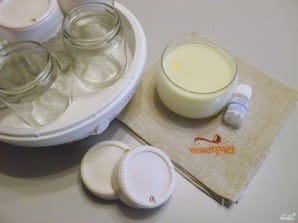
Prepare a yogurt maker, clean and dry (sterile!) Jars. Boil the milk, let it cool to 40 degrees.
[ 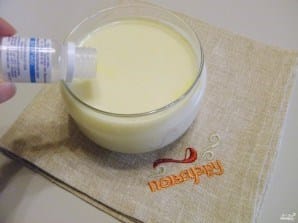 ] (https://img.povar.ru/uploads/f4/14/08/35/zakvaska_dlya_iogurta_v_domashnih_usloviyah-280143.JPG “Pour dry sourdough powder into warm boiled milk)
Pour dry yeast-leavened “Yogurt” into warm boiled milk. Stir well with a wooden spoon.
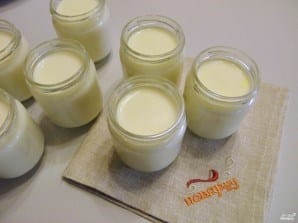
Pour the milk into jars and send it to the yogurt maker for 8-10 hours. Adjust the temperature, its limits should be 37-39 degrees. In cold milk, bacteria will not grow, but in hot milk they will die.
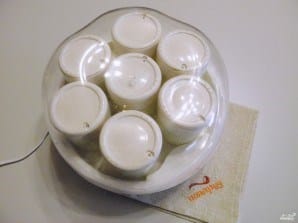
After 8-10 hours, remove the jars from the yogurt maker and refrigerate for 30-40 minutes. During this time, the yogurt will become thicker. Serve yogurt as a dessert, breakfast, or afternoon snack. You can diversify it with fruits and sweeten with honey.
What you need to make a yoghurt starter
You will need: – 2 liters of milk (any fat content); – dry starter culture; – a two-liter container; – a towel or a large sheet of paper.
Since beneficial bacteria have the ability to acquire a pathogenic character, wash your hands thoroughly before starting work, and use only clean dishes during the preparation of the starter culture.
You can buy the starter base at the pharmacy. For example, it can be dry starter cultures “Evitalia”, “Narine”, “Lactobacterin”, “Bifidumbacterin”. A substance that contains beneficial live bacteria capable of multiplying is suitable.
Many people advise using commercial yogurt, which is marketed as live, as a starter for yoghurt. But this is undesirable, as it can also bring harmful bacteria into your homemade yogurt, which will develop during the heating process, which can lead to indigestion or even poisoning.
To make yogurt from sourdough, you need to take:
- Liter of milk (quality matters)
- 1 liter yoghurt starter
You can cook in a yogurt maker, thermos, multicooker, you can even just pour the milk into a jar or pan and put it near the battery (if you are preparing a drink in winter and your batteries are hot, of course).
First of all, pay attention to the choice of milk. It should be of excellent quality, preferably homemade. This is the main rule. As for the starter cultures. As a rule, they are not much different.
The only thing worth paying attention to is the storage conditions. Starter cultures should only be stored in the refrigerator. If the leaven has been kept warm for a long time, the lactic acid bacteria in it may die, and accordingly, the drink will not work. You can freeze the starter, in most cases, this helps to extend its shelf life.
About three hours before cooking, remove the starter from the refrigerator. This will allow the lactic acid bacteria to activate and the fermentation process will go faster. Pour the milk into a saucepan or any other container.
Place on oven and heat slightly. If you are not sure about the quality of the milk, it is better to boil it and then cool it down. The temperature of the milk, into which it is desirable to introduce the starter culture, should be no more than 36 degrees (body temperature).
Lactic acid bacteria develop best at this temperature, when it rises above 50 degrees, they die.
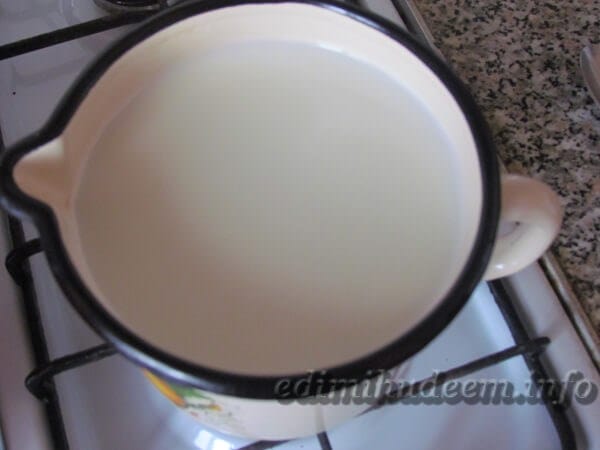
Add the starter culture and simply stir it with a spoon.
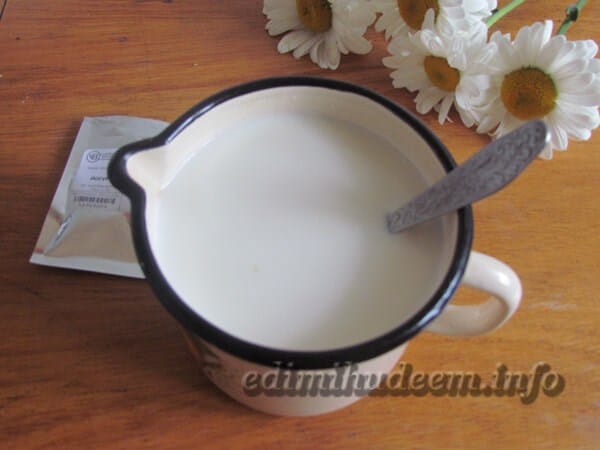
Now pour into cups from a yogurt maker, multicooker or just a thermos, as in this recipe. Close the lid. The fermentation time is approximately 8 hours, it may take up to 10 hours.
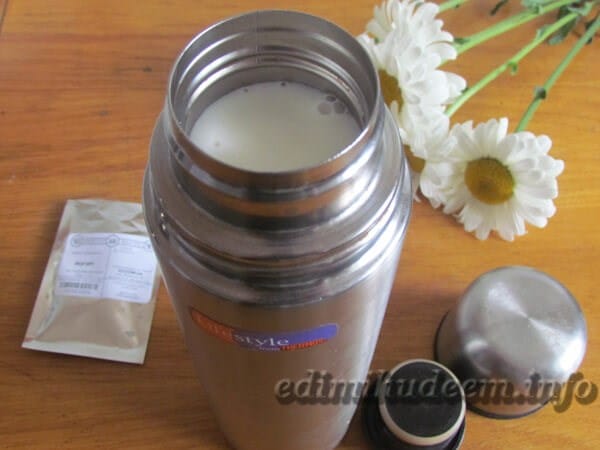
Pour the finished yogurt into a jar and store in the refrigerator for up to three days.
In principle, the preparation of the drink is very simple. But sometimes, especially if you have never cooked such foods before, difficulties can arise.
Why the sourdough yoghurt didn't work:
- You used spoiled starter. Its expiration date has passed or it has not been properly stored.
- You put the starter culture in too hot milk and the bacteria just died.
- You used low-quality milk reconstituted from powder (this does not happen often).
Another common problem is that the drink is liquid. The reasons why yoghurt turns out to be liquid are the same. Plus, you could have used skimmed milk, for example, bought it in the market, previously diluted with water, or purchased milk of not the best quality in the store.
The answer to the question of why yoghurt turns out to be sour lies in the fermentation time. To make the drink less acidic, ferment it less time. The longer the drink is kept warm, the more lactic acid will be produced in it.
However, this also depends on the temperature. For example, in a yogurt maker or multicooker, the drink ferments faster, since the temperature at which it is prepared is higher. Try not to keep the drink warm for more than 10 hours
What sourdough is made from
You can buy homemade yogurt starter in a supermarket or pharmacy in liquid or dry form. “Live” starter cultures are stored for a short time, unlike dry ones, maximum – 20 days. Dry bacteria do well for a year if stored properly. The sourdough is a mixture of Bulgarian or acidophilus bacillus, thermophilic streptococcus and other bacteria that begin to multiply vigorously once in milk. The starter culture also includes lactobacilli, which destroy pathogenic microflora in the intestines, and calcium, which is useful for bones and teeth. The most popular starter cultures are the probiotics “Simbilakt”, “Vitalakt” and “Acidolact”, the starter cultures from Vivo “Streptosan” or “Bifivit”, as well as acidophilus.
As a starter, Bifidumbacterin, Lactobacterin, Narine, natural store-bought yoghurt such as Activia, or the remains of homemade yoghurt are quite suitable. But you can ferment milk with a self-prepared fermented milk product no more than 2-3 times, otherwise the yogurt will turn out to be liquid and not very tasty. Some housewives ferment milk with sour cream or kefir. You can make your own live starter culture by adding dry bacteria to boiled and chilled milk at 38 ° C. Read the annotations and respect the indicated proportions. Soak the milk for 8 hours in a warm place, and the sourdough is ready. It is stored in the refrigerator for no more than 5 days; to make yogurt, you need to take 2 tbsp. l. for 1 liter of milk. In the freezer, live starter culture can “live” for several months.
Proportions and subtleties
It is easier with dry bacteria – as it is written in the annotation, you mix it, but what about live starters? If you are using store-bought yoghurt, add 100 g per 1 liter of milk, and if you cook on the basis of your own yoghurt, then 2-3 tbsp is enough. l. By the way, the fermentation time is usually indicated on the packaging with pharmacy bacteria, since the activity of microorganisms can be very different.
Get a kitchen thermometer to measure the temperature of your milk. It is very important to cool the milk exactly to 40 ° C; alas, it will not work to determine the degree of readiness of the milk by eye. How to make yogurt from homemade milk? In the same way, only it will have to be boiled to kill bacteria. And one more tip – it is not at all necessary to sterilize the dishes, it is enough to load it into the dishwasher and turn on the high-temperature mode.
The time when the yoghurt is ready is determined empirically. If 7 hours have passed, and it is still liquid, let it ferment further. It all depends on the quality of the milk and starter culture. The longer the yogurt is fermented, the thicker it will turn out, but if you overexpose it, it will acquire a sour note.
Do not shake the container of yoghurt and try not to move it so as not to disrupt the fermentation process.
Yoghurt maker or slow cooker?
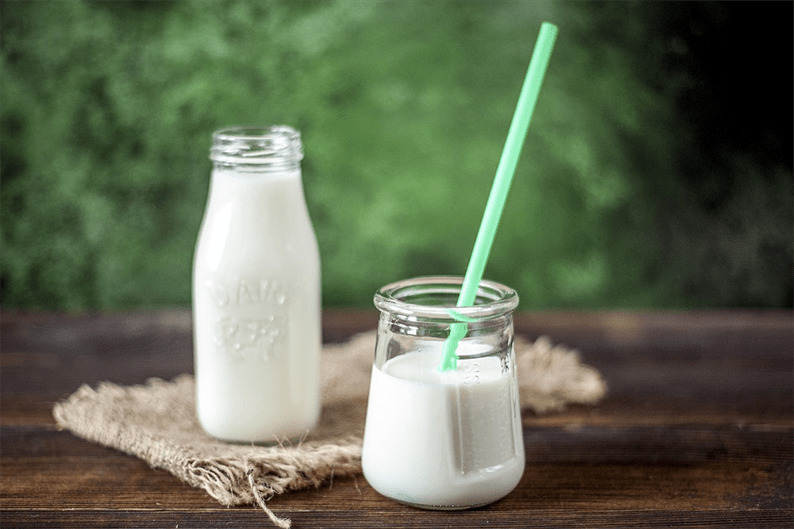
The easiest way to make homemade yogurt in a yogurt maker is to scald the jars with boiling water, pour in milk mixed with sourdough, close the lids with scalded boiling water, turn on the desired temperature and forget about yogurt for the night. In the morning, you can already enjoy a delicious and healthy breakfast by mixing yoghurt with nuts and fruits, seasoning it with cottage cheese or oatmeal.
You can make homemade yogurt without a yogurt maker – in a slow cooker. Modern devices have the “Yogurt” function, thanks to which a constant temperature is maintained. Of course, the multicooker bowl must also be scalded with boiling water first.
If you don't have a slow cooker or yogurt maker, you can take a regular, clean stainless steel pot, fill it with sourdough milk, and turn the oven on to low heat. A saucepan wrapped in a warm towel or blanket should be placed on an open oven lid or next to a radiator for at least 7-8 hours.
Most Popular Yogurt Supplements
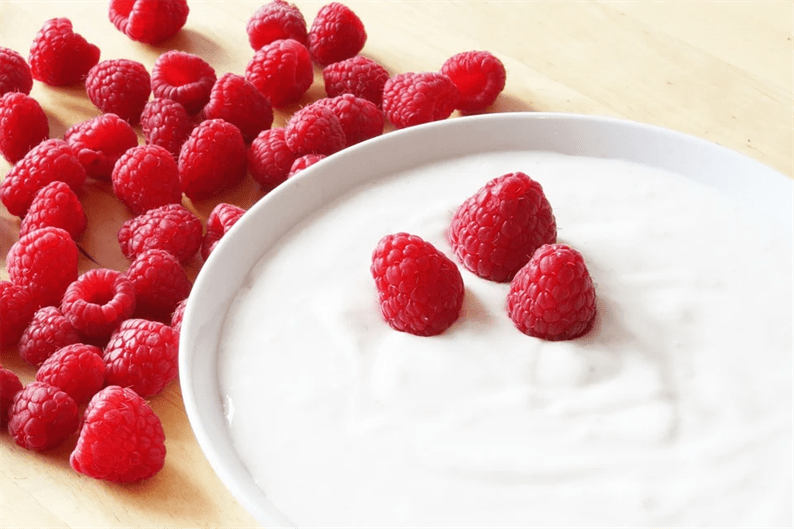
Yogurt with sweet fruits and berries is very tasty – with raspberries, strawberries, cherries, bananas, apricots, mangoes, peaches and whatever you like. The yoghurt flavor is enriched by nuts, bran, germ flakes, rolled oats, chocolate chunks, coffee, honey, condensed milk, coconut flakes, fruit or chocolate syrup, jam, jam, juices, fruit purees, vanilla and spices.
Do not add berries, fruits and sugar at the beginning, otherwise bacteria will begin to ferment the fruit, and not the milk. Such additives are only added to the finished product! On the other hand, nuts and cereals can be placed on the bottom of the jars before fermentation begins; they will not affect the quality of the yogurt in any way. Instead of sugar, it is better to use syrup or powdered sugar so that the grains do not crunch on your teeth.
There are not many calories in homemade yogurt, unless, of course, this light dietary product is weighted down with fatty and sweet additives. And how much to store homemade yogurt depends on the availability of additives. Without them, the finished product can stand in the refrigerator for 3 days, but if you added fruits and berries, it is advisable to eat yogurt in 12 hours. It turns out that it is better not to cook fruit yoghurts for future use.
Yoghurt based on purchased
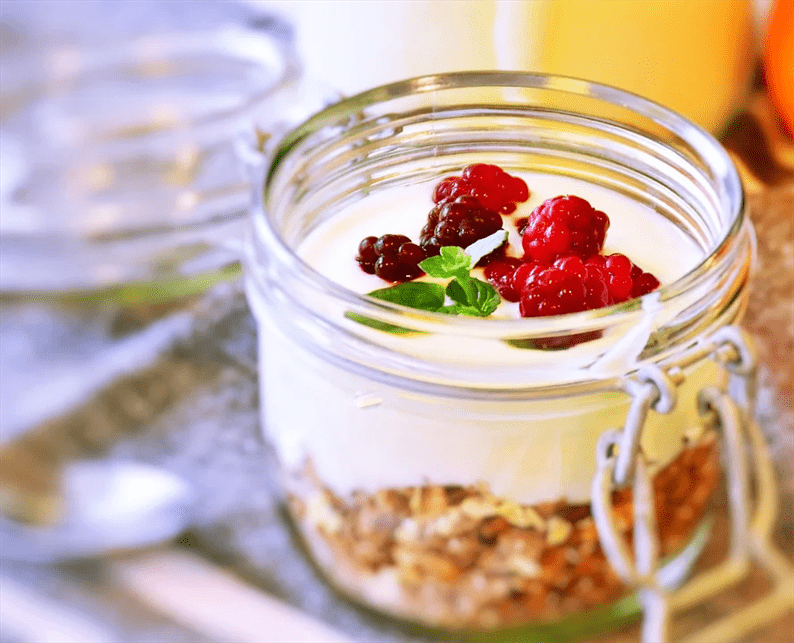
It is quite possible to make homemade yoghurt without sourdough, for example, with commercial yoghurt without additives. To do this, you will need 1 liter of milk with a fat content of 3.5–6%, heated to 40 ° C. Homemade milk should be boiled beforehand.
Add 5 tbsp to it. l. natural yogurt, mix well and pour boiling water over the jars of the yogurt maker. Put on the bottom of the containers 1 tbsp. l. fragrant berry jam and a few nuts – walnuts, almonds or hazelnuts. It is better to pre-crush the nuts into large pieces. Place the containers in the pan of the yogurt maker and set the timer for 6-8 hours. Place the finished yogurt in the refrigerator for 4 hours, then serve with cheese cakes and pancakes.
Greek yogurt for salads
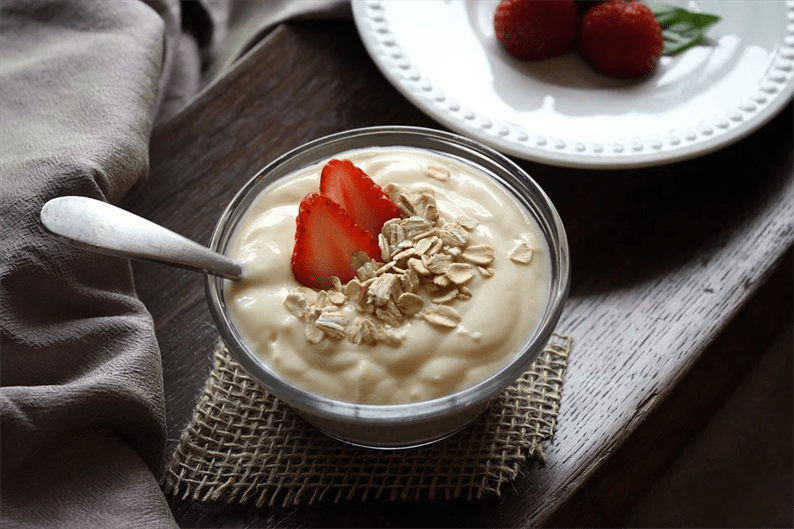
Natural yogurt can be used to dress salads instead of mayonnaise. Or make cake cream out of it. It is tasty, healthy and low in calories.
Buy the Evitalia starter culture, which is a complex of live microorganisms, probiotics. Heat 2 liters of milk to 40 ° C, pour in 2 tbsp. l. milk into a bottle with bacteria, shake well until smooth, pour the starter culture into the milk and mix thoroughly with a whisk.
Now pour the yogurt base into jars or a saucepan, which should be wrapped in a blanket and left in a warm room overnight. In the morning, put yogurt in cheesecloth, folded in several layers, and keep for 1-4 hours – to get a thick, but very tender mass.
Season with Greek yogurt on a fresh vegetable salad, or serve as a dessert after mixing with mashed banana and chocolate chips.
Benefits of a yogurt maker
This technique will be very useful for preparing fermented milk products from natural ingredients. At the same time, you can be completely sure of their high quality, since the user himself chooses the components.
By creating various healthy yoghurts and other dairy products, you can change the recipe and make the desired consistency. In addition, natural additives can be added to desserts to enhance and diversify the taste. In a yogurt maker, you can make a thick creamy dessert with fruit syrup or light drinking yogurt.
Expenses for fermented milk products from stores will be much lower. It will be enough to buy several types of sourdough and milk as the main ingredient. This is enough for several servings of delicious desserts at a minimum cost.
Also, the technique saves the cook's time, and the recipes themselves are very simple. All you need to do is mix the starting ingredients and pour them into a bowl. The rest of the process happens automatically.
During the preparation of yoghurt, you can go about your business, and the machine can also work at night. In this case, several servings of fresh dairy desserts will already be ready for breakfast.
What can you cook
By changing the recipe, from the same components, you can get products of different taste, percentage of fat and consistency. In the morning, thick, rich yogurt with berries or fruits is perfect as a substitute for a full breakfast. During the day or at night, you can drink light drinks that improve digestion.
In addition to classic yoghurt, you can use a yoghurt maker to do:
- homemade cottage cheese;
- fermented baked milk;
- kefir;
- sour cream;
- yogurt;
- dessert mixes with various additives.
To prepare a certain product, you need to buy a special leaven. The result will depend on the type of bacteria it contains. Also, natural yogurt, which is sold in stores, or such mixtures as Actimel, Activia, can be used as a starter culture.
If the yoghurt was prepared according to the classic recipe, a small amount of it can be used to ferment the next batch. To do this, transfer a few tablespoons to a separate jar and refrigerate.
The thickness and taste of the composition at the exit is determined by the fat content and the type of the initial ingredients. For thick products, you need to take heavy cream or milk, and 2.5-3% milk will make a light and liquid drink.
Recipes
If fresh raw milk is used as the main component, then it must first be boiled. Then cool to room temperature and combine with sourdough. Store-bought pasteurized product does not need to be boiled.
Ryazhenka
It can be made from a liter of low-fat milk and 200 ml of sour cream. Or from a special ferment that is sold in a pharmacy.
For cooking:
- Bring the milk to a boil, then simmer a little over low heat. Be careful not to burn the liquid.
- Remove from heat and let cool to 30-40 degrees.
- In a small amount of milk, dilute the sour cream until a homogeneous consistency is obtained and pour into the remaining milk.
- Pour the mixture into the bowl of the yogurt maker, close the lid and turn on the appliance.
Ryazhenka is cooked at a temperature of 30 ° for about nine hours. At the end of this time, put the made drink in the refrigerator for 1.5-2 hours. After that, it can be consumed.
Cottage cheese
To make delicious cottage cheese at home, take one and a half liters of fresh milk.
Workpiece:
- Boil it and let it cool.
- Then add 100 grams of cottage cheese and 20 ml of lemon juice to the milk.
- Stir and pour 100 ml of ready-made natural yogurt into the mixture.
- Turn the appliance on for cottage cheese cooking.
When the yogurt maker turns off, take out the cups with the finished product. It will be necessary to separate the whey from the curd by throwing it on a sieve and letting the whey drain. After that, send the curd to the refrigerator for 3-4 hours.
Sour cream
To prepare sour cream, you will need a liter of cream and half a liter of fermented baked milk. Cream should be taken 20-30% fat. And instead of fermented baked milk, you can use a special leaven.
Actions:
- Mix and shake the ingredients.
- Pour into cups and place in a yogurt maker.
- Set the cooking time to 7 o'clock.
After turning off the device, all that remains is to get the sour cream and put it to cool for about an hour.
Is it possible to cook cheese in a yogurt maker
Although many instructions say that using the device you can cook cheese, this is not entirely true. You can make yogurt, which is then used as the main component for making cheese.
Yogurt is prepared according to the usual recipe from milk and sourdough, herbs (oregano, basil) and salt are added to it.
The fermented milk mixture cooled in the refrigerator is poured onto cheesecloth in a colander (there should be at least 4 layers of cheesecloth). The gauze knot is squeezed out, suspended for several hours so that the serum is removed from the product. Then the knot is placed in a cold place under oppression for 2-3 days. The result of the work is delicious and soft cheese.
Sources used and useful links on the topic: https://sovetexpert.ru/gotovim-jogurt-v-jogurtnice.html https://syrodelkin.ru/iz-kakogo-moloka-gotovit-jogurt.html https: // tehno. guru / ru / prigotovlenie-jogurta-v-jogurtnice-v-domashnih-usloviyah-recepty / https://attuale.ru/zakvaska-dlya-jogurta-3-retsepta-prigotovleniya-v-domashnih-usloviyah/ https: // FB.ru/article/198266/zakvaski-dlya-yogurta-v-domashnih-usloviyah-kak-prigotovit-domashniy-yogurt https://povar.ru/recipes/zakvaska_dlya_iogurta_v_domashnih_usloviyah-40773.html https: //www.wday. ru / dom-eda / soh / yogurtovyie-zakvaski-v-domashnih-usloviyah / https://edimihudeem.info/domashnij-jogurt-iz-zakvaski.html https://www.edimdoma.ru/kulinarnaya_shkola/posts/22458-sekrety-prigotovleniya-domashnego-yogurta https://tehnopomosh.com/dlya-kuhni/jogurtnitsy/chto-mozhno-prigotovit-krome-jogurta.html https: //homeasking.com/chto-prigotovit-v-jogurtnice-krome-jogurta/
Post source: lastici.ru