
What color is the sun really? Why are there no stars in space?

Observing from space
To examine a luminary without eye protection, even while on Earth, is a dangerous business. Bright sunlight can burn the cornea. Therefore, it is very difficult for ordinary observers to say what color the sun really is. But images from space unambiguously answer that our star is white.
It is known from the physics course that, as such, there is no white color. This is the result of mixing all the shades of the spectrum from red to violet. The luminosity of white light is due to the Sun's effective color temperature of 5780 Kelvin.
Why is the Sun yellow on Earth? The atmosphere of our planet strongly scatters stellar rays. In addition, the air shell absorbs short-wave radiation (violet, blue, blue and green shades of the spectrum) and the luminary appears in front of us in a yellow-orange color. The star becomes intensely red at dusk and dawn, when its light is more refracted in the atmosphere. Also, the more polluted the atmosphere, the redder the solar circle will appear. It can take on a white-blue hue in cloudless weather, being at the very zenith.
Light from other stars
We have already learned that the real color of the Sun is white. And in this the main role is played by the temperature of its surface. It turns out that the lower the color temperature, the redder the light will look. Red dwarfs and giants are examples of this. The former have a mass ten times less than that of the sun, and their temperature does not exceed 3500 Kelvin. These are the coldest stars in the universe.
The situation is different with red giants. These are luminaries whose mass and diameter exceed the solar parameters. But their surface temperature has become lower due to the complete combustion of the internal reserves of hydrogen fuel. As they expand, they burn the helium around them and become colder.
Stars with temperatures above 6,000 Kelvin go into the blue-blue part of the spectrum. The hottest – blue supergiants – can heat up to 50-60 thousand kelvin. Their luminosity exceeds the luminosity of yellow dwarfs by tens of thousands of times. This spectral class includes Rigel, Gamma Sails, Tau Big Dog, Zeta Korma.
The sun will not always shine with white light. By wasting the reserves of hydrogen in the core, it will turn into a red giant, and after its explosion it will turn white again. At the same time, its size will be reduced by a hundred times. So it will shine for a long time, gradually cooling down, and after billions of years it will become completely black.
The secret of the stars
How to catch a star in a photo
Astronauts shoot our planet with very short exposures, because the Earth is very bright and there is a danger of exposing the photo. For this reason, the stars do not have time to appear in the black sky.
But they can be seen in the photo of the Earth's night hemisphere. In this case, the exposure should last for a few seconds. Stars, thunderstorms, lightning and illuminated cities easily appear in the photo.
Experts point out that it is not easy to take a high-quality picture of the stars. Yes, we see them, thanks to the peculiarities of the structure of the eyes. However, the electronic matrices of cameras are not yet as perfect as our organs of vision. Therefore, to get a good photo, you need to have both professional skills and excellent equipment.
Lighting problems
The stars are clearly visible in space. In fact, we can see them better from space than through our dense atmosphere. That is why scientists continue to send telescopes there.
The reason the stars are not visible in photographs has much more to do with photography itself than with astronomy.
The stars are quite dim compared to the light reflected from the Earth and the Moon. Taking good pictures in outer space requires a fast shutter speed and a very short exposure. This means that our planet and the moon are clearly visible, but the stars often do not appear in the photo.
Travel speed
Besides the unusual lighting conditions in outer space, there is another factor that requires fast camera response times. The ISS travels at a speed of 8 kilometers per second, which is great for being in orbit, but the photos are blurry.
Equipment features
This is not the only problem. Try to photograph the night sky with your smartphone. How many stars do you see? What happens if you try to photograph something in the foreground? Can your camera also pick up the stars in the background?
It is for these reasons that astrophotographers use highly expensive equipment, optimized for a specific task, and carefully plan weather conditions and exposure times.
But even if the stars are often not visible in all photos, videos and online broadcasts, there are many beautifully captured images showing the stars, and even the Milky Way, captured by the ISS, which are in the public domain, so you can see them at any time. …
Why can't the sun illuminate space?
Anyone can see the sun, which illuminates the entire sky and surrounding objects of reality during the day. But if we could just climb several thousand kilometers up, we would notice the increasingly thickening darkness and bright flashes of distant stars. And here a completely natural question arises: if the sun is shining, why is it dark in space?
Experienced physicists have long found the answer to this question. The secret is that the Earth is surrounded by an atmosphere filled with oxygen molecules. They reflect sunlight directed towards them, acting like billions of miniature mirrors. This effect gives the impression of a blue sky overhead.
There is too little oxygen in outer space to reflect light from even the closest source, so no matter how strong the sun shines, it will be surrounded by a frightening black haze.
Olbers paradox
Diggs mused about a sky covered with an endless number of stars. He was confident in his theory, but one thing confused him: if there are many stars in the sky that never end, then it must be very bright at any time of the day or night. In any place where the human eye falls, there must be another star, but everything happens exactly the opposite. This he did not understand.
After his death, this was temporarily forgotten. In the 19th century, during the life of the astronomer Wilhelm Olbers, this riddle was again remembered. He was so worried about this problem that the question of why it is dark in space, if the stars are shining, was called the Olbers paradox. He found several possible answers to this question, but in the end he settled on the version that spoke of dust in outer space, which covers the light of most stars with a dense cloud, so they are not visible from the surface of the Earth.
After the death of the astronomer, scientists learned that powerful radiations of energy emanate from the surface of stars, which can heat the temperature of the surrounding dust to such an extent that it begins to glow. That is, clouds cannot interfere with starlight. The Olbers paradox received a second life.
Space researchers have tried to study it, offering other options for answering a burning question. The most popular was the version about the dependence of starlight on the location of its carrier: the further away the star, the weaker the radiation from it. This option was not continued, since there are an infinite number of stars, there should be enough light from them.
But every night the sky darkens. Another generation of astronomers proved that Diggs and Olbers were wrong in their assumptions. Edward Garrison, a renowned explorer of space phenomena, became the author of the book “Darkness of the Night: The Mystery of the Universe.” He laid in it another theory, which is still held today. According to her, there are not enough stars to constantly illuminate the night sky. a limited number, they tend to end, like our Universe.
An infinite number of stars – myth or reality?
There is a mathematical theorem: if you look at a substance with non-zero density, which is located in an infinite outer space, then in any case it can be seen through a certain distance. In the case when space is infinite and filled with stars, a gaze directed in any direction should see the next star.
From the same theorem, we can conclude that the light from the stars will be directed in all directions and reach the earth's surface, regardless of their location. That is, the boundless Universe, filled with constantly sparkling stars, would have a bright sky at any time of the day.
The Role of the Big Bang
At first glance, it seems that such a theory does not find confirmation in real life. A person cannot see all galaxies from the earth's surface, even with the help of special devices. To confirm their existence, he had to go into space, moving away from his home planet at a certain distance.
But scientists have their own opinion, which is based on the Big Bang – it was after it that the formation of planets began. Yes, there are many galaxies and individual stars outside the Earth, but their light has not yet reached us, since not much time has passed since the explosion from an astronomical point of view. It follows from this that the process of the development of the Universe is not yet complete, and cosmic processes can affect the distance between the planets, delaying the moment when their light will be visible from the earth's surface.
Astrophysicists believe that the reason for the Big Bang is that the universe had a higher temperature and density in the past. After the explosion, the indicators began to fall, which made it possible to start the process of formation of stars and galaxies, so today they are not surprised by the fact why it is dark and cold in space.
Telescope as a way to see the past of the stars
Any observer on the earth's surface can see the starlight. But few people know that the star sent us this light in the distant past.
For example, you can remember Andromeda. If you go to her from Earth, the journey will take 2,300,000 light years. This means that the light that it emits reaches our planet during this period of time. That is, we see this galaxy as it was more than two million years ago. And if suddenly a catastrophe occurs in outer space that destroys it, then we will find out about it after the same period of time. By the way, the light of the Sun reaches the surface of the earth 8 minutes after the start of the journey.
The modern process of technological development has affected telescopes, making them more powerful than the first copies. Thanks to this property, people see light from stars, which began to go to Earth almost ten billion years ago. If you remember the age of the universe, which is 15 billion years, then the figure makes an indelible impression.
The true color of space
Only a narrow circle of specialists knows that with the help of electromagnetic devices it is possible to see completely different shades of space. All celestial bodies and astronomical phenomena, including supernova explosions and the moments when clouds of gas and dust hit each other, emit bright waves that can be captured by special devices. Our eyes are not adapted for such actions, so people are surprised why it is dark in space.
If people were given the opportunity to see the electromagnetic background of the environment, then they would see that even a dark sky is very bright and rich in colors – in fact, there is no black space anywhere. The paradox is that in this case, humanity would not have a desire to explore outer space, and modern knowledge about planets and distant galaxies would remain unexplored.
Remoteness of stars
Remoteness of stars
However, after Olbers it was calculated that the stars with the energy they emitted are capable of heating any dust so that it itself begins to glow. Then the night sky was seemingly bright with glowing dust. Everything returned to normal – yes, a paradox. Scientists have developed other theoretical explanations. For example, distant stars shine fainter than closer ones, so the light from distant stars is either very weak or simply not visible. However, this explanation is unsatisfactory, because if there are countless stars, then there should still be enough light. The sky should still be bright.
Why is space black despite the light of the stars
The mysterious blackness of space is a true mystery that scientists have argued about for hundreds of years. Why don't the stars of our Universe all together shine with an even blinding light? Why is the sky black at night? Astronomer Thomas Diggs became interested in this issue in the 16th century. Diggs was convinced that the universe has no end or edge and extends infinitely in all directions, that the universe exists forever and will remain forever, and that there are innumerable stars in the universe.
Why is the sky blue, if there is darkness in space
Only modern technologies have coped with the task. It turns out that the matter is in the atmosphere of our planet, filled with a large amount of oxygen. It reflects sunlight like a mirror. Thus, the effect of a blue sky is created, which is impossible in space, where there is very little oxygen.
The light is not reflected there even from the closest source. And no matter how bright the Sun is, it is still destined to be surrounded by dark cosmic haze.
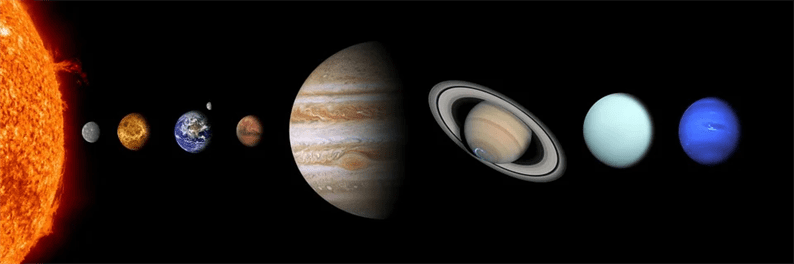
In fact, there are many shades in space.
What is the space of the cosmos
With the help of electromagnetic equipment, you can find out the real color of outer space and its shades. All celestial bodies and phenomena occurring in the Universe emit bright waves. To see them, you need a device, because human eyes are not adapted for this. Therefore, space is always dark for us.
If people had the opportunity to see the electromagnetic background in the environment, then they would notice that even at night, our sky is actually very bright.
Galaxies can be seen from Earth with the naked eye
From the Earth with the naked eye, we can see as many as four galaxies: in the Northern Hemisphere, our Milky Way and Andromeda (M31) are visible, and in the South – the Large and Small Magellanic Clouds.
The Andromeda Galaxy is the largest of the nearest to us. But if you arm yourself with a large enough telescope, you can see many more thousands of galaxies. They will appear as hazy spots of various shapes.
The solar system is nearly 4.5 billion years old
Looking up at the night sky, we look into the past
When we look into the night sky and see the stars we are used to, we are truly looking back in time.
This is because we actually see light sent by a very distant object many years ago. All the stars that we see from Earth are many light years away from us. And the farther a star is, the longer it takes for its light to reach us.
For example, the Andromeda galaxy is 2.3 million light years away. That is, exactly as long as its light reaches us. We see the galaxy as it really was 2.3 million years ago. And we see our Sun with a delay of eight minutes.
The sun rotates around its axis unevenly. At the equator – in 25.05 Earth days, at the poles – in 34.3 days
There is not absolute silence in space
Our ears perceive vibrations in the air, and in space, due to the airless environment, we really cannot hear any sounds.
But this does not mean that they are not there. In fact, even a rarefied gas or vacuum can conduct a sound of a very large long wave that is inaudible to our ears. Its source can be collisions of gas and dust clouds or supernova explosions.
Of course, we cannot hear such electromagnetic waves. But some spacecraft have instruments that can capture radio emission, and scientists, in turn, can convert it into sound waves. For example, here we can listen to the “voice” of the giant Jupiter, made by the Cassini spacecraft in 2001.
What is the temperature in space
In fact, our usual idea of temperature is not entirely applicable to outer space. Temperature is a state of matter, and, as you know, there is practically no such state in outer space.
Still, outer space is not lifeless. It is literally permeated with radiation from a variety of sources – collisions of gas and dust clouds or supernova explosions and much more.
It is believed that the temperature in open space tends to absolute zero (the minimum limit that a physical body in the Universe can have). Temperature absolute zero is the origin of the Kelvin scale or minus 273.15 degrees Celsius.
Planets and their satellites, asteroids, meteorites and comets, cosmic dust and much more play an important role in shaping the temperature of space. Because of this, the temperature can fluctuate. In addition, a vacuum is an excellent heat insulator, something like a huge thermos. And due to the fact that there is no atmosphere in space, objects in it heat up very quickly.
For example, the temperature of a body placed in space near the Earth and under the rays of the Sun can rise to 473 degrees Kelvin, or almost 200 degrees Celsius. That is, space can be both hot and cold, depending on where it is measured.
What does the surface of the sun look like?
The new telescope built to study the Sun has released its first images, and they are simply breathtaking. The photographs show the Sun's surface in the finest detail we've ever seen – revealing Texas-sized convective granules and tiny magnetic features on the Sun's surface that extend far into space.
Despite all the spectacularity of the presented images, photographing the sun's surface is not the main task of the telescope. So, with the help of the device, scientists hope to better understand the dynamics of the evolution of the Sun, as well as how the processes taking place on the star affect life on Earth.
Each of the solar granules shown in the image is comparable in size to the US state of Texas.
Of particular interest to scientists are the magnetic fields of the Sun entangled by the plasma, which can lead to solar storms on the Earth, which, in turn, can disable all electronic equipment on the planet. Less powerful solar storms can also affect communication and navigation systems, but to a much lesser extent, while creating the magnificent auroras that can be seen at high latitudes. However, despite the entire level of knowledge that mankind has been able to acquire over the entire time of studying solar activity, our ability to predict space weather remains extremely limited, which can lead to very unpleasant consequences on a planetary scale. Scientists hope that the Inouye telescope will help deal with such a misunderstanding. providing a large amount of necessary information about the processes taking place in the immediate vicinity of our star. The telescope can be helped in this difficult task by a set of modern instruments, most of which have not yet been connected. One such device could be a cryogenic near-infrared spectropolarimeter (CryoNIRSP) designed to measure the magnetic field of a star in its corona. Another state-of-the-art device will be a diffraction-limited near-infrared spectropolarimeter (DL-NIRSP), aimed at studying magnetic fields and their polarization. One such device could be a cryogenic near-infrared spectropolarimeter (CryoNIRSP), designed to measure the magnetic field of a star in its corona. Another state-of-the-art device will be a diffraction-limited near-infrared spectropolarimeter (DL-NIRSP), aimed at studying magnetic fields and their polarization. One such device could be a cryogenic near-infrared spectropolarimeter (CryoNIRSP), designed to measure the magnetic field of a star in its corona. Another state-of-the-art device will be a diffraction-limited near-infrared spectropolarimeter (DL-NIRSP) aimed at studying magnetic fields and their polarization.
The original color of the universe – according to researchers
Scientists have argued that the color of the universe is the same mint green as the ice cream in the photo.
Immediately after the results were announced, the scientists were severely criticized. Journalists from the Guardian and other publications smashed the hapless astronomers.
There was a reason for that – it's hard to believe that the universe is really some kind of turquoise. But were the scientists wrong?
Billions of years as material for analysis
The study spanned several billion light years and about 200,000 galaxies. It was the largest analysis of space in history – large enough to provide a plausible picture of the universe.
With the help of spectral analysis, the entire light energy of the Universe was investigated, broken down by wavelength (and by colors corresponding to a specific length).
It is worth clarifying here that white consists of many colors of the spectrum, therefore, by directing the beam of the flashlight to the prism, you will get a rainbow at the output.
How to produce oxygen in space?
Oxygen deficiency is one of the biggest obstacles to deep space exploration. The Earth is the only place where the volumes of this gas are sufficient for the survival of mankind, but the need to take large reserves of this important element for life on long space flights will be a very costly and daunting task. For example, on the same International Space Station, oxygen reserves are replenished by electrolysis of water (its decomposition into hydrogen and oxygen). This is done on the ISS by the Electron system, which consumes 1 kg of water per person per day. Oxygen supplies are also replenished from time to time during cargo missions to the orbital station. It is believed that when the terraforming of Mars begins, electrolysis will become one of the ways to produce oxygen for the Martian colonists, but humanity does not yet have such technologies.
So the Caltech scientists decided to find a different method of producing oxygen as part of their research. In the end, they came up with a reactor that, in simple terms, takes and removes C (carbon) from the “CO2” (carbon dioxide) formula, leaving only oxygen. The researchers found that if carbon dioxide molecules were accelerated and hit against inert surfaces such as gold foil, they could be split into molecular oxygen and atomic carbon.
Scientists say their reactor works like a particle accelerator. First, the CO2 molecules in it are ionized and then accelerated by the electromagnetic field, after which they collide with the gold surface. In its current form, the plant has a very low efficiency: for every 100 CO2 molecules, it is capable of producing about one or two molecules of molecular oxygen. However, the researchers draw attention to the fact that their reactor has proven that this concept of oxygen production is indeed possible and may become scalable in the future.
The researchers explain that a similar reaction to produce oxygen in space can occur naturally. Concept development began with an attempt to explain the unexpected discovery of molecular oxygen on comets. After the Rosetta spacecraft detected gas escaping from the surface of comet 67P / Churyumov-Gerasimenko, scientists initially assumed that this oxygen had been frozen in it for billions of years, in fact, since the formation of the solar system, that is, for about 4, 6 billion years. But this hypothesis has remained very controversial until now, since such “frozen” molecular oxygen should have a very high chemical potential and interact with other components of the cometary matter, according to the opinion of a number of scientists.
However, in 2017, the Koltech team offered a different explanation. Professor of the California Institute of Technology and molecular engineering specialist Konstantinos Giapis drew attention to the chemical reactions taking place on the surface of comet 67P / Churyumov – Gerasimenko, since they seemed to him very similar to the reactions that he studied in the laboratory for over 20 years. The scientist suggested that the mechanism well-studied by him, consisting in the fact that atomic oxygen of the comet's substance is converted into molecular oxygen under the action of water molecules bombarding the surface, also containing one oxygen atom, is well applicable in astrophysics to explain the data obtained by scientists from the Rosetta mission … This inspired scientists to develop the reactor.
Why make oxygen in space?
In the future, the reactor could be used to produce oxygen for astronauts who will fly to the Moon, Mars and beyond. On Earth, such a scale-based installation could also be very useful, because it can reduce the concentration of carbon dioxide in the atmosphere and convert them into oxygen, thereby helping to combat global climate change. However, scientists note that their installation is not yet ready for the practical phase.
“Is this the final device? Not. Could this device solve the Mars issue? Not. However, this device proves one previously proposed concept that seemed impossible, “commented Konstantinos Giapis, head of the research project.
Earth and its atmosphere
If we talk about our planet Earth, then there are a large number of molecules, atoms, particles that make up our atmosphere. By volume, the air contains about 78.09% nitrogen, 20.95% oxygen, 0.04% carbon dioxide, etc. Based on the density of molecules at different levels, scientists divide the atmosphere into five main layers:
- Troposphere: 0 to 12 km above sea level.
- Stratosphere: 12 to 50 km.
- Mesosphere: 50 to 80 km.
- Thermosphere: 80 to 700 km.
- Exosphere: 700 to 10,000 km.
These layers exist because the gravity of the Earth pulls all molecules towards itself. Actually, this fact explains why air does not fly into space along with the atmosphere. The density of molecules in the troposphere is high, because it is the layer that is closest to the surface of the Earth, which means that the effect of gravity on the molecules is very large. However, if we go higher and higher and thus move away from the surface of the Earth, the effect of gravity will decrease over time, and with it the density of the air will also decrease. Therefore, the exosphere layer has, in comparison with the tropospheric layer, an extremely low percentage of molecules.
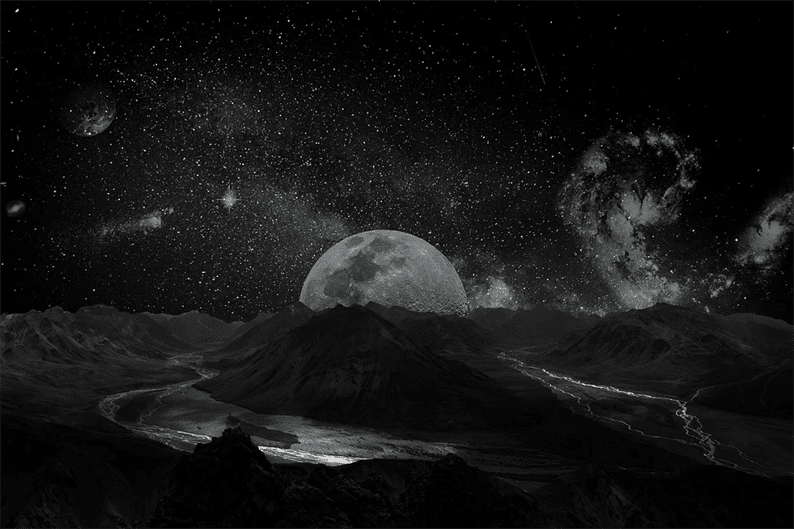
Now let's move directly to the question of why there is no air in space. Actually, from the point of view of physics and astronomy, this question is not 100% correctly formulated. The fact is that air is present even in space. The only remark is that such air is not suitable for any living creatures. It is also worth clarifying that when we think about the question of why there is no air in space, do we mean by the word “space” directly empty space or the atmosphere of other planets?
Is there really no air in space?
So, if we are talking about the atmosphere of other planets, then it is worth noting that each planet has its own gravity. This gravity also depends on the mass of the planet, because it is nothing more than a force that affects the degree of curvature of space-time. The greater the mass of the body (planet or star), the higher the degree of curvature. It also means that the more the body's mass, the stronger the gravity. On other planets, the ratio of the density of molecules in different layers of the atmosphere and the force of gravity is identical to the nature of the relationship between gravity and atmosphere on planet Earth.
So, the density of air molecules will be higher near the surface of the planet, and the density indicator will decrease when moving up. However, for the existence of living organisms on this planet, the composition of air molecules must be balanced, similar to that on Earth.

But if we talk about the empty space of space, which we call a vacuum, then it should also be said that in fact it is not a vacuum at all. Because even empty space is something. It also contains hydrogen molecules and some other particles. But the density of these molecules and particles is extremely negligible, because they are not strongly influenced by the gravitational field of some celestial object.
For this reason, we say that there is no air in space. But this is actually not true. There are still some particles in outer space.
Explanation for kids: why there is no air in space
Imagine a large, empty room (for example, the size of a city). Now imagine that you have left an ant in it. The probability that you will be able to find it is 1/1000000000. The universe is the same room, and since gas tends to occupy all free space, its molecules move away from each other – their density is extremely low.
It's like a drop of ink in the ocean – you can't see it, it doesn't affect anything. It is worth noting that, in fact, a certain percentage of air comes out of the Earth's atmosphere, which, getting into the universe, does not have any significant effect on outer space.
Sources used and useful links on the topic: https://spaceworlds.ru/solnechnaya-sistema/solnce/kakogo-cveta-solnce.html https://fishki.net/3061946-pochemu-v-kosmose-ne-vidno-zvezd .html https://nlo-mir.ru/kosmoss/48518-pochemu-na-nih-ne-vidno-zvezd.html https://FB.ru/article/470458/pochemu-v-kosmose-temno-prichinyi -yavleniya https://kipmu.ru/pochemu-kosmos-chernyj/ https://nlo-mir.ru/kosmoss/pochemu-v-kosmose-tak-temno.html https://www.m24.ru/articles / nauka / 18052016/105261 https://Hi-News.ru/eto-interesno/polucheny-samye-detalnye-fotografii-poverxnosti-solnca.html https://fishki.net/1625189-uchenye-opredelili-nastojawij-cvet -vselennoj-kotoryj-mnogih-razocharoval.html https://Hi-News.ru/technology/problema-proizvodstva-kisloroda-v-kosmose.html https://FB.ru/article/422118/pochemu-v-kosmose-net-vozduha-i-deystvitelno-li -eto-pravda
Post source: lastici.ru