
Some interesting facts about Pluto. Interesting facts about Pluto
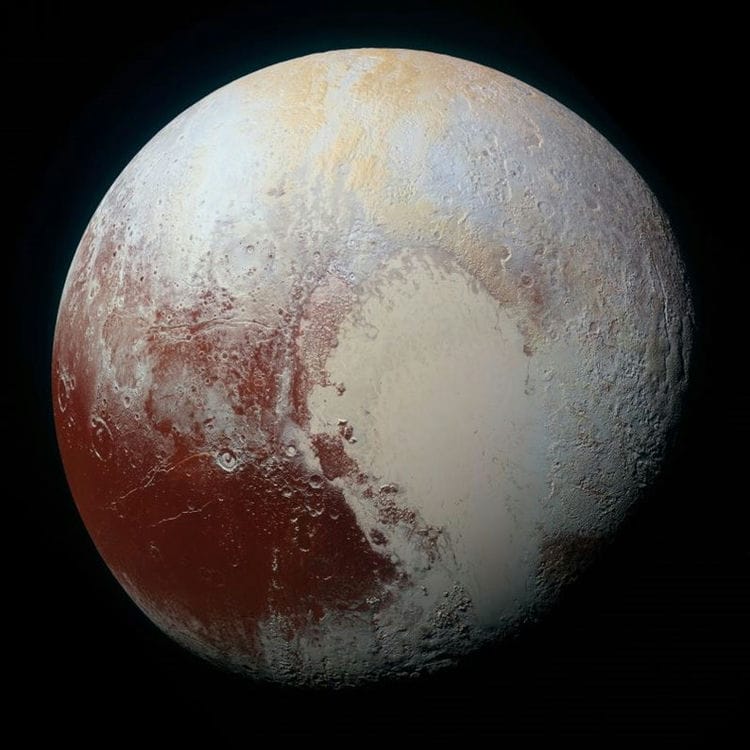
What is Pluto according to modern ideas
Today Pluto is classified as a dwarf planet.
A dwarf planet is an object that revolves around the sun, has enough mass for gravitational forces to form its spherical shape, but it is too small to clear its orbit from other objects.
Pluto has more in common with a comet than with a planet.
The highest quality photo of Pluto today
What do we know about Pluto
Pluto either approaches the Sun to 4.4 billion km, then moves away to 7.4 billion km. It is located in a region of space called the Kuiper Belt and is the largest object in it.
The Kuiper Belt is a disc-shaped shadow zone that exists behind the planet Neptune, which contains thousands of small icy objects similar to Pluto in size and composition.
Pluto is smaller in volume than the Earth's moon, about 3 times. Its area is 17.7 million km2, for comparison, the area of Russia is 17.1 million km2.
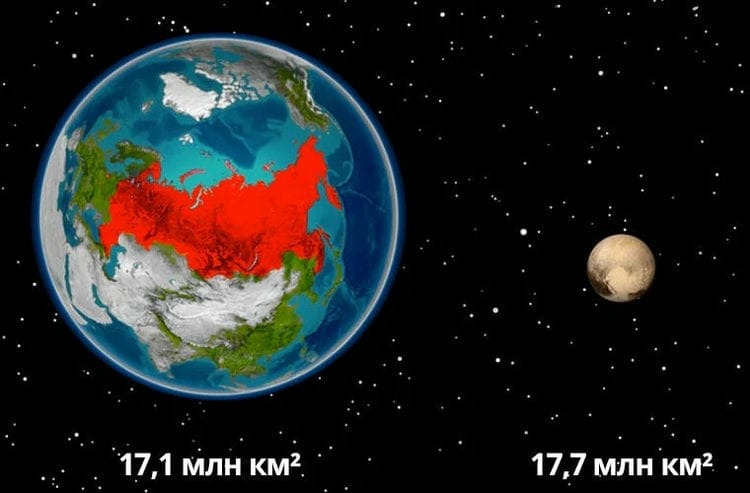
Comparison of the sizes of Russia and Pluto
Pluto takes about 248 years to orbit the Sun, and one day for Pluto is about 6.5 days on Earth.
Pluto has five moons: Charon, Nikta, Hydra, Kerberus and Styx. At the same time, Pluto and Charon tend to be viewed by many as a double planet: these are two objects of similar mass, they are located close to each other, and the center of mass of their “tandem” is located outside Pluto.
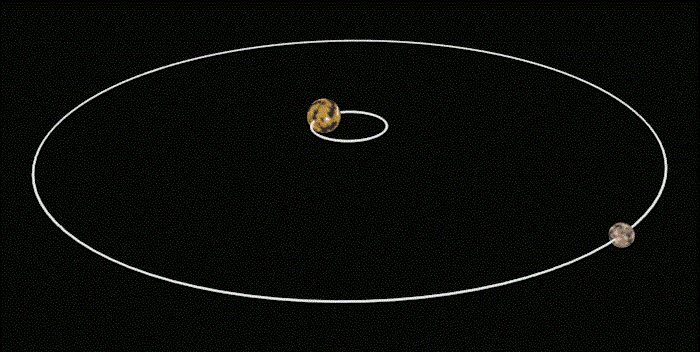
Pluto and Charon revolve around the same center of gravity
Why did they even pay attention to Pluto's status?
In 2003, a new object was sighted beyond Pluto, which was originally attributed to the tenth planet. The size of the new object has been estimated to be larger than Pluto, although today we know this is not the case. The object was named Eris.
The discovery of Eris sparked a debate about the criteria that define a planet and whether Pluto should be called a planet. As a result, a resolution was adopted, which prescribed new criteria that determine what a planet is. Due to their size and non-standard orbits, Pluto and Eris did not meet these criteria, and they began to be called dwarf planets.
Pluto is also referred to as plutoid. Plutoid is a dwarf planet farther from the planet Neptune in the solar system.
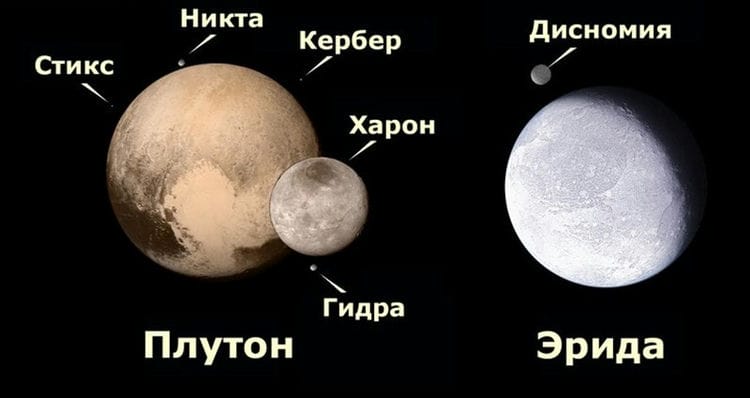
Pluto, Eris and their moons
Why Pluto is no longer considered a planet
According to the resolution, the planet is a celestial body that has a circular shape, revolves around the Sun and can cleanse its surroundings. Pluto meets two criteria: it is round and revolves around the Sun, but it did not pass the third criterion: it cannot clear its orbit like the other eight planets. Let's dwell on this in more detail.
As planets form, they become the central gravitational body in the orbit in which they move around the sun. If other smaller objects meet on their way, then they are either absorbed or captured by the force of gravity. There are objects in the orbit of Pluto, with approximately the same mass as it, and it turns out that it is forced to coexist with them.
Other factors that contributed to the abolition of Pluto's planetary status include:
- its small size, which is smaller than the Earth's moon;
- its dense and rocky surface, which is not like the neighboring gaseous planets – Jupiter, Saturn, Uranus and Neptune;
- its unusual orbit, passing around the Sun at an angle of 17 degrees, unlike all other planets in the solar system, which rotate in the same plane;
- its largest moon, Charon, is half the size of Pluto, and they revolve around a common center of gravity.
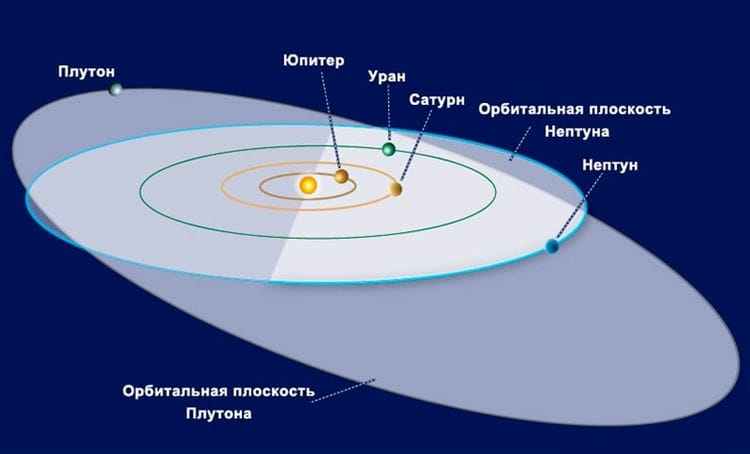
Orbit of Pluto and planets
Pluto's status does not diminish interest in him
Although Pluto is just a dwarf planet, it still fascinates astronomers. NASA even sent a New Horizons spacecraft to this icy object. In 2015, he reached Pluto and took the first high-quality images of its surface. Regardless of its status, Pluto remains an object of study and passion for astronomers.
Description and characteristics
Pluto's orbit is such that during its stay at the point closest to the Sun, the planet is at a distance equal to 29 astronomical units. As for the farthest location, this distance is 49 AU. e. Unlike other objects related to the solar system, the planet rotates in a different plane, at an angle of 17 degrees. Some part of it is located above the ecliptic, and some – below it.
Due to the wide range of changes in its orbit, the planet periodically changes its location, replacing Neptune, located closer to the Sun. The last time it happened was in 1979, the exact date is February 7th. The closeness to the Sun in comparison with Neptune was achieved before 1999 (February 11). This made it possible to obtain additional information about such an object as the orbit of Pluto.
This event became important, since the last time such a picture was observed only in the 1700s. Due to the low mass that the dwarf planet has, the interaction of the orbit with Neptune is chaotic. Nevertheless, it is in the power of astronomers to predict its position in both directions in time with a range of millions of years.
Recent astronomical events have developed in such a way that Pluto left the list of planets. The adoption of such a decision took place in 2006 within the framework of a meeting organized by the forces of the International Astronomical Union.
Features of “behavior”
Speaking about the orbital features of the rotation of this planet, it is worth paying attention to the following parameters and characteristics:
-
distance to the sun
-
tilt angle;
-
resonance with the planet;
-
the period of revolution around the star (year on Pluto);
-
time of rotation around its own axis (day).
Pluto's orbit
Pluto's path around the sun is elliptical. The fact is that the orbit is located at an angle of 17 degrees. As a result, it regularly coincides with the orbit of Neptune. The year on Pluto, according to the calculations of the researchers, lasts 248 years. That is, exactly this amount of time is required for the planet to complete one revolution around the Sun.
During this period, the approximation between the star and the planet is 30 AU. e., and the distance is 39 a. e. 1 a. e. equals 150 million km. The orbit resembles an elongated ellipse, therefore it is eccentric. And the fact that it has a slope indicates the absence of rotation of the dwarf with the SS on a single plane. After all, part, as already noted, is above, and part is below.
Given that the mass of the object is low, its orbit seems to be chaotic. This is due, first of all, to the fact that the influence of Neptune is felt. Currently, scientists are able to calculate the “behavior” of the planet for a period of a million years in advance, but further events are unpredictable. And since 2006 Pluto is not a planet, because it did not “pass” in one parameter – it could not clear the orbit. Some scientists have expressed their feelings about the collision of Pluto and Neptune. However, these doubts are dispelled, because there is a resonance between them – 3 to 2.
Dwarf planet Pluto: a brief description
Interesting facts about Pluto: this is the only planet in the solar system that has never been visited by research vehicles until 2015. Located very far from the Sun, scientists assumed its existence at the beginning of the 20th century, when they noticed deviations in the calculations of the orbits of the two ice giants Uranus and Neptune. In 1930, a tiny space object, barely visible by the most powerful telescopes, was recognized by the young astronomer Tombaugh as a planet.
Slow motion in its orbit makes the brightness of the dwarf object stable. It has the most elongated elliptical orbit compared to other planets. The closest distance from the Sun to Pluto at the point of its orbit is 4447 million km, and the farthest one is 7392 million km. Thanks to this feature, the ex-planet approaches the Sun much closer than Neptune, and becomes the eighth in a row.
The main characteristics of a small planet:
- density is 2 * 103 kg / m3
- diameter – 2390 km;
- volume – 1.09 * 1019 m3
- what is the average temperature on Pluto's surface? Minus 233 ° C;
- Pluto's mass in kg reaches 1.29 * 1022
- the rotation period takes almost 249 years on Earth;
- on average, the object is located at a distance of 2871 million km from the Sun;
- travel speed – 4.74 km / s;
- makes one rotation around the axis in 6.39 days on Earth;
- low gravity with free fall acceleration 0.6 m / s2.
Going from Earth on an excursion to a dwarf object, you will have to overcome 7.5 billion kilometers.
Continuing to consider the characteristics of the planet Pluto, we note that it is covered with depressions, which in the photo of the view from space resemble numerous bites. There are many mountains on the planet, the highest being 3000 meters. It is not only high, but elongated along the meridian of the equator, encircling almost half of the planet.
Interesting facts about the dwarf planet Pluto
The small planet surprises with its moving hills. A huge number of such hills simply move along the surface. Scientists suggest that convective forces acting from inside the planet were the cause of this phenomenon.
There are some more surprising facts:
- disputes about what Pluto is and about the removal of the status of a full-fledged planet are still ongoing. Demotion to the “dwarf” befell him because of the “impure” orbit. However, some scientists disagree, and argue that other planets, including the Earth, do not meet this requirement;
- the dwarf space object has a family of moons – Charon was famous for many years, then 4 more were discovered: Styx, Kerber, Nikta and Hydra;
- could have rings – judging by the theory, space debris rotating around a dwarf object could “grow together” into rings. Today it is reliably clear that he has no rings;
- Of all the dwarf planets discovered, it is the largest, but not the heaviest – Eris took the lead.
Astronomers propose to study a dwarf with a similar to him Charon, which rotates side by side in orbit, like a binary system of planets.
How many times Pluto makes a revolution around the Sun
Did you know how long a year is on Pluto? 248 earth years. The Earth makes one revolution around the star per year, while a dwarf object will take 248 Earth years to do this. Since the first discovery appeared, the space object has not yet made a single complete revolution. This will happen in the distant year 2178.
This is because the orbit of a small planet has a different trajectory, which is different from other planets in the solar system. The space body rotates in an elliptical plane, which deviates from the other orbits by about 17 °. In this case, one edge of the ellipse is farther from the star than the opposite.
Amazing Pluto and Sun Facts:
- compared to the Earth, the planet receives 1600 times less sunlight;
- radiation from our luminary to reach the surface of a dwarf planet, it takes 5 Earth hours;
- if Pluto got a little closer to the Sun, it could have a tail, like a comet;
- because of the small fraction of solar radiation reaching the surface of the dwarf, one can easily observe space from the planet.
Another feature of the rotation of a small planet is its movement in relation to our Earth in the opposite direction. Sunrise occurs in the west, sunset, respectively, in the east. Judging by earthly standards, such a phenomenon occurs once every seven days.
How much Pluto weighs and its size compared to Earth
The diameter of the planet Pluto is approximately 2390 km, which is 70% of the diameter of the Moon and only 18% of the Earth. The size of the planet is so small that it occupies 0.59% of our planet in volume. It turns out that 170 celestial bodies the size of Pluto can fit inside the Earth.
The mass of the dwarf is only 0.2% of the earth's mass, in comparison with the lunar – 18%. The area, which is 3.3% of the Earth's territory, turned out to be striking. This size is equal to the territory of Russia.
Scientific research has shown that the dwarf is smaller than other planets, and even smaller than seven natural satellites in the solar system:
- Ganymede;
- Titanium;
- Callisto;
- Io;
- Moon;
- Europe;
- Triton.
Astronomers have discovered another planet with similar characteristics – Eridu, which is ahead of its dwarf counterpart in size.
What is Pluto made of
The idea of a dwarf as an ice sphere with a white surface turned out to be wrong. In fact, in the brief description, the surface of the planet Pluto is dirty yellow with a brown tint, which is confirmed by the images of the Hubble telescope. On them you can see the plains and depressions, pools, ice deposits and craters.
The composition of the planet's surface is represented by nitrogen ice with admixtures of methane and carbon. Several years ago, studies of the New Horizons spacecraft told mankind that the dwarf consists of 50% -70% stone, and everything else is ice.
The planet's core is also rocky, protected by a large layer of ice. In the process of radioactive decay, a small planet heats up and may have a liquid ocean.
In 1988, the message about Pluto as the owner of its own atmosphere became interesting. Naturally, this is not our usual sky with fluffy clouds and air, but a gas envelope of small thickness that appears at certain points in the orbit.
Astronomers discovered the presence of an atmosphere on the dwarf while observing it, at the time of movement in front of the Sun. After examining the faint blackout that appeared on the planet before Pluto covered it with itself, scientists concluded that it was the atmosphere. Later, after analyzing the data, it became known that the planet has a thin shell of gas.
Scientists from the Chadra Observatory, conducting long-term observations, published information that the planet gives off X-rays, the source of which is a combination of gases emanating from the bowels of Pluto.
Orbital period of the year on Pluto
With an eccentricity of 0.2488, Pluto is capable of approaching the Sun by 4,436,820,000 km and moving away by 7,375,930,000 km. The average distance is 5,906,380,000 km.

At certain times, Pluto and Neptune find themselves in the same orbit. But they are not destined to collide because of the resonance in 2: 3. This is a stable cycle and Pluto will return to its position in 2227.
Sidereal and sunny day
The dwarf planet Pluto performs an axis rotation called a sidereal day. Due to the fact that the planet moves along the orbital path for a long time, its sidereal and sunny days practically converge – 6 days, 9 hours and 36 minutes.
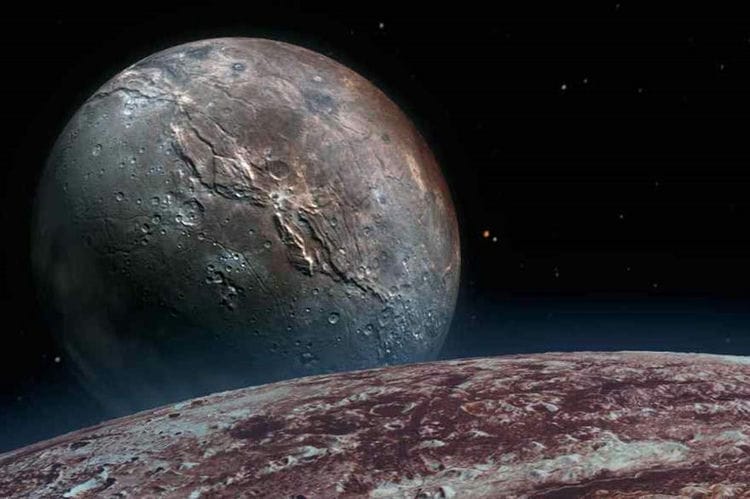
Pluto's surface view showing the large moon Charon
It is important to note that due to the scale of Charon, both objects resemble a binary system. The satellite takes 6 days and 9 hours to orbit around Pluto, which means they are in a tidal block and look at each other on one side.
But the year on Pluto covers 248 Earth years. And all this time the moon will hang over your head.
Seasonal changes throughout the year on Pluto
For an inhabitant of Pluto, the Sun would appear to be the brightest object, but it did not look the same as in our sky. Despite the remoteness, the eccentricity of the orbital path leads to remarkable seasonal variations.
The temperature on the surface practically does not change and stays in the range from -240 ° С to -218 ° С. But the amount of incoming sunlight for each side is different.
The Pluto-Charon system is perpendicular to the orbit. It turns out that during the solstice ¼ of the surface is in constant daylight, and the second part is immersed in darkness.
This resembles the situation with the Earth's Arctic Circle. But on a dwarf planet, this applies to almost the entire territory, and periods span centuries!
Even if Pluto is no longer a planet, then it still has many interesting features that you want to watch.
History of the planet Pluto
Back in the 80s of the XIX century, many astronomers unsuccessfully tried to find a certain Planet-X, which, by its behavior, influenced the orbital characteristics of Uranus. Searches were carried out in the most separated areas of our space, approximately at a distance of 50-100 AU. from the center of the solar system. American Percival Lowell spent more than fourteen years in an unsuccessful search for a mysterious object that continued to excite the minds of scientists.
It will take half a century for the world to receive proof of the existence of another planet in the solar system. The discovery of the planet was carried out by Clyde Tombaugh, an astronomer at the Flagstaff Observatory, which was founded by the same restless Lowell. In March 1930, Clyde Tombaugh, observing through a telescope that part of space in which Lowell admitted the existence of a large celestial body, discovered a new fairly large space object.
Subsequently, it turned out that due to its small size and small mass, Pluto is not able to influence the larger Uranus. Oscillations and interaction of the orbits of Uranus and Neptune have a different nature associated with the special physical parameters of the two planets.
The open planet was named Pluto, thus continuing the tradition of naming the celestial bodies of the solar system in honor of the gods of the ancient Pantheon. There is another version in the history of the name of the new planet. Pluto is believed to have gotten its name from Percival Lowell because Tombaugh suggested matching the name with the restless scientist's initials.
Until the end of the 20th century, Pluto firmly occupied a place in the planetary row of the solar family. The changes in the status of the planet occurred at the turn of the millennium. Scientists were able to identify a number of other massive objects in the Kuiper belt, which called into question the exceptional position of Pluto. This prompted the scientific world to revise the position of the ninth planet and answer the question of why Pluto is not a planet. In accordance with the new formal definition of the term “planet”, Pluto dropped out of the general ensemble. The result of long debate and discussion was the decision of the International Astronomical Union in 2006 to transfer the object to the category of dwarf planets, putting Pluto on a par with Ceres and Eris. A little later, the status of the former ninth planet of the solar system was further downgraded, including it in the category of minor planets with tail number 134 340.
What do we know about Pluto?
The former ninth planet is considered the farthest of all large celestial bodies known to this day. Observing such a distant object is possible only with the help of powerful telescopes or from photographs. It is quite difficult to fix a faint small point in the sky, since the planet's orbit has specific parameters. The periods are marked when Pluto has a maximum brightness and its luminosity is 14m. However, in general, the distant wanderer does not differ in bright behavior, and the rest of the time he is practically invisible, and only during the period of confrontations the planet opens itself up for observation.
One of the best periods for studying and exploring Pluto was in the 90s of the XX century. The farthest planet was at a minimum distance from the Sun, closer to its neighbor Neptune.
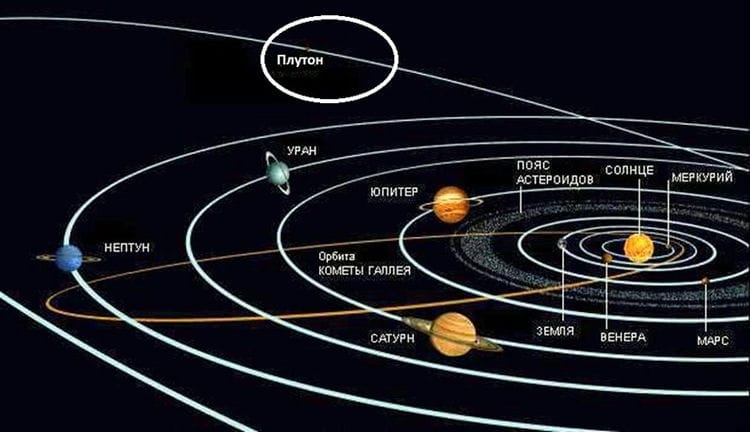
Pluto's orbit
According to astronomical parameters, the object stands out among the celestial bodies of the solar system. The baby has the largest orbital eccentricity and inclination. Pluto completes its stellar path around the main luminary in 250 Earth years. The average speed of movement in orbit is the smallest in the solar system, only 4.7 kilometers per second. In this case, the period of rotation of the small planet around its own axis is 132 hours (6 days and 8 hours).
At perihelion, the object is located from the Sun at a distance of 4 billion 425 million km, and at aphelion it runs away by almost 7.5 billion km. (to be precise – 7375 million km.). With such huge distances, the Sun gives Pluto 1600 times less heat than we – earthlings receive.
The deviation of the axis is 122.5⁰, the deviation of the orbital path of Pluto from the plane of the ecliptic has an angle of 17.15⁰. In simple terms, the planet lies on its side, rolling as it moves in orbit.
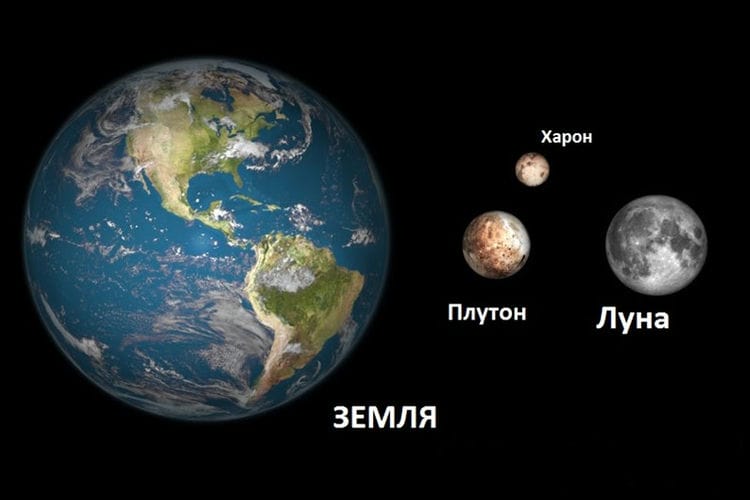
Pluto dimensions
The physical parameters of the dwarf planet are as follows:
- the equatorial diameter is 2,930 km;
- Pluto's mass is 1.3 × 10²² kg, which is 0.002 Earth masses;
- the density of the dwarf planet is 1.860 ± 0.013 g / cm³;
- the acceleration of gravity on Pluto is only 0.617 m / s².
The size of the former ninth planet is 2/3 the diameter of the moon. Of all the known dwarf planets, only Eris has a larger diameter. The mass of this celestial body is also small, which is six times less than the mass of our satellite.
Dwarf planet retinue
However, despite such a small size, Pluto bothered to get five natural satellites: Charon, Styx, Nikta, Kerber and Hydra. They are all listed in order of distance from the parent planet. Charon's size makes it have a baric center, the same as Pluto, around which both celestial bodies revolve. In this regard, scientists consider Pluto-Charon a binary planetary system.
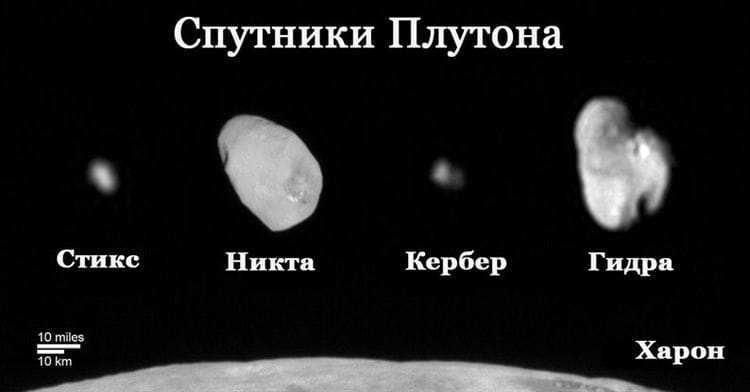
Moons of Pluto
The satellites of this celestial body are of a different nature. If Charon has a spherical shape, then all the others are huge and shapeless giant stones. Probably, these objects were captured by Pluto's gravitational field from among the asteroids wandering in the Kuiper belt.
Charon is Pluto's largest moon, discovered only in 1978. The distance between the two sites is 19,640 km. Moreover, the diameter of the largest moon of the dwarf planet is 2 times less – 1205 km. The ratio of the masses of both celestial bodies is 1: 8.
Other satellites of Pluto – Nykta and Hydra – are approximately the same in size, but they are much inferior in this parameter to Charon. Styx and Nyx are generally barely visible objects with sizes of 100-150 km. Unlike Charon, the remaining four moons of Pluto are located at a considerable distance from the parent planet.
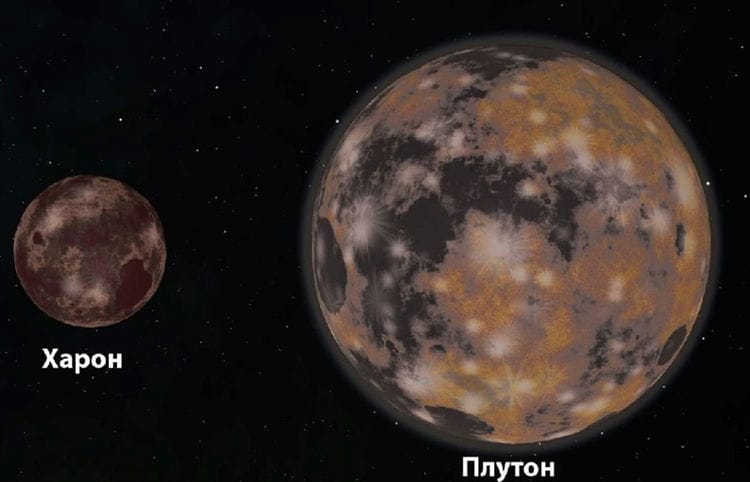
Comparison of Pluto and Charon
When observing through the Hubble telescope, scientists were interested in the fact that Pluto and Charon have a significantly different color. Charon's surface appears darker than Pluto's. Presumably, the surface of the largest satellite of the dwarf planet is covered with a thick layer of cosmic ice, consisting of frozen ammonia, methane, ethane and water vapor.
The atmosphere and a brief description of the structure of the dwarf planet
In the presence of natural satellites, Pluto can be considered a planet, albeit a dwarf one. To a large extent, this is also facilitated by the presence of the Pluto atmosphere. Of course, this is not an earthly paradise with a high content of nitrogen and oxygen, but Pluto still has an air blanket. The density of this celestial object's atmosphere varies with distance from the Sun.
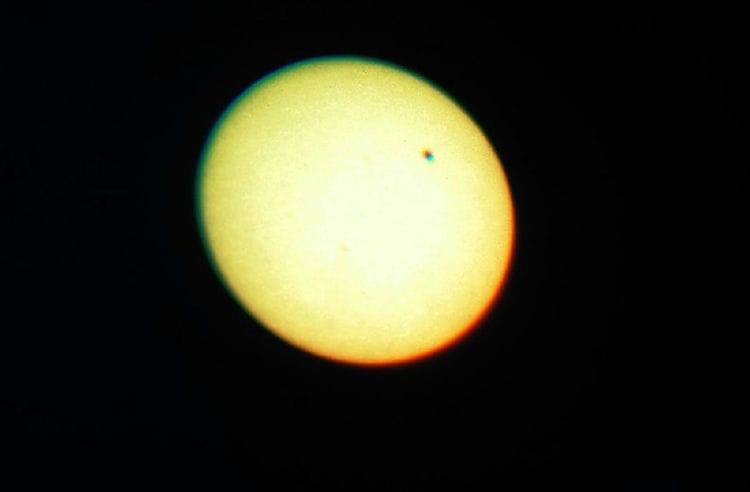
Pluto in the solar disk
For the first time, Pluto's atmosphere was spoken of in 1988, when the planet passed through the solar disk. Scientists admit the idea that a dwarf's air-gas envelope appears only during the period of closest approach to the Sun. With a significant distance from Pluto from the center of the solar system, its atmosphere freezes out. Based on the spectral images taken from the Hubble Space Telescope, the composition of Pluto's atmosphere is roughly the following:
- nitrogen 90%;
- carbon monoxide 5%;
- methane 4%.
The remaining one percent is accounted for by organic compounds of nitrogen and carbon. The strong rarefaction of the air-gas envelope of the planet is evidenced by data on atmospheric pressure. On Pluto, it ranges from 1-3 to 10-20 microbar.
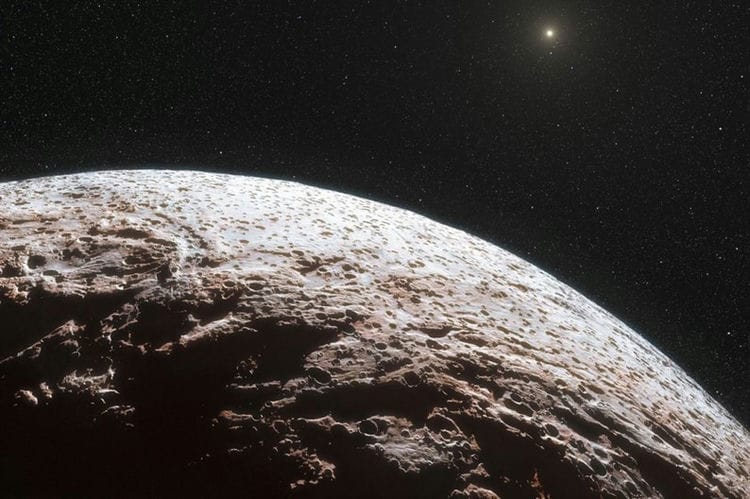
Pluto's surface
The surface of the planet has a characteristic slightly reddish hue, which is caused by the presence of organic compounds in the atmosphere. After studying the obtained images, polar caps were discovered on Pluto. It is assumed that we are dealing with frozen nitrogen. Where the planet is covered in dark spots, it is likely that there are vast fields of frozen methane that are darkened by sunlight and cosmic radiation. The alternation of light and dark spots on the dwarf's surface indicates the presence of seasons. Like Mercury, which also has a highly tenuous atmosphere, Pluto is covered in craters of cosmic origin.
Temperatures in this distant and dark world are very low and incompatible with life. On the surface of Pluto, there is an eternal cosmic cold with a temperature of 230-260 ° C below zero. Due to the recumbent position of the planet, the poles of the planet are considered the warmest areas. Whereas the vast expanses of Pluto's surface are permafrost.
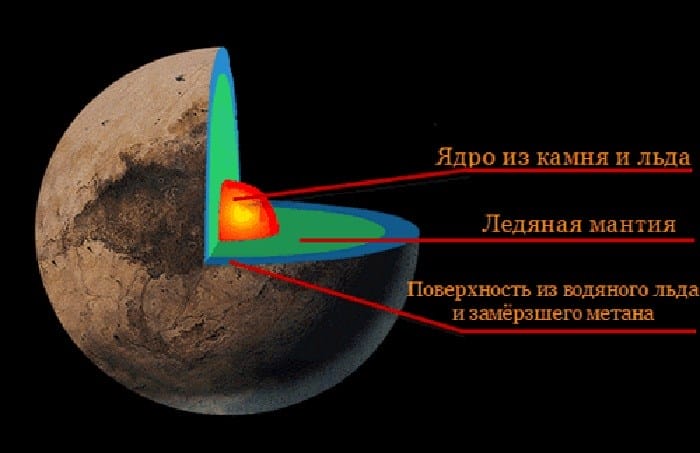
Pluto's structure
As for the internal structure of this distant celestial body, then a typical picture is possible, characteristic of the terrestrial planets. Pluto has a fairly large and massive core composed of silicates. Its diameter is estimated at 885 km, which explains the rather high density of the planet.
Interesting research facts of the former ninth planet
The huge distances that separate the Earth and Pluto make it very difficult to study and research with the help of technical means. It will take about ten Earth years to wait for earthlings until the spacecraft reaches Pluto. Launched in January 2006, the New Horizons space probe was only able to reach this region of the solar system in July 2015.
For five months, as the automatic station “New Horizons” approached Pluto, photometric studies of this area of space were actively carried out.
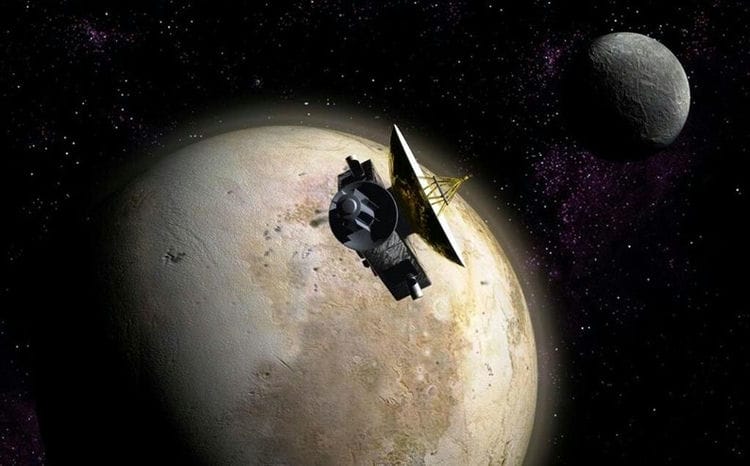
Flight of the probe “New Horizons”
This device was the first to fly in close proximity to a distant planet. Previously launched American probes Voyagers, the first and second, focused on the study of larger objects – Jupiter, Saturn and its satellites.
The flight of the New Horizons probe made it possible to obtain detailed images of the surface of the dwarf planet under number 134 340. The object was investigated from a distance of 12 thousand km. The Earth received not only detailed images of the surface of the distant planet, but also photographs of all five satellites of Pluto. Until now, NASA laboratories are working on detailing the information received from the spacecraft, as a result of which we will get a clearer picture of that world far from us in the future.
What celestial body can be called a planet?
Only a celestial body revolving around the Sun and possessing sufficient gravity to have a shape close to a sphere can be considered a planet. In addition, a body is referred to a planet, the orbit of which does not intersect with anything.
Why didn't Pluto fit the definition of “planet”?
According to the IAS definition, a planet must meet three requirements:
1 It must revolve around the Sun (or another star).
2 It must be massive in order to take a spherical shape under the influence of its own gravity.
3 It must clear its own orbit (there should be no other bodies of the same size nearby, except for its own satellites).
Pluto falls under points 1 and 2, but does not meet the third requirement, since it failed to clear its own orbit. The mass of the dwarf planet is only 0.07 of the mass of all objects in its orbit. For example, the mass of the Earth is 1.7 million times greater than other bodies in its orbit.
What celestial body can be called a dwarf planet?
According to the IAS definition, a celestial body is considered a dwarf planet, which:
- Orbits the Sun (or another star).
- It has sufficient mass to maintain hydrostatic equilibrium under the action of gravitational forces and to have a nearly spherical shape.
- It is not a satellite of the planet.
- Cannot clear the area of its orbit from other objects.
Opening
The presence of Pluto was predicted even before it was found in the survey. In the 1840s. Urbain Verriere used Newtonian mechanics to calculate the position of Neptune (then not found yet) based on the displacement of Uranus's orbital path. In the 19th century, close examination of Neptune showed that its rest was also disturbed (the transit of Pluto).
In 1906, Percival Lowell founded the search for Planet X. Unfortunately, he passed away in 1916 and did not wait to be discovered. And he did not even suspect that Pluto was displayed on two of his plates.
Photo of Pluto on January 23 and 29, 1930
In 1929, the search was resumed, and the project was entrusted to Clyde Tomb. The 23-year-old spent a whole year taking pictures of the sky, and then analyzing them to find the moments of displacement of objects.
In 1930, he found a possible candidate. The observatory requested additional photographs and confirmed the presence of a celestial body. On March 13, 1930, a new planet in the solar system was discovered.
Name
After the announcement, Lowell Observatory began to receive a huge number of letters suggesting names. Pluto was the Roman deity in charge of the underworld. This name came from the 11-year-old Venice Bernie, who was suggested by her astronomer grandfather. Below are photos of Pluto from the Hubble Space Telescope.
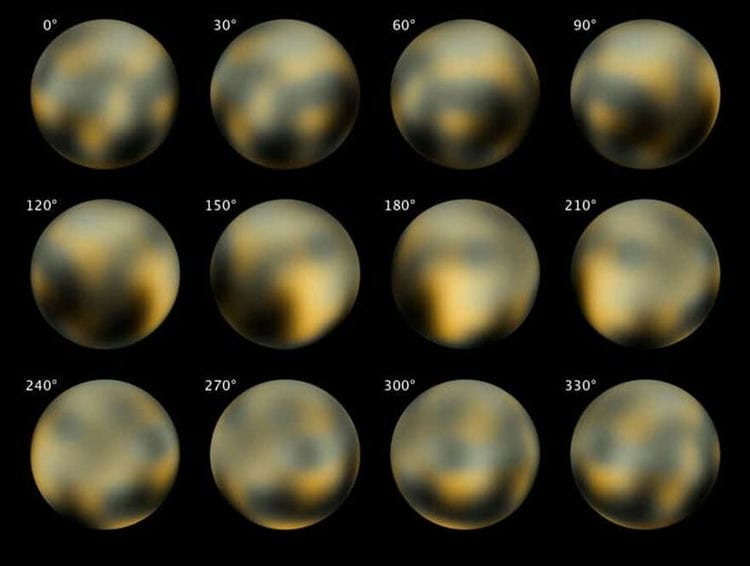
Pluto observed by the Hubble telescope in 2002-2003
It was officially named on March 24, 1930. Among the competitors were Minerva and Kronus. But Pluto fit perfectly, as the first letters reflected Percival Lowell's initials.
They quickly got used to the name. And in 1930, Walt Disney even named Mickey Mouse's dog Pluto after the object. In 1941, the element plutonium appeared from Glenn Seaborg.
Size, mass and orbit
With a mass of 1.305 x 10²² kg, Pluto is the second most massive among dwarf planets. The indicator of the area is 1.765 x 10⁷ km, and the volume is 6.97 x 10⁹ km3.
physical characteristics
Now you know which planet Pluto is, but let's study its rotation. The dwarf planet is moving along a moderate eccentric orbital path, approaching the Sun by 4.4 billion km and moving away by 7.3 billion km. This suggests that it sometimes comes closer to the Sun than Neptune. But they have a stable resonance, so they avoid collisions.
Orbit and rotation
It takes 250 years to pass around the star, and makes an axial revolution in 6.39 days. The slope is 120 °, resulting in notable seasonal variations. During the solstice ¼ of the surface is continuously warming up, while the rest is in darkness.
Name
Surprisingly, the name of the new planet was not given by its discoverer. He has, of course, received the prestigious Royal Astronomical Society of London medal and many other awards. But the right to name the new planet was not given to him, but to the laboratory. As a result, at a special vote, scientists chose one of the three most popular options. It was offered by an eleven-year-old girl from England named Venice Bernie. The young lady rightly noted that since Pluto was the god of the underworld, then the most distant planet, where it is so dark and cold, his name would be the best fit. In addition, it was consistent with the long tradition of taking names for celestial objects from the mythology of Ancient Rome.
Where is
The average distance from the Sun to Pluto is approximately forty astronomical units. Simply put, it is 40 times farther than Earth. In the units we are used to, this is about 6 billion kilometers. However, the orbit along which the planet moves is so elongated that for some time of its long period of revolution around the star it is closer to the latter than even Neptune (aphelion is almost 3,000,000,000 km farther than perihelion). The motions of these planets do not intersect only because they are in different planes.
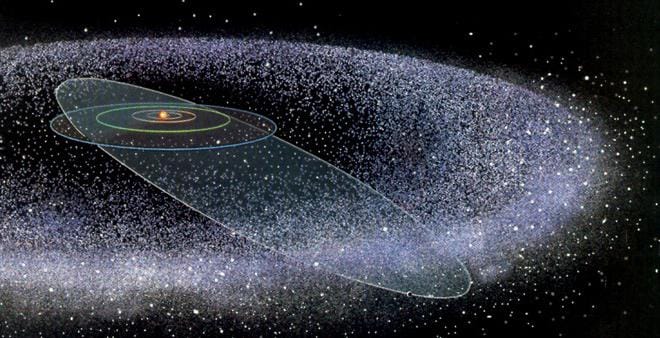
And between them there is a so-called orbital resonance: during the time that Neptune makes three revolutions around the Sun, Pluto makes two of them. At the same time, sometimes he even turns out to be closer to Uranus. In general, Pluto is the only planet whose orbit is at an angle of seventeen degrees to the solar equator. All others rotate approximately in the same plane. Pluto makes a complete revolution around the Sun in almost two hundred and forty-eight years.
Conditions
The location of the planet has a direct impact on the processes taking place on it. Although we can only judge them by observations. So, astronomers have noticed that Pluto has an atmosphere, and it extends further than Earth's. It's all about weak gravity, because the ninth planet is many times lighter than ours. But there is one more peculiarity. There is an atmosphere only during Pluto's approach to the Sun. When the small planet moves away, ultra-low temperatures freeze the gases, and they go into a solid state. Pluto's surface pressure is about one tenth of the atmosphere. Chemical composition: nitrogen, ammonia, carbon dioxide, methane, possibly neon and argon. Moreover, the content of the first is about ninety-nine percent. The temperature of the atmosphere is about one hundred and eighty degrees Celsius below zero. It's much higher than on the surface. Most likely, the latter is due precisely to the evaporation of gases. They cool the planet.
The average temperature on the surface is about forty-three Kelvin, and the planet receives the radiant energy fifteen hundred times less than the Earth. At the same time, according to scientists, the Sun in the sky of Pluto should stand out noticeably. And it is unlikely that pitch darkness reigns over its surface. But the weather on the planet Pluto is most likely disgusting. Not only is it terribly cold there. According to scientists, during periods of Pluto's atmosphere over its surface, the strongest winds are likely to blow. To date, there is no data on the presence of a magnetic field in the dwarf planet.
Dimensions and structure
Due to the large distance to the planet, it is not yet possible to determine its exact dimensions. According to modern concepts, the radius of Pluto is one thousand one hundred and eighty-four kilometers. And its mass is five times less than the satellite of the Earth. Astronomers have noticed that Pluto reflects sunlight as if its surface were composed of frozen gases. Is it so? Presumably, the surface of the planet, constantly facing Charon (satellite), consists of methane ice. At the same time, the other hemisphere is covered with frozen nitrogen. Moreover, the top layer of the planet (up to three hundred kilometers deep) is solid ice, including water. Then comes the core, consisting of rocks. According to some reports, if heating processes are still going on inside the planet, then it is quite possible that a liquid ocean exists under the surface of Pluto.
Satellites
At the moment, it is known about the existence of five natural satellites of Pluto. These are Charon, Styx, Nikta, Hydra and Kerber. At the same time, the first is no longer considered a satellite, since Pluto is considered by many to be a double dwarf planet. What is connected with the peculiarity of the system of these two bodies. Their barycenter is outside the volume of Pluto. And Charon is always located above only one side of a dwarf planet. So their periods of circulation coincided. Of course, the question remains of how, in general, Pluto could get such a huge satellite in comparison with it. Research suggests a similar composition of the two celestial objects. Perhaps another massive body once collided with Pluto. As a result, Charon was formed from the ejected substance. The same, by the way, is the theory of the origin and satellite of the Earth of the Moon.
Historical background of the discovery
The dwarf planet, like its largest satellite called Charon, was discovered in 1978.Since the discovery, the planet was considered the ninth and belonged to the solar system. In the 1950s, it was suggested that Pluto is one of the dwarf planets orbiting in this area within the framework of close orbits. At the end of the 20th century, this hypothesis received official confirmation, which was repeated in the 21st century. In the same period of time, many other objects were discovered.

Who Discovered Pluto?
For a long time, the discovery of Pluto was accompanied by all kinds of research carried out with the help of terrestrial and near-terrestrial astronomical means. And in 2015, it became possible to study the body at close range. At the end of the 19th century, when observing Uranus, scientists assumed that another object was affecting the planet's orbit. In 1906 P. Lowell from Boston, owner of the observatory, became the pioneer of a large-scale project related to the search for the ninth planet. After the discovery of this object, the specialist named it “Planet X”.

Discoverer of Pluto Clyde Tombaugh
Another version of the discovery of Pluto is associated with 1919. At that time, Milton Humason was looking for the ninth cosmic body, and Pluto managed to get on 4 pictures. When carrying out their detailed analysis, only those areas were found that are close to the ecliptic. As for Pluto, among the many stars, he was lost. Nevertheless, now the answer to the question of who discovered Pluto is clear.
Another specialist in research work is Tombaugh. He systematically took pictures of the night sky. Each site was photographed three times, and in the photographs one had to look for objects capable of changing their position. In 1930, a year after the start of hard work, this scientist discovered the desired object. This news quickly spread on television, for which the discoverer received a large number of awards and honors.
Sources used and useful links on the topic: https://topor.info/why/pluton-ne-planeta https://CosmosPlanet.ru/solnechnayasistema/pluton/orbita-plutona.html https://lfly.ru/planeta- pluton-interesnye-fakty-o-karlikovoj-planete.html https://v-kosmose.com/pluton-planeta-solnechnoy-sistemyi/god/ https://WarWays.ru/kosmos/pluton.html https: // aif.ru/dontknows/file/pochemu_pluton_yavlyaetsya_karlikovoy_planetoy https://zen.yandex.com/media/kosmostrannik/planeta-pluton-otkrytie-klassifikaciia-issledovanie-5cdf06f9bf108700b2408d63 https://www.syl.ru/article/156512/new_planeta- pluton-kak-vyiglyadit-pluton-pochemu-pluton-lishili-statusa-planetyi https://CosmosPlanet.ru/solnechnayasistema/pluton/kto-otkryl-pluton.html
Post source: lastici.ru