
24 fps: how frame rate has become the standard and whether it needs to be changed. The Phantom of the Soap Opera: Why Movies Are No Longer Shot at 24fps

Brain stress
In the early days of cinematography, the concept of image quality was straightforward. Is the projector spinning so fast that the frames merge into a moving picture? That's great! We do not overclock further in order to save expensive film, even if flickering appears on the screen. In 1926, with the advent of sound films, it was necessary to come to the standard of 24 frames per second, so that the tonality of voices did not jump. This format has not changed for years – no one wanted to overpay for extra meters of film. In addition, an increase in the size of the bobbins would lead to an increase in the cost of their delivery.
Oddly enough, the total transition to digital did not improve the situation. Today, “extra” frames turn into more stringent requirements for the camera matrix and the power of editing systems, as well as large volumes of information carriers. At the same time, the time and cost of creating computer graphics directly depend on the number of frames in a scene, and in fact, in the budget of a modern film, such expenses are much more important than the price of a film 30 years ago.
Kosakovsky on the set of “Watercolors”
So why bump the frame rate at all? The fact is that, to put it mildly, it is not very suitable for conveying dynamic scenes. If a continuous movement is broken into pieces of 1/24 second, the object on the screen will certainly either flicker, or smear, or both at once.
How exactly he will behave depends on the settings of the camera. Usually, a flying object or landscape details in a panorama are somewhat blurred in each separate frame, like an athlete in a photo with an insufficient exposure. A series of such pictures creates the illusion of smooth movement, but it is impossible to see small details on them.
The only way to create a truly detailed motion picture is to shoot and display at at least 48 fps, or better yet. Otherwise, the final processing of the visual series is forced to do … the viewer's brain. He will try not to notice the flicker, and will restore the smeared leaves on the trees from memory. But it will certainly send a signal to the subconscious that the picture in front of your eyes is not real, does not correspond to the perception of the real world.
Acceleration pioneers

Shot from the film “Aquarelle”
The first to overcome the sacred barrier were television men. They did this not out of aesthetic maximalism, but for purely technical reasons. In the days of CRT TVs, it was important that the frame rate coincided with the frequency of the current in the mains – otherwise, unpleasant noise appeared on the screen. As a result, European viewers watch TV at 50 fps, and American viewers – 60. It was in this format, to which high resolution was later added, that large-scale series began to be shot, but then a very strange thing happened. The unusually realistic image with deliberately smooth movement did not become a visual standard, but turned into a cliché, opposing serial fast food to the high aesthetics of large film cinema. The soap opera effect was so strong
They tend to believe that the main reason for the embarrassment was a persistent visual stereotype. Simply put, viewers are subconsciously accustomed to enjoying the art of cinema, looking exactly at the flickering picture. This habit was formed in us from birth and is so tightly embedded in the mechanisms of perception that a radical change in the picture, even for the sake of improvement, causes organic rejection in many.
Hollywood is mastering HFR
The high frame rate also had supporters among directors. The first really high-profile project in HFR (High Frame Rate) was “The Hobbit: An Unexpected Journey” by Peter Jackson. Shooting at 48 fps really made the picture more picturesque and helped to improve the quality of 3D, popular in 2012. However, despite the billions in cash and three Oscar nominations, critics who saw the picture in the original (and not the 24 fps transfer) erupted in a mass of negative reviews. And they complained about “soap”.

Peter Jackson on the set of The Hobbit
On the other hand, despite the annoyance of the aesthetes, the soft dynamics has managed to take root in home TV viewing. The fact is that many household TVs make the already imperfect transmission of motion even worse. This is how their matrices are arranged. Therefore, the engineers came up with a clever move – artificial ones created by analyzing the image are inserted between real frames. As a result, the picture does not twitch, but the feeling of cinema remains at a minimum – as in a poorly drawn cartoon. However, this does not really matter for sports and news, and therefore in almost all models this function is turned on right at the factory. At the same time, he praised her in advertising as an excellent “enhancer” of the picture.
It got to the point that such eminent directors as Christopher Nolan, Ryan Johnson, James Gunn, and Tom Cruise, who joined them, began to publicly urge technology developers to abandon this vicious practice. And it seems that common sense takes over. Just the other day, the UHD Alliance, which includes LG, Panasonic and Vizio, among others, announced the appearance of the so-called “director's mode” – a setting that will allow you to watch a movie in its original form.
Ang Lee's long and soapy journey
However, while some directors are fighting for the inviolability of age-old traditions, others are trying to revolutionize visual aesthetics. Another famous Hollywood innovator, Ang Lee, took up the HFR banner. Billy Lynn's Long Way to Halftime Football was the first ever film to be shot at 120 frames per second.
The technical uniqueness and the military-patriotic plot promised him good chances in the race for the 2017 Oscars, but alas, the cumbersome scenario and criticism of the notorious “soap” effect dashed all hopes. However, the works of the creator of “Life of Pi” and other visual hits were not in vain. Published on Ultra HD Blu-ray at 60 fps, “Long Way …” allows any advanced home theater owner to make up their own minds about the controversial but extremely progressive technology that may be the future.

Ang Lee on the set of Billy Lynn's Long Halftime Football Game
Finally, supporters of high frame rates have a very serious trump card in store: one of the most active supporters of HFR is James Cameron. He has repeatedly stated that this technology will definitely be used in the sequels to Avatar.
And there is no doubt that such words will have extremely serious consequences for the entire film industry.
The shooting of the IQOS film project, filmed based on the real stories of the adult users of the brand, has ended
The IQOS (Aykos) film project “True Stories” was launched this spring especially for adult users of the brand from Russia. Each of them could take part in the creation of five real short films – film novels, combined into a single film almanac called “(Non) random stories.”

IQOS brand presented a trailer for the movie “(Un) random stories”
For the first time IQOS presented exclusive fragments from the movie “(Un) random stories”, based on real stories of adult users of the brand from Russia. The big online premiere of the movie almanac, consisting of five movie novels, will take place on 13 August.
Video service START invests in the production of short meters
Video service START together with the production center Potential are launching a competition for short films “Quick Start”. The winners will receive production and financial support, their films will be released on the video service in the line of original START projects. The grant for the implementation of each film is one million rubles, the total number of winners can be from 1 to 5.
Operating principle
Scientists have found that in one second, a person consciously captures only 24 frames. True, there are certain features, for example, this parameter depends on the speed of movement of images on the screen and the clarity of the picture. That is why the additional frame – the twenty-fifth, which was shown in the same period of time, is perceived exclusively by the human subconscious.

So what is the 25 frame effect? This is a video technology used to prevent the glow from the equipment from entering the screen. Two types of techniques are used to create this effect. The action of the cinema projector is such that, after it produces frames, it is closed by a curtain or shutter. It is at this moment that the 25th frame is displayed on the screen. However, for this you need another projector. But how do you see the 25th frame, for example, in films? Experts say: his image should be much lighter than the rest of the frames, and the duration should be much shorter. Otherwise, all information will not go into the subconscious, but is just considered consciousness. That is, this process is very difficult to implement. It is for this reason that skeptics reject the existence of this phenomenon and any impact on a person.

For the sake of fairness, we note that in fact, the 25th frame is not hidden at all: each picture is marked by the eyes of the observer. However, it can merge with similar ones due to the inertia of vision. It is not difficult to notice an extra frame: for example, a short word in large print can be easily read. It's easy to make sure of this: you can use your home computer and any editing program for this. The study of 25 frames by the American Psychological Association led to the fact that the psychological effect of this influence was officially denied. It happened in 1958.
History of the phenomenon
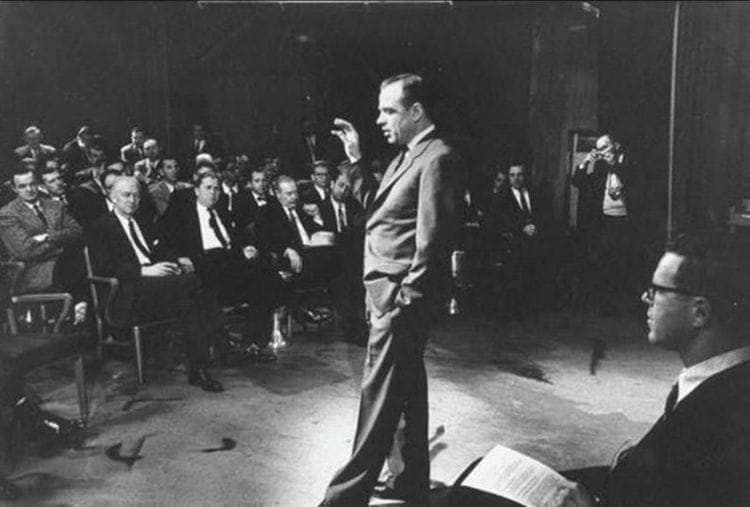
For the first time, businessman James Wykeri spoke about such a phenomenon as frame 25. He conducted an experiment in one of the cinemas in the United States of America. Throughout the summer season, James, demonstrating the highly popular film, inserted images of popcorn and cola between the usual frames. Some sources say that these were phrases: “Are you hungry? Eat Popcorn or Drink Coca-Cola.
Vykeri presented his findings to the public: he argued that such a non-standard marketing ploy worked, and sales of the drink and corn doubled! Immediately after that, the businessman patented his discoveries and founded a company that added 25 frames with advertisements of various goods directly to films.
Of course, such an event aroused extraordinary interest, because it was about influencing the subconscious of a person and persuading him to purchase certain goods. Unsurprisingly, government officials and media representatives demanded that James re-experiment. Vykeri repeated his research, but it turned out that the information he had presented before turned out to be a “duck”! That is, none of the people who watched the film with the twenty-fifth frame did not succumb to propaganda, and there was no increase in purchases.
It should be said that the official request for the provision of previous data and figures, James Vykeri responded with a categorical refusal. That is, we can say that the whole essence of the 25th frame is an artificially caused phenomenon and has a specific task. Which one? Elementary: creating a business and making money by selling this service.
Fiction or reality?
What is hidden behind this phenomenon? Is this reality or fiction? Is there a twenty-fifth frame ad? In order to answer these questions, we have collected known facts. For example, the Fellowship of American Psychologists has conducted its own research. As a result of observing people, experts made conclusions: the question of how the 25th frame affects a person can be answered in one word – not at all. The official denial of this phenomenon came out in 1958. Psychologists weren't the only ones doing research. A student from New York named Rogers, examining frame twenty-five, went to the theater where Vykeri claimed the experiment was taking place. The guy was waiting for incredible discoveries: the director said that no research had ever been carried out within the walls of this cinema. And after the student saw the area of cinemas and the number of screenings, he realized that the number of subjects declared by James Vykeri simply would not fit in a small cinema in one season. By the way, after 5 years, the businessman admitted that he had not conducted any research, and simply fabricated all the data.
Late research
This is rather strange, but despite the disappointing research results, interest in this phenomenon has not faded. Research continues even today.
For example, scientists from the Netherlands confirm the impact of the twenty-fifth frame on the human subconscious. True, for this, hidden advertising must be designed in the form of jumping alphabetic or numeric values. In addition, scientists have determined that the exposure time of this frame should not be 1/25 of a second, but a little longer.
The results of this study by Dutch specialists were published in the popular scientific journal Journal of Experimental Social Psychology. The BBC also studied the unusual effect. Their results show that there is little difference between the group that received subliminal ads and those who did not see such ads.
40 years late
The twenty-fifth frame interested Russians with a delay of almost four decades. Through the efforts of the yellow press, interest in this phenomenon appeared only in the nineties of the last century. It was then that articles appeared in the newspapers that the population was being zombified, of course, with the help of this unusual shot. By the way, at the same time, videotapes for studying various languages, treatment of diseases with the help of 25 frames became widespread. It should be noted that the population of the country turned out to be incredibly gullible, few doubted that this phenomenon could help.
The legislation of Russia and Ukraine prohibits the use of hidden advertising that affects the subconscious of a person. In the Russian Federation, this is regulated by paragraph 9 of Article 5 of the Federal Law “On Advertising”:
It is not allowed to use in radio, television, video, audio and film products or in other products and to distribute hidden advertising, that is, advertising that has an impact on their minds that consumers do not realize, including such impact through the use of special video inserts. (double sound recording) and in other ways.
By the way, specialists from the All-Russian Research Institute of Television and Radio have managed to develop a unique device that allows detecting any extraneous and unauthorized information in a TV signal, including the twenty-fifth frame.
What does the twenty-fifth frame mean?
It has been established that a person consciously catches and perceives 24 frames in one second of time. True, this parameter depends on the clarity of the picture and the speed of the image on the screen. Therefore, the additional frame shown in this period of time is perceived exclusively by the subconscious.
What is the 25 frame effect? This is a video technology, which is usually used to prevent the glow from the equipment from entering the screen. Two types of techniques are used for the effect to appear. The cinema projector is designed in such a way that after the delivery of frames it is closed with a curtain or shutter. In the resulting pause, 25 frames are displayed on the screen. To do this, you need another projector that reproduces the necessary information. In this case, the conditions are met. But how do you see frame 25 in movies?
A person consciously captures and perceives 24 frames in one second of time
The image of the 25th frame should be lighter than the rest of the frames of the broadcast film, program or cartoon. Plus, the duration of the image is selected. It should be shorter than the main frames. Otherwise, the information is read by consciousness, and does not go into the subconscious.
As you can see, this process is difficult to carry out. Therefore, skeptics and reject the existence of the phenomenon of 25 frames and its impact on people. In order not to get lost in conjectures, check the presence of the phenomenon yourself. To do this, you need computer equipment and a standard video editing program. The inserted image or word is viewed and read, a person's vision is not disabled, he captures information, but does not attach meaning to it. If it is not entirely clear how this happens, then imagine a noisy room where many people are talking. It is impossible to make out the words of an individual person, but the cry of a child is heard in this scale.
The history of the appearance of the 25th frame
For the first time, James Wykeri spoke about this phenomenon. He provided the public with the conclusions that he made according to his own observations. For this, the businessman conducted an experiment in one of the US cinemas. During the summer season, James demonstrated the popular tape by inserting cola and popcorn images between regular frames.
According to the businessman, the marketing ploy worked: sales of soda and corn doubled. Vykeri patented the discovery and opened a company that provides services for adding 25 frames with advertising of goods to films.

Skeptics reject the existence of the 25th frame phenomenon and its impact on people
Naturally, such an event caused an explosion in the world. After all, we are talking about influencing a person's consciousness and persuading him to purchase certain goods. Government officials and media representatives have demanded repeated experiments. James did some research, but the data presented above turned out to be a duck. None of the people who watched the film succumbed to the propaganda, and there was no increase in purchases. Interestingly, when asked to provide previous data and figures, Vykeri refused.
The story of the appearance of the 25th frame makes it clear that the phenomenon is caused artificially and has a specific task, namely, creating a business and making money by selling a service.
Much later, frame 25 was perceived as a threat to children and adults.
Frame 25 Effect: Fiction or Reality?
So what is behind this phenomenon? Is this fiction or reality? Does 25 frames exist in video ads? Here are some known facts to find answers to these questions:
- The Fellowship of Psychologists in America has conducted its own research. Based on observations of people, psychologists concluded that frame 25 does not have an effect on a person declared by James. The official refutation came out in 1958.
- A student from New York Rogers, examining frame 25, went to the cinema, where the research was carried out. In New Jersey, the guy was waiting for amazing discoveries. The director assured that such experiments had never been carried out within the walls of a cinema. Having seen the area of the halls and the number of sessions, the student realized that the declared number of subjects would not fit in a movie theater in one season.
- 5 years after the experiments, the businessman made a confession. He argued that the research was not carried out, and all the data were fabricated.
- Since interest in the 25th frame has not faded away, research continues to this day. Dutch scientists confirm its effect on the subconscious of people. To do this, hidden advertising must be designed in the form of jumping alphabetic or numeric values. Plus, scientists have deduced a different exposure time. To get the effect, 25 frames must be longer than 1/25 sec.
- Russian media exploded with information about 25 frames in the 90s. The journalists argued that with the help of this technology, propaganda and zombies are being carried out among the population. People were persuaded to learn foreign languages, to cure bad habits by buying videotapes. Whether this was actually unknown. But, in 2006, the authorities adopted a bill prohibiting the use of 25 frames in audio, radio, video production, through the TV screen and cinemas.
Slimming 25 frame effect
Surprisingly, people, understanding the impact of 25 frames on the subconscious, consciously acquire courses with its recording. The 25 frame slimming effect is especially popular. There are many rave and negative reviews online.
How does this technique work? Losing weight with 25 frames is a video with words, pictures, images. The course is set on a computer and viewed daily for 30 minutes a day. The developers of the program recommend taking a monthly break, then repeating the course again. To improve the result, you should pronounce the phrases from the video before going to bed. That's it, you don't need to do anything else. Just expect to go from plump to a slender goddess.
It's amazing that people believe that you can lose weight from watching a video. Why is this happening? Well-known weight loss programs involve serious work associated with dietary adjustment and physical activity.

Slimming 25 frame effect
Losing weight with 25 frames is an easy way, while programs do not cost a lot of money. So why not give it a try? Moreover, there are positive reviews about the use of the program.
Before deciding to buy this course, think about whether you are sure that the program will not do any harm. What other suggestions can be written under the topic of losing weight? Plus, keep in mind that positive reviews about the program are an elementary lie written by fake people. Although the effect of the program is possible due to the action of another little-studied phenomenon – the placebo phenomenon: believing in the effectiveness of the program, some people do lose 2-3 kg.
25 frame effect in cartoons
The question of the presence of 25 frames in programs for children and cartoons has been repeatedly raised by child psychologists. Caring people have created a video that proves the presence of an extra shot and the impact on children.
Many parents wondered if there is a 25 frame in Disney cartoons. Especially went to cartoons produced by Disney. The tough actions of the heroes of the cartoon Shrek were discussed, in particular, the video talked about the substitution of concepts: behind the positive hero, cruel and aggressive actions were hidden. For example, Princess Fiona kills a bird, and Shrek inflates a frog. Over time, the noise around children's programs has decreased, and cartoons have not been banned.
Nevertheless, it is worth asking the question: why is 25 frame dangerous in cartoons? Perhaps the parents are in vain raising a panic … But while we do not have a definite answer, we advise you to approach carefully to the choice of programs for the child. Young children take what is happening in the frame literally and apply what they see in real life. The child is usually unable to distinguish good from bad, as there is no accumulated experience behind him. Children under 6 years old are especially susceptible to the influence of what they see on the screen.
It is not yet known whether 25 frames are used in cartoons.
Show kids cartoons by age. Start with pictures for the little ones. Look for cartoons recommended and tested by psychologists. Plus, consider the time the child spends watching TV: limit it to 30-60 minutes. in a day.
Despite the official statement of the person who opened the 25th frame, about the falsification of facts, they continue to study and apply it. Courses are issued for learning English, 25 frames are inserted into political advertising, used to attract children's attention. The real impact has not been proven, since the information is read by the subconscious, which works individually for each person
What is frame 25?
The 25th frame is subliminal, i.e. located below the threshold of conscious perception, a message. As a rule, the 25th frame is understood as a non-existent technique of influencing the human subconscious with the help of a special insert into any video sequence of a hidden message in the form of additional frames.
The author of the presented technique is considered to be a man named James Wykeri (we will talk about him later), who later admitted that his experiments, the results of which indicated that the 25th frame affects human consciousness, were fabricated. But even in our time, the use of the 25th frame is prohibited by law in many countries around the world.
How does frame 25 work?
The essence of the 25th frame effect is that human vision distinguishes only 24 frames per second. Based on this, any additional frame that is shown in less than 1/24 of a second, without being fixed by consciousness, immediately falls into the subconscious.
But in reality, any information that enters the brain is always processed by the subconscious, and after that it gets into the consciousness, which will process it and extract the most important from it. Thanks to this process, huge amounts of data are simply screened out, and, moreover, they can significantly exceed 1/25 of a second, like, for example, television advertising, to which we are all accustomed. And this suggests that the 25th frame is not as effective as it is commonly thought.
In addition, the 25th frame itself cannot be called hidden, because the viewer's eye captures all the frames, however, due to the fact that vision is inert, the 25th frame merges with all the others and the person does not seem to see it.
If we talk about the psychological effect that the 25th frame allegedly has, then the American Psychological Association refuted it back in 1958.
How did the 25th frame appear?
In 1957, the above-mentioned businessman James Wykeri made a statement according to which he conducted an experiment in one of the cinemas in New Jersey (USA). In the process of showing the film “Picnic”, at the moments of a change of frames, with the help of special equipment, a demonstration of frames of hidden advertising was made (“Eat Popcorn”, “Coca-Cola”). The screening of the film continued throughout the summer of that year. And according to Vykeri, the sale of Coca-Cola in the cinema increased by 17%, and the sale of popcorn by 50%. After that, Mr. Vykeri patented a new technique, and even later founded his own company specializing in subliminal advertising in films.
The idea of creating this technology came from a businessman after he got acquainted with a new invention at that time called “tachytoscope” – a device that gave short light flashes of up to 1/60000 of a second, not recorded by human vision. By the way, with the help of these flashes, the Kodak company was able to photograph a flying bullet. As a result, our “inventor” decided to apply these flashes in a new way.
Media reports soon piqued the interest of scientists, government officials and advertising agents, who requested another experiment. James Vykeri arranged a series of “shows”, but none of them affected the subjects properly – none of the people expressed a desire to do what they were told. In 1958, the Advertising Research Foundation demanded that the businessman provide all the data on the experiment he conducted in 1957, but Vykeri refused.
Some time later, New York student Stuart Rogers visited Fort Lee in New Jersey to write a paper on the Wykeri experiment. There he saw that the cinema where Vykeri conducted his research could not accept 50 thousand people in 1.5 months, as they said. In addition, the director of the institution assured the student that he had never heard of any experiments in his cinema before. Many scientists also wanted to repeat the experiment with the 25th frame, but this did not bring significant results.
Finally, in 1962, James Vykeri made an official statement that the experiment conducted five years ago, like all sales statistics, was fabricated.
Further studies
Despite the events described above, one issue of New Scientist magazine reported that there are cases where hidden advertising works. But the part of this hidden message should be a stream of jumping alphabetic and digital data, and appear for a time that should exceed 1/25 of a second. Scientists from the University of Nijmegen (Netherlands), who conducted an experiment under the leadership of Johan Karremans on the effectiveness of the latent influence of the 25th frame, came to similar conclusions.
Effects
The experiment, conducted by James Vykeri, caused a large number of myths in the media and outrage in society. In the same 1957, the journalist Norman Cousinis published an article in the Saturday Review titled “The Tainted Subconscious”, in which he pointed out that the 25th frame could be used not only for advertising, but also for propaganda.
In Russia, information about the 25th frame also made itself felt. So, in 1990, articles began to appear in the “yellow press” that the population was zombified by means of the 25th frame, and videotapes were advertised on the study of a foreign language, treatment of diseases, alcoholism, etc. Interestingly, such articles were published in such numbers that people did not even have doubts that this information was true. And in 2006, Russia passed a law banning the use of the 25th frame and other methods of subliminal advertising in any audio, video, television, radio and film production.
Accusations of using 25 frames
The first interesting accusation concerns Japan: after the incident with epileptic seizures in children from Japanese families, the famous animated series “Pokemon” was accused of using the 25th frame.
The second charge is related to the 2006 parliamentary elections in Ukraine. Then Yevgeny Kushnaryov, the head of the electoral company “Party of Regions”, made a statement that the 25th frame was used in the campaign tape “Zagroza. The Truth is Terrible “, which was shown on one of the Ukrainian TV channels.
And the third charge concerns the 2014 political crisis in Ukraine. This time, the Ukrainian security service accused Russian TV channels of using the 25th frame. SBU press secretary Marina Ostapenko pointed out that prohibited methods of informational and psychological influence were revealed in the programs of Russian TV channels, namely: frame 25. As an example, the 25th footage was named with the following content: “National Guard killers”, “Bandera are killing people” and “I set fire to the right sector.” More specifically, the 25th frame was used by the Russia-24 TV channel.
Whether it is true or not, it is not up to us to judge. But one thing we know for sure – the 25th frame is not only a topic for long conversations and fascinating discussions, but also a wonderful element of the plot of various films. If you have a desire, you can see the 25th frame with your own eyes or get acquainted with one of the ideas for using it.
In the first case, we invite you to watch the film “Fight Club” with Edward Norton and Brad Pitt in the lead roles – here the 25th frame is used several times: when one of the main characters inserts it into a movie while working in a cinema, as well as at the beginning and at the end of Fight Club.
In the second case, we recommend watching the 21st episode of the Colombo television series – in this film, the 25th frame is used first by the killer to influence the victim, and then by Lieutenant Colombo to influence the killer.
If you wish, you can find other films with 25 frames. But if you want to learn how to influence the subconscious of a person yourself, then we recommend that you master more effective techniques, for example, techniques and techniques of NLP.
The essence of the 25 frame technique
If we delve deeper into this question, then we find the following. It is believed that the human brain is capable of perceiving 24 frames in 1 second at the level of consciousness, and if you add an extra frame to this, then it, bypassing consciousness, is immediately deposited in the subconscious.
However, in fact, the opposite is true. First, a person perceives information at a subconscious level, and then at a conscious level. This was proved and promulgated by scientists back in 1958, but, nevertheless, the myths about 25 frames continue to live on.
History of appearance
The history of the 25th frame began in 1957. It was then that a certain J. Vykeri reported that he was conducting a new experiment in one of the American cinemas. A film was shown, which included hidden ads for famous advertising products – Coca-Cola and popcorn. According to the published results, after this, sales of both of them increased significantly, and the creator even patented his technique.
Later, scientists tried to repeat the experiment. As a result, the effect of “25 frame” on the subconscious was not found, and in further experiments Vykeri simply refused.
Then one of the students tried to write an essay on this topic, but found a complete inconsistency with the reality of the information that Wykeri provided at one time. Firstly, the cinema in which the experiment was allegedly carried out simply could not accommodate the number of people mentioned. Secondly, the director of the institution claimed that no real experiments were carried out.
All this led to the fact that Vykeri himself was forced to admit to falsifying the results of his first experiment and did not refuse his words in the future.
Development of events
But even after all these events, the hype around the 25 frame effect did not subside. Some media outlets argued that the method was effective, and scientists from the Netherlands independently conducted a number of studies and came to the conclusion that if hidden advertising takes no more than 1/25 of a second, then it can really affect the subconscious of a person. Does this mean that the effectiveness has been proven? Unknown.
Where did this myth come from?
In 1957, ingenious marketers James Vicari and Francis Thayer conducted an experiment that would take advertising to the next level. In a movie theater in a place called Fort Lee, they experienced what were called subliminal messages for six weeks. In total, more than 45,000 viewers were exposed to these messages.
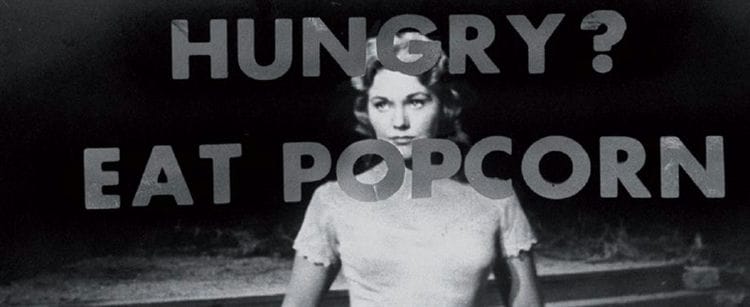
The experiment was as follows. While the audience watched the film “Picnic” (1955), they were shown text inserts with the following content: “Hungry? Eat Popcorn and Drink Coca-Cola. According to Vicari, messages appeared and disappeared on the screen so quickly that they were invisible to the consciousness of the audience, but influenced the subconscious. Inserts flashed for 3/1000 seconds and were displayed every 5 seconds.
A shot from the same film with the overlaid caption. And really, why not crunch?
After the experiment, Vicari compared six weeks' current sales of cola and popcorn to the previous six. The numbers, he said, surprised him: sales of Coca-Cola grew by 18.1%, and popcorn by as much as 57%. Impressive, right?
The 25th frame effect made James Vicari more famous. He patented this technology and opened his own company, the James M. Vicary Company, which began to engage in “subliminal advertising.”
The Americans were seriously afraid that some cunning businessman would control their subconsciousness. The CIA even prepared a report on the Vicaris invention, after which the US Congress almost passed a law prohibiting the embedding of the 25th frame in films.
There was a lot of hype in the press. The 25th frame and James Vicari became even more famous after the publication of the book The Hidden Persuaders by writer and journalist Vance Packard in the same year, in which the author sensationally denounced the “dirty methods” of advertisers. It got to the point that advertising using the 25th frame was banned in the UK.
So the story of the 25th frame began its march through the minds of millions of people.
Here we would all sit down and come to terms with the fact that we are already deeply zombified, if not for a couple but.
Vicari himself admitted that he invented his experiment
One small detail. The story of the 25th frame began with an experiment by James Vicari … which was fabricated. He admitted this in a 1962 television interview. When the president of the American Psychological Corporation, Dr. Henry Link, suggested repeating the experiment, Vicari was forced to declare that the results were falsified by him.
And when researcher Stuart Rogers asked the manager of the cinema in which James allegedly played the 25th frame film, it turned out that he was not familiar with him and that there had never been any experiment. Essentially, the Vicari came up with the effect to cash in on gullible advertisers willing to shell out large sums for “subliminal ads.”
In January 1958, the FCC (Federal Communications Commission) required James Vicar to demonstrate the effect of the 25th frame. Congressmen, scientists and journalists were invited to the conference on this occasion. Naturally, James could not have any impact on the audience.
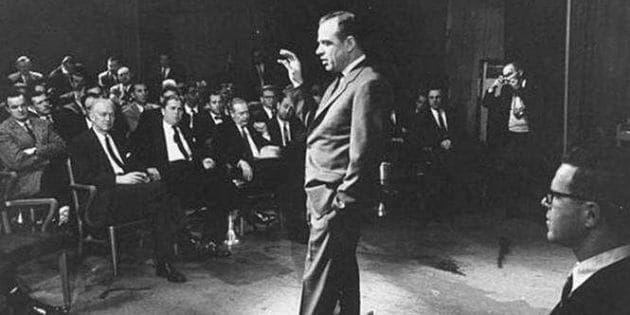
Vicars make excuses to the FCC
Later, he decided on another experiment (it was necessary to somehow restore the tarnished name) with the help of the Canadian Broadcasting Company. In the half-hour TV show, the message “Call now” was inserted, repeated 352 times. And … no increase in the number of calls was recorded.
James Vicari disappeared from public view. Later, on September 17, 1962, an interview with him appeared in the Advertising Age newspaper. There, he finally personally admitted that there had never been any experiment and he came up with the effect of the 25th frame, just to attract attention and earn extra money.
Scientific research has not confirmed the actions of the 25th frame
After all the Vicars' statements in 1958, scientists from the American Psychological Association were tired of this farce and they denied the possibility of the 25th frame in any way to influence the audience. True, people did not stop believing in the myth of “subconscious influence” after that.
Ian Zimmerman, a psychologist at the University of Missouri – Columbia, in his article for the scientific journal Psychology Today, denies the possibility of influencing people with “subliminal messages.”
Many are convinced that subliminal messages are a powerful and effective way to get us to do things we don't want to do. But this is not the case. This is just a myth.
Jan Zimmermann
In 2006, researchers from Utrecht University and Radbud University in the Netherlands conducted another experiment. They showed subjects a three-minute clip of the group Spooks with the word Lipton occasionally appearing in the frame.
And as a result, a significant number of participants, after watching the video, declared that they did not want to drink at all – even though they were fed salty food before the experiment. Those who wanted to drink were divided into two camps: 46% preferred Lipton tea, 54% chose just water. The researchers admitted that the 25th frame did not have the expected effect.
In an article for the BBC, marketer and psychologist Paul Buckley of the Cardiff School of Management also argues that 25 frame messages don't work.
In practice, there is no evidence that “subliminal messages” have any power. Of course, many countries around the world have laws prohibiting their use on television. But no one has yet been able to point out a single case when such a message worked.
The human eye perfectly distinguishes the 25th frame
The myth is based on the belief that the human eye cannot recognize more than 24 frames per second. Accordingly, the 25th frame supposedly bypasses consciousness and affects the subconscious. You do not see him – but he acts.
But in fact, a person can perceive more than 24 frames.
In the early days of cinema, when films were silent, the Lumière brothers (and all the filmmakers who followed them) used 16-frame photography. This decision was made to save money: the consumption of 35 mm film was exactly 1 foot per second, so it was more convenient to carry out calculations.

For the illusion of smooth movement, 12 frames are enough. But the more there are, the better.
Then, with the advent of sound films, a frequency of 24 frames per second became the standard. And now films in the cinema are shown at 48 or 72 frames per second. Each of the 24 original frames is repeated two or three times to reduce flicker. It is believed that a frame rate of 72 Hz is sufficient for smooth images.
But it is not so. For example, Air Force pilots could identify an aircraft from a picture that appeared in front of them only for 1/220 seconds, that is, they are able to perceive 220 frames per second. And then there is research confirming that humans can capture single frames even at 500 Hz!
So, if you really write down some message and insert the 25th frame into it, you will see it and can decipher it without any subconsciousness. And you won't be able to watch films with such a “secret” frame: it will ripple in your eyes and distract you from watching. Our video confirms this:
Sources used and useful links on the topic: https://kinoreporter.ru/so-skorostju-24-kadra-v-sekundu/ http://www.cinemotionlab.com/novosti/24_fps_kak_chastota_kadrov_stala_standartom_i_nuzhno_li_ee_izmenyat/ https: // ru / article / 385254 / kadr-eto-chto-takoe-sut-effekt-vliyanie-go-kadra-na-cheloveka https://sunmag.me/sovety/17-03-2014-effekt-25-kadra-vymysel -ili-realnost.html https://4brain.ru/blog/25-%D0%B9-%D0%BA%D0%B0%D0%B4%D1%80-%D0%BF%D1%80%D0 % B0% D0% B2% D0% B4% D0% B0-% D0% B8% D0% BB% D0% B8-% D0% B2% D1% 8B% D0% BC% D1% 8B% D1% 81% D0 % B5% D0% BB / https://blog.wikium.ru/25-kadr.html https://Lifehacker.ru/25-j-kadr/
Post source: lastici.ru