
What is cryptocurrency in simple terms. Cryptocurrency – what is it in simple words and how to use it
What is blockchain and cryptocurrency? Explanation for six year olds.
To explain the essence of cryptocurrencies in simple terms, it is best to resort to the method of analogy. Imagine going on a picnic with a friend. And you have one apple that you grabbed just in case. True, you just ate a shish kebab and you didn't need an apple. So you gave it to a vegetarian friend. Now you have zero apples at your disposal, and your friend has one.
Let's take a closer look at this simple fact of giving an apple. The apple passed from one hand to another. This is an event that has happened, which is confirmed by the fact that you had an apple, and now a friend has it. And in order to simply pass the apple from hand to hand, you two did not need any third party to help you with the donation (for example, issued a certificate of donation of an apple). And, once again, we repeat, it is quite obvious that you have zero apples, and your friend at a picnic has one. Now your friend owns your former apple, and he can, in turn, give it to another person. That is, it is a simple direct economic relationship in the form of donation. It is clear that in the place of an apple there can be anything: a chocolate bar, a car, a gram of gold, one ruble … But let's not get ahead of ourselves.
Now, let's say you have one digital apple. This can be, for example, a digital photo or a picture of an apple on a flash drive or smartphone. How can your friend know that the digital apple that used to be yours is now personally his and only his? What if you still have a copy?
Here you need to strain your imagination a little, because the most important and most difficult moment for understanding any cryptocurrency comes! How can your friend know that you have not copied the picture of the apple to your computer or smartphone in advance? How can he be sure that the digital photo of the apple now belongs to him and no one else owns the digital apple except him? Perhaps you have previously posted a picture of an apple on your social media page and this picture has already been downloaded by all your other friends?
Obviously digital exchange is a challenge because sending digital apples is not like sending physical apples.
How to solve the problem? Perhaps digital apples need to be tracked in a specific ledger, ledger, constantly updated directory of all donations. And this book, since it is digital, must exist on the Internet, and someone must be responsible for it, that is, keep it, control its completion.
But here we run into two limitations:
- The owner of the digital ledger, that is, the ledger for apples, can simply assign to himself, on his balance sheet, as many apples as he wants, and when he wants! This fundamentally undermines the credibility of such a ledger.
- And if this accountant gets sick, or if he goes to jail, or if he dies, then the keeping of the ledger for apples will be stopped altogether!
Is there some way to replicate our picnic apple-giving, but digitally?
Cryptocurrencies provide such a method. And this is how it works, in simple terms.
The ledger for apples, that is, a register of all digital apples and their distribution by owner, is not hosted by a third party who can get sick or go to jail, but is hosted on many computers around the world. All operations of transferring digital apples from one person to another (the so-called transactions) that have ever occurred with digital apples will be recorded in this digital ledger distributed among all computers.
And to deceive this book, this registry is simply impossible. It is created (programmed) in such a way that you cannot give digital apples, which a person does not have, you cannot just ascribe them to yourself. Such operations simply won't sync with everyone else in the system.
In addition, the general ledger is not controlled by one person, it is owned by everyone. Anyone can open it, update it, check it and make sure that everything is accurate and without cheating.
Well, now, actually, to the point. Such a system (digital ledger) exists and it is called blockchain. And digital apples are called cryptocurrencies. The most famous cryptocurrency is Bitcoin. Simply put, one bitcoin is one digital apple.
Now let's explain everything that has been said, if possible, with the most simplified description of the main properties of blockchain and cryptocurrencies:
- The first feature of cryptocurrencies as a ledger for transaction records is that they are open source, and the total number of apples is defined in the ledger from the beginning so that no one can create an infinite number of digital apples.
- The second feature is that when a transfer is made, the sending and receiving of the digital apple know for sure that one has lost bitcoin, and the other has gained. Earlier, before cryptocurrencies, there was no such confidence, because this technology itself did not exist.
- The third feature is that within a cryptocurrency system, the exchange of digital apples is very similar to the exchange of physical, real fruits. It is as simple, convenient and reliable as watching a physical apple leave my hand and fall into the hands of a friend. And only two people are involved in the transaction, no one else. By the way, it is because of this property that many governments see cryptocurrencies as a threat to the state financial system, because it is almost impossible to control cryptocurrencies in the same way as the dollar or the ruble. However, this is already a topic for a separate article.
So, completely simplifying the description, we can say that cryptocurrencies are digital apples that can be shared, transferred, exchanged, paid, given, like ordinary physical objects, for example, apples or gold bars.
But that's not all. In the world of digital apples, there is another useful feature: you can deal not only with one or a thousand apples, but also with 0.000003487 or 0.009 apples. And any share of an apple can be sent at the touch of a button worldwide, instantly.
And now, finally, one more, the most “non-currency” possibility of cryptocurrencies: you can attach notes, contracts, certificates, identity cards to digital apples, in a word, the benefits of this technology are much more than from a simple transfer of an apple from hand to hand.
After reading all of the above, probably any person will have a question: is cryptocurrency a currency? How can such a clever and useful program code be considered money?
Of course, there is not and cannot be one simple answer. The technology itself is too young and too many different aspects are intertwined around it: socio-psychological, economic, political.
If, again, follow the principle of simplification, then one thing should be remembered: no matter what monetary rate the cryptocurrency has, whatever politicians and economists say about it, no matter how many cryptocurrencies there are, all cryptocurrencies use the technology of a distributed ledger, in which information is recorded about all transfers (transactions). By the way, the ledger for digital apples is the famous “blockchain”! The very first blockchain was developed by Satoshi Nakamoto, and it was he who formed the basis of bitcoin as a cryptocurrency. However, this is already history …
What is blockchain and cryptocurrency in simple words. Explanation for adult teapots.
Cryptocurrencies like Bitcoin have overtaken Kim Kardashian and Donald Trump in Google searches. What is it, and why are millions of people around the world interested in crypto coins? Let's figure it out.
It is impossible to answer the question: “what is cryptocurrency” in simple words without talking about distributed ledger technology. Distributed ledger technology is primarily a database, but not simple. Many users of this database have copies of it, that is, they store it on their computers, in powerful smartphones, in the “cloud” or on a hard drive. This distributed storage of information is what is called distributed ledger technology.
This technology has a modern embodiment – the blockchain: information is not just stored, but “packed” into blocks, and the new block contains all the data that was in the previous one. For the creation of new blocks, the system in which this all happens, that is, the blockchain, can issue a reward in the form of a cryptocurrency.
Cryptocurrency is a certain digital code (in physical form, bitcoin does not exist in the form of a coin!), Information about which is stored on the blockchain and which – oh, miracle! – even has an estimate in ordinary money.
So, bitcoin on July 16, 2019 could be sold for an amount of $ 10.5 thousand. This does not mean that you have to buy a whole bitcoin – you can buy only one hundred millionth part, that is, one satoshi. And you can buy more than one satoshi, but 50 million – this means that you will buy half a bitcoin.
Most popular cryptocurrencies
Bitcoin is not the only cryptocurrency. The popular aggregator CoinMarketCap has about 2 thousand of them. However, in reality there are about 6 thousand of them, plus you also need to take into account that there are tokens.
The token differs from cryptocurrencies in that it is launched on the basis of the cryptocurrency blockchain, that is, on top of it. Sometimes, to distinguish Bitcoin from all other cryptocurrencies, Bitcoin is called a cryptocurrency, and all other cryptocoins are called altcoins.
Tokens and coins, altcoins and cryptocurrencies: what's the difference (short and simple!)
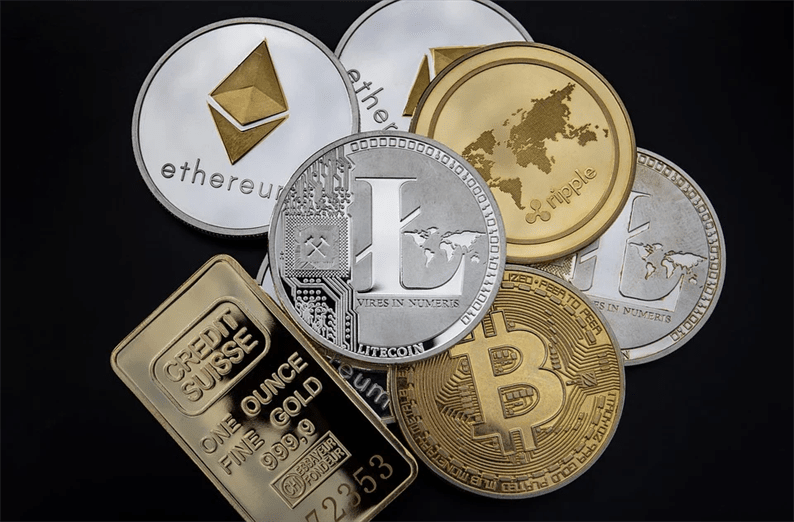
There are cryptocurrencies on the market for every taste and wallet. There are top 5 crypto-currencies, which is determined by how many units of a particular crypto-coin are issued, taking into account their market price – thus, it turns out that the most “weighty” by this parameter, which is called capitalization (this is the total market value of all issued coins) are included in this list.
Bitcoin
At the top, of course, is bitcoin: it has been “living” for more than 10 years, its creator is considered to be someone (person or organization) known under the pseudonym “Satoshi Nakamoto”. There are many versions of who it really is – from Craig Wright to the CIA, but none of the versions has yet been confirmed.

“Satoshi Nakamoto” was active in the first two years of Bitcoin's existence, but it was all over the Internet, that is, no one saw him. And then “left the radar”. By the way, this makes Bitcoin an exquisite asset: it is really decentralized, since there is no one who pulls the strings of this project. What can not be said about all other cryptocurrencies: when you ask the question, “what is a cryptocurrency?”, The first thing to ask is what kind of cryptocurrency we are talking about, and who is its developer and creator. Cryptocurrencies cannot appear on their own – there is still one or those who start this process.
Ether (Ethereum)
The second largest cryptocurrency by capitalization is ether, which is created on the Ethereum blockchain. Its creator is Vitalik Buterin, an emigrant from Russia, and Joseph Lubin, an American.
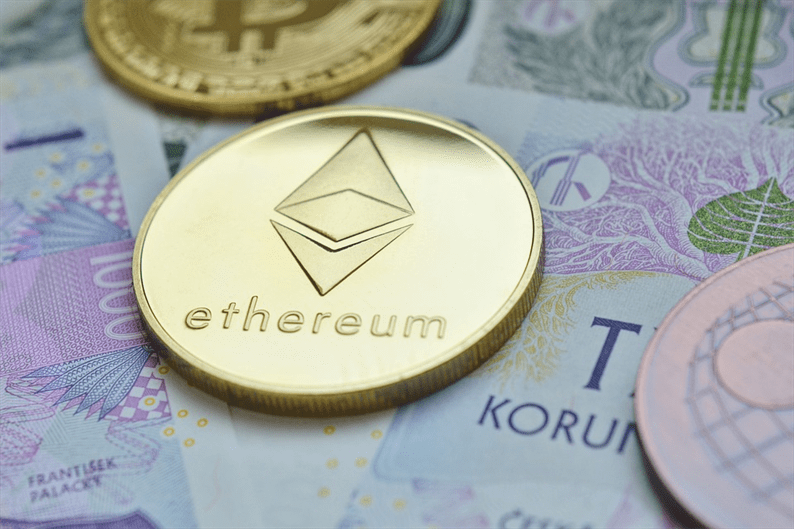
Ether is known for the fact that its blockchain has become massively used to launch a variety of tokens, as well as special programs – decentralized applications. Ethereum, like Bitcoin, is not very common as a medium for transactions – where they are generally allowed.
Recall that in Russia it is possible to purchase goods and services only for the Russian ruble and the Bank of Russia does not leave any other options in this regard.
In fairness, it is worth noting that in the United States, Japan and South Korea, the authorities are not that permitting the use of cryptocurrencies for such purposes – they still do not object, perceiving cryptocoins as a tool for barter transactions, that is, the exchange of one product for another. At the same time, in most countries of the world, the purchase of cryptocurrencies not for the purpose of using them as money, but as an investment asset, is de facto not prohibited.
Bitcoin Cash and Litecoins
In the three countries mentioned (USA, Japan and South Korea), Bitcoin Cash and Litecoins, cryptocurrencies, which occupy the fourth and fifth places in terms of capitalization, are widespread as a means of calculation. Bitcoin Cash actually appeared as a hard fork of Bitcoin.
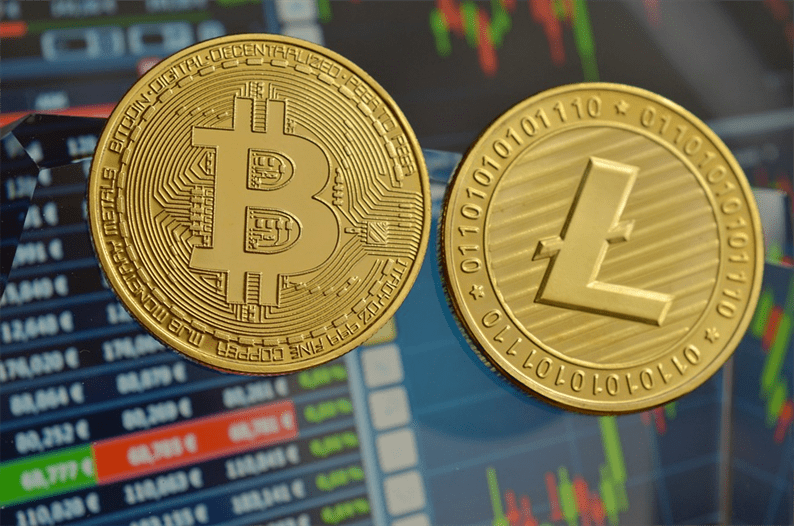
A hard fork is a “spinning off” of a new blockchain from the old blockchain, as opposed to just a “fork”, that is, updating the system by developers. Both of these cryptocurrencies were conceived precisely for servicing transactions – to do it quickly, without hackers being able to “poke their nose”, although this, alas, is not excluded, and also without large commissions.
XRP (Ripple)
Finally, XRP is in the top 5: it is the third in terms of capitalization. Previously, it was called Ripple, but now this name is assigned to the fund, which is indirectly related to this asset.
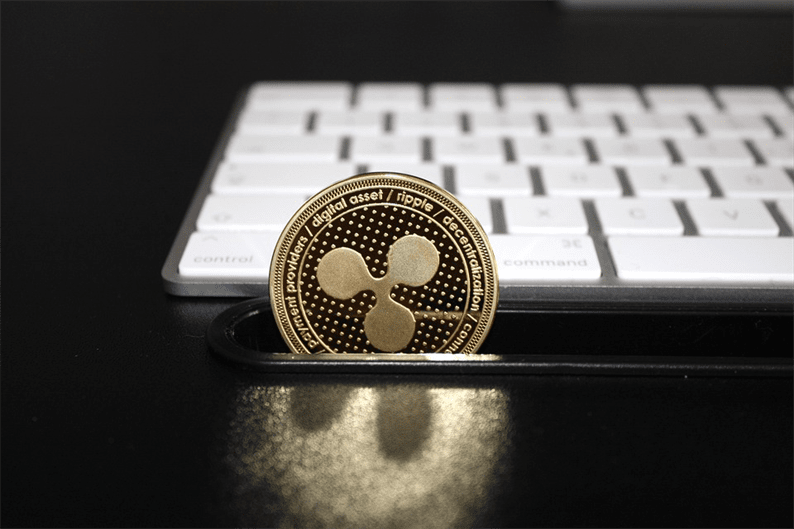
XRP is increasingly specialized in being Bitcoin Cash or Litecoin not for individuals, but for legal entities, especially for banks and other participants in the financial market. XRP uses, for example, Santander Bank in Spain to conduct cross-border payments in fiat money.
That is, XRP is used as a “carrier of monetary value”, when at the input of a money transfer and at its output we see ordinary money, euros or US dollars, for example.
Stablecoins
You now know that there are cryptocurrencies with a wide variety of functionalities. And this is a plus. In addition to the top 5, it can be noted that there are stablecoins – these are cryptocurrencies that are pegged in value to ordinary money, for example, to the US dollar. That is, they resemble the Saudi rial – the currency of Saudi Arabia, which has a fixed rate against the US dollar. A stablecoin can also be pegged to other money, as well as to the price of gold, oil, and even be issued on the basis of other crypto coins.
Why is Bitcoin sometimes called a pyramid?
A typical reason for skeptics' doubts is the comparison of cryptocurrency with the Ponzi pyramid. It contains one similar feature: money does not appear as a result of the production of goods or services, but “out of thin air.” This is where questions arise about what the cryptocurrency is backed by, why it costs so much and what needs to be done to get coins.

Real money can be obtained from the sale of products and the provision of services. Mining, in the understanding of many investors, seems to be an imitation of work, because no effort is made to extract new coins (everything happens in automatic mode). In fact, the economic essence of digital money is similar to the production of goods.
The miner faces the following costs:
- One-time – purchase of powerful equipment (video card or ASIC-computer);
- Permanent – payment for consumed electricity;
- Variables – repair or replacement of equipment that is out of order.
There is a risk of serious breakdowns when you have to purchase equipment from scratch. And only after the completion of the “production” cycle, when a new coin appears, can we talk about earnings. It is difficult for those owners of bitcoins who acquired them through exchange operations to understand where they come from and what the calculation of the present value is based on.
It turns out that all comparisons with the pyramid come from misunderstanding, unwillingness to analyze and delve into the fundamental foundations of what is happening in the market. Bitcoin has taken root as an asset worth investing in. This is confirmed by the regular appearance of altcoins – its analogues. It remains to adapt to reality in the same way as we got used to the sharply increased US dollar and euro.
Profitable investment
A resident of Norway bought 5,000 bitcoins for $ 27 a few years ago and forgot about them. After a while, the media began to write about the growth of the Bitcoin (or cryptocurrency) rate. Then the Norwegian remembered the password and finally learned that his 5 thousand coins turned into $ 886 thousand dollars.
Briton James Howells created 7,500 bitcoins in 2009, then they “cost” $ 675,000. Subsequently, he threw the hard drive to which they were attached to a landfill. Now his coins would be worth $ 7.5 million.
The unlucky Briton would be well understood by a man who ordered pizza for bitcoins in 2010, not knowing that in three years the cost of these coins would be several million dollars.
The currency provokes an increase in crime
At the end of 2012, Bitcoin was only $ 13.5. In April 2013, he was given $ 266 for it. Experts note that e-currency could gain popularity because it is possible to buy drugs, pornography, fake documents, etc. with bitcoins on the Internet anonymously.
The Silkroad website, now closed by the FBI, has sold 9.5 million bitcoins worth of drugs in its two and a half years of operation, which is equivalent to $ 1.2 billion.
Money can be stolen by hackers
The European payment system BIPS was recently hacked, as a result of which 1,295 bitcoins were stolen. More than 20 thousand owners of “coins of the future” have stored their savings in cyber currency on the servers of this company. Before that, a similar story happened with another service where bitcoins could be stored – Inputs.io.
What to buy with bitcoins?
More and more companies are ready to accept bitcoins for payment. British billionaire Richard Branson is ready to exchange cryptocurrency for a flight into space. In real money, the flight will cost travelers a quarter of a million dollars. Bitcoins are accepted by the travel company CheapAir, a university in Cyprus, several pubs in London.
History and future of bitcoins
Until recently, bitcoins were called the neglected currency of the future and a pyramid for geeks. And this is the first electronic currency that is decentralized – there is no intermediary bank, no processing center. There is no limit limiting the transfer of this money, there are no rules and special forms for the transfer.
Bitcoins are often compared to gold, the amount of which is limited in the world and which can be exchanged for any currency in different countries.
Currency can be bought on the stock exchange, and then it is profitable to sell it there. You can create coins by teaming up with other users on dedicated sites.
Experts are in no hurry to call bitcoins electronic money. And although startups are already emerging (with the support of investment funds) that promise to create an ecosystem for using bitcoins, there are also enough skeptical people.
How can you get bitcoins?
There are several ways to buy BTC. However, the process can be fraught with difficulties. For example, there are a large number of scam sites listing fake coins from other blockchains (Bitcoin Cash, Bitcoin Gold, etc.). Use only reliable and proven services (ratings and reviews of cryptocurrency services can be viewed on our website).
There are no longer any free ways to get BTC. After the rapid growth of the cryptocurrency rate, such services for receiving free electronic coins ceased to exist or switched to a different mode of operation. To obtain cryptocurrency by any method, the costs of certain resources are required.
The main ways to get bitcoins:
- Cloud mining is the best way to get Bitcoin for 2020. It is a rental of the power of a cloud mining service in the form of a contract for a year. All the cryptocurrency mined by this power goes to your account. On average, the income is from 200% to 600% per year, it all depends on the course and the growth in the complexity of the network. But keep in mind in cloud mining there are a lot of scam sites or pyramids, you can only trust old and proven services, there are not so many of them on the market, the most reliable is IQ Mining. In our separate material, you can find the full rating of cloud mining services.
- Classic mining. Mining coins on our own equipment. Miners, as it were, lease the hashrate of their ASICs and video cards to obtain cryptocurrency by using computing power. There are many BTC mass mining farms. For several years now, this option for mining BTC has been unprofitable for an ordinary user, giving way to more flexible and profitable cloud mining.
- Buying cryptocurrency. You can buy e-currency for money on cryptocurrency exchanges (now all major platforms support depositing funds in rubles and dollars) and in special exchangers, we have published a detailed overview of the most popular and reliable ones here.
- Cranes. The only free way to get bitcoins is very time consuming and yields miserable dividends. The user of the service only needs to click on advertising banners and videos, but the cost of the transition is very low, since 2018 this method has become completely ineffective.
Distinctive features of BTC as a cryptocurrency
- There is no control. Complete lack of control over the system by anyone. Millions of computers that mine bitcoins are included in this system. No one has the ability to dictate their terms to the owners of the cryptocurrency.
![What is cryptocurrency in simple terms. Cryptocurrency - what is it in simple words and how to use it]() Easy to use It takes about 5 minutes to create a BTC wallet that is ready for immediate use. You will not be asked anything, you do not need to pay a penny.
Easy to use It takes about 5 minutes to create a BTC wallet that is ready for immediate use. You will not be asked anything, you do not need to pay a penny.- Anonymity and transparency. It happens! Bitcoin wallet is completely anonymous and completely transparent at the same time. It is very easy to create a great variety of wallets without specifying your name, phone number, etc. But the entire transaction history is stored in the bitcoin network (remember the blockchain). If you publicly advertise that this wallet is yours, then anyone can find out all your transactions and the amount of BTC on the account, in order to ensure anonymity, you need to use one wallet for one transaction.
- Irrevocable transactions. After sending bitcoins to the addressee, it is impossible to return them if the recipient does not want to do it himself.
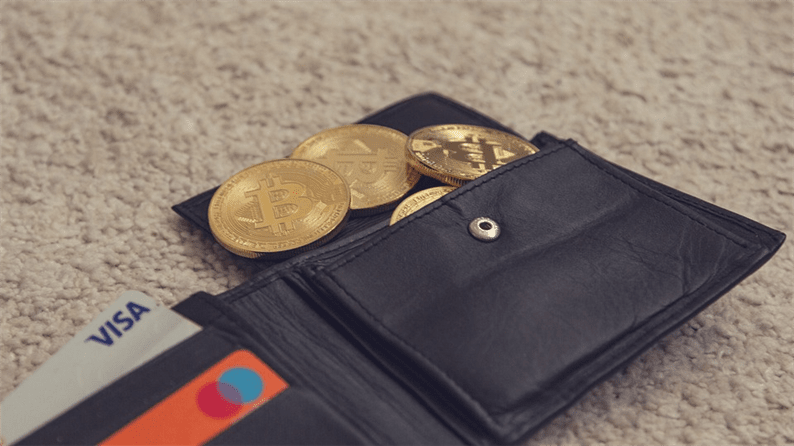 Easy to use It takes about 5 minutes to create a BTC wallet that is ready for immediate use. You will not be asked anything, you do not need to pay a penny.
How Bitcoin and BlockChain Technology Works
- The basic principle of creation was to create such a database that would not have a main server (was decentralized). Encrypted copies of this database are kept by all participants in the system. If we consider bitcoin, then the base represents all operations performed with this cryptocurrency (extraction, transfer, purchase, sale). Absolutely everything is recorded in the database and is available to all participants in the system.
- Any new record in such a database is synchronized with all its copies for everyone who participates in this system. The matching algorithms come into play. If someone tries to steal something, then he will have to replace the data of more than half of the system participants, because the network has over a million members, it is almost impossible.
- Each new block in the database contains information (hash) about the previous block, and so on, block by block. This information confirms that the block is intact, not altered or tampered with. In order to forge a block (payment), you will have to change the entire block chain, which is stored not in one place, but on millions of computers. And for this you need to get access to each of them. A pointless and very costly exercise.
With technology more or less clear, let's move on to the principles that were laid down in Bitcoin:
- BTC is limited to a maximum of 21 million. This principle shields cryptocurrency from inflation. At the moment, no one is in a position to print or discount them. It can be compared to gold, because both gold and bitcoins can only be bought or mined.
- Mining (mining) bitcoin is a complex process of calculations – enumeration of numbers, in which the hash is set by a special template. Mining is carried out on computers or special systems (farms). Mining is possible both on your own equipment and using cloud services.
- The complexity of this pattern is determined in such a way that for any number of miners (equipment in the network), Bitcoin appears once every 10 minutes. Whoever decrypts a block of transactions receives a reward in the form of BTC tokens.
- Computers that are involved in the mining of cryptocurrency simultaneously provide the ability to make transactions in the system, convey this information to all participants in the system, by adding and synchronizing this information between databases. All new transactions are confirmed every 10 minutes when the next unit of cryptocurrency is mined.
- All users of the system have a specific address (cryptographic account) and a secret key with which transfers are signed from their account to the account of another user of the system. It looks like a regular e-wallet and password.
Differences between bitcoin and classic fiat money (rubles, dollars, euros)
BTC is the very first cryptocurrency that appeared in 2009. For the first time, the principle of operation of the peer-to-peer bitcoin network, on which a certain Satoshi Nakamoto worked, could be familiarized two years before the appearance of the digital currency.
Decentralized currency, which is not controlled by any bank or exchange office, has always been a nightmare for the global financial system. It is scattered around the globe, works only online, is not provided with anything, and every user in the world is able to influence the course without leaving the computer. At the same time, the computational function of the server grows, which in the system can look like a continuous operation.
Electronic cryptocurrency has a number of striking differences from conventional cash and other valuable financial assets.
Bitcoin has the following differences:
- Decentralization. There is no central control body for the network; it is distributed to all computers used for computing resources. The decentralized system uses a special program code that regulates the work of network participants and the emission schedule.
- Irreversibility of transactions. After the cryptocurrency is transferred from one addressee to one of the online wallets to another (for example, webmoney), it cannot be returned to the original account.
- Limitation of emission. The mathematical algorithms are built in such a way that the generation of coins is closed. The total amount of BTC will never change.
- Low transfer fees. A feature of Bitcoin is the absence of any intermediaries in the transaction, due to which there is no commission fee. A small percentage of the commission can be for transactions with bank accounts.
- Does inflation affect the exchange rate? World inflation is isolated from the financial economy, so inflation has no effect on the exchange rate, unlike conventional currencies.
Bitcoin (BTC) can be described in simple terms as follows: calculations of a mathematical nature generate the mining process into a small piece of computer code.
Today, hundreds of millions of transactions take place using cryptocurrency. Therefore, to the question “what is bitcoin” we will answer in simple words – money that has its own exchange rate in relation to another currency, but does not have a physical form.
Unlike government currency, cryptocurrency cannot be printed. However, this does not mean that virtual coins (coins) appear out of nowhere. Cryptocurrency is a digital object that contains a colossal amount of information that has a cryptographic code. Simply put, this is a kind of virtual memory card that has a digital record.
In order to generate a new record, it is necessary to find the only correct solution to the most complex mathematical algorithm. Since even the smartest person is not able to cope with such a task, the computing power of a computer is used for these purposes.
Why bitcoin is needed and how can it be used?
If you happen to ask these investors why bitcoins are needed, most likely you will see only embarrassed looks and raised eyebrows. Gold, for example, is used in mints, in jewelry, as a conductor for high-precision electronics, and as a material for medical implants.
Determining the spectrum of asset use is somewhat more complicated. If BTC is a true commodity, its value should not only consist of the value of an investment vehicle. So what is this asset used for?
As an alternative means of payment
If you spend enough time online, you may have noticed a growing number of projects accepting Bitcoin as a means of payment. Big players in the market, including Overstock.com, Expedia, Newegg, DishNetwork and Microsoft, do not hesitate to do so.
Some companies only accept Bitcoin. Why? Sometimes entrepreneurs do something that goes against the principles of traditional financial institutions, be it providing VPN traffic, selling marijuana, or showing adult videos. Since bitcoin uses a peer-to-peer system, such services do not have to worry about blocking their accounts. It makes sense for their users to get themselves a bitcoin wallet.
In general, Bitcoin has become quite popular. It is accepted by over 100,000 online and offline merchants, and the number is growing every day.
Alternatively to a debit card
Bitcoin provides opportunities similar to banking services. In some regions, people already have access to bitcoin ATMs where they can withdraw funds from their wallet or transfer them to a bitcoin card. Such cards can become an alternative to debit bank cards. There is even a tangible bitcoin coin, but this is more of an expensive souvenir than a practical thing.
As a permanent register of transactions
In January 2009, when Satoshi Nakamoto mined the genesis block of bitcoin, he left the following entry in it: “The Times of January 3, 2009: the chancellor is on the verge of another bank bailout.”
This reference to the modern banking system reflects one of the basic elements of Bitcoin. The blockchain records all transactions of this cryptocurrency. More importantly, due to the fact that third-party data can be entered into records, bitcoin can be used to exchange information and values that are not related to itself. This mechanism is much better implemented by altcoins like Ethereum, but it was Bitcoin that first proposed such a concept.
Instead of fiat currency
Bitcoin is a ready-made solution for those who do not want or cannot use fiat currency, who have lost faith in central banks, who live in a country with a degrading economy or in a region where there is no stable currency. Aside from Bitcoin's recent super-volatility, it currently represents a good investment and a healthy alternative to fiat currency.
Of course, no one knows what the future holds for Bitcoin. However, the use cases described above are valid for the time being and, apparently, will be valid for a while.
How Bitcoin and other cryptocurrencies are supported
There is no country or even a company behind Bitcoin that would be responsible for its value with its resources. To calculate its real weight, you will have to look for other methods of accounting for the price of an asset. The closest is the assessment of rare materials and matters: this principle allows us to name the approximate price of diamond or tritium, rhodium or graphene. The latter exist in the volume of a couple of grams and took years to create. Someone will say that they are priceless, but economists call 3 numbers at once:
- production cost;
- assessed value;
- market value.
Take, for example, the rarest mineral in the Guinness Book – painite.
A gram of crystal-painite is estimated at $ 9 thousand. Practical value is zero, it is not used anywhere. But on the expedition thousands of dollars were spent and only 25 samples were obtained.
How much will collectors give for this curiosity? A million or two? Maybe a billion? We do not know this, the samples have long been in private collections. So what is the reason for the value of this mineral, which is considered many times more valuable than platinum and diamonds? There is only one answer – demand and resources, which are ready to give for it.

Understanding what bitcoin is backed by, you need to consider:
- Cryptocurrency is a set of numbers derived from mathematical calculations. In its production, a certain amount of resources is spent: they can be considered a cost. It is relatively low, but it will grow every year: blocks are more and more difficult to decode, energy costs and equipment depreciation will only make bitcoin more expensive.
- There are not so many bitcoins and the issue is strictly limited – 21 million btc will be mined by about 2034. After this point, mining will stop. the number of bitcoins will only decrease.
The reduction of bitcoins is inevitable – just as a person can lose coins, the holder of a cryptocurrency can “lose” the key. You can also take into account the withdrawal of bitcoin addresses from circulation together with the owners who have left this world. An additional release is not provided, which will make the btc coin more and more every year rare and therefore expensive.
- Demand raises the price – the law of trading. In 2016-2017, bitcoin is given almost 3 thousand dollars and due to the excitement, the rate promises to grow. Naturally, this process cannot be considered endless, but so far the limit has clearly not been passed. The willingness to give up any other fiat currency for Bitcoin gives it real weight.
- Bitcoin has already begun to circulate in a number of countries along with other assets: btc coins are accepted by shops and Internet services, transactions in bitcoin and are carried out by Paypal and WebMoney. The Satoshi wallet, as a part of bitcoin, is increasingly offering online services along with other payment instruments.
These facts are the answer to the question of what Bitcoin is supported by. From the moment when the pizza seller gave 2 circles of goodies for 25 btc, bitcoin gained value and, as it becomes clear, it is unlikely to drop to this level. But what the limit will be, time will tell.
Differences between secured and unsecured cryptocurrencies
The very idea of creating digital systems based on smart contracts and Blockchain technology, which we wrote about at this link, is inherently revolutionary. It allows you to significantly reduce the risks of transferring funds between users, hide the identity of the real owner of a particular crypto account, and also makes it possible to receive passive profit.
However, constant fluctuations in the exchange rate up or down do not allow the full use of unsecured cryptocurrencies as an alternative means of payment in modern society.
Secured digital coins have every chance of becoming the basis for many decentralized financial applications and banks, where every transfer of funds should have minimal volatility.
And given the fact that most of them work on the basis of smart contract technology, which makes it possible to maximally secure the transaction between the recipient of funds and the sender, cryptocurrencies with a constant exchange rate have a good development prospect in the near future.
Types of secured cryptocurrencies
At this time, digital assets with a constant exchange rate can be divided into:
-
Backed by fiat money.
-
Backed by valuable assets.
-
Backed by cryptocurrencies.
Let's take a look at each view in more detail.
Examples of fiat-backed cryptocurrencies
This type of secured digital coins is the most common in our time.
The main principle of fiat-backed assets is that their Blockchain platforms are far from decentralized, as they are, in fact, developed by central management systems, but every coin here is backed by a reliable reserve currency.
The most popular type of such backed cryptocurrency is the Tether coin (USDT), which has a total capitalization of over $ 2 billion at the time of writing .
By looking at Tether's long-term chart, you can see that the USDT digital currency has indeed remained stable throughout its existence.
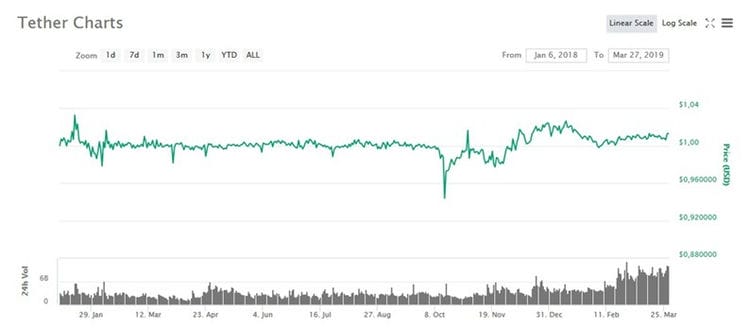
At first glance, this blockchain company may seem successful, but upon detailed analysis, it raises many questions. For example, more and more users on the Internet are beginning to believe that the release of new USDT coins serves as a tool for pumping the Bitcoin cryptocurrency rate.
There are also many rumors that Tether is not actually fully backed by real fiat US dollars. Although the developers, of course, provide information and facts to the contrary.
Of course, the digital currency Tether really has a stable rate, and each asset of USDT, according to the founders of the company, is backed by real USD, however, it is still difficult to call this cryptocurrency full and safe, since it is completely centralized.
That is why users who have invested their money in Tether or in other cryptocurrencies backed by fiat money have the opportunity to keep their capital in a stable state during the market correction, but however, all their funds will be completely in the hands of the issuer, who can dispose of them as they like.
This is the main risk of secured digital assets backed by any fiat.
Examples of cryptocurrencies backed by valuable assets such as gold
For centuries, gold was considered the most valuable metal, which was used in various spheres of life (as a universal currency, raw materials, etc.). Now, the intrinsic value of gold is strongly supported by the trust of people, which has been formed over thousands of years.
Based on these factors, the developers of some digital companies decided to create cryptocurrencies backed by gold. Thus, they combine the established value of gold and the high-tech Blockchain system into a single monetary system.
Such a hybrid, according to many crypto experts, is much more reliable than the modern payment system of society. The fact is that during crises and a decline in the development of the economies of the countries of the world, the entire fiat system begins to endure a certain instability, however, even in such turbulent periods, gold remains a more reliable and stable asset, in which people believe most.
Now one of the most famous gold- backed cryptocurrencies is the Digix Gold Token. Its capitalization is over $ 4 million.
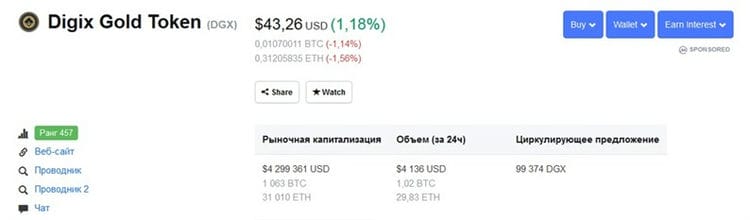
Digix Gold Token is interesting because here each coin is equivalent to 1 gram of gold. Due to this, it turns out to achieve a stable value of this digital asset over time.
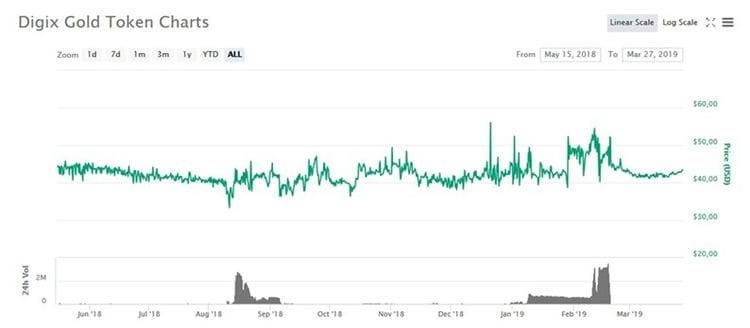
According to the founders of this digital company, each Digix Gold Token cryptocurrency is 100% backed by pure gold bars, which are officially approved by the London Bullion Market Association.
The company purchases precious metals in the form of 100-gram gold bars for all its internal funds and creates the required number of coins in its tokenized system based on Ethereum (ERC-20 token technology), which will have the equivalent value of the purchased gold.
If you look at the charts, you can really be convinced that Digix Gold Token maintains a relatively constant value of its cryptocurrency.
Examples of assets backed by cryptocurrencies
This type of cryptocurrency was created with the sole purpose of increasing the decentralization of secured Blockchain systems.
This is their significant plus, the other side of the coin is high volatility.
Users believe that such currencies will not be in demand in the future, since the main qualities of modern cryptocurrencies based on Blockchain technology and smart contracts are low volatility and the ability to manage a single registry system by reaching a consensus on the part of network participants.
I would also like to note that it is difficult to really provide such cryptoassets and set them a stable rate, since this requires the release of a huge volume of emission of internal digital coins, and this, in turn, requires huge financial costs.
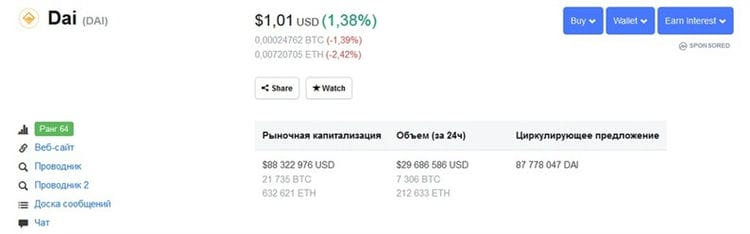
An example of cryptocurrencies backed by digital assets is Dai, which is backed by the Ethereum platform.
Here, additional emission of coins is created on demand and backed up by a certain number of Ethereum coins (stability can be achieved due to the system of pledges and management of quotations).
Thus, the founders managed to create a stable ERC-20 tokenized platform, which always has a value of 1 USD.
At the time of this writing, the capitalization of the Dai cryptocurrency is more than $ 80 million.
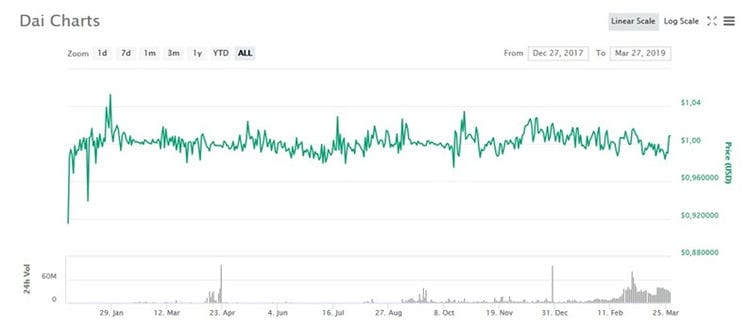
Having studied the graph of the growth of the cryptocurrency over the past period, one can make sure that even despite the increasing number of DAI emissions in this digital system, the value of each coin almost always remains fixed.
four.
Prospects for secured cryptocurrencies
Secured cryptocurrencies, they are also stablecoins, are very promising assets that are gradually gaining popularity in the crypto market and popularity among large corporations, venture capital investors in the world.
The main reason for this is reliability and reduced volatility. It is for these qualities that people fell in love with secured cryptocurrencies, because with the help of them you can already make safe financial transfers, as well as keep your capital in a constant volume during a downward market trend.
Unsecured digital currencies like Bitcoin, Ethereum, Litecoin can really provide an opportunity to get a good profit in both the short and long term. However, the risks of investing in them can be significantly higher than in secured crypto assets, which have their own emission centers.
In all likelihood, the trend of the development of secured cryptocurrencies, backed by fiat, precious metals, and minerals, will continue in the future, so the prospects for cryptocurrencies with a constant rate are very broad.
How is the price of bitcoin formed?
To understand what the Bitcoin cryptocurrency is backed by and find out its real price, look at the following factors:
- Digital money is formed by computing the most complex cryptographic tasks. The cost item for bitcoin mining forms its cost. Fixed costs are energy costs. But it is also worth considering the constantly updated equipment. But this is a justified waste, since bitcoin will only grow in the future;
- all cryptominers will be able to mine all bitcoins by 2140;
- the price of any product has always increased or decreased depending on the demand for it. Every experienced stock speculator knows about this. The price of bitcoin will rise if there is demand for it. As soon as they start selling it in large quantities, it will immediately collapse;
- For the first crypto – bitcoin, you can now buy almost any product. In some states, payment in BTC is available for transport, food, and even real estate. Quite a long time ago, the WebMoney payment system developed its own wallet on its basis and began to conduct transactions between its members.
The most reliable means
Rubles, dollars and similar currencies may be subject to inflation. Speaking of cryptocurrency, hyperinflation is not scary. Fiat and cryptocurrencies need to fear deflation. And although this is a rare, but gradual phenomenon that will continue until the banknotes of the reserve fund are completely exhausted. Bitcoin has an emission of 21 million coins.
As you can see, Bitcoin is an ideal “haven” for an investor, but there are pitfalls here – the BTC rate is difficult to analyze even through technical analysis.
Also, if you lose access to the keys (password) of your bitcoin wallet, you will not be able to get the funds back. This is precisely the significant advantage of cryptocurrency – anonymity and security of transactions.
If the bank declares itself bankrupt, then through special mechanisms of influence (courts, the Central Bank), as a result, it will be possible to return part of the compensation for the loss of the deposit.
The world's Ministries of Finance are realizing the clear advantage of cryptocurrency over fiat money. They are actively exploring blockchain technology as well as bitcoin and other altcoins. It is possible that different countries of the world will eventually have their own cryptocoins. However, not all countries are positive. There are individual states that have introduced the strictest ban on the use of crypt.
Conclusion
Above, we managed to find out that bitcoin and other alts are secured solely from the interest and mining costs of its holders. However, this does not allow us to consider cryptocurrency a “soap bubble” that can burst at any moment.
In addition, many people do not realize that the dollars and rubles that are usual for us, despite the provision of gold and foreign exchange reserves, can be stamped in the amount necessary for the authorities. Therefore, there are big differences between securing cryptocurrency and national currency. Preference in the choice should be given to digital money.
Sources used and useful links on the topic: https://wilhard.ru/bitcoin/what-is-blockchain-and-cryptocurrency/ https://alpari.com/en/beginner/articles/bitcoin-backed-by/ https: //aif.ru/dontknows/file/chto_takoe_bitkoin_i_zachem_on_nuzhen https://Mining-CryptoCurrency.ru/bitcoin/ https://coinspot.io/beginners/zachem-nuzhen-bitcoin-prostymi-slovami/ http: // bitcoin-zone .ru / em-obespechen-bitkoin / https://info.finance/kriptovalyuta-novichkam/obespechennye-kriptovalyuty-chto-takoe-stejblkoiny https://5bitcoin.ru/chem-obespechivaetsya-kriptovalyuta-bitkoin-i-drugie/
Post source: lastici.ru