
Fractional thermolysis – a method of laser skin rejuvenation
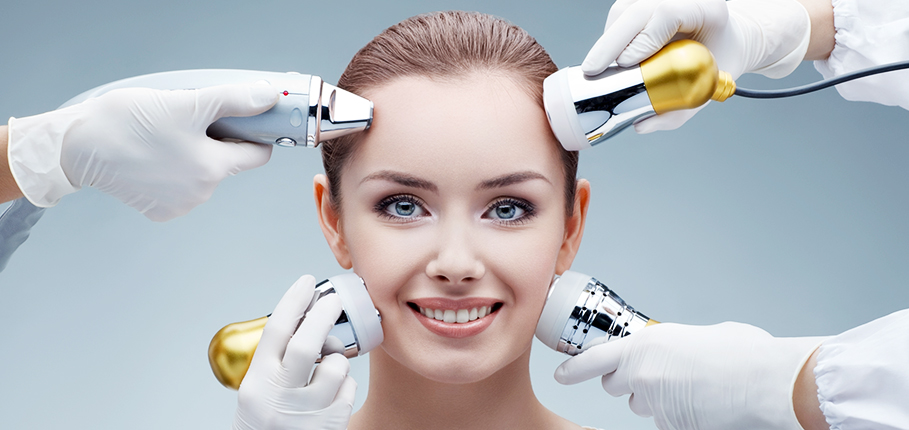
There are so many innovative methods to preserve youth that patients are sometimes lost in the choice. Those wishing to activate the natural processes of skin renewal and rejuvenation can be offered such an effective procedure as fractional thermolysis, during which the upper layer of the epidermis is removed with a laser polishing device.
The principle of operation of the technique
Fractional thermolysis technology was first tested by American scientists in 2004. Since then, it has undergone many clinical studies and has become a powerful tool in modern cosmetology. The essence of fractional thermolysis (photothermolysis, nanoperforation, fraxel) is that with the help of a special device, the laser beam is divided into many ultrafine fractions.
The procedure involves the use of very small, targeted laser beams, resulting in microscopic damage to the treated area of the skin.
Laser irradiation increases the local temperature of certain areas of the skin, which inevitably results in heating of the intracellular contents and destruction of cellular structures. In turn, this activates the recovery processes, leads to increased production of fibrillar protein (collagen) and the formation of new epithelial cells. And the more collagen in the epidermal layer, the less wrinkles and other defects on the skin.
With regard to molecular changes, here it is necessary to note the appearance of heat shock proteins, hyaluronic acid and the appearance of a transforming growth factor (a special polypeptide). All these substances accelerate the utilization of damaged collagen from cells and form its new molecules.
The surface layer of the skin, as a rule, is restored already on the second day after cosmetic manipulations. Exfoliation of dead cells ends in about 10-12 days.
Intensive recovery begins at each damaged area, since nature provides for a high rate of regeneration for the skin tissue. Due to the point impact, a fairly solid supply of healthy cells is formed in the skin, which serve as a source of new epitheliocytes.
Ablative and non-ablative technology
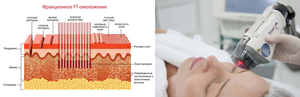
When a laser pulse is used, which contributes to the evaporation of the active substance, it is most likely that we are talking about laser ablation. Ablative photothermolysis uses laser radiation, the energy of which is mostly stored in water molecules. By briefly affecting a local area, the laser beam instantly raises the temperature of the water contained in the tissues up to 300 degrees. At the site of evaporation, an open wound of a small size appears, next to which thermally coagulated epitheliocytes are concentrated.
Such thermolysis requires a longer recovery than non-ablative technology, but the result will look much more spectacular. The disadvantages of the method, perhaps, can only be attributed to the fact that there is a certain risk of infection of the tissues of the deep dermal layer.
Non-ablative thermolysis is considered a less traumatic procedure. Here, a laser beam is used, which practically eliminates the risk of damage to the epidermis – a burn forms under it. Destroyed epithelial cells do not evaporate, but settle within the dermis, respectively, the patient does not have to deal with open wounds. Lifting and rejuvenation are not as obvious as with another method, since dead skin cells do not go anywhere, which means that the tightening effect is minimal.
Unlike the ablative technique, the patient is insured against infection of skin tissues, since the integrity of the surface layer of the skin is not violated during the procedure.
Positive and negative sides
Like plastic correction, fractional thermolysis makes the skin less rough and rough. But if surgery is considered a radical way to improve the appearance of the skin, then thermolysis is classified as sparing. Despite this, its effectiveness is no less. Moreover, the range of tasks that fractional thermolysis solves is even wider than that of contouring.
The main advantages of the technique are as follows:
-
recovery takes place as soon as possible;
-
during the procedure, the patient does not experience pain;
-
the result is stored for a long period;
-
laser exposure is equally harmless to any skin type;
-
even the most sensitive areas of the skin respond well to the laser;
-
lack of strict restrictions during the rehabilitation period;
-
the minimum number of possible side effects;
-
the risk of blood infection with any virus (HIV, hepatitis) is zero.
Although thermolysis is considered a high-tech and safe method, nevertheless, it has its own side effects, in particular:
- penetration through the skin of microbial agents – staphylococci and streptococci;
- abnormal redness of the skin;
- inflammation and accumulation of fluid in the treated area of the skin;
- the appearance of hyperpigmentation, small burns and cracks, acne.
Indications and contraindications
The bulk of clients are women of the older generation who are eager to smooth out wrinkles and eliminate moderately pronounced wrinkles on the face and neck. Of course, the effect will meet all expectations, but, in addition, the procedure allows you to solve other cosmetic problems, including:
-
![Fractional thermolysis - a method of laser skin rejuvenation]()
elimination of pigmentation, age spots and traces formed due to the influence of sunlight;
-
leveling age-related signs of skin aging;
-
smoothing deep wrinkles;
-
narrowing of pores;
-
elimination of small wrinkles on the eyelids;
-
return to the epidermis of lost elasticity;
-
elimination of the consequences of acne;
-
getting rid of stretch marks and scars.
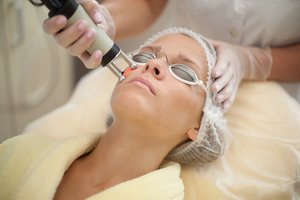
Under some circumstances, patients are forced to look for an alternative to fractional thermolysis, since laser rejuvenation can lead to exactly the opposite result. So, the procedure is contraindicated in the following cases:
- during childbearing;
- during the lactation period;
- with exacerbation of existing diseases;
- with acute respiratory infection, including influenza;
- in the presence of malignant neoplasms;
- if the patient has poor blood clotting;
- when the face is covered with many moles;
- if there are foci of inflammation on the skin;
- in the presence of autoimmune diseases;
- if the patient is being treated with certain drugs.
Technology of the procedure
Preliminary consultation with a cosmetologist is an obligatory stage of any cosmetic procedure, at which the doctor's goal is to clarify the client's wishes and inform about various nuances.
First of all, the cosmetologist treats the patient's skin using a cotton pad with an anesthetic cream applied to it (EMLA, Anestol). Then an ointment is applied to the surface of the skin to facilitate the sliding of the device.
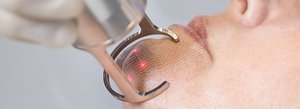
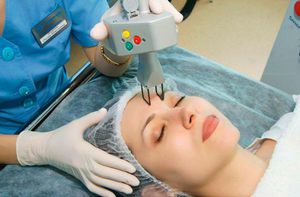
After that, armed with a device with a special nozzle, the specialist proceeds to the treatment of problem areas. The applied anesthetic and the flow of cool air minimize pain, creating additional comfort for the patient. Patients, with rare exceptions, may complain of a slight tingling sensation.
The Fraxel device, developed by American scientists, has made a splash in the field of non-invasive cosmetology. Specialists received a unique opportunity to carry out laser thermolysis using a specific nozzle for each specific purpose. In some preparations, only a thulium rod is involved, while in others, an erbium one, there are also combined models. Depending on which part of the skin is to be treated, one or another rod is selected.
The entire session rarely lasts more than thirty minutes. If you need to remove stretch marks on the hips and abdomen, it may take a little longer.
The original Fraxel apparatus has 4 main modes, each of which allows the laser beam to penetrate to a given depth:
- fine. Gentle surface effect. The best option for working with the eyelids, mammary glands and other sensitive areas of the body.
- repair. The thulium rod provides a deep penetration of the laser stream into the skin, which makes it possible to get rid of deep wrinkles and marks and adjust the oiliness of the skin. If there is vascular dyschromia, gaping pores, then such a restoration is the best choice.
- restore. The most popular technique today, which allows you to forget about shallow wrinkles and small scars after acne.
- RestoreDual. The procedure is carried out with the simultaneous use of two rods at once – erbium and thulium. It will help those who have pronounced scars and scars.
How many sessions are needed to achieve a tangible effect depends largely on the severity of the lesions and the specifics of the treated areas, but usually at least 5-7 procedures are performed.
Features of the rehabilitation period
After fractional thermolysis, the skin needs special care, especially in the first days. For daily hygiene, products such as Bepanten and Panthenol are suitable. Revitalizing masks will not be superfluous either. The face should be constantly lubricated with some kind of nourishing and moisturizing cream.
In order to maintain the achieved effect, it is extremely important to follow the simple advice of doctors:
-
![Fractional thermolysis - a method of laser skin rejuvenation]()
for the first time three days to exclude any physical activity;
-
do not visit the bath and sauna, and do not take a hot bath for a month;
-
give up cosmetic procedures for a month, including peeling;
-
limit the time spent in the sun, since an excess of ultraviolet radiation is doubly dangerous for newly restored skin;
-
Avoid alcohol and cigarettes while recovering.
After the procedure, some patients notice swelling and redness on the skin. This should not be scary, after a few days, as soon as the redness subsides, you need to see a beautician so that he can evaluate the result of therapy.
Issue price
Laser correction, admittedly, the procedure is not cheap. The cost of fractional thermolysis varies depending on the prestige of the clinic, the amount of work performed, the prices of consumables, etc. The average price of one thermolysis session is about 10-20 thousand rubles. Thermolysis of the face and neck will cost less than the same manipulations performed in the abdomen, buttocks and other parts of the body.
Modern cosmetology does not stand still, but the debate about the advisability of using a laser in this area has not subsided so far. No matter what anyone says, fractional laser thermolysis is rightfully recognized as one of the safest and most effective procedures.
Post source: salon.kr.ua