
Dual citizenship of Russia with other countries. Is it beneficial for a Russian citizen to have dual citizenship?
Citizenship concept
In this article, we will look at whether a person can hold two citizenships at the same time. But more on that later. First, let's try to define this term.
Often, speaking about a person's citizenship, we mean his legal affiliation to any state, the laws of which he must comply with; the state, in turn, guarantees a person his rights and freedoms, protection and patronage both on its territory and far beyond its borders.
Most often, citizenship is acquired at birth by the nationality of the parents, at the place of birth, or as a result of voluntary entry into it, or, in other words, naturalization.
Dual citizenship: origins and reasons
The concept of dual citizenship appeared in the bourgeois era. This is due to the fact that during the feudal system, the peasants were attached to the land and this actually prohibited the migration of the population from the lower classes. Representatives of the upper class, one might say, became the first bipatrids, since some of them owned property located in different states.
A person's bipatrism can be based on both personal and social reasons, although the latter, of course, prevail. The inconsistency of laws regulating this issue in different countries often leads to legal conflicts. So, very often the existence in the laws on citizenship of different states of such principles as “the right of blood” and “the right of the soil” leads to its occurrence.
By the “right of blood”, the child automatically receives the citizenship of the parents; by the “right of the soil,” he receives the citizenship of the country in which he was born.
This is how people with dual citizenship appear.
By right of soil, almost all countries of Latin America, Africa, Oceania, and also the United States automatically grant citizenship after the applicant reaches the age of majority. This right is recognized by France – provided that they have lived in the country for at least 5 years and by Germany – if the applicant for a passport has lived in it for more than 8 years. A child born in Spain can also apply to become citizens of the kingdom, but after reaching the age of 19.
Another common case is marriage with a foreigner, while his homeland automatically provides his passport to the newly-made spouse, without requiring the previous one to be abandoned. Belgium and Mexico are examples of such countries. Another most common reason is emigration and the subsequent naturalization of a citizen in a new country, which also does not require abandoning the previous one when accepting citizenship.
Depending on specific objective and subjective circumstances, a person can acquire either a second citizenship or dual citizenship as a result of:
- migration, resettlement;
- marriage with a foreigner;
- naturalization when renunciation of the existing civil status is not required;
- the birth of children in mixed marriages;
- restoration of the citizenship of a person previously deprived of it, and at the same time recognition of his legal belonging to another foreign state.
Well, the main reason why people with dual citizenship appeared is the emerging contradictions in the normative legal acts governing citizenship issues in different countries. As a rule, many of these states, accepting new citizens into their ranks, are guided only by their own normative legal acts and the constitution. There is no single approach to this issue, as well as a single international agreement or treaty that governs it.
Methods for obtaining citizenship
- By birthright (read additionally: List of countries where you can obtain citizenship by birth of a child, even when the parents have a different citizenship).
- By marriage to a US citizen.
- Get a Green Card.
- Enlist in military service.
- Naturalization.
- Investment.
- Obtaining in the country of asylum (Read more: “How to obtain refugee status in the USA”).
In what cases is dual citizenship possible in the Russian Federation?
Dual citizenship “in its pure form” for a citizen of our country is possible only if the Russian Federation has an international treaty or an international agreement with the state of a person's second nationality on the settlement of issues of dual citizenship.
In this regard, in practice, only two situations are possible.
Situation number 1.
Strange as it may sound, but at the present time Russia has a similar agreement in force (of September 7, 1995) with only one state – Tajikistan.
Thus, citizens of Tajikistan, upon acquiring Russian citizenship, in accordance with the above agreement (on a reciprocal basis), retain their citizenship, that is, they have dual citizenship in a “pure form”.
Situation number 2.
A similar international agreement with Turkmenistan of December 23, 1993, which was in force earlier, ceased to be effective on May 18, 2015. Thus, the citizens of this state who took Russian citizenship during the period of the said Agreement, from the point of view of Russian legislation, also retain their Turkmen citizenship, that is, they have dual citizenship in a “pure form.”
As can be seen from the above, the possibility for a Russian citizen to have dual citizenship “in its pure form” is exhausted by two cases that are quite rare in practice.
But this does not mean at all that he, with the exception of the above two cases, cannot have, quite rightfully, the citizenship of a foreign state.
Can a Russian citizen have the citizenship of another state
A citizen of Russia, and in addition to the previously considered two cases, may have the citizenship of a foreign state.
By itself, such a possibility is enshrined at the highest constitutional level – part 2 of Art. 62 of the Constitution of the Russian Federation states “The fact that a citizen of the Russian Federation has citizenship of a foreign state does not diminish his rights and freedoms and does not release him from obligations arising from Russian citizenship, unless otherwise provided by federal law or an international treaty of the Russian Federation.”
That is, Russian legislation fully admits the possibility of a citizen of our country having the citizenship of a foreign state.
Moreover, it does not matter at all, the number of states that recognize him as their citizen.
If a citizen of Russia, upon acquiring the citizenship of a foreign state, has not formalized his withdrawal from the citizenship of our country in the prescribed manner, then he continues to remain a Russian citizen.
At the same time, you should also know that a Russian citizen who has foreign citizenship is considered by our country exclusively as a citizen of Russia, and his acquisition (or possession) of foreign citizenship does not entail the termination of Russian citizenship (parts 1 and 2 of article 6 Federal Law “On Citizenship of the Russian Federation” dated May 31, 2002 No. 62-FZ).
For the reasons described above, a similar situation, outside the framework of the previously mentioned international treaties and agreements on the settlement of issues of dual citizenship, it would be more correct to call “second citizenship” as a kind of “dual citizenship” – if a Russian citizen has the citizenship of one foreign state or “multiple citizenship “- if a Russian citizen has the citizenship of several foreign states.
Attitude towards dual citizenship in the Russian Federation
The conditions for acquiring dual citizenship are spelled out in Russian law.
The main criterion in this situation, as is clear from the above definition, is the existence of an agreement between states, and therefore in Russia it is not prohibited to have dual citizenship.
The list of states with which such an agreement has been signed is small and includes only Tajikistan, whose citizens, if desired, can also become Russians.
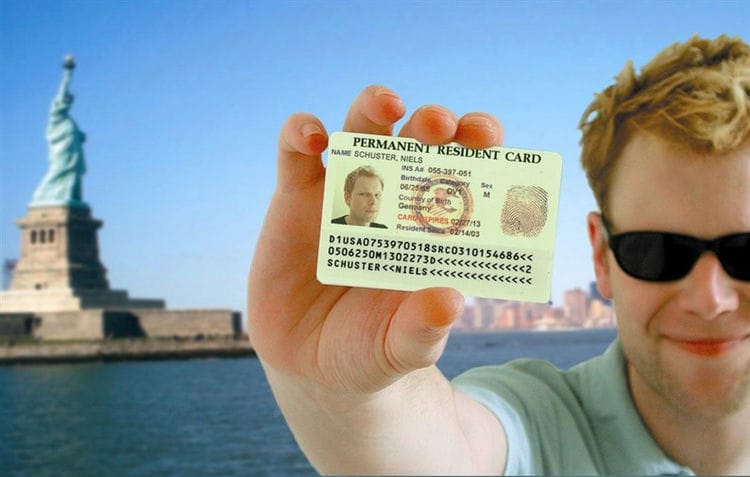
Green card
Holders of this card are provided with many opportunities in America. Therefore, many immigrants want to get a green card. This document gives you the right to live and work in the United States without being a citizen. In addition, the card is often referred to as an immigrant visa. It allows you to visit other countries, as well as bring your relatives with you. Also, with a green card, you can study in educational institutions, enjoy the rights of American citizens. The only thing that the card does not allow is to participate in election campaigns.
You can issue a document on condition:
- If you have relatives in the United States.
- As a result of marriage to an American citizen.
- At the request of the head of the company in which the person works.
- Upon receiving refugee status.
- Investing a large amount of investment in the development of the economy.
- Based on the results of the drawing.
The latter condition occurs every year from October 1 to November 3 by submitting an application. The probability of winning is 1: 200.
The following persons have the right to participate in the drawing:
- with secondary education;
- work experience over 2 years;
- having the status of a citizen of a country from which no more than 50 thousand people have recently moved to the United States.
To participate in the drawing, you need to follow the instructions:
- Visit the official website of the government.
- Fill in personal information.
- To upload a photo.
- Send data.
- Wait until the code arrives, with the help of which the result of the drawing is checked.
Second citizenship: grounds for obtaining, opportunities, rights and obligations
The absence of international treaties between the Russian Federation and other countries does not mean at all that Russians cannot get a second passport. Only in this case it is necessary to speak not of dual, but of second citizenship, which Russian legislation also does not prohibit.
At the same time, according to Russian law, Russians are considered only as citizens of the Russian Federation who have the corresponding rights and obligations. Another prerequisite for the legality of obtaining a second citizenship will be the notification of the Main Directorate of Internal Affairs of the Ministry of Internal Affairs of Russia about this.
The solution to the question of how a Russian citizen can obtain a second citizenship depends on the legislative framework of another state, whose passport he is going to receive. For example, Norway and Denmark exclude dual citizenship, therefore, if you are going to stay there for permanent residence or planning to obtain the status of a citizen, be prepared for the fact that you will have to give up your Russian identity card.
Nevertheless, the policy of globalization and the opening of borders has allowed many states to be more loyal to the possession of several foreign passports by their citizens.
Having a second passport has many advantages:
- free crossing the border of any country;
- visa-free entry to countries with which the state has signed relevant agreements;
- the right to medical care and education, starting a business;
- the opportunity to use social guarantees;
- the right to work in states with which an agreement has been signed: for example, a French citizen can work in all countries of the European Union.
Dual and second citizenship: what are the differences
In the legislation of the Russian Federation, there are no gradations for these two concepts. However, from a legal point of view, the differences can be formulated as follows:
- Double. The applicant receives a passport of the second country, provided that such a position is approved in his home state. This is possible if the countries have an international agreement on dual citizenship;
- Second. It is given in the absence of an agreement between the countries. In this case, the term can also be designated as “multiple citizenship”, since a person is entitled to have several passports at once. A Russian applies for a passport of another country, only guided by his own needs. The permission of the home state does not matter.
Both the one and the other status of a Russian has its own characteristics.
Second citizenship
The person is obliged to adhere to the legal characteristics of the state where he is at the moment. At the same time, the authorities perceive a person as a citizen of only their own country and ignore the presence of the second.
However, there are also limitations: it is not possible to obtain a passport without renouncing the original citizenship in all countries. In some cases, the applicant will be forced to give up the passport of their home country.
Advantages and Disadvantages of Second Citizenship
Holders of dual citizenship can freely travel between countries and have the right to independently decide where to serve in the army. Their children after birth become dual citizens, and upon reaching the age of 14 they receive two passports.
When obtaining a second citizenship, such privileges are not entitled, but there are advantages. Among them:
- A citizen can freely cross the borders of countries without a visa (for example, the holder of a passport of a European country no longer needs to get a Schengen);
- The holder of multiple citizenship has the right to live and work freely in all countries whose passports he has;
- He enjoys all the rights and available benefits listed in the Constitutions of states.
So, if a person often has to travel between countries for work or for personal purposes, a second citizenship will be a real salvation. But, despite the seeming uniqueness of this status, there are a number of disadvantages.
For example:
- You have to pay taxes not in one, but in two or several countries at once;
- Some states impose restrictions on holders of second citizenship: for example, they are not allowed to hold high-paying positions and government posts;
- Army service will have to take place in two countries alternately.
But not all states are so categorical. For example, the government of Cyprus offers tax incentives to passport holders of their country.
With which countries does the Russian Federation have international treaties on dual citizenship?
Russians have the right to apply for dual citizenship only with Tajikistan. The international agreement on dual citizenship with the Russian Federation has been in effect since 07.09.1995. Relying on its content, the citizens of Tajikistan draw up a Russian passport, preserving in a “pure form” the rights and obligations of a citizen of their state, thereby acquiring Russian rights and obligations on a reciprocal basis.
Bipatrid, who lives in one of the countries of the International Agreement, is obliged to act within the framework of the Constitution and the law, as well as respect the customs and traditions of the state in which he lives. In addition, while temporarily staying in the territory of another country, a bipatrid is also obliged to comply with the law and maintain respect for the traditions and customs of the local population.
The bipatrid's rights are preserved and are valid in both states. The holder of the double indigenate is responsible for the subject and fulfills the duties that the subject is endowed with in the state in which he permanently resides.
An international agreement with Turkmenistan also existed, but expired on May 18, 2015. The agreement between the Russian Federation and Turkmenistan has been in effect since 23.12.1993. If a person from Turkmenistan received a Russian passport during the existence of an international agreement, his rights and obligations are still valid as the holder of dual citizenship in both states.
Accordingly, dual citizenship of the Russian Federation “in its pure form” is available to Russians only in two cases and only with two countries. However, this does not mean that the acquisition of a second passport, by virtue of the Constitution of the Russian Federation, is impossible or illegal.
Application procedure

Depending on the specific case, the procedure may differ. There are steps common to all:
- Registration on the USCIS website.
- Filling out an application form (form N-400). Answers to questions should only reflect reliable information.
- Prepare a package of documents, in each case it is individual.
- Send the application and copies of documents by mail to the migration center.
- Waiting for an answer lasts on average 5-9 months, but it can be delayed.
- In case of refusal, an appeal can be made. It is better to enlist the support of a lawyer specialized in this matter.
- A positive decision is expressed in an invitation for an interview.
- Passing an interview is a crucial moment, you need to prepare for it.
An application for U.S. citizenship must be made at one of the USCIS offices in the country. It is impossible to deal with this issue remotely from abroad. The application itself can be submitted by mail, but then the applicant must come to the office to take biometric data and fingerprint. After considering the application, it is necessary to pass an interview, where the level of language proficiency, as well as knowledge of the country, will be established. Upon successful completion of the interview, the applicant is invited to the oath-taking ceremony. There he surrenders a Green Card and receives a certificate of citizenship.
Can I have two citizenships in the absence of an international treaty? How many citizenships can you have?
According to Art. 62 of the Constitution of the Russian Federation, Russians have the right to claim citizenship of a foreign state. To obtain a foreign status, applicants act in one of the following ways:
- get dual citizenship;
- obtain two citizenships.
In the absence of an international agreement between the Russian Federation and a foreign country, it is impossible to issue dual citizenship, you can only get a second citizenship. For Russia, such a citizen will be considered exclusively a citizen of the Russian Federation.
As already mentioned, dual citizenship is available in cases where a Russian either applies for a Tajik passport, since an international agreement is in force with him, or has already accepted the state ownership of Turkmenistan, since he is a citizen of Turkmenistan. the international agreement was valid only until May 18, 2015.
By birthright
Regardless of what citizenship the parents have, a child born in the United States automatically receives American citizenship. At the same time, parents do not have this right.
If the parents of the child are American citizens, but the child was born in another country, then he will still receive citizenship. Read more: “How Much Does a US Childbirth Cost”
How to get a second citizenship
The procedure for obtaining a second citizenship for Russians depends on the specific foreign country. This is due to the fact that the legislation in each country is different, respectively, there is no single order.
If the Russians came into possession of the foreign status of a state that did not sign the corresponding international agreement, from a legal point of view, the Russians remain only a Russian for their state, and therefore they are obliged to enter and leave the country according to Russian documents, since he has two citizenships.
Without a signed agreement, a Russian does not have dual citizenship, but a second citizenship, in addition to his Russian. The Russian applies to the Russian state. bodies and organizations only with documents issued by Russian competent authorities, despite the presence of a passport of another state, and despite the fact that the appeal is possible to institutions located abroad (consulates or embassies).
What negative consequences await a Russian who acquired a second citizenship
There are negative consequences of accepting a second or dual citizenship. Relying on the Federal Constitutional Law “On the Government of the Russian Federation” No. 2 of 12/17/1997, bipatrides, holders of second citizenship, Russians with a residence permit of a foreign state, are not appointed to the posts of Chairman of the Government of the Russian Federation, Deputy Chairman of the Government of the Russian Federation and federal ministers.
Cases when a Russian is not accepted into the civil service, or when a civil servant is not entitled to stay in the civil service, are regulated by clauses 6 and 7 of Article 16 of the Federal Law “On the State Civil Service of the Russian Federation” dated July 27, 2004 No. 79:
- if a citizen has entered into foreign citizenship (accordingly, he has issued dual citizenship);
- if a Russian has acquired a second foreign citizenship, the possession of which is not provided for by an international treaty.
The applicant is not accepted for municipal service in the cases provided for by clauses 6 and 7 of article 13 of the Federal Law “On municipal service in the Russian Federation” dated 02.03.2007 No. 25:
- if the Russian has acquired the citizenship of a foreign state, has issued a residence permit or other document that gives the Russian the right of permanent residence in a country with which Russia has not signed an appropriate international agreement, according to which the Russian is allowed to work in the municipal service in the Russian Federation;
- in the presence of foreign citizenship, if there is no international agreement between the Russian Federation and this state, which would endow the Russian citizen with the right to work in the municipal service and foreign citizenship at the same time.
Who can find out that you have a second citizenship
A number of countries prohibit dual citizenship. In particular, in order to obtain German or Norwegian citizenship, you will have to go through the procedure for renouncing Russian citizenship.
At the same time, Hungary does not disseminate information about its citizens to third parties.
Those. if you get the citizenship of this country, no one will know about it except you and government officials. Nevertheless, even if Russia does not know about your Hungarian citizenship and vice versa, this does not relieve you of your obligations to these states.
Responsibility for concealing the fact of dual citizenship
A Russian citizen who has dual citizenship is obliged to notify the Russian side of this. For this, a written application is submitted to the migration authorities of Russia at the place of actual residence. For this, the citizen has 60 days from the date of entering the second citizenship.
If a citizen does not submit such an application for objective reasons (he is constantly in another country and has no opportunity to come to Russia), he must notify the responsible authorities that he received a second citizenship within a month after he once again enters Russia …
Sanctions for late appeal are regulated by Article 19 of the Code of Administrative Offenses of the Russian Federation. For violation of the deadlines for contacting the FMS, you will have to pay a fine of 500-1000 rubles.
Important: The Criminal Code of the Russian Federation contains Article 330.2, which punishes violators for deliberately concealing the fact of having dual citizenship. Despite the criminal nature of the article, imprisonment because of it is not expected. Maximum – up to 200 thousand rubles. a fine or up to 400 hours of correctional labor.
330.2 of the Criminal Code of the Russian Federation was applied for the only time in December 2014. This case was called precedent and the Investigative Committee for the Leningrad Region stated that certain “special grounds” were required to initiate a criminal article, the details of which were not disclosed in the press.
The rights and obligations of a bipatrid
Please note that if a Russian acquires a passport of a foreign state, his rights and obligations as a citizen will apply to each state of citizenship, not just Russia.
In each country, a bipatrid may have the following responsibilities:
- comply with the Constitution and legislation, honor culture and traditions;
- to protect historical and natural heritage;
- go through military service in the army;
- pay taxes (depending on the location of the source of income) and so on.
At the same time, a foreign passport gives a Russian a number of rights, including:
- the ability to freely cross the border and live indefinitely on the territory of at least two states – Russia and a country of second citizenship;
- the right to use national health and education systems;
- suffrage – the right to choose legislative, representative and municipal authorities;
- the right to freely conduct business – such investments will be considered not foreign, but national;
- the right to work and so on.
Please note that in some cases bipatrides may be limited in their civil rights or burdened with additional obligations established by the legislation of a particular country. We will tell you about the restrictions imposed by Russian law later.
Where can you apply for dual citizenship
In the meantime, let's figure out where you can get a second citizenship for Russians. To do this, it is necessary to study the basics of the legislation of foreign countries on citizenship. An analysis of such foundations allows us to draw an unambiguous conclusion: dual citizenship in international practice is not particularly widespread. As a rule, we are talking about historically related territories.
But the situation is different with the second / multiple citizenship. The legislation of a number of countries directly provides for the possibility of their citizens to have a passport of a foreign state, while others, on the contrary, do not provide citizens with such a right, however, they do not require mandatory renunciation of their existing citizenship.
Thus, it is customary to include the following among the countries of the world that are “tolerant” to bipatrism:
These are the most popular countries for obtaining a second passport, but, of course, not all of them. Each of them has its own characteristics and conditions for registration of the status of a citizen, which we will discuss below.
Whose citizenship do Russians choose as a second
To make dual citizenship in Russia is not a problem – it is enough to live in the country for 5 years with a residence permit or have preferential grounds for obtaining a passport. Accordingly, Russians are also looking for countries where the most preferential and simplified regime for obtaining a second passport is provided for them.
The most popular for citizens of the Russian Federation are:
- Israel – there are repatriation programs for citizens of Jewish origin in the country;
- Great Britain and Cyprus are popular among businessmen, as they allow obtaining citizenship by investment;
- United States of America – economic and political reasons, as well as the presence of a huge number of Russian-speaking migrants in the country, allow many Russians to freely move to the United States;
- Poland – there are many ethnic Poles among Russians who, according to Polish law, can receive a “residence card” or a “Pole's card” on preferential terms and move to the country;
- Finland – territorial proximity, common historical past and repatriation programs – all this pushes Russians to apply for Finnish passports;
- the Baltic countries mean territorial proximity, high level and at the same time relatively cheap life and entry into the Schengen zone.
Benefits of getting a second passport
Those of the Russians who were able to issue a passport of another state, obviously, have already appreciated all the advantages of their position, especially if it is a passport from the United States or one of the countries of the European Union.
These obvious benefits are:
- dual residence permit with dual citizenship – a bipatrid can live indefinitely on the territory of any of the countries of his citizenship without consequences;
- dual citizenship of a child – children will automatically receive both citizenships if at least one of his parents has them;
- free movement on the territory of the EU countries – with European citizenship, a Russian can move, live, work, study and exercise any other civil rights in any of the EU countries;
- impossibility of extradition – in the event of criminal prosecution by the authorities of the Russian Federation, no foreign state will extradite its citizen to Russia, even if he also has a Russian passport;
- ease of obtaining visas – given the geopolitical situation in the world, it is much easier to obtain a visa to any other country in the world with any other passport than with a Russian document.
Sources used and useful links on the topic: https://zen.yandex.com/media/100migrantov/chto-nujno-znat-o-dvoinom-grajdanstve-5d358f88e3062c00aeeba714 https://mjj.ru/ssha/kak-poluchit-grazhdanstvo -ssha.html https://grazdanstvo-rf.ru/priobretenie-grazhdanstva-rf/priem/dvojnoe-grazhdanstvo-v-rf https://immigrationtorussia.com/grazhdanstvo/dvojnoe/polychenie-dvoinogo-grajdanstia-rf -pravila https://emigras.ru/amerika/ssha/kak-poluchit-grazhdanstvo-ssha https://MigrantVisa.ru/russia/gragdanstvo/dvojnoe/ https://residentrf.ru/poluchenie-grazhdanstva-rf/dopuskaetsya -li-vozmozhnost-dvojnogo-grazhdanstva-v-rossii https://ruswi.com/kak-poluchit-grazhdanstvo-ssha https://www.bp-u.ru/yuridicheskiy-likbez/kak-poluchit-vtoroe-grazhdanstvo-rossiyanam-osobennosti-i-nyuansy/ https://topmigrant.ru/grazhdanstvo/dvojnoe-grazhdanstvo/kak-statvo bipatridom.html
Post source: lastici.ru